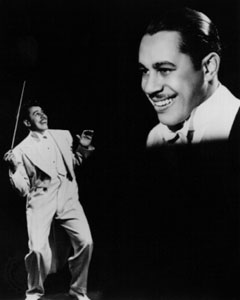
Merry Christmas to Miss Letty and company.
And Merry Christmas to you and that Raggedy gal, Miss Glass.

Hoke never did show to drive Miss Letty to de sto, soooo she'll have to drive herself, but before going here's a song from Tony Martin.
Artist: Tony Martin
Song: Here
(Recitation)
If some of ya'll never been down South too much...
I'm gonna tell you a little bit about this, so that you'll understand
What I'm talking about
Down there we have a plant that grows out in the
woods and the fields,
looks somethin' like a turnip green.
Everybody calls it Polk salad. Polk salad.
Used to know a girl that lived down there and
she'd go out in the evenings and pick a mess of it...
Carry it home and cook it for supper, 'cause that's about all they had to eat,
But they did all right.
Down in Louisiana Where the alligators grow so mean
There lived a girl that I swear to the world Made the alligators look tame
Polk salad Annie polk salad Annie
Everybody said it was a shame
Cause her mama was working on the chain-gang
(a mean, vicious woman)
Everyday 'fore supper time She'd go down by the truck patch
And pick her a mess o' Polk salad And carry it home in a tote sack
Polk salad Annie 'Gators got you granny
Everybody said it was a shame
'Cause her mama was aworkin' on the chain-gang
(a wretched, spiteful, straight-razor totin' woman,
Lord have mercy. Pick a mess of it)
Her daddy was lazy and no count
Claimed he had a bad back
All her brothers were fit for was stealin' watermelons out of my truck patch
Polk salad Annie, the gators got your granny
Everybody said it was a shame
Cause her mama was a working' on the chain gang
(Sock a little polk salad to me, you know I need a mess of it)
That sure doesn't sound like the man from the Casbah, right?
Merry Christmas, Letty, from Vivienne and myself to you and all your listeners!

Reyn, our audience thanks you and Vivienne, and I thank you and Vivienne.
From Joey Ramone and Louis Armstrong.
I see trees of green, red roses too
I see them bloom for me and you
And I say to myself
What wonderful world
I see skies of blue and clouds of white
Bright sunny days, dark sacred nights
And I think to myself
What a wonderful world
The colors of the rainbow are so pretty in the skies
Are also on the faces of people walking by
I see friends shaking hands saying
How do you do?
They're really saying
I love you
I see babies cry, I watch them grow
They'll learn much more than I'll ever know
And I think to myself
What a wonderful world
Yes, I think to myself
What a wonderful world
And I say to myself
What a wonderful world.
Well, folks, it's a wonderful world today at least. <smile>
hope you are all having a nice christmas !
i've asked uncle louis to play for you :

Quote:'Zat you, Santa Claus?
Gifts I'm preparin'
For some Christmas sharin'
But I pause because
Hangin' my stockin'
I can hear a knockin'
'Zat you, Santa Claus
Sure is dark out
Not the slighest spark out
Pardon my clackin' jaws
Uh, who there
Who is it
Uh, stoppin' for a visit
'Zat you, Santa Claus
Are you bringin' a present for me
Something pleasantly pleasant for me
That's what I've been waitin' for
Would you mind slippin' it under the door
Four winds are howlin'
Or maybe that be growlin'
My legs feel like straws
Oh my, my, me, my
Kindly would you reply
'Zat you, Santa Claus
Yeah
Oh hangin' my stockin'
I can hear a knockin'
'Zat you, Santa Claus
Yeah, say now
Hey there, who is it
Stoppin' for a visit
'Zat you, Santa Claus
Whoa there Santa you gave me a scare
Now stop teasin' 'cause I know you're there
We don't believe in no goblins today
But I can't explain why I'm shakin' this way
Well I see old Santa in the keyhole
I'll give to the cause
One peek and I'll try there
Uh-oh there's an eye there
'Zat you, Santa Claus
Please, please
I pity my knees
Say that's you Santa Claus
That's him alright
I am certain that everyone is having a nice Christmas, hbg. Thanks for the sachmo song.
And I have invited Bizet to play.
The flower that you threw to me
Remained with me while I was in prison.
Withered and dried, the flower
Always maintained its sweet scent.
And for hours,
My eyes, with eyelids closed,
I became intoxicated by this smell
And in the night I saw you!
I began to curse you,
I detested you, to saying to myself:
Why is it necessary for fate
To put herself there in my path?
Then I accused myself of blasphemy
And I felt only within myself
I felt but one desire
A single desire, a single hope
To see you again, oh Carmen,
To see you again!
For you had only to appear
Only to throw your glance at me
In order to take a hold of all my being
Oh my Carmen!
And I was owned by you.
Carmen, I love you!
http://www.youtube.com/watch?v=XBBn3krFIHU
This is a lovely way to spend an evening. can't think of anything I'd rather do
This is a lovely way to spend an evening, can't think of anyone as lovely as you
A casual stroll through a garden. a kiss by a lazy lagoon
Catching a breath of moonlight, humming our favorite tune
This is a lovely way to spend an evening
I want to save all my nights and spend them with you
Catching a breath of moonlight, humming our favorite tune
This is a lovely way to spend an evening
I want to save all my nights and spend them with you
Goodnight, my friends.
http://www.youtube.com/watch?v=x_N7rXDQLSU&feature=related
From Letty with love
Sending Ms Letty the warmest Christmas greetings!
(even though I loathe Christmas! :wink:)
Good morning, WA2K radio audience.
Wow! It's great to see msolga in our wee cyber studio. Hey Aussie, I understand how you feel about Christmas. There's too much frantic stuff that goes on, but thank you so much for that greeting, gal.
You probably don't know The Four Tops of Motown, but I used to love to dance to this one, all. and since today is Abdul Fakir's birthday, why not?
Sugarpie honeybunch
You know that I love you
I can't help myself
I love you and nobody else
In and out my life
You come and you go
Leaving just your picture behind
And I kissed it a thousand times
When you snap your fingers
Or wink your eye
I come a running to you
I'm tied to you, baby
And there's nothing I can do
Ooh, sugar
Sugarpie honeybunch
I'm weaker than a man should be
I can't help myself
I'm a fool in love you see
Wanna tell you I don't love you
Tell you that we're through
And I've tried
But everytime I see your face
I get up all choked up inside
When I call your name, girl
It starts the flame burning in my heart
Tearin' it all apart
No matter how I try
My love I cannot hide
Sugarpie honeybunch
You now that I'm weak for you
I can't help myself
I love you and nobody else
Sugarpie honeybunch
I'll do anything you ask me to
I can't help myself
I want you and nobody else
Sugarpie honeybunch
You know that I love you
I can't help myself
Richard Widmark
From Wikipedia, the free encyclopedia
Born December 26, 1914 (1914-12-26) (age 93)
Sunrise Township, Minnesota
Years active 1947-1992
Spouse(s) Jean Hazlewood (1942-1997)
Susan Blanchard (1999-)
[show]Awards
Golden Globe Awards
Most Promising Newcomer - Male
1948 Kiss of Death
Richard Widmark (born December 26, 1914) is an Academy Award-nominated American film actor.
For his contribution to the motion picture industry, Widmark has a star on the Hollywood Walk of Fame at 6800 Hollywood Boulevard. In 2002, he was inducted into the Western Performers Hall of Fame at the National Cowboy & Western Heritage Museum in Oklahoma City, Oklahoma.
Biography
Widmark grew up in Princeton, Illinois, and attended Lake Forest College, where he studied acting. He taught acting at the college after graduation, before debuting on radio in 1938 in Aunt Jenny's Real Life Stories. He appeared on Broadway in 1943 in Kiss and Tell. He was unable to join the military during World War II because of a perforated eardrum.
Widmark's first movie appearance was in 1947's Kiss of Death, as the giggling, sociopathic villain Tommy Udo. His most notorious scene in the film found Udo pushing a wheelchair-bound old woman (played by Mildred Dunnock) down a flight of stairs to her death. Kiss of Death was a commercial and critical success, and started Widmark's seven-year contract with 20th Century Fox. He was nominated for the Academy Award for Best Supporting Actor and won the Golden Globe Award in 1947 as 'Most Promising Newcomer' for his role. Widmark's character was also the inspiration for the song, "The Ballad of Tommy Udo", by the band Kaleidoscope.
In 1950, Widmark co-starred with Paul Douglas, Barbara Bel Geddes, Jack Palance and Zero Mostel in Elia Kazan's classic film noir Panic in the Streets, and with Gene Tierney in Jules Dassin's Night and the City, which are considered classic film noirs. Two years later, in 1952, Widmark had his handprints cast in cement at Grauman's Chinese Theatre. During his stint at Fox, he appeared in The Street with No Name and Don't Bother to Knock with Marilyn Monroe among other projects. His later filmography includes Vincente Minnelli's 1955 cult film The Cobweb with Lauren Bacall.
Personal life
Widmark was married to his first wife, Jean Hazlewood, a writer, for almost 55 years, from April 5, 1942 until her death on March 2, 1997. Their daughter, Anne Heath Widmark, an artist and author, married baseball legend Sandy Koufax on January 1, 1969 (but divorced in 1982). In September 1999, Widmark married Susan Blanchard, who earlier was Henry Fonda's third wife. Now retired, Widmark resides in Roxbury, Connecticut, where he has lived since the 1950s.
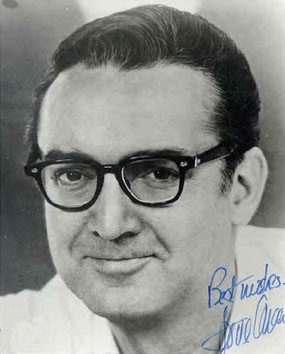
Steve Allen
From Wikipedia, the free encyclopedia
Born December 26, 1921(1921-12-26)
New York City, New York, USA
Died October 30, 2000 (aged 78)
Los Angeles, California, USA
Spouse Dorothy Goodman 1943-1952; divorce, Jayne Meadows 1954-2000; his death
Stephen Valentine Patrick William Allen (December 26, 1921 - October 30, 2000) was an American musician, comedian and writer. As the first host of The Tonight Show, Allen was instrumental in innovating the concept of the television talk show, and is often called the father of television talk shows.
Biography
Early life
Allen was born in New York City, the son of Isabelle (née Donohue), a vaudeville comedienne who performed under the name Belle Montrose, and Carroll Allen, a vaudeville performer who used the stage name Billy Allen.[1] Allen was raised on the South side of Chicago by his mother's Irish Catholic family. Milton Berle once called Allen's mother "the funniest woman in vaudeville".
Allen's first radio job was on station KOY in Phoenix, Arizona after he left Arizona State Teachers' College (now Arizona State University) in Tempe, Arizona while still a sophomore. He enlisted in the US Army during World War II and was trained as an infantryman. He spent his service time at Camp Roberts, near Monterrey, California, and did not serve overseas. Allen returned to Phoenix before deciding to move back to California.
Career
Allen became an announcer for KFAC in Los Angeles then moved to the Mutual Broadcasting System in 1946, talking the station into airing a five night a week comedy show called "Smile Time", co-starring Wendell Noble. Allen had an opportunity to move to CBS Radio's KNX in Los Angeles and did so. His music and talk format gradually changed to include more talk to his half hour show, boosting his popularity and creating standing room only studio audiences. During one episode of the show, reserved primarily for an interview with Doris Day, his guest star failed to appear. Instead Allen picked up a microphone and went into the audience to ad lib for the first time.[2] In 1950 and for 13 weeks his show substituted for Our Miss Brooks, for the first time exposing Allen to a national audience. Allen next went to New York to work for TV station WCBS.
He achieved national attention when he was pressed into service at the last minute to host Arthur Godfrey's Talent Scouts when its host was unable to appear. Allen turned one of Godfrey's live Lipton commercials upside down, preparing tea and instant soup on camera, then pouring both into Godfrey's ukulele. With the audience (including Godfrey watching from Miami) uproariously and thoroughly entertained, Allen gained major recognition as a comedian and host. Leaving CBS, he created a late-night New York talk-variety TV program in 1953 for what is now WNBC-TV. The following year, on September 27, 1954, the show went on the full NBC network as The Tonight Show, with fellow radio personality Gene Rayburn (who later went on to host hit game shows such as Match Game) as the original announcer. The show ran from 11:15 pm to 1:00 am on the east coast.
While Today Show developer Pat Weaver is often credited as Tonight's creator, Allen often pointed out that the show was previously "created" ?- by himself ?- as a local New York show. "This is Tonight, and I can't think of too much to tell you about it except I want to give you the bad news first: this program is going to go on forever", Allen told his nationwide audience that first evening. "Boy, you think you're tired now. Wait until you see one o'clock roll around."
It was as host of The Tonight Show that Allen pioneered the 'man on the street' interviews and audience-participation comedy breaks that have become commonplace on late-night TV. In 1956, while still hosting Tonight, Allen added a Sunday-evening variety show scheduled directly against The Ed Sullivan Show on CBS and Maverick on ABC. One of Allen's guests was comedian Johnny Carson, a future successor to Allen as host of The Tonight Show; among Carson's material during that appearance was a portrayal of how a poker game between Allen, Sullivan and Maverick star James Garner, all impersonated by Carson, would transpire. Allen's programs helped the careers of singers Steve Lawrence, and Eydie Gorme who were regulars on his early Tonight Show, and Sammy Davis, Jr..
In 1956 NBC offered Allen a new, prime-time Sunday night Steve Allen Show aimed at dethroning CBS's top-rated Ed Sullivan Show. The show included a typical run of star performers including early TV appearances by Elvis Presley and Jerry Lee Lewis. Allen, a pianist whose love of jazz influenced all his TV shows and the music presented on them, had a strong personal distaste for Rock 'n Roll music, and often presented skits ridiculing rockers. He also generated controversy by not only presenting rock music on television, by insisting Presley wear a tuxedo and stand still while singing, not for reasons of morality but for comedic effect. Allen also provided a nationwide audience for his famous 'man on the street' comics, such as Pat Harrington, Jr., Don Knotts, Louis Nye, Bill Dana, Dayton Allen and Tom Poston. All were relatively obscure performers prior to their stints with Allen, and went on to stardom.
Allen remained host of "Tonight" for three nights a week (Monday and Tuesday nights were taken over by Ernie Kovacs) until early 1957, when he left the "Tonight" show to devote his attention to the Sunday night program. It was his (and NBC's) hope that the Steve Allen show could defeat Ed Sullivan in the ratings. While he did defeat Sullivan on a few occasions, Sullivan continued to dominate. But ironically, what the critics had called an epic battle of two talk giants ended up with both beaten handily by the western Maverick. In September of 1959, Allen relocated to Los Angeles, and left Sunday night television. Back in LA, he continued to write songs, hosted other variety shows, and wrote books and articles about comedy.
The 1985 documentary film, Kerouac, the Movie, starts and ends with footage of Jack Kerouac reading from On The Road as Allen accompanies on soft jazz piano, from The Steve Allen Plymouth Show in 1959. "Are you nervous?" Allen asks him; Kerouac answers nervously, "Naw."
Allen helped the recently invented Polaroid camera become popular by demonstrating its use in live commercials, and amassed a huge windfall for his work because he had opted to be paid in Polaroid Corporation stock.
From 1962 to 1964, Allen re-created the Tonight Show on a new late-night Steve Allen Show syndicated by Westinghouse TV. The show, taped in Hollywood, was marked by the same wild and unpredictable stunts, comedy skits that often extended down the street to a supermarket known as the Hollywood Ranch Market. He also presented Southern California eccentrics, including health food advocate Gypsy Boots and an early musical performance by Frank Zappa. One notable program which Westinghouse refused to distribute featured Lenny Bruce, during the time the comic was repeatedly being arrested on obscenity charges; footage from this program was first telecast in 1998 in a Bruce documentary aired on HBO. Regis Philbin took over hosting the Westinghouse show in 1964, but only briefly.
The theater in Hollywood was billed as the "Steve Allen Playhouse" at the corner of La Mirada and Vine, and was an old vaudeville theater. It was built in 1906, and was the theater where Bob Hope did his first stand-up act, and was also the theater for filming the "You Bet Your Life" program with Groucho Marx. During a renovation, the entire interior of the building was burned out, and it is now a mental health clinic.
The show also featured plenty of jazz played by Allen and members of the show's band, the Donn Trenner Orchestra, which included such virtuoso musicians as guitarist Herb Ellis and flamboyantly comedic hipster trombonist Frank Rosolino (whom Allen credited with originating the 'Hiyo!' chant later popularized by Ed McMahon). While the show was not an overwhelming success in its day, David Letterman, Steve Martin, Harry Shearer, Robin Williams and a number of other prominent comedians have cited Allen's 'Westinghouse show', which they watched as teenagers, as highly influential on their own comedic visions.
Allen later produced a second half-hour show for Westinghouse titled Jazz Scene which featured West Coast jazz musicians such as Rosolino, Stan Kenton and Teddy Edwards. The short-lived show was hosted by Oscar Brown, Jr..
Allen hosted a number of television programs up until the 1980s, including the game show I've Got a Secret (replacing original host Garry Moore) in 1964 and The New Steve Allen Show in 1961. He was a regular on the popular panel game show What's My Line? (where he coined the popular phrase, "Is it bigger than a breadbox?") from 1953 to 1954 and returned frequently as a panelist after Fred Allen died in March, 1956 until the series ended in 1967. In the summer of 1967, he brought most of the regulars from over the years back with "The Steve Allen Comedy Hour", featuring the debuts of Rob Reiner, Richard Dreyfuss, and John Byner, and featuring Ruth Buzzi, who would become famous soon after in "Laugh-In". In 1968-71 he returned to syndicated nightly variety-talk, with the same wacky stunts that would influence David Letterman in later years, including becoming a human hood ornament, jumping into vats of oatmeal and cottage cheese, and beinng lathered with dog food, allowing dogs backstage to feast on the free food. Allen in those two years also introduced Albert Brooks and Steve Martin for the first time to a national audience. A syndicated version of I've Got A Secret hosted by Allen and featuring panelists Pat Carroll and Richard Dawson premiered in local syndication in 1972, taped in Hollywood. In 1977 he produced Steve Allen's Laugh-Back, a syndicated series combining vintage Allen film clips with new talk-show material reuniting his 1950s TV gang. From 1986 through 1988, Allen hosted a daily 3-hour comedy show that was heard nationally on the NBC Radio Network, featuring sketches and America's best known comedians as regular guests. His co-host was radio personality Mark Simone, and they were joined frequently by comedy writers Larry Gelbart, Herb Sargent and Bob Einstein.
Allen was an accomplished composer who wrote over 10,000 songs. In one famous stunt, he made a bet with singer-songwriter Frankie Laine that he could write 50 songs a day for a week. Composing on public display in the window of a Hollywood music store, Allen met the quota, winning $1,000 from Laine. One of the songs, Let's Go to Church Next Sunday, was recorded by both Perry Como and Margaret Whiting. Allen's best-known songs are "This Could Be the Start of Something Big" and "The Gravy Waltz", which won a Grammy Award in 1963 for best jazz composition. He also wrote lyrics for the standards "Picnic" and "South Rampart Street Parade". Allen composed the score to the Paul Mantee imitation James Bond film A Man Called Dagger (1967) with the score orchestrated by Ronald Stein.
Allen was also an actor. He wrote and starred in his first film, the Mack Sennett comedy compilation Down Memory Lane, in 1949. His most famous film appearance is in 1955's The Benny Goodman Story, in the title role. The film, while an average biopic of its day, was heralded for its music, featuring many alumni of the Goodman band. Allen later recalled his one contribution to the film's music, used in the film's early scenes: the accomplished Benny Goodman could no longer produce the sound of a clarinet beginner, and that was the only sound Allen could make on a clarinet!
From 1977 to 1981, Allen was the producer of the award-winning PBS series, Meeting of Minds ?- a "talk show" with actors playing the parts of notable historical figures, and Steve Allen as the host. This series pitted the likes of Socrates, Marie Antoinette, Thomas Paine, Sir Thomas More, Attila the Hun, Karl Marx, Emily Dickinson, Charles Darwin, and Galileo Galilei in dialogue and argument. This was the show Allen wanted to be remembered for, because he believed that the issues and characters were timeless, and would survive long after his passing. However, Meeting of Minds did not prove to be a television evergreen: a proposed revival of the show was rejected as being "too cerebral".[citation needed] This may be more an indictment of the denigration of popular tastes, of which Allen himself wrote about in his last book, "Vulgarians at the Gates", than any obtuseness on the shows' part.
Allen was a comedy writer, and author of more than 50 books, including Dumbth, a commentary on the American educational system, and Steve Allen on the Bible, Religion, and Morality. He also wrote book-length commentaries on show-business personalities ('Funny People,' 'More Funny People'). Perhaps influenced by his son's involvement with a religious cult, he became an outspoken critic of organized religion and an active member of such humanist and skeptical organizations as the Council for Media Integrity, a group which debunked pseudo-scientific claims. (for more about Allen's skepticism, see Paul Kurtz, "A Tribute to Steve Allen," Skeptical Inquirer magazine, January/February 2001.)
Allen was also notoriously contemptuous of rock 'n' roll music, although he was showman enough to scoop Ed Sullivan by being one of the first to present Elvis Presley on network television (after Presley had appeared on the Tommy and Jimmy Dorsey Stage Show and Milton Berle shows). On this occasion, he had Elvis wear a top hat and the white tie and tails of a 'high-class' musician while singing "Hound Dog" to an actual hound, who was similarly attired. According to Jake Austen, "the way Steve Allen treated Elvis Presley was his federal crime. Allen thought Presley was talentless and absurd, and so he decided to goof on him. Allen set things up so that Presley would show his contrition by appearing in a tuxedo and singing his new song 'Hound Dog' to an elderly basset hound..."[3] Elaine Dundy says that Allen smirkingly presented Elvis "with a roll that looks exactly like a large roll of toilet paper with, says Allen, the 'signatures of eight thousand fans.' " Presley looked "at Steve as if to say: 'It's all right. I've been made a worse fool in my life,' and after he patted the basset hound he is about to sing Hound Dog to, he wiped his hands on his trousers as if to wipe away Steve Allen, the dog and the whole show."[4] Guitarist Scotty Moore later said Elvis and the members of his band were "all angry about their treatment the previous night". Presley often referred to the Allen show as the most ridiculous performance of his career. That apparent mockery was consistent with other situations in which Allen had singers in such comic scenarios on his show, in contrast to the simple "singing in front of a curtain" style of the Sullivan show. The house singers on the early Tonight show were subjected to many such stunts.
It must be remembered that Allen was in his late thirties at the time, and was brought up in his formative years with a big band/jazz perspective.Stan Freberg and others of his generation also comically mocked rock 'n' roll at the time, but credit must be given for simply having the artists on in the first place. Rock 'n' roll was just coming into its own, and the nation itself didn't embrace it collectively at first, particularly folks like Allen who were brought up in the big band/crooner era. At the very least, he was an unintentional trailblazer of rock simply by breaking in new artists, per Sullivan. Jerry Lee Lewis was so touched by Allen's booking of him for the first time to a national audience that he named his first son Steve Allen Lewis after him.
Allen also had many black jazz artists on his early Tonight show, all exposed to a national audience for the first time, including Earl Hines, Billie Holiday, Bobby Short, Coleman Hawkins, Lionel Hampton, Sarah Vaughn, Thelonius Monk, Dizzy Gillespie, and Count Basie. Allen was honored with numerous awards from black organizations for that very same trailblazing.
Allen has two stars on the Hollywood Walk of Fame: a TV star at 1720 Vine St. and a radio star at 1537 Vine St.
Personal life
Allen's second wife was actress Jayne Meadows, daughter of Christian missionaries, and sister to actress Audrey Meadows. The marriage of Allen and Meadows produced one son. They were married from 1954 until his death in 2000. Allen had three children, Steve Allen Jr., Brian Allen, and David Allen, from an earlier marriage that ended in divorce. In the mid 1970s, Brian became involved with a religious cult known as the Love Family and during that time, he took the name "Logic Israel."
Despite his Catholic upbringing, Allen was a secular humanist and Humanist Laureate for the Academy of Humanism, a member of CSICOP and the Council for Secular Humanism. He was a student and supporter of general semantics, recommending it in Dumbth and giving the Alfred Korzybski Memorial Lecture in 1992. Allen was a supporter of world government and served on the World Federalist Association Board of Advisers.[5] In spite of his liberal position on free speech, his later concerns about the smuttiness he saw on radio and television, particularly the programs of Howard Stern, caused him to make proposals restricting the content of programs, allying himself with the Parents Television Council. Coincidentally, his full-page ad on the subject appeared in newspapers a day or two before his unexpected death. Allen had been making speeches in which he referred to himself as an "involved Presbyterian".
Allen made a last appearance on the Tonight show on September 27, 1994, for the show's 40th anniversary broadcast. Jay Leno was effusive in praise, and actually knelt down and kissed his ring.
Death
On October 30, 2000, Allen was driving to his son's home in Encino, California when his car was struck by another vehicle backing out of a driveway. Allen and the other driver were not injured and damage to both vehicles was minimal so the two exchanged insurance information and Allen continued on. Shortly after arriving at his son's home, Allen did not feel quite right and decided to take a nap. While napping, Allen suffered a massive heart attack and was pronounced dead shortly after 8 p.m. Autopsy results concluded that the traffic accident earlier in the day had caused a blood vessel in Allen's chest to rupture causing blood to leak into the sac surrounding the heart. This condition is known as hemopericardium.[1] In addition, Allen also suffered four broken ribs as a result of the accident. Allen was 78 years old, and is interred in Forest Lawn Memorial Park-Hollywood Hills in Los Angeles.
Alan King
From Wikipedia, the free encyclopedia
Born December 26, 1927(1927-12-26)
New York City, New York, U.S.A.
Died May 9, 2004 (aged 76)
New York City, New York, U.S.A.
Occupation Comedian
Alan King (December 26, 1927 - May 9, 2004) was an American comedian known for his biting wit and often angry humorous rants. King became well-known as a Jewish comedian and satirist. He appeared in a number of movies and television shows. King wrote several books, produced films, and appeared in plays. In later years, he helped many philanthropic causes.
Biography
Early life
The youngest of several children, King was born Irwin Alan Kniberg in New York City, New York, to Minnie (née Solomon) and Bernard Kniberg, a handbag cutter.[1] He spent his first years on the Lower East Side of Manhattan. Later, King's family moved to Brooklyn. King used humor to survive in the tough neighborhoods. As a child, King performed impersonations on street corners for pennies.
When he was fourteen, King performed "Brother, Can You Spare A Dime" on the radio program Major Bowes Original Amateur Hour. He lost first prize, but was invited to join a nationwide tour. At fifteen, King dropped out of high school to perform comedy at the Hotel Gradus in the Catskill Mountains. After one joke that made fun of the hotel's owner, King was fired. He worked in Canada in a burlesque house while also fighting as a professional boxer. He won twenty straight fights before losing. Nursing a broken nose, King decided to quit boxing and focus on his comedy career. King began working as a doorman at the popular nightclub Leon and Eddie's while performing comedy under the last name of the boxer who beat him, "King".
Career
King began his comedy career with one-liner routines and other material concerning mothers-in-law and Jews. King's style of comedy changed when he saw Danny Thomas performing in the early 1950s. King realized that Thomas was talking to his audience, not at them, and was getting a better response. King changed his own style from one-liners to a more conversational style that used everyday life for humor. His comedy inspired other comedians like Jerry Seinfeld and Billy Crystal.
King married Jeanette Sprung in 1947. They had three children, Andrew, Robert, and Elainie Ray. His wife persuaded him to move to Forest Hills, Queens for their children, and later, to Great Neck, Long Island, where he lived for the rest of his life. There, he developed comedy revolving around life in suburbia. With America moving to suburbs, King's humor took off.
King began opening for many celebrities including Judy Garland, Patti Page, Nat King Cole, Billy Eckstine, Lena Horne and Tony Martin. When Martin was cast in the movie Hit the Deck, he suggested King for a part, which gave King his first movie role. King played small roles in movies in the 1950s, but disliked playing stereotypical roles that he described as "always the sergeant from Brooklyn named Kowalski".[2] King eventually expanded his range and made a name for himself playing gangsters in five movies, including Cats Eye and The Anderson Tapes.
Like many other Jewish comics, King worked the Catskill circuit known as the Borscht Belt. His career took off after appearances on the Ed Sullivan, Perry Como, and Garry Moore Shows. Living just outside New York City, King was frequently available when Sullivan needed an act to fill in for a last-minute cancellation. King also became a regular guest host for The Tonight Show Starring Johnny Carson, hosted the Oscars in 1972, and was the MC for President John F. Kennedy's inauguration in 1961. King was also the long-standing host of the New York Friar's Club celebrity roasts.
King was the first recipient (1988) of the award for American Jewish humor from the National Foundation for Jewish Culture. The award was subsequently renamed in his honor.
Personal life
Throughout his life, King was deeply involved in charity work. He founded the Alan King Medical Center in Jerusalem, raised funds for the Nassau Center for Emotionally Disturbed Children (near his home in Kings Point, New York), and established a chair in dramatic arts at Brandeis University. He also created the Laugh Well program, which sends comedians to hospitals to perform for patients. In the 1970s, King turned his passion for tennis into a pro tournament in Las Vegas called the Alan King Tennis Classic, which was carried on national TV by the TVS Television Network. He also started the Toyota Comedy Festival.
King died at the Memorial Sloan-Kettering Cancer Center in Manhattan on May 9, 2004, after succumbing to lung cancer. He was 76.
A local United Way office realized that the organization had never received a donation from the town's most successful lawyer. The person in charge of contributions called him to persuade him to contribute.
"Our research shows that out of a yearly income of at least $700,000, you give not a penny to charity. Wouldn't you like to give back to the community in some way?"
The lawyer mulled this over for a moment and replied, "First, did your research also show that my mother is dying after a long illness, and has medical bills that are several times her annual income?"
Embarrassed, the United Way rep mumbled, "Um ... no."
The lawyer interrupts, "or that my brother, a disabled veteran, is blind and confined to a wheelchair?"
The stricken United Way rep began to stammer out an apology, but was interrupted again.
"or that my sister's husband died in a traffic accident," the lawyer's voice rising in indignation, "leaving her penniless with three children?!"
The humiliated United Way rep, completely beaten, said simply, "I had no idea..."
On a roll, the lawyer cut him off once again, "So if I don't give any money to them, why should I give any to you?"
UhOh, BioBob. Wonder if Ticomaya heard that lawyer joke.
He will probably think that it is funny as well.
Thanks for the celeb bio's. Unfortunately, about the only song that I can play for our listeners is the one by that King of comedy. Perhaps when Raggedy arrives, we can be better inspired.
Brother, Can You Spare A Dime?
Gorney, Harburg
They used to tell me
I was building a dream.
And so I followed the mob
When there was earth to plow
Or guns to bear
I was always there
Right on the job.
They used to tell me
I was building a dream
With peace and glory ahead.
Why should I be standing in line
Just waiting for bread?
Once I built a railroad
I made it run
Made it race against time.
Once I built a railroad
Now it's done
Brother, can you spare a dime?
Once I built a tower up to the sun
Brick and rivet and lime.
Once I built a tower,
Now it's done.
Brother, can you spare a dime?
Once in khaki suits
Gee we looked swell
Full of that yankee doodle dee dum.
Half a million boots went sloggin' through hell
And I was the kid with the drum!
Say don't you remember?
They called me Al.
It was Al all the time.
Why don't you remember?
I'm your pal.
Say buddy, can you spare a dime?
Once in khaki suits,
Ah, gee we looked swell
Full of that yankee doodle dee dum!
Half a million boots went sloggin' through hell
And I was the kid with the drum!
Oh, say don't you remember?
They called me Al.
It was Al all the time.
Say, don't you remember?
I'm your pal.
Buddy, can you spare a dime?
Hey, Raggedy. I didn't know that Richard Widmark played in The Alamo, nor that The Green Leaves of Summer was from the motion picture, PA.
Thanks, gal, for the info and the great collage of the celebs.
Also surprised to find out that Steve Allen wrote the lyrics to Gravy Waltz.
GRAVY WALTZ
(Ray Brown / Steve Allen)
Joe Williams & Friends - 1963
Pretty mamma's in the kitchen this glorious day
Smell the gravy simmerin' nearly half a mile away
Lady morning glory, I say good morning to you
Chirpy little chickadee told me that my baby was true
Well, she really ran to get her frying pan
When she saw me coming
Gonna get a taste before it goes to waste
This honeybee's humming
Mister Weeping Willow, I'm through with all of my faults
?'cause my baby's ready to do the ever new gravy waltz
Well, she really ran to get her frying pan
When she saw me coming
I'm gonna get a taste before it goes to waste
This honeybee's humming
Mister Weeping Willow, I'm through with all of my faults
?'cause my baby's ready to do the ever new gravy waltz
Mr Weeping Willow, I'm through with all of my faults
?'cause my baby is ready to do the ever new gravy,
Mmm, nice gravy dear, waltz.
http://www.youtube.com/watch?v=qpxtCd1qOaQ
hope you won't wear yourself out from shopping today :wink:
ehbeth left at 9 this morning and is expected back at ... ...

let's enjoy a little swing time music !
hbg
Quote:
BACK IN YOUR OWN BACKYARD ... You'll find your happiness lies
Al Jolson / Billy Rose / Dave Dreyer
The bird with feathers of blue
Is waiting for you
Back in your own backyard
You'll see your castles in Spain
Through your window pane
Back in your own backyard
Oh you can go to the East
Go to the West
But someday you'll come
Weary at heart
Back where you started from
You'll find your happiness lies
Right under your eyes
Back in your own backyard
The bird with feathers of blue
Is waiting for you
Back in your own backyard
You'll see your castles in Spain
Through your window pane
Back in your own backyard
Oh you can go to the East
Go to the West
But someday you'll come
Weary at heart
Back where you started from
You'll find your happiness lies
Right under your eyes
Back in your own backyard
Hey, hbg. I know that song. UhOh!
Thanks, Canada. I still think it amazing that Al Jolson's father wanted him to be a cantor, and he ended up doing minstrel and singing about Dixie. Tell ehBeth that Letty has never been a compulsive shopper. I think it has to do with large crowds and trying on bathing suits.
Found this mini bio about Al, folks.
Waiting for the Robert E. Lee
Lewis F. Muir (M) and L. Wolfe Gilbert (L) - 1912: This is one of many songs that helped make Al Jolson famous, or possibly vice versa. In Tin Pan Alley, author Dave Jasen tells of its curious origin. Muir already had a string of hits behind him, and had just composed When Ragtime Rosie Ragged the Rosary. Gilbert, in a column for the New York Clipper, wrote a column attacking the song as sacrilege, and derided both the composer and the publisher. The two ran into each other a few days later, and Muir asked Gilbert about any hits he had written. Gilbert named some obscure publications that Muir had never heard of. Gilbert challenged Muir to write a song with him if he was so talented. They went to Muir's home that evening and turned out a love ballad and a Dixie chorus. The next morning they took their songs to Muir's publisher, Fred Mills. Mills told them the ballad stank, and that Dixie songs were now passé. He offered Gilbert a batch of songs to show him what Mills Music published. Gilbert left steaming, then realized he hadn't taken the songs offered him. He came back in and Mills asked him to play that Dixie tune again because he couldn't get it out of his head. A few weeks later, Jolson introduced Waiting for the Robert E. Lee, and it has been a favorite ever since.
Way down on the levee in old Alabamy,
There's daddy and mammy, there's Ephriam and Sammy,
On a moon light night you can find them all,
While they are waitin' the banjos are syncopatin'
What's that they're sayin'? What's that they're sayin'?
While they keep playin' they're hummin' and swayin'.
It's the good ship Robert E. Lee that's come to carry the cotton away
Chorus: Watch them shufflin' along. See them shufflin' along.
Go take your best gal, real pal, go down to the levee, I said to the levee
And join that shufflin' throng, hear that music and song.
It's simply great, mate, waitin' on the levee, waitin' for the Robert E. Lee.
The whistles are blowin', the smoke stacks are showin',
The ropes they are throwin', excuse me, I'm goin'
To the place where all is harmonius.
Even the preacher, he is the dancing teacher.
Have you been down there? Were you around there?
If you ever go there you'll always be found there.
Why dog gone, here comes my baby on the good old Robert E. Lee.
Watch them shufflin' along. See them shufflin' along.
Go take your best gal, real pal, go down to the levee, I said to the levee
And join that shufflin' throng, hear that music and song.
It's simply great, mate, waitin' on the levee, waitin' for the Robert E. Lee.
letty :
ebeth arrived in her little honda civic with (big :wink: ) john , cleo and bailey ... ... the car was PACKED . she'll be leaving with the aforementioned and even more stuff - we've suggested , that she buy a trailer !
crowds don't bother her - that's why she likes the big apple !
after our first visit to NYC when she was 12 years old - we stayed for a whole week - she decided THAT SHE WOULD LEAVE HOME TO LIVE IN NYC !!!
hbg
and here is billie holiday singing irving berlin
Quote:The snow is snowing, the wind is blowing
But I can weather the storm
What do I care how much it may storm?
I've got my love to keep me warm
I can't remember a worse December
Just watch those icicles form
What do I care if icicles form?
I've got my love to keep me warm
Off with my overcoat
Off with my glove
I need no overcoat
I'm burning with love
My heart's on fire, the flame grows higher
So I will weather the storm
What do I care how much it may storm?
I've got my love to keep me warm
(i pair of longjohns come in handy sometimes :wink: )