dyslexia wrote:my ex sang a duet with Paul Robeson on stage when she was a mere prat of a child. It was somewhere in Harlem in the late 1940's.
Are there and photos of her, accompanying him? They'd be worth a lot of money now, if there are! There's an auction house in NYC, that deals with ephemera, of that kind. Manuscripts, photos, first editions and anything to do with the Harlem Renaissance. The famous photo, of all of the Jazz musicians of that era, bring a hefty price! The name of the auction house, is Swann Galleries and they have a website. I'm on their mailing list, but I can't afford the hefty prices, these offerings bring.
Letty:
I lost track of my replies from this group and I had to come back 5 pages to retrieve this.
Been watching all of the Christmas Movies, trying to cheer myself up. The Christ Child will come, anyway, like the snow falling everywhere, but where you are! We had a bit of it, last week, but living by the ocean, ours turned to rain. It was 18 degrees here yesterday, but it warmed up to 39, by the afternoon, praise God!
My 8 and 40 club, had its' annual Christmas Party. My Girlfriend/sister, gave me all red/white/and blue everything! She knows how much I love this country and would don red/white and blue, everyday, if I could! People often ask me why I wear it so much and I say, for my freedom, I thank those serving and the veterans! I don't consider myself a sappy American, just a loyal one. We're not a perfect Nation, by any stretch, but I love it, just the same. FYI: 8 and 40 is the Fun and Fellowship, Auxilairy, of The American Legion Auxiliary, formed in Paris, back in 1922, as a rest and relaxation, part of the Parent Organization. Only those members who have distinguished themselves, are asked to join. This is my 19th year!
I'm not a joiner, by nature, but I was serving as the County Sgt. at Arms, when I was asked to join this great group of Ladies, who raise funds for children with Cystic Fibrosis and respiratory ailments, in Children.
Having been a child with chronic bronchitis and hayfever, all my life, I jumped right in. We exchanged cute little inexpensive, yet thoughtful gifts last night. I wore my little mistletoe head-band, because I'm re-living my 3rd childhood, on purpose! You know life, is just a rest stop, on the way to eternity and if I can make a difference in anyone's life, it's a star in my crown. You have already made a difference in mine. Thank You!
Sharon

Ralph Richardson
From Wikipedia, the free encyclopedia
Birth name Ralph David Richardson
Born 19 December 1902(1902-12-19)
Tivoli Road, Cheltenham, Gloucestershire, England
Died 10 October 1983 (aged 80)
Marylebone, London, England
Resting place Highgate Cemetery, London, England
Spouse(s) Muriel Hewitt (1924-1942)
Meriel Forbes (1944-1983)
[show]Awards
Academy Awards
Nominated: Best Supporting Actor
1949 The Heiress
1984 Greystoke: The Legend of Tarzan, Lord of the Apes
BAFTA Awards
Best Actor
1952 The Sound Barrier
Sir Ralph David Richardson (19 December 1902 - 10 October 1983) was an English actor, one of a group of theatrical knights of the mid-20th century who, though more closely associated with the stage, did their best to make the transition to film.
Biography
Richardson was born in Cheltenham, Gloucestershire, England. When he was a baby, his mother, Lydia Russell, left his father and took him with her to Gloucester, where he was raised in the Roman Catholic faith of his mother (his father and brothers were Quakers). His father supported them with a small allowance. Lydia Richardson wished Ralph to become a priest. Ralph was an altar boy in Brighton, England and was educated by the Xaverian Brothers, but was never particularly religious.
Career
Stage
Richardson made his West End début in 1926. Thereafter he became one of the Old Vic Theatre's major stars, one of his early big roles being Caliban to the Prospero of John Gielgud, a professional association that lasted for four decades. Richardson scored additional Old Vic triumphs as Enobarbus in Antony and Cleopatra, Toby Belch in Twelfth Night, and Bottom in A Midsummer Night's Dream.
At Malvern in 1932, he played Face in Ben Jonson's The Alchemist. In 1933 he played the title role in W. Somerset Maugham's final play Sheppey at Wyndham's Theatre, and became an undisputed West End star in The Amazing Dr. Clitterhouse (1936).
After active service in World War II serving as a Lieutenant-Commander in the Royal Naval Volunteer Reserve, Richardson joined Laurence Olivier and the director John Burrell as co-director of the Old Vic Theatre, where his notable roles included Falstaff (to Olivier's Hotspur), Bluntschli in Arms and the Man (Olivier as Sergius), Cyrano in Cyrano de Bergerac, and Peer Gynt, in which Olivier took the cameo role of the Button Moulder. Richardson also directed Alec Guinness in Richard II, taking on the role of John of Gaunt in the production when the Old Vic governors insisted that either Richardson or Olivier were contractually obligated to act in all the productions. After he was dismissed at the Old Vic, Richardson appeared with the Royal Shakespeare Company in Stratford-on-Avon but had mixed results, with his 1952 performance as Macbeth being the greatest failure of his career. He fared better at the Bristol Old Vic in his appearance as Volpone to Anthony Quayle's Mosca in Ben Jonson's Volpone, in the title role of Timon of Athens in his 1952 return to the Old Vic, and on Broadway in his Tony-nominated role in The Waltz of the Toreadors (1957). He made a misstep in turning down the English language premiere of Waiting for Godot, a decision that he regretted for the remainder of his life.
In 1960s he appeared successfully as Sir Peter Teazle in John Gielgud's production of School for Scandal, as the Father in Six Characters in Search of an Author in London (1963), a return to Nick Bottom in A Midsummer Night's Dream (1964) and the original production of Joe Orton's controversial farce What The Butler Saw in the West End at the Queen's Theatre in 1969 with Stanley Baxter, Coral Browne, and Hayward Morse.
In the 1970s he appeared in the West End (for example in William Douglas-Home's play Lloyd George Knew My Father with Peggy Ashcroft), and with the National Theatre under Peter Hall's direction, where among the classics he played Firs in The Cherry Orchard and the title role in John Gabriel Borkman along with Wendy Hiller and Peggy Ashcroft. He continued his long stage association with John Gielgud, appearing together in two new works, David Storey's Home and Harold Pinter's No Man's Land.
Radio and Television
From 1954 - 1955 he played the character of Dr. John Watson (mistakenly called 'James' in several episodes) in an American/BBC radio co-production of canonical Sherlock Holmes stories, which starred Gielgud as the famous consulting detective and featured Orson Welles as the villainous Professor Moriarty. In the 1960s he played Lord Emsworth on BBC television in dramatisations of P.G.Wodehouse's Blandings Castle stories, with his real-life wife Meriel Forbes playing his domineering sister Connie, and Stanley Holloway as his butler Beach.
Recordings
Richardson made several spoken word recordings for the Caedmon Audio label in the 1960s. He re-created his role as Cyrano de Bergerac opposite Anna Massey as Roxane, and played the title role in a complete recording of Shakespeare's Julius Caesar (play), with a cast that included Anthony Quayle as Brutus, John Mills as Cassius, and Alan Bates as Marc Antony. He also recorded some English Romantic poetry, such as The Rime of the Ancient Mariner, for the label.
Film
His film appearances included The Citadel, The Heiress (his first nomination for an Academy Award), Richard III (playing Buckingham to Olivier's Richard), Our Man in Havana (with Alec Guinness and Noel Coward), O Lucky Man!, Oh! What a Lovely War, Dragonslayer, Tales from the Crypt (as the Crypt Keeper himself) and Time Bandits. His final film appearance was as the sixth Earl of Greystoke in the 1983 movie Greystoke: The Legend of Tarzan, Lord of the Apes, for which he was again nominated for an Academy Award.
Music
Richardson recorded the narration for Prokofiev's Peter and the Wolf, and the superscriptions for Vaughan Williams' Sinfonia Antartica - both with the London Symphony Orchestra, the Prokofiev conducted by Sir Malcolm Sargent and the Vaughan Williams by André Previn.
Awards and honours
Richardson was knighted by King George VI in 1947. In 1963 he won the Best Actor Award at the Cannes Film Festival for Long Day's Journey Into Night. He won the BAFTA Award for Best British Actor for The Sound Barrier (1952), and was nominated on another three occasions. He was also nominated for three Tony Awards for his work on the New York stage, for his performances in The Waltz of the Toreadors, Home, and No Man's Land. He received Oscar nominations for The Heiress and Greystoke: The Legend of Tarzan, Lord of the Apes, and the New York Film Critics Circle Awards for The Sound Barrier and Greystoke.
Family
He was a nephew of the mathematician Lewis Fry Richardson. He was married to the actress Meriel Forbes (a member of the theatrical Forbes-Robertson family).
Sir Ralph Richardson died of a stroke, aged 80, and was interred at Highgate Cemetery.
Trivia
Richardson habitually rode a motorbike even in his seventies. He rode a Norton Dominator and in his later years changed to a BMW.
Was part of a trio of great English stage actors, the other two being friends Laurence Olivier and John Gielgud. They appeared together in Olivier's Richard III (1955) and in several scenes of the mini series Wagner (1983), which was released shortly after Richardson's death. Sadly he is the least remembered of the trio, as people often quote 'Olivier and Gielgud', but forget Richardson. This may be due to the fact he did less film work, than Oliver and Gielgud, despite being the same calibre of actor as they were.
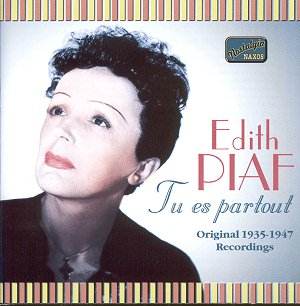
Édith Piaf
From Wikipedia, the free encyclopedia
Birth name Édith Giovanna Gassion
Also known as La Môme Piaf
Born December 19, 1915
Origin Belleville, Paris, France
Died October 11, 1963 (Aged 47) (off. date)
Placassier, France
Genre(s) French pop, cabaret,
torch songs
Occupation(s) Singer, songwriter, actress
Years active 1935 - 1963
Édith Piaf (December 19, 1915-October 11, 1963) was one of France's most beloved singers[1] and became a national icon. Her singing reflected her tragic life, with her specialty being the poignant ballad performed in a heartbreaking voice. Among her famous songs are "La vie en rose" (1946), "Hymne à l'amour" (1949), "Milord" (1959), "Non, je ne regrette rien" (1960). A filmed biography on her life, titled La Môme (released in English as La Vie En Rose), was released in June 2007. There have been other dramatized versions of her life, including a Tony Award-winning play entitled Piaf, which was also telecast on PBS.
Early life
Despite numerous published biographies, much of Édith's life is shrouded in mystery.[2] She was born Édith Giovanna Gassion[3] in Belleville, Paris, the high-immigration district later described by Daniel Pennac. Legend has it that she was born on the pavement of Rue de Belleville 72, but her official birth certificate states she was born at Hôpital Tenon,[4] the hospital for the 20th arrondissement of which Belleville is part. She was named Édith after the World War I British nurse Edith Cavell, who was executed for helping French soldiers escape from German captivity.[5] Piaf?-a Parisian colloquialism for "sparrow"?-originated as a nickname she would receive 20 years later.
Her mother, Annetta Giovanna Maillard (1895-1945), was a part-Italian native of Livorno, a port city on the western edge of Tuscany, Italy. She was working as a café singer under the name Line Marsa.[4] Louis-Alphonse Gassion (1881-1944), Edith's father, was a street acrobat [6] with a past in the theatre. Piaf was soon abandoned by her parents, lived for a short time with her maternal grandmother, Emma (Aïcha) Saïd ben Mohammed (1876-1930), who was a Kabyle. Shortly thereafter, Édith's father took the child to his mother, who was a cook at a brothel in Normandy, and he then joined the French Army in 1916 to fight in World War I. The prostitutes helped look after Edith.[1]
From three to seven she was allegedly blind as a result of meningitis. According to one of Piaf's biographies, she recovered her sight in what is referred to as a miracle, after her grandmother's prostitutes pooled money to send her on a pilgrimage honoring Saint Thérèse de Lisieux. In 1929, at 14, she joined her father in his acrobatic street performances all over France, where she first sang in public.[1] She then took a room at Grand Hôtel de Clermont (18 rue Veron, Paris 18ème) and separated from him, going her own way as a street singer in Pigalle, Ménilmontant, and the Paris suburbs (cf. the song "Elle fréquentait la Rue Pigalle"). She joined her half-sister Simone Berteaut ("Momone")[4] in this endeavor, and the two became lifelong partners in mischief.[1] She was about 16 years old when she fell in love with a delivery boy, Louis Dupont.[1] At 17 she had her only child, a little girl named Marcelle, who died at the age of two of meningitis.[6] Like her own mother before her, Edith found it difficult to care for a child while living a life of the streets, so she would often leave Marcelle alone while she was away, and Dupont took the child to raise himself before Marcelle's death months later.[1] Edith's next boyfriend was a pimp by the name of Albert who took a commission from the money she made singing in exchange for not forcing her into prostitution. One of her friends, a meek girl named Nadia, killed herself when faced with the thought of becoming a prostitute and Albert nearly shot Edith when she broke things off in reaction to Nadia's death.[1]
Singing career
In 1935, Édith was discovered in the Pigalle area of Paris[1] by the nightclub owner Louis Leplée,[3] whose club Le Gerny off the Champs Elysees[6] was frequented by the upper and lower classes alike. He persuaded her to sing despite her extreme nervousness, which, combined with her height of only 4 feet 8 inches[7] (1.47 m),[4] inspired him to give her the nickname that would stay with her for the rest of her life and serve as her stage name, La Môme Piaf[3] (The Waif Sparrow, Little Sparrow or Kid Sparrow in Parisian slang).[1] Leplée taught her the basics of stage presence and told her to wear a black dress which would later become her trademark apparel.[1] Leplée ran a large publicity campaign prior to her opening night, which resulted in a number of celebrities including actor Maurice Chevalier attending the opening.[1] Her nightclub gigs led to her first two records produced that same year,[7] with one of them penned by Marguerite Monnot, an ongoing collaborator throughout Piaf's life.[1]
On April 6, 1936,[1] Leplée was murdered and Piaf was questioned in the matter and accused of being an accessory, but she was acquitted.[3] He had been killed by mobsters with previous ties to Piaf.[8] This resulted in much negative media attention directed towards Piaf,[4] which threatened her career.[1] To rehabilitate her image, she recruited Raymond Asso, with whom she would also become romantically involved. He changed her stage name La Môme Piaf to "Edith Piaf," barred her undesirable acquaintances from seeing her, and commissioned Monnot to write songs unique to Piaf's previous life on the streets.[1]
In 1940, Édith co-starred in Jean Cocteau's successful one-act play Le Bel Indifférent.[1] She began to make friends with famous people, such as Chevalier and the poet Jacques Borgeat. She wrote the lyrics of many of her songs and collaborated with composers on the tunes. In 1944, Édith Piaf discovered Yves Montand in Paris, made him part of her act, and became his mentor[4] and lover.[8] Within a year, he became one of the most famous singers in France, and she broke off their relationship when he had become almost as popular as she had.[1]
During this time, she was in great demand and very successful in Paris[3] as France's most popular entertainer.[7] After the war, she became known internationally,[3] touring Europe, the United States, and South America. She helped to launch the career of Charles Aznavour in the early 1950s, taking him on tour with her in France and the United States and recording some of his songs.[1] However, at first she met with little success with US audiences, who regarded her as downcast.[1] After a glowing review by a prominent New York critic, she met with better success[1] and her popularity in the United States was such that she appeared on the Ed Sullivan Show eight times and at Carnegie Hall twice (1956[6] and 1957).
Her signature song "La vie en rose"[1] was written in 1945 and was voted a Grammy Hall of Fame Award in 1998.
The legendary Paris Olympia concert hall is where Piaf achieved lasting fame, giving several series of concerts at the hall, the most famous venue in Paris,[4] between January 1955 and October 1962. Excerpts from five of these concerts (1955, 1956, 1958, 1961, 1962) were issued on record and CD and have never been out of print. The 1961 concerts were promised by Piaf in an effort to save the venue from bankruptcy and where she debuted her song "Non je ne regrette rien".[4] In April 1963, Piaf recorded her last song, "L'homme de Berlin".
World War II
During World War II, she was a frequent performer at German Forces social gatherings in occupied France, and many considered her a traitor; following the war she claimed to have been working for the French resistance. While there is no evidence of this per se, it does seem to be true that she was instrumental in helping a number of individuals (including at least one Jew) escape Nazi persecution. Throughout it all, amazingly, she remained a national and international favorite.[9] Piaf dated a Jewish pianist during this time and co-wrote a subtle protest song with Monnot.[1] According to one story, singing for high-ranking Germans at the One Two Two Club[10] earned Piaf the right to pose for photographs with French prisoners of war, to boost their morale. The Frenchmen were supposedly able to cut out their photos and use them as forged passport photos,[10] and some of them managed to escape.
Personal life
The great love of Piaf's life,[3] the married boxer Marcel Cerdan, died in an October 1949 plane crash, while flying to New York to meet Édith. Cerdan's Air France flight, flown on a Lockheed Constellation, went down in the Azores, killing everyone on board, including famous violinist Ginette Neveu. [11] Their affair made international headlines,[4] as Cerdan was the middleweight world champion and a legend in France in his own right. Piaf was later married twice. Her first husband was Jacques Pills, a singer. They married in 1952 and divorced in 1956. Her second husband, Greek[1] Théo Sarapo, was a 26-year-old hairdresser-turned-singer and actor, 20 years younger than Piaf. They married in 1962. They sang together in some of her last engagements.[1]
In 1951 she was involved in a car crash along with Aznavour, breaking an arm and two ribs, and thereafter had difficulty breaking serious morphine and alcohol addictions.[1] Two more near-fatal car crashes exacerbated the situation.[6] Her first husband, Jacques Pills, took her into rehab on three different occasions to no avail.[1]
Death and legacy
At the early age of 47, Piaf died of liver cancer at Plascassier, on the French Riviera, on October 11, 1963, the same day that her friend Jean Cocteau died.[12] She had slipped in and out of consciousness for the last months of her life.[6] It is said that Sarapo drove her body back to Paris secretly so that fans would think she had died in her hometown.[10][1] She was buried in Père Lachaise Cemetery, in Paris, where her grave is one of the most visited.[1] Although she was denied a funeral mass by the Roman Catholic archbishop of Paris because of her lifestyle,[10] her funeral procession drew tens of thousands[1] of mourners onto the streets of Paris and the ceremony at the cemetery was attended by more than 100,000 fans.[10][13] Aznavour recalled that Piaf's funeral procession was the only time since the end of World War II that he saw Parisian traffic come to a complete stop.[10]
A two-room museum is dedicated to Piaf, the Musée Édith Piaf[10] at 5, rue Crespin du Gast, 75011, Paris.
Today she is still remembered and revered as one of the greatest singers of France.[4][1]
A film of Piaf's life by Olivier Dahan, La Vie En Rose, debuted at the Berlin Film Festival in February, 2007. Titled La Môme in France, the film stars Marion Cotillard as Piaf. Dahan's film follows Piaf's life from early childhood to her death in 1963. David Bret's definitive biography, Piaf, A Passionate Life, was re-released by JR Books to coincide with the film's release.
Edmund Purdom
From Wikipedia, the free encyclopedia
Birth name Edmund Anthony Cutlar Purdom
Born December 19, 1924 (1924-12-19) (age 83)
Welwyn Garden City, Hertfordshire, England, UK
Edmund Anthony Cutlar Purdom, known as Edmund Purdom is an English actor. He was born on December 19, 1924 in Welwyn Garden City, Hertfordshire, England.
Life and career
He was educated by the Jesuits at St Ignatius' College and by the Benedictines.
He began his acting career in 1945 on the stage, appearing in productions which included Romeo and Juliet and Molière's The Imaginary Invalid.
In 1951-52, he appeared in small roles with the Laurence Olivier/Vivien Leigh company on Broadway in Shakespeare's Antony and Cleopatra and Shaw's Caesar and Cleopatra when his good looks brought him to the attention of Hollywood. His appearance in small roles in Titanic and Julius Caesar led to his being cast in the leading role opposite Ann Blyth in the MGM musical The Student Prince in 1954, a part originally intended for Mario Lanza who was deemed too corpulent for the role. Purdom lip-synched to Lanza's voice.
His best-remembered role was as the title character in The Egyptian, 20th Century-Fox's most-lavish production of 1954 for which Marlon Brando had originally been cast. In the same year, he appeared in another MGM musical, Athena, opposite his future wife Linda Christian, Jane Powell and Debbie Reynolds. He then played the title role in the biblical epic The Prodigal, MGM's most-lavish production of 1955. He partnered Ann Blyth again in the swashbuckling adventure, The King's Thief (1955) which also co-starred David Niven and George Sanders.
After that, his career as a major film star ran out of steam, with the exception of some rare cameo appearances, such as The Yellow Rolls-Royce in 1964.
Purdom relocated to Rome, Italy, where he first played parts in "sword and sandal" epics and has lived there ever since. He has continued to work extensively in Italian B-movies, on television and as a voice dubbing actor for many years (dubbing lines from Italian to English). In 1984, he directed his first and only film, Don't Open 'Til Christmas. Roman Catholic devotees will recognize his distinctive voice in the narration for a popular short documentary on the life of Padre Pio.
He has been married four times and divorced three times: his first three wives, all divorced, were Anita Philips (or Phillips), the mother of his children; Linda Christian in 1962, ex-wife of Tyrone Power; and Alicia Darr, of Polish Jewish extraction. In 2000 he married Vivienne.
Phil Ochs
From Wikipedia, the free encyclopedia
Background information
Birth name Philip David Ochs
Born December 19, 1940(1940-12-19)
El Paso, Texas
Died April 9, 1976 (aged 35)
Far Rockaway, New York
Genre(s) Folk
Occupation(s) Protest singer, guitarist.
Instrument(s) Guitar, Vocals, Piano
Years active 1964-1976
Label(s) Elektra, A&M, Smithsonian Folkways, Rhino, Vanguard, Hannibal
Philip David Ochs (December 19, 1940-April 9, 1976) was a U.S. protest singer (or, as he preferred, a "topical singer"), songwriter, musician and recording artist who was known for his sharp wit, sardonic humor, earnest humanism, political activism, insightful and alliterative lyrics, and haunting voice. He wrote hundreds of songs in the 1960s and released eight LP record albums in his lifetime.
He performed at many political events, including anti-Vietnam War and civil rights rallies, student events, and organized labor events over the course of his career, in addition to many concert appearances at such venues as New York City's The Town Hall and Carnegie Hall. Politically, Ochs described himself as a "left social democrat" who turned into an "early revolutionary" after the 1968 Democratic National Convention in Chicago, which had a profound effect on his state of mind.[1] He was often seen as a radical and also a patriot ?- though he was also interested in differing political philosophies as well as journalism, and was an avid fan of music and movies.
After years of prolific writing in the 1960s, Ochs' mental stability declined in the 1970s and eventually he succumbed to a number of problems including bipolar disorder and alcoholism, and he took his own life in 1976.
Some of his major influences were Woody Guthrie, Pete Seeger, Buddy Holly, Elvis Presley, Bob Gibson, Faron Young, Merle Haggard, John Wayne, and John F. Kennedy. His best known songs include "Power and the Glory", "Draft Dodger Rag", "There But for Fortune", "Changes", "Crucifixion, "When I'm Gone", "Love Me I'm a Liberal", "Links on the Chain", "Ringing of Revolution", "Outside of a Small Circle of Friends", and "I Ain't Marching Anymore".
Early years
Born in El Paso, Texas in 1940, Phil Ochs' family moved around frequently. He was raised in Far Rockaway, New York, then Perrysburg in upstate New York, where he first studied music ?- clarinet[2] ?- and then his family moved to Columbus, Ohio. He grew up in a non-political and non-religious Jewish middle-class family. His father, Jacob ("Jack") Ochs, was a doctor; his mother, Gertrude Phin Ochs, was from Scotland. His father, who had treated soldiers at the Battle of the Bulge, suffered from manic depression[3] and was thus not always available to his children.
As a teenager, Ochs was recognized as a talented clarinet player, and was praised for having "exceptional musical feeling" and a "gift for interpretation"[4]. His youthful musical skills allowed him to play clarinet underage with the Capital University Orchestra in Ohio. Although Phil originally played classical music, he soon became interested in other sounds on the radio, such as early rock icons Buddy Holly and Elvis Presley, and he was also interested in country music and listened to Faron Young, Ernest Tubb, Hank Williams, Sr., and Johnny Cash avidly.
Ochs spent a lot of time at the movies too, and he especially liked big screen heroes such as John Wayne and Audie Murphy, and a little later he developed an interest in movie rebels such as Marlon Brando and James Dean.
After graduating from the Staunton Military Academy in rural Virginia in 1958, he enrolled in the Ohio State University in Columbus. Unhappy after his first semester, he took a leave of absence and went to Florida. While in Miami, the 18-year-old Ochs was put in jail for two weeks for sleeping on a park bench, an incident he would later recall: "Somewhere during the course of those fifteen days I decided to become a writer. My primary thought was journalism ... so in a flash I decided ?- I'll be a writer and a major in journalism."[5]
He returned to Ohio State to study journalism and began to be interested in politics, with a particular interest in the Cuban Revolution of 1959[6] This was where he met Jim Glover, a fellow student who was a devotee of folk music and who introduced Ochs to the music of Pete Seeger, Woody Guthrie, and The Weavers. Glover taught Ochs how to play guitar, and they debated politics. Ochs began prolifically writing newspaper pieces, often on radical themes. When the student paper refused to publish some of his more "radical" articles, he started his own underground newspaper called "The Word". His two main interests, politics and music, soon merged, and Ochs began writing topical political songs. Ochs and Glover formed a duet at first called "The Singing Socialists" and then "The Sundowners", but they broke up before their first professional gig and Glover went to New York City to be a folksinger. Phil's parents and younger brother had moved from Columbus to Cleveland, Ohio, and Phil started to spend more time there and began performing professionally at a local folk club called Farragher's Back Room, and was the opening act for a number of musicians, including the Smothers Brothers in the summer of 1961. Ochs met Bob Gibson that summer as well, and according to Dave Van Ronk, Gibson became "the seminal influence"[7] on Ochs' writing. Ochs continued at Ohio State into his senior year, but was bitterly disappointed at not being appointed Editor-in-Chief of the college newspaper, and dropped out in his last semester without graduating.[8]
Early career
In 1962 Phil moved to New York City and began playing numerous small folk clubs, and eventually became an integral part of the Greenwich Village folk music scene. He emerged as an unpolished yet passionate vocalist who wrote poignant lyrics about war, civil rights, labor struggles and other topics which continue to be relevant to this day, and could perhaps be described as a socially conscious patriot in the tradition of Woody Guthrie. He described himself as a "singing journalist", or "troubadour journalist", saying he built his songs from stories he read in Newsweek. By the summer of 1963 he was well known enough in folk circles to be invited to sing at the Newport Folk Festival where he performed "Too Many Martyrs" (co-written with Bob Gibson ), "Talking Birmingham Jam" and "Power and the Glory", his rousing patriotic, but not uncritical, Woody Guthrie-esque anthem that brought the audience to its feet; also appearing at Newport '63 were Peter, Paul and Mary, Joan Baez, Bob Dylan, and Tom Paxton. Ochs' return appearance at Newport in 1964 was widely praised, with "Draft Dodger Rag" and other songs. But he was not invited to appear in 1965, the festival when Dylan famously ?- or infamously ?- rocked out "Maggie's Farm" with an electric guitar. Although many in the folk world decried Dylan's choice, Ochs was amused, and admired his courage in defying the folk establishment.[9]
Ochs contributed many songs and articles for Broadside Magazine, and it was at Broadside he had his first chance to record. His first three albums (All the News That's Fit to Sing (1964), I Ain't Marching Anymore (1965), and Phil Ochs in Concert (1966)), all on Elektra Records, contain some of his best work as a pure folk singer and examples of two traditional genres that Ochs contributed to in his early performances, namely the talking blues (such as "Talking Vietnam Blues") and the musical reinterpretation of older poetry (as of Alfred Noyes's "The Highwayman" and Edgar Allan Poe's "The Bells").[10] During this early period of his career, his friend Bob Dylan said, "I just can't keep up with Phil. And he's getting better and better and better."[11] This praise and friendly rivalry was to change in 1965, and on one occasion Ochs' criticism of one of Dylan's songs led Dylan to throw him out of his limousine, proclaiming: "You're not a folksinger. You're a journalist".[12]
His managers in the early part of his career were Albert Grossman (manager of Dylan and Peter, Paul, and Mary) followed by Arthur Gorson. Gorson had close ties with such groups as Americans For Democratic Action, the Student Nonviolent Coordinating Committee, and Students for a Democratic Society.[13]
Generally a quixotic and high-strung type of person, Phil would often have drastic mood swings, one way and then the next. He was known to enjoy himself, fraternize, joke, drink, and debate extensively with others. Through much of the 1960s Phil seemed to be in a manic creative mood, and he kept advancing his musical art form with each subsequent album release.
Middle career
In 1967, Ochs ?- now managed by his brother Michael ?- left Elektra for A&M Records and moved to California, trying a different musical approach and enhancing his solo acoustic guitar performance style with richer orchestration. In his later studio albums (Pleasures of the Harbor (1967), Tape from California (1968), Rehearsals for Retirement (1969), and the ironically titled Greatest Hits (1970), which actually contains all original material and no reissued recordings) he moved away from simply-produced topical songs and experimented with ensemble and even orchestral instrumentation, "baroque-folk", in the hopes of producing a pop-folk hybrid that would be a hit.
Robert Christgau, writing of Pleasures of the Harbor in May 1968, did not consider this a good turn. While describing Ochs as "unquestionably a nice guy
impossible to dislike" as a person, he then went on to say "Too bad his voice shows an effective range of about half an octave
[and that] his guitar playing would not suffer much if his right hand were webbed. Very bad indeed that he has learned so little from Mao Tse-tung's poetry
". (Eight of Mao's poems had appeared on the record jacket of In Concert, with the tagline "Is this the enemy?".) "Pleasures of the Harbor", continued Christgau, "
epitomizes the decadence that has infected pop since Sgt. Pepper.
[The] gaudy musical settings
inspire nostalgia for the three-chord strum
"[14] Always quick with ironic humor, Ochs includes Christgau's comment (unattributed) about his so-called webbed-hand guitar playing in the 1968 songbook The War is Over on a page called "The Critics Raved", opposite a full-page picture of Ochs standing in a New York City street garbage can.[15] Despite his sense of humor, Ochs was unhappy that his work was not receiving the critical acclaim and popular success he had hoped for.
Although he was trying new things musically, Ochs did not abandon his protest roots lyrically or personally ?- among others, his "White Boots Marching in a Yellow Land" and "The War is Over" include powerful anti-war lyrics ("Raw recruits are lining up like coffins in a cage"[16] and "But just before the end, even treason might be worth a try ?- this country is too young to die"[17]). Other representative tunes from these albums are "Outside of a Small Circle of Friends", about public, political, and personal apathy, a song in which Ochs used the powerful example of the murder of Kitty Genovese, who was killed despite having her cries for help heard by others, to demonstrate the ambivalent nature of society; "Crucifixion," where he compares the deaths of Jesus Christ and President John F. Kennedy as part of an inevitable "cycle of sacrifice" in which the world builds up heroes and turns around to celebrate their destruction; "Chords of Fame," warning against the dangers and corruptions of fame; "Pleasures of the Harbor," a lyrical portrait of the lonely sailor seeking human connection far from home; "Jim Dean of Indiana," an homage to a small town boy who left to be a movie star, but ended up buried in his small town; and the sad and beautiful "William Butler Yeats[18] Visits Lincoln Park and Escapes Unscathed", about the despair felt in the aftermath of the Chicago 1968 Democratic National Convention police riot. None actually became hits, although "Small Circle of Friends" received airplay and reached #118 on the Billboard charts before being banned from many radio stations for suggesting (perhaps sarcastically) that "smoking marijuana is more fun than drinking beer". It was the closest Ochs ever came to the Top 40. (Joan Baez, however, did have a hit in 1965 with her cover of Ochs' song "There But for Fortune", which was also nominated for a Grammy award for "Best Folk Recording".)
A lifelong movie fan, Ochs worked the narratives of justice and rebellion that he saw in films as a young man into his music, describing some of his songs as "cinematic" (e.g., in the live spoken intro to "Ringing of Revolution" from Phil Ochs in Concert). He was disappointed, and bitter, when his onetime hero John Wayne embraced the Vietnam War with what Ochs saw as the blind patriotism of The Green Berets.
...here we have John Wayne, who was a major artistic and psychological figure on the American scene... who at one point used to make movies of soldiers who had a certain ... sense of honor [about] what the soldier was doing... Even if it was a cavalry movie doing a historically dishonorable thing to the Indians, even as there was a feeling of what it meant to be a man, what it meant to have some sense of duty... Now today we have the same actor making his new war movie in a war so hopelessly corrupt that, without seeing the movie, I'm sure it is perfectly safe to say that it will be an almost technically-robot-view of soldiery, just by definition of how the whole country has deteriorated. And I think it would make a very interesting double feature to show a good old Wayne movie like, say, She Wore a Yellow Ribbon with The Green Berets. Because that would make a very striking comment on what has happened to America in general.[19]
Phil Ochs is perhaps best known as a political activist. He was profoundly concerned with the escalation of the Vietnam War. He performed tirelessly at anti-war rallies all around the country and actively supported Eugene McCarthy's bid for the 1968 Democratic nomination for President. He organized several "The War is Over" rallies ("...Is everybody sick of this stinking war? In that case, friends, do what I and thousands of other Americans have done ?- declare the war over."[20]).
Phil was involved in the creation of the Youth International Party,[21] known as the "Yippies", standing alongside '60s radicals Jerry Rubin, Abbie Hoffman and Paul Krassner, although not always in agreement[22] with the Yippie point of view or their tactics.[23]. But he was part of the planning of the Yippies' "Festival of Life" which was to take place at the 1968 Democratic National Convention along with demonstrations by other anti-war groups including the National Mobilization Against the War in Vietnam. Despite warnings that there might be trouble, Ochs went to Chicago as both a guest of the McCarthy campaign, and to participate in the demonstrations. He performed in Lincoln Park, Grant Park and at the Chicago Coliseum, witnessed the violence perpetrated by the Chicago police against the protestors, and was himself arrested at one point.[24]
The events of 1968 ?- the assassinations of Martin Luther King, Jr. and Robert F. Kennedy, the violent police riot in Chicago, and the eventual election of Richard Nixon ?- left Ochs disillusioned and depressed. The cover of his 1969 Rehearsals for Retirement album eerily portrays a tombstone with the words
PHIL OCHS
(AMERICAN)
BORN: EL PASO, TEXAS, 1940
DIED: CHICAGO, ILLINOIS, 1968
Ochs testified for the defense at the infamous trial of the Chicago 7 in December 1969 along with other anti-war activists. His testimony included his recitation of the lyrics to "I Ain't Marching Anymore", followed by his singing it to the press corps outside of the courtroom: the singing was aired by Walter Cronkite on the CBS Evening News, to Phil's amusement.[25]
Late career
But after the trial he changed direction, deciding that he needed to get back to his musical roots in order to try to have more influence on the general public, the "regular" folks, the working class, the middle class, and to speak directly to the people. He thought he needed to be "part Elvis Presley, part Che Guevara". He commissioned a gold lamé suit from one of Elvis' costumers that he would wear for the cover photograph on Greatest Hits and he went on tour ?- most famously in Carnegie Hall in March 1970 ?- wearing that suit, singing medleys of songs by Buddy Holly, Elvis, and Merle Haggard, as well as some new songs from Greatest Hits and new interpretations of his old songs. The Carnegie Hall shows (immortalized in the Gunfight at Carnegie Hall album) were met with hostility from some of the people in the crowd, but with wild appreciation from many others. The first show of the night was cut short by a bomb threat; the second, midnight, show went on until 3AM, with loyal fans cheering to the end.[26]
During the time of the "gold suit" concerts, Phil was taking several pills to get through sometimes rocky performances. He had been taking Valium for years to help control his nerves by this point, and was also drinking heavily. At points, he was even prescribed Lithium for his growing mental problems, though he didn't enjoy taking it. The downers would sometimes pull him down too far to perform the way he wanted, so he tried to take uppers to counter their effects, with often devastating results. Pianist Lincoln Mayorga recalls this time, "He was physically abusing himself very badly on that tour. The wine was pulling him one way and the uppers were pulling him another way, and he was kind of a mess. There were so many pharmaceuticals around ?- so many pills. I'd never seen anything like that".[27] Phil eventually decided to attempt to cut back on pills, but alcohol was still primarily his drug of choice throughout much of the rest of his life.
Ochs would not record any further albums, partly depressed by his lack of widespread appreciation and compounded by feelings of disillusionment, he slipped deeper into manic-depression, alcoholism and idleness, but he still tried to continue his political activism in a number of ways whenever he could.
International travels
He began to travel the world, and met and sang with Chilean folksinger Víctor Jara, a supporter of Chilean President Salvador Allende--a Marxist who had been democratically elected in the 1970 Chilean presidential election?--both of whom later died during the 1973 coup d'état, Jara after being publicly tortured, Allende under unclear circumstances.
In October 1970, he performed with Joni Mitchell, James Taylor, and the Canadian band Chilliwack at the first Greenpeace Benefit Concert, organized to raise funds to send a ship to protest a planned underground hydrogen bomb test by the US at the Aleutian island of Amchitka. Ochs was personally invited by John Lennon to sing at a large benefit in December of 1971 on behalf of John Sinclair, an activist poet who had been arrested on minor drug charges and given an overly severe sentence; Ochs performed at the "Free John Sinclair" benefit along with Stevie Wonder, Allen Ginsberg, and many others; the rally culminated in Lennon making his first post-Beatle-breakup live onstage appearance[28] with Yoko Ono.
This was not a prolific songwriting time for Ochs, but he still had his genius: for example re-working his old sarcastic song "Here's To The State Of Mississippi" as "Here's To The State of Richard Nixon" with cutting lines such as "and the speeches of the President are the ravings of a clown"--later improved by Ochs to "and the speeches of the Spiro are the ravings of a clown", referring to Nixon's vitriolic Vice President, Spiro Agnew.[29] Despite his disillusionment with the political process as a result of the 1968 election, Ochs continued to work for the election campaigns of antiwar candidates, such as George McGovern's profoundly unsuccessful Presidential bid in 1972 and he continued to record and perform sporadically.
While visiting Africa in 1973, Ochs was attacked and strangled by robbers, which damaged his vocal cords. The attack exacerbated his growing mental problems, and at times he became increasingly paranoid. He believed the attack may have been arranged by government agents (he was convinced that the FBI had extensive files on him), but he continued his trip, and recorded a "single" in Africa.
Angry and upset on his return from Africa at the deaths of Allende and Jara during the Chilean coup d'état, in May 1974 Ochs organized a major benefit concert, "An Evening with Salvador Allende," at New York's Madison Square Garden Felt Forum which included films of the late Allende, and singers and political activists such as Pete Seeger, Arlo Guthrie, Ramsey Clark, and Bob Dylan, who agreed at the last minute to appear when he heard that the concert had sold so few tickets that it was in danger of being cancelled. Once Dylan's participation was announced, the event quickly sold out.
This led to a reconciliation between Dylan and Ochs, who discussed touring together. That never came about, but the idea eventually evolved into Dylan's Rolling Thunder Review.
The Vietnam War officially ended in April 1975: in what would be his last activist event, Phil Ochs led a final "War is Over" rally in New York's Central Park, which brought together over 100,000 people to hear Harry Belafonte, Odetta, Pete Seeger and others. Ochs and Joan Baez sang a duet of his "There But for Fortune" and he closed with a finally true rendition of his song "The War is Over".
Decline and death
Intensely disappointed by his lack of commercial success and unable to write new songs, Ochs was also haunted by bipolar disorder and an alternate personality under the drunken, chaotic persona John Butler Train. After spiralling downward in a long stretch of erratic, self-destructive behavior, Phil Ochs hanged himself on April 9, 1976 at his sister's home in Far Rockaway, New York.
Many years after his death, it was revealed that the FBI had a file of nearly 500 pages on Ochs.[30] Much of the information in those files relates to his association with counter-culture figures, protest organizers, musicians, and other so-called "subversive" types. The FBI often didn't do a very diligent job of collecting information on Ochs: his name is frequently misspelled as "Phil Oakes" in their files, and they continued collecting information on him after his death, until somehow, months later, they heard that he had passed on.[31]
Congresswoman Bella Abzug (D-NY), an outspoken antiwar activist herself who had appeared at the final "War is Over" rally just a year before, entered this statement into the Congressional Record on April 29, 1976:
Mr. Speaker, a few weeks ago, a young folksinger whose music personified the protest mood of the 1960s took his own life. Phil Ochs?-whose original compositions were compelling moral statements against war in Southeast Asia?-apparently felt that he had run out of words.
While his tragic action was undoubtedly motivated by terrible personal despair, his death is a political as well as an artistic tragedy. I believe it is indicative of the despair many of the activists of the 1960s are experiencing as they perceive a government which continues the distortion of national priorities that is exemplified in the military budget we have before us.
Phil Ochs' poetic pronouncements were part of a larger effort to galvanize his generation into taking action to prevent war, racism, and poverty. He left us a legacy of important songs that continue to be relevant in 1976 ?- even though "the war is over".
Just one year ago?-during this week of the anniversary of the end of the Vietnam War?-Phil recruited entertainers to appear at the "War is Over" celebration in Central Park, at which I spoke.
It seems particularly appropriate that this week we should commemorate the contributions of this extraordinary young man.[32]
Writing in the Village Voice ten days after Ochs died ?- far too late for Ochs to appreciate the irony or benefit from belated praise ?- the same critic Robert Christgau who had been so critical of the Pleasures of the Harbor album eight years earlier wrote: "... I came around to liking Phil Ochs's music, guitar included. My affection [for Ochs] no doubt prejudiced me, so it is worth [noting] that many observers who care more for folk music than I do remember both his compositions and his vibrato tenor as close to the peak of the genre."[33]
Legacy
Thirty years after his death, Phil Ochs continues to influence singers and fans worldwide, many of whom never saw him perform live. There are active online discussion groups and listservs dedicated to Ochs and his music (e.g., the "no-more-songs" listserv and two Yahoo groups)[34]; websites that have music samples, photographs, and other links (e.g. a MySpace Music page); articles and books[35] continue to be written and published about Ochs (e.g., Big Bridge Press devoted an entire issue[36] to his work): all of which promote his legacy to a new generation of fans. He is survived by his older sister, Sonny Ochs (Tanzman), who runs a series of "Phil Ochs Song Nights" ?- with a rotating group of performers keeping his music and his legacy alive, singing his songs in cities across the U.S; his younger brother, Michael Ochs, who is a well-known photographic archiver of rock music personalities; and his daughter Meegan Lee Ochs who worked with Michael to produce a wide-ranging box set of her father's music titled Farewells & Fantasies ?- the title was taken from Phil's sign-off on the "postcard" on the back of the Tape from California LP: "Farewells & Fantasies, Folks, P. Ochs" . Ochs was married to Alice Skinner Ochs in 1962 and separated in 1965 ?- they never divorced.
Covers and updates
Phil Ochs' songs have been covered by David Rovics, Cher, Cilla Black, Gordon Lightfoot, Pete Seeger, Judy Collins, Harry Nilsson, Dave Van Ronk, Carolyn Hester, Julie Felix, Jim and Jean, Joan Baez, Eric Andersen, Billy Bragg, Peter Asher, Teenage Fanclub, Ani DiFranco, Gene Clark, Dick Gaughan, Eugene Chadbourne, John Wesley Harding, Crispian St. Peters, Eddie Vedder, The Weakerthans, Marianne Faithfull, Travis MacRae, Melanie Safka, Diamanda Galás, Freddie Feldman and They Might Be Giants, Ray Naylor, Black 47, The Shrubs, Thea Gilmore and Pat Humphries among many others.
Jello Biafra and Mojo Nixon, in their album Prairie Home Invasion, recorded a version of "Love Me, I'm a Liberal" with lyrics updated to the Clinton era. Evan Greer, part of the Riot Folk collective, later updated "Love Me, I'm a Liberal" for the Bush era. Ryan Harvey, also part of the Riot Folk collective, has remade "Cops Of The World" with updated lyrics. The Clash used some of the lyrics to Ochs' "United Fruit" in their song "Up in Heaven (Not Only Here)," which appeared on their 1980 album Sandinista!. During their recent performance on VH1's Storytellers, Pearl Jam covered "Here's to the State of Mississippi" with updated lyrics to include Jerry Falwell, Dick Cheney, John Roberts, Alberto Gonzales and George W. Bush.
In 1998 Sliced Bread Records released a tribute album[37] a 2 CD set of 28 Ochs songs covered by artists such as Pat Humphries, Billy Bragg, Sammy Walker, Magpie, Dave Van Ronk, Tom Paxton, Eric Andersen, Arlo Guthrie, Peter Yarrow, Nanci Griffith, John Gorka, and many others. The liner notes indicate that all record company profits from the sale of the set were to be divided between the ACLU Foundation of Southern California and Sing Out! magazine.
Kind Of Like Spitting released an entire album, Learn: The Songs Of Phil Ochs, consisting of covers of nine songs written by Ochs and originally recorded by him, in order to pay tribute to his music and raise awareness to the artist they felt had been overlooked by many. On his solo acoustic tour following 'Learn's' release, frontman Ben Barnett refused to sell Kind Of Like Spitting T-Shirts opting instead for black shirts with bold white letters spelling 'OCHS'.
Tributes
The Todd Snider song "Thin Wild Mercury" is about Ochs' infamous clash with Dylan and getting thrown out of his limo, wrapping up the situation with the line "Judas went electric and he never looked back". Ochs is mentioned in the Dar Williams song "All My Heroes Are Dead," the Will Oldham song "Gezundheit," the They Might Be Giants song "The Day". The Josh Joplin Group recorded an eponymous tribute to Ochs on their album Useful Music. Schooner Fare recorded "Don't Stop To Rest (Song for Phil Ochs)" on their album Closer to the Wind (1981). In addition, he is the subject of "I Dreamed I Saw Phil Ochs Last Night", by British singer Billy Bragg, from his 1990 album The Internationale. British group Latin Quarter memorialized him in the song "Phil Ochs" on their album Long Pig (1993). John Wesley Harding has also recorded a song titled "Phil Ochs, Bob Dylan, Steve Goodman, David Blue & Me", the title a reference to the Ochs song "Bach, Beethoven, Mozart and Me". Singer-Songwriter Nanci Griffith wrote a song about Phil entitled "Radio Fragile". English folk/punk songwriter Al Baker recorded a song about Ochs entitled "All The News That's Fit To Sing", a reference to Ochs' first album, Cajun musician Vic Sadot wrote a song about Phil entitled "Broadside Balladeer", singer-songwriter Jen Cass has recorded a song titled "Standing In Your Memory", and Harry Chapin "The Parade's Still Passing By" as tributes to Phil Ochs. Expressing his feelings upon learning of Ochs' death, Tom Paxton in his 1978 album Heroes wrote the touching song titled simply "Phil". On The 2005 Kind Of Like Spitting Album "In The Red" Songwriter Ben Barnett included his song "Sheriff Ochs" inspired by reading a Biography of Ochs.
The punk band Squirrel Bait cited Ochs as a major creative influence in the liner notes of their 1986 album Skag Heaven, and cover him with the title track from Tape From California. A Greek folk record, Dimitris Panagopoulos' Unstable Equilibrium (1987), was dedicated to the memory of Phil Ochs.
Popular culture
Among Ochs' many admirers were the short story writer Breece D'J Pancake and actor Sean Penn. Meegan Lee Ochs writes in her Foreword to Farewells & Fantasies that she and Sean Penn discussed "over many years" the possibility of making a movie about her father.[38] Author Jim Carroll's autobiography, The Basketball Diaries, was dedicated to Phil Ochs.[39] The Go-Betweens' Grant McLennan wore a shirt with the words "Get out of the car Ochs" in an early promo photo. The film Spanking the Monkey contains reference to Ochs and his suicide. Ochs is mentioned in the Stephen King novel "Hearts in Atlantis".
Professional affiliations
Ochs was a member of the American Federation of Television and Radio Artists[40], which is affiliated with the AFL-CIO.
The music publishing company he formed with Arthur Gorson, Barricade Music, was an ASCAP company.
Robert Urich
From Wikipedia, the free encyclopedia
Robert Urich (December 19, 1946 - April 16, 2002) was an actor, best known for playing private investigators on the television series Spenser: For Hire (1985-1988) and Vega$ (1978-1981). He also starred in numerous other television series over the years including: S.W.A.T. (1975), Soap (1977) and The Lazarus Man (1996).
Early years
He was of Rusyn and Slovak extraction and raised Roman Catholic in the small town of Toronto, Ohio. Due to the similarity in names with Toronto, Ontario, many sources list him incorrectly as being a Canadian. His second wife, Heather, actually is a Canadian from the latter city.
Urich attended Florida State University on a football scholarship. In 1968, he earned a bachelor's degree in Radio and Television Communications. He went on to Michigan State University after working in Ohio to earn a master's degree in Broadcast Research and Management.
Urich was first married to actress Barbara Rucker (1968-74)[1]. He later married actress Heather Menzies [2] in 1975, and they remained married until his death in 2002. Heather Menzies Urich had played one of the von Trapp children, Louisa, in the film version of The Sound of Music with Julie Andrews. Urich and Menzies adopted three children, Ryan, Emily and Allison. Like her husband, Menzies battled cancer (ovarian) and she is a cancer survivor. She works tirelessly with the Urich Fund for Sarcoma Research at the University of Michigan Comprehensive Cancer Center.
Acting career
Between 1973 and just prior to his death in 2002, Urich had lead or supporting roles in no less than 19 television series and miniseries (including several documentary programs). He also regularly hosted National Geographic TV specials. In 1992, Urich hosted the CBS TV special The Bat, the Cat, and the Penguin, which was a behind-the-scenes look of the upcoming motion picture Batman Returns. Most of his TV series were short-lived, however several were successes, including Vega$ and Spenser: For Hire. In the 1990s, Urich reprised the role of Spenser in several made-for-TV films. He also played a main character, Jake Spoon, in the acclaimed television miniseries Lonesome Dove, a role for which he received many positive reviews.
In 1996, Urich announced that he had been diagnosed with a rare form of cancer, synovial cell sarcoma, that attacks joints. The TV series he was working on at the time, The Lazarus Man, was doing well but was ultimately cancelled. His failing health was cited as the reason. Urich ultimately died from this disease, although he continued to appear in film and TV during treatment. His final TV series role was in the sitcom Emeril in 2001.