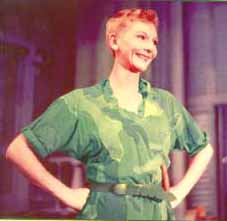
Mary Martin
From Wikipedia, the free encyclopedia
Birth name Mary Virginia Martin
Born December 1, 1913
Weatherford, Texas
Died November 3, 1990 (aged 76)
Rancho Mirage, California
Spouse(s) Ben Hageman (1929-1936)
Richard Halliday (1940-1973)
Children Larry Hagman (b.1931)
Heller Halliday
[show]Awards
Emmy Awards
Outstanding Lead Actress - Miniseries/Movie
1955 Producers' Showcase
Tony Awards
Best Leading Actress in a Musical
1950 South Pacific
1955 Peter Pan
1960 The Sound of Music
Mary Virginia Martin (December 1, 1913, Weatherford, Texas - November 3, 1990, Laguna Beach, California) was a Tony Award winning American star of (mainly stage) musicals. Among the roles she originated were Nellie Forbush in South Pacific and Maria in The Sound of Music. She was also a Kennedy Center Honoree in 1989.
Early life
Her life as a child, as Martin describes it in her autobiography My Heart Belongs, was secure and happy. She had close relationships with both her mother and father, as well as her siblings. Her autobiography details how the young actress had an instinctive ear for recreating musical sounds.
Martin's father, Preston Martin, was a lawyer and her mother, Juanita Presley, was a violin teacher. Although the doctors told Juanita that she would risk her life if she attempted to have another baby, she was determined to have a boy. Instead, she had Mary, who became quite a tomboy. Mary's birth was an event as all of the neighbors gathered around Juanita's bedroom window, waiting for the raising of a curtain to signal the baby's arrival. "It must have been a good omen?-curtains have been going up for me ever since" (p. 16).
Her family had a barn and orchard that kept her entertained. She played with her older sister Geraldine (whom she calls "Sister"), climbing trees and riding ponies. Martin adored her father. "He was a tall, good-looking, silver-haired, with the kindest brown eyes. Mother was the disciplinarian, but it was Daddy who could turn me into an angel with just one look" (p. 19). Martin, who said "I'd never understand the law" (p. 19), began singing outside the courtroom where her father worked every Saturday night at a bandstand where the town band played. She sang in a trio of little girls dressed in bellhop uniforms. "Even in those days without microphones, my high piping voice carried all over the square. I have always thought that I inherited my carrying voice from my father" (p. 19).
She went to a voice teacher who thought she was too young but gave in because she never stopped singing. She remembered having a photographic memory as a child, making it easy to memorize songs, as well as get her through school tests. She got her first taste of singing solo at a fire hall, where she soaked up the crowd's appreciation. "Sometimes I think that I cheated my own family and my closest friends by giving to audiences so much of the love I might have kept for them. But that's the way I was made; I truly don't think I could help it" (p. 20). Martin's craft was developed by seeing movies and becoming a mimic. She'd win prizes for looking, acting and dancing like Ruby Keeler and singing exactly like Bing Crosby. "Never, never, never can I say I had a frustrating childhood. It was all joy. Mother used to say she never had seen such a happy child?-that I awakened each morning with a smile. I don't remember that, but I do remember that I never wanted to go to bed, to go to sleep, for fear I'd miss something" (p. 20).
As she grew older, Martin dated Benjamin Jackson Hageman while in high school, before being sent to the Ward-Belmont finishing school in Nashville, Tennessee. Besides imitating Fanny Brice at singing gigs, she thought school was dull and felt confined by the strict rules. She was homesick for Weatherford, her family and Hageman. During a visit, Mary and Benjamin convinced Mary's mother to allow them to marry. They did, and by the age of 17, Martin was legally married, pregnant with her first child (Larry Hagman) and forced to leave finishing school. However she was happy to begin her new life. She soon learned that this life was nothing but "role playing" (p. 39).
Their honeymoon was at her parent's house, and Martin's dream of life with a family and a white-picket fence faded. "I was 17, a married woman without real responsibilities, miserable about my mixed-up emotions, afraid there was something awfully wrong with me because I didn't enjoy being a wife. Worst of all, I didn't have enough to do" (p. 39). It was "Sister" who came to her rescue, suggesting that she should teach dance. "Sister" taught Martin her first real dance?-the waltz clog. Martin perfectly imitated her first dance move, and she opened a dance studio. Here, she created her own moves, imitated the famous dancers she watched in the movies, and taught "Sister's" waltz clog. "I was doing something I wanted to do?-creating" (p. 44).
Wanting to learn more moves, Martin went to California to attend a dance school, and opened her own dance studio in Mineral Wells. She was given a ballroom studio under a certain deal?-she had to sing in the lobby every Saturday. Here, she learned how to sing in a microphone and how to phrase blues songs. One day at work, she accidentally walked into the wrong room where auditions were being held. They asked her what key she'd like to sing "So Red Rose". Having absolutely no idea what her key was, she sang regardless and got the job. She was hired to sing "So Red Rose" at the Fox Theater in San Francisco, followed by the Paramount Theater in Los Angeles. There would be one catch ?- she had to sing in the wings. She scored her first professional gig, unaware that she would soon be center stage.
Soon after, Martin learned that her studio had been burnt down by a man who thought dancing was a sin.[citation needed] She began to express her unhappiness ?- she needed to let go and be free. Her father gave her advice, saying that she was too young to be married. Martin, leaving behind everything, including her young son, Larry, and went to Hollywood while her father handled the divorce for her. In Hollywood, Martin plunged herself into auditions?-so many that she became known as "Audition Mary". Her first professional audition and job was on a national radio network. She sang on a program called "Gateway to Hollywood" and was told that her job was "sustaining". Little did she know that "sustaining" meant unpaid.[citation needed] Among one of Martin's first auditions in Hollywood, she was "determined to give them everything I could do", before announcing her intention to sing "in my soprano voice, a song you probably don't know, Indian Love Call". After singing the song, "a tall, craggly man who looked like a mountain" told Martin that he thought she had something special. He added, "Oh, and by the way, I know that song. I wrote it." It was Oscar Hammerstein II (pp. 58-59). This marked the start of her career.
All quotes taken from Martin's autobiography, Mary Martin: My Heart Belongs
Career
Mary Martin struggled for nearly two years to break into show business. As a struggling young actress, Martin endured humorous and sometimes frightful luck trying to make it in the world, from car crashes leading to vocal instruction, unknowingly singing in front of Oscar Hammerstein II, to her final break on Broadway granted by the very prominent producer, Lawrence Schwab.
Using her maiden name, Mary Martin began pursuing a performing career singing on radio in Dallas and in nightclubs in Los Angeles. Her performance at one club impressed a theatrical producer, and he cast her in a play in New York. That production did not open, but she got a role in Cole Porter's Leave It to Me!. In that production, she became popular on Broadway and received attention in the national media singing "My Heart Belongs to Daddy".
"My Heart Belongs to Daddy" catapulted her career and became very special to Mary ?- she even sang it to her ailing father in his hospital bed while he was in a coma. Martin did not learn immediately that her father had died. Headlines read "Daddy Girl Sings About Daddy as Daddy Dies". Due to the show's demanding schedule, Martin couldn't even attend her father's funeral.
She received the Donaldson Award and the New York Film Critics Circle Award in 1943 for One Touch of Venus. In 1955 and 1956, she received, first, a Tony for Peter Pan, and then an Emmy for appearing in the same role on television. She also received Tony Awards for South Pacific, and, in 1959, for The Sound of Music.
Although she did a few films early in her career, she was generally passed over for the filmed version of the musical plays in which she starred. She herself once explained that she did not enjoy making films, because she did not have the "connection" with an audience that she had in live performances. The closest she ever came to preserving her stage performances were her famous television appearances as Peter Pan (she had starred in a musical version on Broadway in 1954, and this production was subsequently performed on NBC television in RCA's compatible color in 1955, 1956 and 1960). While Mary Martin did not enjoy making theatrical films, she did apparently enjoy appearing on television, as she did frequently.
She died, aged 76, from colorectal cancer in California in 1990.
Marriages, relationships
Her first husband was Ben Hageman, a lawyer; they divorced in 1936. Their son is actor Larry Hagman, who once appeared with his mother in South Pacific as a member of the chorus.
She married a second time in 1940 to Richard Halliday, and they had a daughter, Heller Halliday, who is Larry's half-sister.
It has been reported that she was in a longtime relationship with actress Janet Gaynor. At some point, her ex-husband, Ben Hageman, stated that his ex-wife was having an affair with Gaynor.[citation needed]Though Martin denied the story, speculation on the gossip circuit continued. The speculation was overshadowed by the horrified reaction of entertainment industry workers in 1982 when a 36-year-old drunken driver named Robert Cato ran a red light in San Francisco and crashed into a taxi whose passengers were Martin, Ben Washer, described by the Los Angeles Times as her longtime confidant and business associate, Gaynor and her husband, Paul Gregory. Washer was killed instantly. Gaynor's injuries were critical and proved to cause her death two years later.
Trivia
She was an avid needlework enthusiast, who created a substantial volume of work including rugs, chairs, pillows, dresses, pocket books, samplers and framed pieces. In 1969, she released a book titled "Mary Martin's Needlepoint" that included numerous photos of her petit point and cross stich work. Martin, who created all of her own patterns, provided extensive needlework tips in the book.
By the time that the film version of South Pacific was made (1958), Martin was rejected for the film role by producer Joshua Logan and the part went to the much younger Mitzi Gaynor. Martin was reportedly bitterly disappointed.
The New Pornographers, a Canadian band, paid tribute to Mary Martin in their song, The Mary Martin Show.
Martin dubbed Margaret Sullavan's singing voice in the 1938 film The Shopworn Angel.
Matt Monro
From Wikipedia, the free encyclopedia
Background information
Birth name Terence Edward Parsons
Born 1 December 1930
Shoreditch, London, England
Died 7 February 1985 (aged 54)
Cromwell Hospital, London, England
Occupation(s) Singer
Years active 1956 ?- 1985
Label(s) Decca, Parlophone, Capitol, Columbia
Website
http://www.mattmonro.com/
Matt Monro (1 December 1930, Shoreditch, London - 7 February 1985, Ealing) was an English ballad singer of the 1960s and one of the international post-World War II entertainers. Throughout his 30-year career, he filled cabarets, nightclubs, music halls and stadiums, from Australia, Japan, the Philippines, and Hong Kong to Africa, the Middle East, Europe, and the Americas. He sold more than 100 million records during his lifetime.[citation needed]
Early career
He was born Terence Edward Parsons in Shoreditch, London [1]. Affectionately nicknamed "the singing bus driver" (because one of his many occupations prior to achieving fame was driving the Number 27 bus from Highgate to Teddington), he got his first break in 1956 when he became a featured vocalist with the BBC Show Band. An important influence on his early career was the pianist Winifred Atwell, who became his mentor, provided him with his stage name, and helped him sign with Decca Records.
In 1957 Monro released Blue and Sentimental, a collection of standards. Despite the album's critical acclaim, Monro languished among the young male singers trying to break through at the end of the 1950s, many of them emulating Frankie Vaughan by recording cover versions of American hits. For example, Monro recorded his version of "Garden of Eden". A short recording contract with Fontana Records followed.
By the end of the 1950s, Monro's mid-decade fame had evaporated, and he returned to relative obscurity. He and his wife Mickie lived from her wages as a song plugger and his royalties from a TV advertising jingle for Camay soap. In 1959 he recorded a country pastiche song, "Bound for Texas", for The Chaplin Revue, a feature-length film released by Charlie Chaplin, compiling three of his old First National shorts. It would be the first of many Monro soundtrack themes.
International success
In 1960, George Martin was looking for a singer to record a Frank Sinatra styled ditty that would open the album, Songs For Swinging Sellers, to be used strictly as a guide for Peter Sellers to imitate. Martin offered it to Monro, and when Sellers heard the recording he decided to use it, but billed Monro as "Fred Flange". Though it was a demoralizing experience at the time, the incident developed into a lifelong friendship with Martin, who subsequently asked Monro to begin recording with him for EMI's Parlophone record label. Their second single, "Portrait of My Love", reached number two in the UK Singles Chart.
The following year, he was named Top International Act by Billboard magazine. His follow-up hits included "My Kind of Girl" (1961), "Softly as I Leave You" (1962) and the secondary title song from the James Bond film, From Russia with Love (1963). In 1964, he represented the United Kingdom at the Eurovision Song Contest, singing "I Love the Little Things". He finished second behind Italy's 16-year-old Gigliola Cinquetti), despite what author and historian John Kennedy O'Connor describes in his book The Eurovision Song Contest - The Official History as an "excellent performance of the only English language song of the night".[2]. The Austrian entry "Warum Nur Warum" caught Monro's ear, despite finishing in sixth place, as he recorded the English version "Walk Away", earning him another hit single. He also had a hit with the The Beatles' "Yesterday" in 1965, releasing the first UK version of the most recorded song of all time. The following year Monro sang the Oscar winning title song for the film, Born Free, which became his signature tune. Plus the opening scene for the film, The Italian Job, featured Monro singing "On Days Like These".
Monro achieved fame in the U.S. when "My Kind of Girl" (1961) and "Walk Away" (1964) hit the Top 40. In 1966, following the death of Nat King Cole, EMI moved Monro from Parlophone to Capitol. After relocating to California and recording several albums with American arrangers, Monro returned to the UK and began appearing on EMI's Columbia label, his final U.S. album release being Close To You in 1970.
He continued touring and recording until just before his death, releasing a single and promoting it throughout the UK and Australia in 1984. In one of his final appearances he praised Boy George, noting the importance of quality recordings in all musical genres.[citation needed]
Death and legacy
Monro died from liver cancer in 1985 at the Cromwell Hospital, London [3], leaving a widow, Mickie, and three children: Mitchell, Michele, and Matthew. Mitchell, a professional pilot, died of a heart attack in 2004.
The twentieth anniversary of Monro's passing spotlighted the continuing interest in his music, with a Top 10 tribute compilation CD (UK), a No. 1 concert DVD (UK), a BBC TV documentary, and an official website [4] all appearing in 2005. A 2007 compilation CD entitled From Matt With Love reached the Top 40 of the UK Albums Chart during its first week of release.
In Autumn 2005 Matt Monro Jr. toured the United Kingdom with a tribute concert commemorating the anniversary. Also, EMI re-released Matt Sings Monro, a 1995 duet album that combined his voice with the senior Monro's. Another posthumous Matt Monro duet, with Cliff Richard, appeared on Richard's duets CD, Two's Company, in 2007.
In recent years, many singers riding the resurging wave of retro-pop have cited Matt Monro as a strong influence, including Michael Buble, Monica Mancini and Rick Astley.[citation needed] Musicians' biographies regularly note his stylistic influence on their subjects, including Cass Elliot and Karen Carpenter.[citation needed]
His music
Most of Monro's recordings were produced or overseen by George Martin. Unlike his contemporaries, Monro sang very few of the Tin Pan Alley standards. Instead, he and Martin searched for material written by promising newcomers and commissioned English lyrics for melodies by European composers. He also covered many of the most popular stage and screen songs of the 1950s and 1960s. Over the years, his recordings featured arrangements by Johnnie Spence, Sid Feller, Billy May, John Barry, Buddy Bregman, Kenny Clayton, Colin Keyes, and Martin himself. Monro also teamed up with Nelson Riddle and Billy May for BBC concerts.
Marriages
He was married twice:
Iris 1953 (divorced); one son Mitchell
Mickie Schuller 1959-1985; one daughter Michele and one son Matthew
Woody Allen
From Wikipedia, the free encyclopedia
Birth name Allen Stewart Königsberg
Born December 1, 1935 (1935-12-01) (age 72)
Brooklyn, New York, U.S.
Years active 1950 - present
Spouse(s) Harlene Rosen (1956-1962)
Louise Lasser (1966-1969)
Soon-Yi Previn (1997-)
Partner(s) Mia Farrow (1980-1992)
Children Ronan Seamus Farrow
Parents Martin Konigsberg (1900-2001)
Nettie Cherry (1906-2002)
Influences Ingmar Bergman, Groucho Marx, Federico Fellini, Cole Porter, Anton Chekhov
[show]Awards
Academy Awards
Best Director
1977 Annie Hall
Best Original Screenplay
1977 Annie Hall
1986 Hannah and Her Sisters
BAFTA Awards
Best Direction
1977 Annie Hall
1986 Hannah and Her Sisters
Best Film
1985 The Purple Rose of Cairo
Best Screenplay
1977 Annie Hall
1979 Manhattan
Best Original Screenplay
1985 The Purple Rose of Cairo
1986 Hannah and Her Sisters
1992 Husbands and Wives
César Awards
Best Foreign Film
1980 Manhattan
1986 The Purple Rose of Cairo
Golden Globe Awards
Best Screenplay
1985 The Purple Rose of Cairo
Goya Awards
Best European Film
2006 Match Point
Woody Allen (born Allen Stewart Königsberg on December 1, 1935) is a three-time Academy Award-winning American film director, writer, actor, jazz musician, comedian, and playwright. His large body of work and cerebral film style, mixing satire, wit and humor, have made him one of the most respected and prolific filmmakers in the modern era.[1] Allen writes and directs his movies and has also acted in the majority of them. For inspiration, Allen draws heavily on literature, philosophy, psychology, Judaism, European cinema and New York City, where he was born and has lived his entire life.
Early years
Allen was born and raised in New York City to a Jewish family; his grandparents were Yiddish and German-speaking immigrants.[2] His parents, Martin Königsberg (born on December 25, 1900 in New York; died on January 13, 2001) and Nettea Cherrie (born in 1908 in New York; died in January 2002), and his sister, Letty (born 1943), lived in Midwood, Brooklyn.[3] His parents were both born and raised on the Lower East Side of Manhattan.[2] His mother worked as a bookkeeper at her family's business.[2] Allen spoke Yiddish during his early years and, after attending Hebrew school for eight years, went to Public School 99 and to Midwood High School. During that time, he lived in part on Avenue K, between East 14th and 15th Streets. Nicknamed "Red" because of his red hair, he impressed students with his extraordinary talent at card and magic tricks.[4] Though in his films and his comedy persona he has often depicted himself as physically inept and socially unpopular, in fact Woody Allen was a popular student, and an adept baseball and basketball player.
To raise money he began writing gags for the agent David O. Alber, who sold them to newspaper columnists. According to Allen, his first published joke "was in a gossip column. It read: 'Woody Allen says he ate at a restaurant that had O.P.S. prices?-over people's salaries.'"[5]
At sixteen, he started writing for stars like Sid Caesar and began calling himself Woody Allen, which would remain his moniker (although it's unclear if Allen ever legally adopted the stage name). He was a gifted comedian from an early age and would later joke that when he was young he was often sent to inter-faith summer camps, where he "was savagely beaten by children of all races and creeds".[4]
After high school, he went to New York University where he studied communication and film, but, never committed as a student, he was thrown off his course[6] due to lack of punctuality and commitment. He later briefly attended City College of New York.
Comedy writer and playwright
After his false starts at NYU and City College, he became a full-time writer for Herb Shriner, earning $75/week at first.[5] At age 19, he started writing scripts for The Ed Sullivan Show, The Tonight Show, Caesar's Hour and other television shows.[7] By the time he was working for Sid Caesar, he was making $1500/week;[5] with Caesar he worked alongside Danny Simon, whom Allen credits [3] for helping him to structure his writing style.
In 1961, he started a new career as a stand-up comedian, debuting in a Greenwich Village club called the Duplex.[5] He contributed sketches to the Broadway revue From A to Z, and began writing for the popular Candid Camera television show, even appearing in some episodes. Together with his managers, Allen turned his weaknesses into his strengths, developing his neurotic, nervous, and intellectual persona. He quickly became a successful comedian, and appeared frequently in nightclubs and on television. Allen was popular enough to appear on the cover of Life in 1969 when Play It Again, Sam opened on Broadway.
Allen started writing short stories for magazines (most notably The New Yorker) as well as plays, the best known of which are the Broadway productions Don't Drink the Water (1966) and Play It Again, Sam (1969).[8]
Examples of Allen's standup act can be heard on the albums Standup Comic and Nightclub Years 1964-1968.
Film career
Early films
His first movie production was What's New, Pussycat? in 1965, for which he wrote the initial screenplay. He was hired by Warren Beatty to re-write a script, and to appear in a small part. Over the course of the re-write, Beatty's part grew smaller and Allen's grew larger. Beatty was upset and quit the production. Peter O'Toole was hired for the Beatty role, and Peter Sellers was brought in as well; Sellers was a big enough star to demand many of Woody Allen's best lines/scenes, prompting hasty re-writes. This experience with meddling producers, egotistical stars, and directors ruining jokes, along with a similar experience on the James Bond spoof Casino Royale (for which he did uncredited rewrites of his own scenes), led Allen to decide that the only way filmmaking was worthwhile was if he was in control of the film.
Allen's first directorial effort was What's Up, Tiger Lily? (1966), in which an existing Japanese spy movie was redubbed in English by Allen and his friends with completely new, comic dialogue.
1960s and 1970s
His first conventional effort was Take the Money and Run (1969), which was followed by Bananas, Everything You Always Wanted To Know About Sex (But Were Afraid to Ask), Sleeper, and Love and Death.
In 1972, he also starred in the film version of Play It Again, Sam, which was directed by Herbert Ross. All of Allen's early films were pure comedies that relied heavily on slapstick, inventive sight gags, and non-stop one-liners. Among the many notable influences on these films are Bob Hope, Groucho Marx (as well as, to some extent, Harpo Marx) and Humphrey Bogart. In 1976, he starred in, but did not direct, The Front (that task was handled by Martin Ritt), a humorous and poignant account of Hollywood blacklisting during the 1950s.
Annie Hall marked a major turn to more sophisticated humor and thoughtful drama. Allen's 1977 film won four Academy Awards, including Best Picture - an unusual feat for a comedy. Annie Hall set the standard for modern romantic comedy, and also started a minor fashion trend with the unique clothes worn by Diane Keaton in the film (the offbeat, masculine clothing, such as ties with cardigans, was actually Keaton's own). While in production, its working title was "Anhedonia," a term that means the inability to feel pleasure, and its plot revolved around a murder mystery. Apparently, as filmed, the murder mystery plot did not work (and was later used in his 1993 Manhattan Murder Mystery), so Allen re-edited and re-cut the movie after production ended to focus on the romantic comedy between Allen's character, Alvy Singer, and Keaton's character, Annie Hall. The new version, retitled Annie Hall (named after Keaton's grandmother), still deals with the theme of the inability to feel pleasure. Ranked at No. 35 on the American Film Institute' s "100 Best Movies" and at No. 4 on the AFI list of "100 Best Comedies," Annie Hall is considered to be among Allen's best.
Manhattan, released in 1979, is a black-and-white film that can be viewed as an homage to New York City, which has been described as the true "main character" of the movie.[citation needed] As in many other Allen films, the main characters are upper-class academics, literati, and occasional twits. Even though it makes fun of pretentious intellectuals, the story is packed with obscure references that makes it less accessible to a general audience. The love-hate opinion of cerebral persons found in Manhattan is characteristic of many of Allen's movies including Crimes and Misdemeanors and Annie Hall. Manhattan focuses on the complicated relationship between a middle-aged Isaac Davis (Allen) and a seventeen-year-old Tracy (Mariel Hemingway) - which presages Allen's complicated personal relationship with Soon-Yi Previn.[citation needed]
Between Annie Hall and Manhattan Allen wrote and directed the gloomy drama Interiors (1978), in the style of the late Swedish director Ingmar Bergman, one of Allen's major influences. Interiors is considered by critics as a significant breakthrough past Allen's "earlier, funnier comedies" (a line from 1980s Stardust Memories).
1980s
Allen's 1980s films, even the comedies, have somber and philosophical undertones. Some, like September and Stardust Memories, are often said to be heavily influenced by the works of European directors, most notably Ingmar Bergman and Federico Fellini.
Stardust Memories features a main character, a successful filmmaker played by Allen, who expresses resentment and scorn for his fans. Overcome by the recent death of a friend from illness, the character states, "I don't want to make funny movies any more," and a running gag throughout the film has various people (including a group of visiting space aliens) telling Bates that they appreciate his work, "especially the early, funny ones".[9]
However, by the mid-1980s, Allen had begun to combine tragic and comic elements with the release of such films as Hannah and Her Sisters (winner of three Academy Awards) starring British actor Michael Caine, and Crimes and Misdemeanors, in which he tells two different stories that connect at the end. He also produced a vividly idiosyncratic tragi-comical parody of documentary, titled Zelig.
He also made three films about show business. The first movie is Broadway Danny Rose, in which he plays a New York manager; then, The Purple Rose of Cairo, a movie that shows the importance of the cinema during the Depression through the character of the naive Cecilia. Lastly, Allen made Radio Days, which is a film about his childhood in Brooklyn, and the importance of the radio. Purple Rose was named by Time Magazine as one of the 100 best films of all time, and Allen has described it as one of his three best films, along with Stardust Memories and Match Point.[10] (It is worth noting that Allen defines them as "best" not in terms of quality, but because they came out the closest to his original vision.)
Before the end of the eighties he made other movies that were strongly inspired by Ingmar Bergman's films. September is a remake of Autumn Sonata, and Allen uses many elements from Persona[citation needed] in Another Woman.
1990s
His 1992 film Shadows and Fog (1992) is a black and white homage to German expressionists and features the music of Kurt Weill. Allen then made his critically acclaimed drama Husbands and Wives (1992) which received two oscar nominations; Best Supporting Actress for Judy Davis and Best Original Screenplay for Allen. His film Manhattan Murder Mystery (1993) combined suspense with dark comedy, and starred Diane Keaton, Alan Alda and Anjelica Huston.
In the late 1990s he returned to lighter movies, such as Bullets Over Broadway (1994), which earned him an Academy Award nomination for Best Director followed by a musical Everyone Says I Love You (1996): Allen's first and only to date. The singing and dancing scenes in Everyone Says I Love You are similar to the musical starring Fred Astaire and Ginger Rogers, but the plot is comical. The comedy Mighty Aphrodite (1995), in which the Greek and Roman tragedies play a large role, won an Academy Award for Mira Sorvino. Allen's 1999 jazz mockumentary Sweet and Lowdown was also nominated for two Academy Awards for Sean Penn (Best Actor) and Samantha Morton (Best Supporting Actress). In contrast to these lighter movies, Allen veered scathingly dark and satirical towards the end of the 1990s with Deconstructing Harry (1997) and Celebrity (1998). Allen made his only sitcom "appearance" via telephone in the 1997 episode, "My Dinner with Woody" of the show Just Shoot Me!, an episode paying tribute to several of his films.
2000s
Small Time Crooks (2000) was his first film with DreamWorks SKG studio and represented a change in direction: Allen began giving more interviews and made an apparent return to his strictly comedy roots. Small Time Crooks was a relative success, grossing over $17 million domestically, but Allen's next 4 films floundered at the box office, including Allen's most expensive film to date, The Curse of the Jade Scorpion (with a budget of $33 million). Hollywood Ending, Anything Else, and Melinda and Melinda were given "rotten" ratings[11] from film-review website Rotten Tomatoes and each earned less than $5 million domestically. Most critics agreed that Allen's films since 1999's Sweet and Lowdown were subpar, and some critics expressed concern that Allen's best years were now behind him.[12]
Match Point (2005) was one of Allen's most successful films in the past ten years and generally received very positive reviews. Set in London, it starred Jonathan Rhys-Meyers and Scarlett Johansson. It is also markedly darker than Allen's first four films under the DreamWorks SKG banner. Match Point earned more than $23 million domestically (more than any of his films in nearly 20 years)[13] and earned over $62 million in international box office sales.[14] Match Point earned Allen his first Academy Award nomination since 1998 for Best Writing, Original Screenplay and directing and writing nominations at the Golden Globes, his first Globe nominations since 1987. In an interview with Premiere Magazine, Allen stated this was the best film he has ever made.
Allen returned to London to film Scoop, which also starred Johansson, as well as Hugh Jackman, Ian McShane, Kevin McNally. The film was released on July 28, 2006, and received mixed reviews. He has also filmed Cassandra's Dream in London. Cassandra's Dream stars Colin Farrell, Ewan McGregor, and Tom Wilkinson and is expected to be released in November 2007.
After finishing his third London film, Allen headed to Spain. He reached an agreement to film his current project in Barcelona, where shooting started on July 9 2007. The movie will star international and Spanish actors and actresses, including Scarlett Johansson, Javier Bardem, Patricia Clarkson, and Penélope Cruz.[15][16]
Allen has said that he "survives" on the European market. Audiences there have tended to be more receptive to Allen's films, particularly France, a country where he has a large fan base (something joked about in Hollywood Ending). "In the United States things have changed a lot, and it's hard to make good small films now," Allen said in a 2004 interview. "The avaricious studios couldn't care less about good films - if they get a good film they're twice as happy, but money-making films are their goal. They only want these $100 million pictures that make $500 million".[17]
It has been rumored he will write/direct a segment for the upcoming film New York, I Love You
"Woody Allen" character
Allen continues to write roles for the neurotic persona he created in the 1960s and 1970s; however, as he gets older, the roles have been assumed by other actors such as John Cusack (Bullets Over Broadway), Kenneth Branagh (Celebrity), Jason Biggs (Anything Else), and Will Ferrell (Melinda and Melinda).
Awards, nominations and distinctions
Over the course of his career Allen has received a considerable number of awards and distinctions in film festivals and yearly national film awards ceremonies, saluting his work as a director, screenwriter and actor.[7] When premiering his films at festivals, Allen does not screen his motion pictures in competition, thus deliberately taking them out of consideration for potential awards.
Allen's film Annie Hall won four Academy Awards in 1977, including best picture.
Allen won the 1978 O. Henry Award for his short story "The Kugelmass Episode" published in The New Yorker on May 2, 1977.
Allen twice won the César Award for Best Foreign Film, the first in 1980 for Manhattan and the second in 1986 for The Purple Rose of Cairo. Seven other of his movies were nominated for the prize.
In 1986, Allen won the Golden Globe for Best Screenplay for The Purple Rose of Cairo. He was also nominated four times as Best Director, four times for Best Screenplay and twice for Best Actor (Comedy/musical).
At the 1995 Venice Film Festival, Allen received a Career Golden Lion for lifetime achievement.
In 1996, Allen received a lifetime achievement award from the Directors Guild of America.
In 2002 Allen won the Prince of Asturias Award. Subsequently, the city of Oviedo, Spain erected a life-size statue of Allen.[18]
In 2002, Allen received the Palme des Palmes, a special lifetime achievement award granted by the Cannes Festival and whose sole other recipient is Ingmar Bergman.[19]
In a 2005 poll The Comedian's Comedian, Allen was voted the third greatest comedy act ever by fellow comedians and comedy insiders.
In June 2007 Allen received a PhD Honoris Causa from Pompeu Fabra University (Barcelona, Spain).
Academy Awards
Woody Allen has won three Academy Awards and been nominated a total of 21 times: fourteen as a screenwriter, six as a director, and one as an actor. He has more screenwriting Academy Award nominations than any other writer. All are in the "Best Original Screenplay" category. He is tied for fifth all-time with six Best Director nominations. His actors have regularly received both nominations and Academy Awards for their work in Allen films, particularly in the Best Supporting categories.
Annie Hall won four Academy Awards (Best Picture, Best Screenplay, Best Director and Best Actress). The film received a fifth nomination, for Allen as Best Actor. Hannah and Her Sisters won three, for Best Screenplay and both Best Supporting Actor categories; it was nominated in four other categories, including Best Picture and Best Director.
Despite friendly recognition from the Academy, Allen has consistently refused to attend the ceremony or acknowledge his Oscar wins. He broke this rule only once: at the 2002 Oscars Allen made an unannounced appearance, making a plea for producers to continue filming their movies in New York City after the 9-11 attacks.[20] He was given a standing ovation before introducing a montage of movie clips featuring New York.
Title sequences
Virtually all of Allen's films since Annie Hall begin with the same style of title sequence, incorporating a series of black and white title cards in a vintage font (most often Windsor) reminiscent of silent era films, set to a selection of jazz music that occasionally figures prominently later in the film's story (e.g., Radio Days). Additionally, the cast is placed on one such title card and listed in alphabetical order, and not in the order of the relative "star power" of the actors at the time in which the film was made. This too, is reminiscent of silent era films. There is one minor variation in Deconstructing Harry, where the titles are weaved in with a looped shot. Another exception to this is Manhattan, which opens with a series of black and white still shots of the city set to Gershwin's "Rhapsody In Blue"; the film's title comes after the opening narration is over.
Relationships
Harlene Rosen
At age 19, Allen married 16-year-old Harlene Rosen.[5] The marriage lasted five "nettling, unsettling years."[5]
Rosen, whom Allen referred to in his standup act as "the Dread Mrs. Allen," later sued Allen for defamation due to comments at a TV appearance shortly after their divorce. Allen tells a different story on his mid-1960s standup album Standup Comic. In his act, Allen said that Rosen sued him because of a joke he made in an interview. Rosen had been sexually assaulted outside her apartment, and according to Allen, the newspapers reported that she "had been violated." In the interview, Allen said, "Knowing my ex-wife, it probably wasn't a moving violation." In a later interview on The Dick Cavett Show, Allen brought the incident up again where he repeated his comments and that the amount that he was being sued for was "$1 million".
Louise Lasser
Allen married Louise Lasser in 1966. Lasser would go on to co-star with Allen in Take the Money and Run, in what began a pattern of romantic involvement with his leading ladies. Allen and Lasser divorced in 1969 and Allen did not marry again until 1997. Lasser starred in three Allen films after the divorce, Bananas, Everything You Always Wanted to Know About Sex (But Were Afraid to Ask), as well as a brief appearance in Stardust Memories. Allen is alleged to have loosely based aspects of the "Harriet Harman" character from Husbands and Wives (the "kamikaze woman") on his relationship with Lasser.[citation needed]
Diane Keaton
In 1970, Allen cast Diane Keaton in his Broadway play Play It Again, Sam, which had a successful run. During this time she became romantically involved with Allen and appeared in a number of his films, including Annie Hall. Keaton starred in Play It Again, Sam as Tony Roberts's lover. Although Allen and Keaton broke up after a year, she starred in a number of his films after their relationship had ended including Sleeper as a futuristic poet; and in Love and Death as a female character from any Russian novel by Tolstoy or Dostoevsky. Annie Hall was very important in Allen and Keaton's careers. Not only that, but it is said that the role was written especially for her, and even the title speaks to this as Diane Keaton's given name is Diane Hall. She then starred in Interiors as a poet again, followed by Manhattan. Later, she had a cameo in Radio Days, and later, she starred in Manhattan Murder Mystery, because Allen wanted to do it when he did Annie Hall. She has not worked with Allen since Manhattan Murder Mystery, although they are good friends.
Stacey Nelkin
The film Manhattan is said to have been based on his romantic relationship with Nelkin. Her bit part in Annie Hall ended up on the cutting room floor, and their relationship, though never publicly acknowledged by Allen, reportedly began when she was seventeen years old and a student at New York's Stuyvesant High School.[citation needed]
Mia Farrow
Starting around 1980, Allen began a 12-year relationship with actress Mia Farrow, who had leading roles in several of his movies from 1982 to 1992. Farrow and Allen never married, but they adopted two children together: Dylan Farrow (who changed her name to Eliza and is now known as Malone) and Moses Farrow (now known as Misha); and had one biological child, Satchel Farrow (now known as Ronan Seamus Farrow). Allen did not adopt any of Farrow's other biological and adopted children, including Soon-Yi Farrow Previn (the adopted daughter of Farrow and Andre Previn, now known as Soon-Yi Previn). Allen and Farrow separated in 1992 after Farrow discovered nude photographs Allen had taken of Previn. In her autobiography, What Falls Away (New York: Doubleday, 1997), Farrow says Allen admitted to a relationship with Previn.
After Allen and Farrow separated, a long public legal battle for the custody of their three children began. During the proceedings, Farrow alleged that Allen had sexually molested their adopted daughter Malone, who was then seven years old. The judge eventually concluded that the sex abuse charges were inconclusive,[21] but called Allen's conduct with Malone "grossly inappropriate". She called the report of the team that investigated the issue "sanitized and, therefore, less credible" and said she had "reservations about the reliability of the report." She also called Allen's conduct with Soon-Yi "inappropriate." Farrow ultimately won the custody battle over their children. Allen was denied visitation rights with Malone and could only see Ronan under supervision. Misha, who was then 14, chose not to see his father.
In a 2005 Vanity Fair interview,[22] Allen estimated that, despite the scandal's damage to his reputation, Farrow's discovery of Allen's attraction to Soon-Yi Previn, by accidentally finding nude photographs of her, was "just one of the fortuitous events, one of the great pieces of luck in my life. [...] It was a turning point for the better." Of his relationship with Farrow, he said "I'm sure there are things that I might have done differently. [...] Probably in retrospect I should have bowed out of that relationship much earlier than I did."
Soon-Yi Previn
Shortly after separating from Farrow in 1992, Allen openly continued his relationship with Soon-Yi Previn, Farrow's adopted daughter. Even though Allen and Previn denied he was ever her stepfather, the relationship drew much public and media scrutiny. At the time, Allen was 57 and Previn was 22.
Allen and Previn married in 1997. The couple later adopted two daughters, naming them Bechet and Manzie after jazz musicians Sidney Bechet and Manzie Johnson.
Clarinet hobby
Allen is a passionate fan of jazz which is often featured prominently in his movies' soundtracks. He has played the clarinet since adolescence and chose his stage name from an idol, famed clarinetist Woody Herman. He has performed publicly at least since the late-1960s, notably with the Preservation Hall Jazz Band on the soundtrack of Sleeper. One of his earliest televised performances was on The Dick Cavett Show on October 20, 1971.
Woody Allen and his New Orleans Jazz Band[23] play every Monday evening at Manhattan's Carlyle Hotel, specializing in classic New Orleans jazz from the early twentieth century. The documentary film Wild Man Blues (directed by Barbara Kopple) documents a 1996 European tour by Allen and his band, as well as his relationship with Previn. The band has released two CDs: The Bunk Project (1993) and the soundtrack of Wild Man Blues (1997).
Work about or inspired by Woody Allen
Apart from Wild Man Blues directed by Barbara Kopple, there are a number of other documentaries featuring Woody Allen, including: the 2002 cable-television documentary Woody Allen: a Life in Film, directed by Time Magazine film critic Richard Schickel, which interlaces interviews of Allen with clips of his films; and Meetin' WA, a short interview of Allen by renowned French director Jean-Luc Godard.
Waiting for Woody Allen is a 2004 short film parody of Samuel Beckett's "Waiting for Godot." From 1976 to 1984, Stuart Hample wrote and drew Inside Woody Allen, a comic strip based on Allen's film persona. "Central Park West Stories", (Baldini Castoldi Dalai publisher, 2005) by Glauco Della Sciucca (Italian contributor to Columbia Journalism Review, The New Yorker, The Jewish Week, since September 2003) are inspired by Allen. "Death of an Interior Decorator" is a song on Death Cab for Cutie's album Transatlanticism that was inspired by Woody Allen's Interiors.
The character George Costanza, from the sitcom Seinfeld, was originally performed as a caricature of Woody Allen, according to Jason Alexander. In one episode of Seinfeld, Cosmo Kramer talks about being a cast member of Allen's movie project and his famous oneliner "These pretzels are making me thirsty".
In 2003 Keith Black wrote, directed and starred in the award winning film "Get the Script to Woody Allen". The feature was about a neurotic young man who is obsessed with getting his script to Woody.
Psychoanalysis
Allen spent at least 30 years undergoing psychoanalysis, some three days a week. Many of his films contain a psychoanalysis scene. Even the film Antz, a cartoon where he only voices Z, the lead character, begins with a classic piece of Allen analysis schtick.
Moment Magazine says "it drove his self-absorbed work".[24] John Baxter, author of Woody Allen - A Biography, wrote "Like Catholic confession, Allen's form of analysis let the penitent go free to sin again," and that "Allen obviously found analysis stimulating, even exciting."
Allen says he ended his psychotherapy visits around the time he began his relationship with Previn. He says he still is claustrophobic and agoraphobic.[22]
Bette Midler
From Wikipedia, the free encyclopedia
Born December 1, 1945 (1945-12-01) (age 61)
Honolulu, Hawaii
Spouse(s) Martin von Haselberg (1949-)
[show]Awards
Emmy Awards
Outstanding Special - Comedy-Variety or Music
1978 Bette Midler: Ol' Red Hair Is Back
Outstanding Individual Performance - Variety/Music Program
1992 The Tonight Show Starring Johnny Carson
1997 Bette Midler in Concert: Diva Las Vegas
Golden Globe Awards
New Star of the Year in a Motion Picture - Female
1980 The Rose
Best Actress - Motion Picture Musical or Comedy
1980 The Rose
1992 For the Boys
Best Actress - Miniseries
1994 Gypsy
Grammy Awards
Best New Artist (1974)
Record of the Year
1990 Wind Beneath My Wings
Song of the Year
1991 From a Distance
Tony Awards
Special Tony Award (1974)
Bette Davis Midler (born December 1, 1945) is an American singer, actress and comedienne, also known to her fans as The Divine Miss M. She is named after the actress Bette Davis although Davis pronounced her first name in two syllables, and Midler uses one. During her career, she has won four Grammy Awards, an Emmy Award, and a Tony Award, and has been nominated for two Academy Awards. She is currently scheduled to succeed Celine Dion as the headliner at Caesars Palace, beginning February 20, 2008.[1]
Biography
Early life
Midler was born in Honolulu, Hawaii, the daughter of Ruth (née Schindel), a seamstress and housewife, and Fred Midler, a house painter who painted for the Navy while in Hawaii.[2][3] Her parents were from New Jersey and moved to Honolulu shortly before Midler was born. Midler's family was one of the few Jewish families in a mostly Asian neighborhood.[4] She was raised in nearby Aiea and attended Radford High School in Honolulu. She majored in drama at the University of Hawaii (though she only attended for three semesters), and earned money in the film Hawaii (released in 1966) as an extra, playing a seasick passenger.
Career
In 1965, she relocated to New York City after using the money she got for playing an extra, and landed her first professional onstage role in Tom Eyen's Off-Off-Broadway plays in 1965, Miss Nefertiti Regrets and Cinderella Revisited, a children's play by day and an adult show by night.[5] From 1966 to 1969 she played the role of Tzeitel in Fiddler on the Roof on Broadway; during this period her sister Judith, visiting New York to see her perform, was killed by a taxi cab.
In 1970, Midler began singing the Continental Baths, a gay bathhouse in the city, where she became close to her piano accompanist, Barry Manilow, who produced her first major album, The Divine Miss M in 1973.
Despite the way things turned out [with the AIDS crisis], I'm still proud of those days [singing at gay bathhouses]. I feel like I was at the forefront of the gay liberation movement, and I hope I did my part to help it move forward. So, I kind of wear the label of 'Bathhouse Betty' with pride.[6]
?-Bette Midler, Houston Voice
In 1974, she received a Special Tony Award for her contribution to Broadway for her Clams on the Half Shell Revue at the Palace Theater. In 1979 she played the title role of a 1960s drug-addicted rock star, modeled after Janis Joplin, in The Rose, for which she was nominated for the Academy Award for Best Actress. For the period of 1975-1978, she provided the voice of Woody the Spoon on the PBS educational series Vegetable Soup.
In 1985, she was a performer on USA for Africa's fund-raising single We Are the World and participated at the 'Live Aid' event at JFK stadium in Philadelphia. In 1986, she signed a contract with Touchstone Pictures, director Paul Mazursky cast her in Down and Out in Beverly Hills, beginning a successful comedic acting career. She appeared in other popular late-1980s comedies including Ruthless People, Outrageous Fortune, and Big Business. In 1988, she starred in the film drama Beaches. She also contributed her voice to the animated character Georgette, a snobbish poodle, in Disney's Oliver & Company that same year.
She has won four Grammy Awards including the 1973 Best New Artist and the prestigious Record of the Year in 1989 for the # 1 hit "Wind Beneath My Wings", the theme from Beaches. Her rendition of the 1990 "From a Distance" also earned her a Grammy and is another of her most popular songs. When the American Film Institute announced "The 100 years of the Greatest Songs" on June 22, 2004, two of her hits were selected by the board: "Wind Beneath My Wings" (#44) and "The Rose" (#83).
Other films include Scenes from a Mall, For the Boys (for which she was again nominated for an Academy Award), Hocus Pocus, The First Wives Club, and The Stepford Wives. Her television work includes an Emmy-nominated version of the stage musical Gypsy.
Midler won an Emmy Award in 1992 for her memorable performance on the penultimate episode of The Tonight Show in May of that year, during which she sang an emotion-laden "One for My Baby (and One More for the Road)" to Johnny Carson. There was speculation later that there was a falling out between Midler and the only other guest on the show, Robin Williams. It was perceived that Midler had stolen the limelight from Williams. However, the rumors of a feud between them have been denied by both Williams and Midler, and they have since appeared together on several other talk shows, including The Rosie O'Donnell Show in 2003. After her Tonight Show appearance, Midler told USA Today, "It was a great night. Robin and I had a fabulous time, and we'll never forget it."
She had her own short-lived CBS sitcom Bette (2000-2001). Although the initial ratings were high, numbers soon declined and in the show's short lifespan her daughter (played by Lindsay Lohan in the pilot, then by Marina Malota starting with the third episode) and her husband were recast (Robert Hays succeeded Kevin Dunn in the final episode aired). The show was reportedly rocked by backstage turmoil, and did not last a full season. Also in 2001, Bette or Bust, a book chronicling Midler's Divine Miss Millennium Tour was released. After years of declining sales, Bette was officially dropped from Warner Brothers in 2001.
After a long-standing feud with Barry Manilow, the two joined forces for the first time in twenty years in 2003 to record "Bette Midler Sings the Rosemary Clooney Songbook." Of the project, Barry said he had a dream that he was recording with Bette again, so he called her up with the idea and she agreed that it was due time to work together again. They got Columbia Records on board and the album was an instant success, going gold in only a few short weeks. The album was one of her best-selling albums in 20 years, and was nominated for a Grammy the following year.
In 2003-2004 Midler toured her new show Kiss My Brass to sell-out crowds around the United States. In early 2005, Kiss My Brass was equally successful in Australia. After the success of her last album, Columbia Records considered releasing a live album, but it never came to pass. Instead, Bette joined forces again with Barry Manilow for another tribute album, Bette Midler Sings the Peggy Lee Songbook. Released in October 2005, the album sold 55,000 copies the first week of release and debuted at #10.
Midler has guest-starred on The Simpsons in the episode "Krusty Gets Kancelled". Midler is first seen traversing a highway picking up trash when she is approached by Bart and Lisa with a request for Midler to appear on a show to revive Krusty's dying career. She appeared on Seinfeld in the episode "The Understudy," which was the season finale of that show's sixth season. She also appeared on The Nanny in the aptly titled episode "You Bette Your Life".
In 2006, a new Christmas album Cool Yule was released by Midler featuring the title song (written by Steve Allen) and a duet with Johnny Mathis of "Winter Wonderland/Let It Snow." She also began filming on Then She Found Me to be directed by Helen Hunt and starring Hunt, Matthew Broderick and Colin Firth. In 2007, she appeared on the American Idol Season 6 finale, singing "The Wind Beneath My Wings" live at the Kodak Theatre.
Personal life
Midler's manager and boyfriend for a significant period was Aaron Russo.
Midler married Martin von Haselberg (Harry Kipper of her opening act the Kipper Kids) on December 16, 1984 in a chapel in Las Vegas. They had a daughter, Sophie Frederica Alohilani von Haselberg, on November 14, 1986. Sophie is currently a student at Yale University.
Midler is on the Dean's Council at the Yale School of Architecture.
Charity work
In 1995, Midler founded the New York Restoration Project, a non-profit organization with the goal of revitalizing neglected neighborhood parks in economically disadvantaged neighborhoods of New York City. These include Highbridge Park, Fort Washington Park, and Fort Tryon Park in upper Manhattan and Roberto Clemente State Park and Bridge Park in the Bronx.
In 1999, the city planned to auction 114 community gardens for commercial development. Midler led a coalition of greening organizations to save them. NYRP took ownership of 60 of the most neglected plots. Today Midler and her organization work with local volunteers and community groups to ensure that these gardens are kept safe, clean and vibrant. In 2003, Midler opened Swindler Cove Park, a new five-acre public park on the Harlem River shore featuring specially designed educational facilities and the Peter Jay Sharp Boathouse, the first community rowing facility to be built on the Harlem River in more than 100 years. The organization offers free in-school and after-school environmental education programming to students from high-poverty Title I schools. The NYRP has been around for almost 11 years now, making New York a better and cleaner place.
Proof of entitlement mentality
It's time again for the annual "Stella Awards"! For those unfamiliar with these awards, they are named after 81-year-old Stella Liebeck who spilled hot coffee on herself and successfully sued the McDonald's in New Mexico where she purchased the coffee. You remember, she took the lid off the coffee and put it between her knees while she was driving. Who would ever think one could get burned doing that, right?
That's right; these are awards for the most outlandish lawsuits and verdicts in the U.S. You know, the kinds of cases that make you scratch your head. So keep your head scratcher handy.
Here are the Stella's for the past year:
7TH PLACE :
Kathleen Robertson of Austin, Texas was awarded $80,000 by a jury of her peers after breaking her ankle tripping over a toddler who was running inside a furniture store. The store owners were understandably surprised by the verdict, considering the running toddler was her own son.
6TH PLACE:
Carl Truman, 19, of Los Angeles, California won $74,000 plus medical expenses when his neighbor ran over his hand with a Honda Accord. Truman apparently didn't notice there was someone at the wheel of the car when he was trying to steal his neighbor's hubcaps.
Go ahead, grab your head scratcher.
5TH PLACE:
Terrence Dickson, of Bristol, Pennsylvania who was leaving a house he had just burglarized by way of the garage. Unfortunately for Dickson, the automatic garage door opener malfunctioned and he could not get the garage door to open. Worse, he couldn't re-enter the house because the door connecting the garage to the house locked when Dickson pulled it shut. Forced to sit for eight, count 'em, EIGHT, days on a case of Pepsi and a large bag of dry dog food, he sued the home owner's insurance company claiming undue mental Anguish.
Amazingly, the jury said the insurance company must pay Dickson $500,000 for his anguish. We should all have this kind of anguish.
Keep scratching. There are more...
4TH PLACE :
Jerry Williams, of Little Rock, Arkansas garnered 4th Place in the Stella's when he was awarded $14,500 plus medical expenses after being bitten on the butt by his next door neighbor's beagle - even though the beagle was on a chain in its owner's fenced yard. Williams did not get as much as he asked for because the jury believed the beagle might have been provoked at the time of the butt bite because Williams had climbed over the fence into the yard and repeatedly shot the dog with a pellet gun.
Grrrrr ... Scratch, scratch.
3RD PLACE :
Amber Carson of Lancaster, Pennsylvania because a jury ordered a Philadelphia restaurant to pay her $113,500 after she slipped on a spilled soft drink and broke her tail bone. The reason the soft drink was on the floo r: Ms. Carson had thrown it at her boyfriend 30 seconds earlier during an argument. What ever happened to people being responsible for their own actions?
Scratch, scratch, scratch. Hang in there; there are only two more Stella's to go...
2ND PLACE :
Kara Walton, of Claymont, Delaware sued the owner of a night club in a nearby city because she fell from the bathroom window to the floor, knocking out her two front teeth. Even though Ms. Walton was trying to sneak through the ladies room window to avoid paying the $3.50 cover charge, the jury said the night club had to pay her $12,000....oh, yeah, plus dental expenses. Go figure.
1ST PLACE : (May I have a fanfare played on 50 kazoos please)
This year's runaway First Place Stella Award winner was Mrs. Merv Grazinski, of Oklahoma City, Oklahoma who purchased a n ew 32-foot Winnebago motor home. On her first trip home, from an OU football game, having driven on to the freeway, she set the cruise control at 70 mph and calmly left the driver's seat to go to the back of the Winnebago to make herself a sandwich. Not surprisingly, the motor home left the freeway, crashed and overturned. Also not surprisingly, Mrs. Grazinski sued Winnebago for not putting in the owner's manual that she couldn't actually leave the driver's seat while the cruise control was set. The Oklahoma jury awarded her, are you sitting down, $1,750,000 PLUS a new motor home. Winnebago actually changed their manuals as a result of this suit, just in case Mrs. Grazinski has any relatives who might also buy a motor home.
Hey, Raggedy. It's all right to be full of love, just watch out for the other type "full of".

Thanks for the great quartet, and I had not realized that Matt sang "From Russia with Love." I only heard that one song from him and that was because of our buddy Fred.
Welcome back, dj. Your song is enchanting. How difficult it is to "write" a yodel, but the sound comes immediately into my mind. Didn't know that Mary Martin starred in The Sound of Music", either.
I'm with our PA puppy on "Wind Beneath my Wings", but Bette did a great many songs that I like, and here's one that was written for Janis Joplin, folks.
"The Rose"
Some say love, it is a river
that drowns the tender reed.
Some say love, it is a razor
that leaves your soul to bleed.
Some say love, it is a hunger,
an endless aching need.
I say love, it is a flower,
and you its only seed.
It's the heart afraid of breaking
that never learns to dance.
It's the dream afraid of waking
that never takes the chance.
It's the one who won't be taken,
who cannot seem to give,
and the soul afraid of dyin'
that never learns to live.
When the night has been too lonely
and the road has been to long,
and you think that love is only
for the lucky and the strong,
just remember in the winter
far beneath the bitter snows
lies the seed that with the sun's love
in the spring becomes the rose.
it's a tom waits kind of night
 I Hope That I Don't Fall in Love with You
Well I hope that I don't fall in love with you
'Cause falling in love just makes me blue,
Well the music plays and you display your heart for me to see,
I had a beer and now I hear you calling out for me
And I hope that I don't fall in love with you.
Well the room is crowded, people everywhere
And I wonder, should I offer you a chair?
Well if you sit down with this old clown, take that frown and break it,
Before the evening's gone away, I think that we could make it,
And I hope that I don't fall in love with you.
Well the night does funny things inside a man
These old tom-cat feelings you don't understand,
Well I turn around to look at you, you light a cigarette,
I wish I had the guts to bum one, but we've never met,
And I hope that I don't fall in love with you.
I can see that you are lonesome just like me, and it being late,
You'd like some some company,
Well I turn around to look at you, and you look back at me,
The guy you're with has up and split, the chair next to you's free,
And I hope that you don't fall in love with me.
Now it's closing time, the music's fading out
Last call for drinks, I'll have another stout.
Well I turn around to look at you, you're nowhere to be found,
I search the place for your lost face, guess I'll have another round
And I think that I just fell in love with you.
Old Shoes (And Picture Postcards)
I'm singing this song, it's time it was sung
I've been putting it off for a while,
But it's harder by now, 'cause the truth is so clear
That I cry when I'm seeing you smile.
So goodbye, so long, the road calls me dear
And your tears cannot bind me anymore,
And farewell to the girl with the sun in her eyes
Can I kiss you, and then I'll be gone.
Every time that I tried to tell that we'd lost the magic we had at the start,
I would weep my heart when I looked in your eyes
And I searched once again for the spark.
So goodbye, so long, the road calls me dear
And your tears cannot bind me anymore,
And farewell to the girl with the sun in her eyes
Can I kiss you, and then I'll be gone.
I can see by your eyes, it's time now to go
So I'll leave you to cry in the rain,
Though I held in my hand, the key to all joy
Honey my heart was not born to be tamed.
So goodbye, so long, the road calls me dear
And your tears cannot bind me anymore,
And farewell to the girl with the sun in her eyes
Can I kiss you, and then I'll be gone.
So goodbye, so long, the road calls me dear
And your tears cannot bind me anymore,
And farewell to the girl with the sun in her eyes
Can I kiss you, and then I'll be gone.
Can I kiss you, and then I'll be gone, can I kiss you, and then I'll be gone.
 San Diego Serenade
I never saw the mornin' 'til I stayed up all night
I never saw the sunshine 'til you turned out the light
I never saw my hometown until I stayed away too long
I never heard the melody until I needed the song
I never saw the white line 'til I was leavin' you behind
I never knew I needed you until I was caught up in a bind
I never spoke "I love you" 'til I cursed you in vain
I never felt my heart strings until I nearly went insane
I never saw the east coast until I moved to the west
I never saw the moonlight until it shone off of your breast
I never saw your heart until someone tried to steal it, tried to steal it away
I never saw your tears until they rolled down your face
I never saw the mornin' 'til I stayed up all night
I never saw the sunshine 'til you turned out your love light babe
I never saw my hometown until I stayed away too long
I never heard the melody until I needed the song
Fumblin' With the Blues
Friday left me fumblin' with the blues
And it's hard to win when you always lose
Because the nightspots spend your spirit
Beat your head against the wall
Two dead ends and you've still got to choose
You know the bartenders
They all know my name
And they catch me when I'm pulling up lame
And I'm a pool-shooting-shimmy-shyster shaking my head
When I should be living clean instead
You know the ladies I've been seeing off and on
Well they spend your love and then they're gone
You can't be lovin' someone who is savage and cruel
Take your love and then they leave on out of town
No they do
Well now fallin' in love is such a breeze
But its standin' up that's so hard for me
I wanna squeeze you but I'm scared to death I'd break your back
You know your perfume
Well it won't let me be
You know the bartenders all know my name
And they catch me when I'm pulling up lame
And I'm a pool-shooting-shimmy-shyster shaking my head
When I should be living clean instead
Come on baby
Let your love light shine
Gotta bury me inside of your fire
Because your eyes are 'nough to blind me
You're like a-looking at the sun
You gotta whisper tell me I'm the one
Come on and whisper tell me I'm the one
Gotta whisper tell me I'm the one
Come on and whisper tell me I'm the one
 Invitation to the Blues
Well she's up against the register with an apron and a spatula,
Yesterday's deliveries, tickets for the bachelors
She's a moving violation from her conk down to her shoes,
Well, it's just an invitation to the blues
And you feel just like Cagney, she looks like Rita Hayworth
At the counter of the Schwab's drugstore
You wonder if she might be single, she's a loner and likes to mingle
Got to be patient, try and pick up a clue
She said "How you gonna like 'em, over medium or scrambled?",
You say "Anyway's the only way", be careful not to gamble
On a guy with a suitcase and a ticket getting out of here
It's a tired bus station and an old pair of shoes
This ain't nothing but an invitation to the blues
But you can't take your eyes off her, get another cup of java,
It's just the way she pours it for you, joking with the customers
Mercy mercy, Mr. Percy, there ain't nothing back in Jersey
But a broken-down jalopy of a man I left behind
And the dream that I was chasing, and a battle with booze
And an open invitation to the blues
But she used to have a sugar daddy and a candy-apple Caddy,
And a bank account and everything, accustomed to the finer things
He probably left her for a socialite, and he didn't 'cept at night,
And then he's drunk and never even told her that her cared
So they took the registration, and the car-keys and her shoes
And left her with an invitation to the blues
'Cause there's a Continental Trailways leaving local bus tonight, good evening
You can have my seat, I'm sticking round here for a while
Get me a room at the Squire, the filling station's hiring,
And I can eat here every night, what the hell have I got to lose?
Got a crazy sensation, go or stay? now I gotta choose,
And I'll accept your invitation to the blues
I Can't Wait to Get Off Work (And See My Baby on Montgomery Avenue)
I don't mind working, 'cause I used to be jerking off most of my time in bars,
I've been a cabbie and a stock clerk and a soda-fountain jock-jerk
And a manic mechanic on cars.
It's nice work if you can get it, now who the hell said it?
I got money to spend on my gal,
But the work never stops, and I'll be busting my chops
Working for Joe and Sal.
And I can't wait to get off work and see my baby,
She said she'd leave the porch light on for me.
I'm disheveled and I'm disdainful and I'm distracted and it's painful,
But this job sweeping up here is gainfully employing me tonight.
Well "Tom, do this" and "Tom, do that", and "Tom, don't do that",
Count the cash, clean the oven, dump the trash,
Oh your loving is a rare and a copacetic gift,
And I'm a moonlight watch manic, it's hard to be romantic
Sweeping up over by the cigarette machine,
Sweeping up over by the cigarette machine...
I can't wait to get off work and see my baby
She'll be waiting up with a magazine for me.
Clean the bathrooms and clean 'em good, oh your loving I wish you would
Come down here and sweep a-me off my feet, this broom'll have to be my baby,
If I hurry, I just might get off before the dawn's early light.
 I Never Talk To Strangers
Duet with Bette Midler
(Tom)
stop me if you've heard this one
i feel as though we've met before
perhaps i'm mistaken
(Bette)
but it's just that i remind you
of someone you used to care about
but that was long ago
do you think i'd fall for that
i wasn't born yesterday
besides i never talk to strangers anyway
(Tom)
i ain't a bad guy when you get to know me
i just thought there ain't no harm
(Bette)
hey just try minding your own business
bud who asked you to annoy me
with your sad repartee
besides i never talk to strangers anyway
(Bette)
your life's a dimestore novel
this town is full of guys like you
and you're looking for someone to take the place of her
(Tom)
you must be readin' my mail
and you're bitter cause he left you
that's why you're drinkin in this bar
well only suckers fall in love
with perfect strangers
(Tom & Bette)
it always takes one to know one stranger
maybe we're just wiser now
and been around the block so many times
that we don't notice
that we're all just perfect strangers
as long as we ignore
that we all begin as strangers
just before we find
we really aren't strangers anymore
A Sight For Sore Eyes
hey sight for sore eyes it's a long time no see
workin hard hardly workin hey man you know me
water under the bridge didya see my new car
well it's bought and it's payed for parked outside of the bar
and hey barkeeper what's keepin you keep pourin drinks
for all these palookas hey you know what i thinks
that we toast to the old days and dimagio too
and old drysdale and mantle whitey ford and to you
no the old gang ain't around everyone has left town
'cept for thumm and giardina said they just might be down
oh half drunk all the time and i'm all drunk the rest
yea monk's till the champion but i'm the best
i guess you heard about nash he was killed in a crash
hell that must of been two or three years ago now
yea he spun out and he rolled he hit a telephone pole
and he died with the radio on
no she's married and with a kid finally split up with sid
he's up north for a nickle's worth for armed robbery
hey i'll play you some pin ball hell you ain't got a chance
well then go on over and ask her to dance
 Christmas Card From a Hooker in Minneapolis
hey charlie i'm pregnant
and living on the 9th street
right above a dirty bookstore
off euclid avenue
and i stopped takin dope
and i quit drinkin whiskey
and my old man plays the trombone
and works out at the track
and he says that he loves me
even though its not his baby
and he says that he'll raise him up
like he would his own son
and he gave me a ring
that was worn by his mother
and he takes me out dancin
every saturday night.
and hey charlie i think about you
everytime i pass a fillin station
om account of all the grease
you used to wear in your hair
and i still have that record
of little anthony & the imperials
but someone stole my record player
now how do you like that?
hey charlie i almost went crazy
after mario got busted
so i went back to omaha to
live with my folks
but everyone i used to know
was either dead or in prison
so i came back to minneapolis
this time i think i'm gonna stay.
hey charlie i think i'm happy
for the first time since my accident
and i wish i had all the money
that we used to spend on dope
i'd buy me a used car lot
and i wouldn't sell any of em
i'd just drive a different car
every day, dependin on how
i feel
hey charlie for chrissakes
do you want to know the
truth of it?
i don't have a husband
he don't play the trombone
and i need to borrow money
to pay this lawyer
and charlie, hey
i'll be eligible for parole
come valentines day
 Saving All My Love For You
it's too early for the circus, it's too late for the bars, no one's sleepin'
but the paperboys, and no one in this town is makin' any noise, but the dogs
and the milkmen and me.
the girls around here all look like cadillacs, no one likes a stranger here,
i'd come home but i'm afraid that you won't take me back, but i'd trade off
everything just to have you near.
i know i'm irresponsible and i don't behave, and i ruin everything that i
do, and i'll probably get arrested when i'm in my grave, but i'll be savin'
all my love for you.
i paid fifteen dollars for a prostitute, with too much makeup and a broken
shoe, but her eyes were just a counterfeit, she tried to gyp me out of it, but
you know that i'm still in love you.
don't listen to the rumors that you hear about me, cause i ain't as bad as
they make me out to be, well i may lose my mind but baby can't you see, that
i'll be savin' all my love for you.
On the Nickel
sticks and stones will break my bones, but i always will be true, and when
your mama is dead and gone, i'll sing this lullabye just for you, and what
becomes of all the little boys, who never comb their hair, well they're lined
up all around the block, on the nickel over there.
so you better bring a bucket, there is a hole in the pail, and if you don't
get my letter, then you'll know that i'm in jail, and what becomes of all the
little boys, who never say their prayers, well they're sleepin' like a baby,
on the nickel over there.
and if you chew tobacco, and wish upon a star, well you'll find out where
the scarecrows sit, just like punchlines between the cars, and i know a place
where a royal flush, can never beat a pair, and even thomas jefferson, is on
the nickel over there.
so ring around the rosie, you're sleepin' in the rain, and you're always
late for supper, and man you let me down again, i thought i heard a
mockingbird, roosevelt knows where, you can skip the light, with grady tuck,
on the nickel over there.
so what becomes of all the little boys, who run away from home, well the
world just keeps gettin' bigger, once you get out on your own, so here's to
all the little boys, the sandman takes you where, you'll be sleepin' with a
pillowman, on the nickel over there.
so let's climb up through that button hole, and we'll fall right up the
stairs, and i'll show you where the short dogs grow, on the nickel over there.
Ruby's Arms
i will leave behind all of my clothes, i wore when i was with you, all i
need's my railroad boots, and my leather jacket, as i say goodbye to ruby's
arms, although my heart is breaking, i will steal away out through your
blinds, for soon you will be waking.
the morning light has washed your face, and everything is turning blue now,
hold on to your pillow case there's nothing i can do now, as i say goodbye to
ruby's arms, you'll find another soldier, and i swear to god by christmas,
there'll be someone else to hold you.
the only thing i'm taking is the scarf off of your clothesline, i'll hurry
past your chest of drawers, and your broken window chimes, as i say goodbye
i'll say goodbye, say goodbye to ruby's arms.
i'll feel my way down the darken hall, and out into the morning, the hobos
at the freightyards, have kept their fires burning, so jesus christ this
goddamn rain, will someone put me on a train, i'll never kiss your lips again,
or break your heart, as i say goodbye i'll say goodbye, say goodbye to ruby's
arms.
 In the Neighborhood
Well the eggs chase the bacon
round the fryin' pan
and the whinin' dog pidgeons
by the steeple bell rope
and the dogs tipped the garbage pails
over last night
and there's always construction work
bothering you
In the neighborhood
In the neighborhood
In the neighborhood
Friday's a funeral
and Saturday's a bride
Sey's got a pistol on the register side
and the goddamn delivery trucks
they make too much noise
and we don't get our butter
delivered no more
In the neighborhood
In the neighborhood
In the neighborhood
Well Big Mambo's kicking
his old grey hound
and the kids can't get ice cream
'cause the market burned down
and the newspaper sleeping bags
blow down the lane
and that goddamn flatbed's
got me pinned in again
In the neighborhood
In the neighborhood
In the neighborhood
There's a couple Filipino girls
gigglin' by the church
and the windoe is busted
and the landlord ain't home
and Butch joined the army
yea that's where he's been
and the jackhammer's diggin'
up the sidewalks again
In the neighborhood
In the neighborhood
In the neighborhood
Frank's Wild Years
Well Frank settled down in the Valley
and hung his wild years
on a nail that he drove through
his wife's forehead
he sold used office furniture
out there on San Fernando Road
and assumed a $30,000 loan
at 15 1/4 % and put down payment
on a little two bedroom place
his wife was a spent piece of used jet trash
made good bloody marys
kept her mouth shut most of the time
had a little Chihuahua named Carlos
that had some kind of skin disease
and was totally blind. They had a
thoroughly modern kitchen
self-cleaning oven (the whole bit)
Frank drove a little sedan
they were so happy
One night Frank was on his way home
from work, stopped at the liquor store,
picked up a couple Mickey's Big Mouths
drank 'em in the car on his way
to the Shell station, he got a gallon of
gas in a can, drove home, doused
everything in the house, torched it,
parked across the street, laughing,
watching it burn, all Halloween
orange and chimney red then
Frank put on a top forty station
got on the Hollywood Freeway
headed north
Never could stand that dog
Swordfishtrombones
Well he came home from the war
with a party in his head
and modified Brougham DeVille
and a pair of legs that opened up
like butterfly wings
and a mad dog that wouldn't
sit still
he went and took up with a Salvation Army
Band girl
who played dirty water
on a swordfishtrombone
he went to sleep at the bottom of
Tenkiller lake
and he said "gee, but it's
great to be home."
Well he came home from the war
with a party in his head
and an idea for a fireworks display
and he knew that he'd be ready with
a stainless steel machete
and a half a pint of Ballentine's
each day
and he holed up in room above a hardware store
cryin' nothing there but Hollywood tears
and he put a spell on some
poor little Crutchfield girl
and stayed like that for 27 years
Well he packed up all his
expectations he lit out for California
with a flyswatter banjo on his knee
with a lucky tiger in his angel hair
and benzedrine for getting there
they found him in a eucalyptus tree
lieutenant got him a canary bird
and shaked her head with every word
and Chesterfielded moonbeams in a song
and he got 20 years for lovin' her
from some Oklahoma governor
said everything this Doughboy
does is wrong
Now some say he's doing
the obituary mambo
and some say he's hanging on the wall
perhaps this yarn's the only thing
that holds this man together
some say he was never here at all
Some say they saw him down in
Birmingham, sleeping in a
boxcar going by
and if you think that you can tell a bigger tale
I swear to God you'd have to tell a lie...
Soldier's Things
Davenports and kettle drums
and swallow tail coats
table cloths and patent leather shoes
bathing suits and bowling balls
and clarinets and rings
and all this radio really
needs is a fuse
a tinker, a tailor
a soldier's things
his rifle, his boots full of rocks
and this one is for bravery
and this one is for me
and everything's a dollar
in this box
Cuff links and hub caps
trophies and paperbacks
it's good transportation
but the brakes aren't so hot
neck tie and boxing gloves
this jackknife is rusted
you can pound that dent out
on the hood
a tinker, a tailor
a soldier's things
his rifle, his boots full of rocks
oh and this one is for bravery
and this one is for me
and everything's a dollar
in this box
 Time
Time
Well, the smart money's on Harlow
And the moon is in the street
The shadow boys are breaking all the laws
And you're east of East St. Louis
And the wind is making speeches
And the rain sounds like a round of applause
Napoleon is weeping in the Carnival saloon
His invisible fiance is in the mirror
The band is going home
It's raining hammers, it's raining nails
Yes, it's true, there's nothing left for him down here
And it's Time Time Time
And it's Time Time Time
And it's Time Time Time
That you love
And it's Time Time Time
And they all pretend they're Orphans
And their memory's like a train
You can see it getting smaller as it pulls away
And the things you can't remember
Tell the things you can't forget that
History puts a saint in every dream
Well she said she'd stick around
Until the bandages came off
But these mamas boys just don't know when to quit
And Matilda asks the sailors are those dreams
Or are those prayers
So just close your eyes, son
And this won't hurt a bit
And it's Time Time Time
And it's Time Time Time
And it's Time Time Time
That you love
And it's Time Time Time
Well, things are pretty lousy for a calendar girl
The boys just dive right off the cars
And splash into the streets
And when she's on a roll she pulls a razor
From her boot and a thousand
Pigeons fall around her feet
So put a candle in the window
And a kiss upon his lips
Till the dish outside the window fills with rain
Just like a stranger with the weeds in your heart
And pay the fiddler off till I come back again
And it's Time Time Time
And it's Time Time Time
And it's Time Time Time
That you love
And it's Time Time Time