edgar, Thanks for Pat and his song, Texas. I never see him that I don't think of Alice Cooper.
hbg, I had forgotten about those simians. Great, Canada and thanks. Here's another by them.
When love comes knockin' at your door
Just open up and let 'im in.
It's gonna be a magic carpet ride;
So little girl now don't you run and hide.
I know that you've been hurt before
But don't you be afraid no more.
Throw off the chains that bind
And leave the past behind;
When love comes knocking at your door.
When love comes knocking at your door
Just open up and let 'im in.
It's gonna be a magic carpet ride;
So little girl now don't you run and hide.
You'll see a rainbow ev'ry day,
The sun will shine in ev'ry way.
Throw off the chains that bind
And leave the past behind;
No need to worry anymore,
When love comes knocking at your door
At your door,
At your door,
At your door.
Ah
0 Replies
bobsmythhawk
1
Reply
Sun 4 Nov, 2007 07:49 am
Will Rogers
From Wikipedia, the free encyclopedia
Born November 4, 1879(1879-11-04)
Oologah, Indian Territory (now Oklahoma)
Died August 15, 1935 (aged 55)
Point Barrow, Alaska Territory
Occupation actor, comic, columnist, radio personality
Spouse Betty (1908-1944)
Children William Vann "Bill"
Mary Amelia
James Blake
Fred Stone
William Penn Adair Rogers (November 4, 1879 - August 15, 1935) was a Cherokee-American cowboy, comedian, humorist, social commentator, vaudeville performer,Presidential candidate and actor.
Known as Oklahoma's favorite son,[1] Rogers was born to a prominent Indian Territory family and learned to ride horses and use a lariat so well that he was listed in the Guinness Book of World Records for throwing three ropes at once?-one around the neck of a horse, another around the horse's rider, and a third around all four legs of the horse. He ultimately traveled around the world three times, made 71 movies (50 silent films and 21 "talkies"),[2] wrote more than 4,000 nationally-syndicated newspaper columns,[3] and became a world-famous figure.
By the mid-1930s, Rogers was adored by the American people, and was the top-paid movie star in Hollywood at the time. On an around-the-world trip with aviator Wiley Post, Rogers died when their small airplane crashed near Barrow, Alaska Territory in 1935.
Beginnings
Will Rogers was born on the Dog Iron Ranch in Indian Territory, near present-day Oologah, Oklahoma. The house in which he was born was built in 1875 and was known as the "White House on the Verdigris River."[2] His parents, Clement Vann Rogers (1839-1911) and Mary America Schrimsher (1838-1890), were each of Cherokee heritage. Rogers quipped that his ancestors didn't come over on the Mayflower but they "met the boat."[4] Clement Rogers was a distinguished figure in Indian Territory. A Cherokee senator and judge, he served as a delegate to the Oklahoma Constitutional Convention. Rogers County, Oklahoma is named in honor of Clement Rogers.[2] Mary Rogers was the daughter of a Cherokee chief. She died when Will was 11, and his father remarried less than two years after her death.[5]
The "White House on the Verdigris River", the home where Will Rogers was born, near Oologah, OklahomaRogers was the youngest of his parents' eight children. Only three of his siblings, sisters Sallie Clementine, Maude Ethel, and May (Mary), survived into adulthood. The children attended Willow Hassel School in Neosho, Missouri, and later Kemper Military School in Boonville, Missouri. He ended his studies after the 10th grade. He admitted he was a poor student, saying that he "studied the Fourth Reader for ten years."[4] He was much more interested in cowboys and horses, and learned to rope and use a lariat.
After ending his brief formal studies, Rogers worked the Dog Iron Ranch for a few years. Near the end of 1901, he and a friend left home with aspirations to work as gauchos in Argentina.[4] They made it to Argentina in May 1902, and spent five months trying to make it as ranch owners in the Argentine pampas. Unfortunately, Rogers and his partner lost all their money, and in his words, "I was ashamed to send home for more," so the two friends separated and Rogers sailed for South Africa, where he took a job breaking in horses for the British Army near the end of the Boer War.[6]
When the war ended and the British Army no longer required his services, he began his show business career as a trick roper in "Texas Jack's Wild West Circus":
He (Texas Jack) had a little Wild West aggregation that visited the camps and did a tremendous business. I did some roping and riding, and Jack, who was one of the smartest showmen I ever knew, took a great interest in me. It was he who gave me the idea for my original stage act with my pony. I learned a lot about the show business from him. He could do a bum act with a rope that an ordinary man couldn't get away with, and make the audience think it was great, so I used to study him by the hour, and from him I learned the great secret of the show business?-knowing when to get off. It's the fellow who knows when to quit that the audience wants more of.[6]
Grateful for the guidance but anxious to move on, Rogers quit the circus and went to Australia. Texas Jack gave him a reference letter for the Wirth Brothers Circus there, and Rogers continued to perform as a rider and trick roper, and worked on his pony act. He returned to the United States in 1904, and began to try his roping skills on the American vaudeville circuits.
The toast of New York
On a trip to New York City, Rogers was at Madison Square Garden when a wild steer broke out of the arena and began to climb into the viewing stands. Rogers quickly roped the steer to the delight of the crowd. The feat got front page attention from the newspapers, giving him valuable publicity and an audience eager to see more. William Hammerstein came to see his vaudeville act, and quickly signed Rogers to appear on the Victoria Roof?-which was literally on a rooftop?-with his pony. For the next 10 years, Rogers estimated he worked for 50 weeks a year at the Roof and at the city's myriad vaudeville theaters.[6]
In 1908, Rogers married Betty Blake, and the couple had four children: Will Rogers, Jr. (Bill), Mary Amelia (Mary), James Blake (Jim), and Fred Stone. Bill became a World War II hero, played his father in two films, and became a member of Congress. Mary became a Broadway actress, and Jim was a newspaperman and rancher; Fred died of diphtheria at age two.[3] The family lived in New York, but they managed to make it home to Oklahoma during the summers. In 1911, Rogers bought a 20-acre (8.1 hectare) ranch near Claremore, Oklahoma, which he intended to use as his retirement home, for US$500 per acre.[3]
In the fall of 1915, Rogers began to appear in Florenz Ziegfeld's Midnight Frolic. The variety revue began at midnight in the top-floor night club of Ziegfeld's New Amsterdam Theatre, and drew many influential?-and regular?-customers. By this time, Rogers had refined his act to a science. His monologues on the news of the day followed a similar routine every night. He appeared on stage in his cowboy outfit, nonchalantly twirling his lasso, and said, "Well, what shall I talk about? I ain't got anything funny to say. All I know is what I read in the papers." He then made jokes about what he had read in that day's newspapers. The line "All I know is what I read in the papers" is often incorrectly described as Rogers' most famous punch line, when it was in fact his opening line.
His run at the New Amsterdam ran on into 1916, and Rogers' obvious popularity led to an engagement on the more-famous Ziegfeld Follies. Ziegfeld saw comedians as mere 'stage-fillers' who entertained the audience while the stage was reset for the next spectacle of beautiful girls in stunning costumes. Rogers managed to not only hold his own, but achieved star status, with both his roping and his precise satire on the daily news. An editorial in the The New York Times said that "Will Rogers in the Follies is carrying on the tradition of Aristophanes, and not unworthily."[7] Rogers branched into silent films too, for Samuel Goldwyn's company Goldwyn Pictures. He made his first silent movie, Laughing Bill Hyde, filmed in Fort Lee, New Jersey, in 1918. Many early films were made near the major New York performing market, so Rogers could make the film, yet still rehearse and perform in the Follies. He eventually appeared in most of the Follies from 1916 to 1925.
California, here he comes
Rogers and his young family moved permanently to the West Coast in 1919, when Goldwyn Pictures moved to join the rise of filmmaking in California.[8] During the same period of time Rogers made 12 silent movies for Goldwyn, until his contract ended in 1921, he was also making the Illiterate Digest film-strip series for the Gaumont Film Company.
While Rogers enjoyed film acting, his appearances in silent movies suffered from the obvious restrictions of silence?-not the strongest medium for him, having gained his fame as a commentator on stage. It helped somewhat that he wrote a good many of the title cards appearing in his films. In 1923, he began a one-year stint for Hal Roach and made 12 pictures. He made two other feature silents and a travelogue series in 1927, and did not return to the screen until his time in the 'talkies' began in 1929.
From 1929 to 1935, Rogers became the star of the Fox Film lot (now 20th Century Fox). Far from being a "B-Movie" level performer, Rogers appeared in 21 feature films alongside such noted performers as Lew Ayres, Billie Burke, Jane Darwell, Andy Devine, Stepin Fetchit, Janet Gaynor, Boris Karloff, Myrna Loy, Joel McCrea, Hattie McDaniel, Ray Milland, Maureen O'Sullivan, ZaSu Pitts, Dick Powell, Bill "Bojangles" Robinson, Mickey Rooney, and Peggy Wood. He was directed three times by John Ford.
With his voice becoming increasingly familiar to audiences, he was able to basically play himself, without normal makeup, in each film, managing to ad-lib and even work in his familiar commentaries on politics at times. The clean moral tone of his films led to an activity nearly unimaginable today: various public schools taking their classes, during the school day, to attend special showings of some of them. His most unusual role may have been in the first talking version of Mark Twain's novel A Connecticut Yankee in King Arthur's Court. His popularity soared to new heights with films including Young As You Feel, Judge Priest, and Life Begins at 40 with Richard Cromwell and Rochelle Hudson.
Traveling the world
Rogers began a weekly column, titled "Slipping the Lariat Over," at the end of 1922.[9] He had already published a book of wisecracks and had begun a steady stream of humor books.[4] Through the continuing series of columns between 1922 and 1935, as well as in his personal appearances and radio broadcasts, he won the loving admiration of the American people, poking jibes in witty ways at the issues of the day and prominent people?-often politicians. He wrote from a non-partisan point of view and became a friend of presidents and a confidant of the great. Loved for his cool mind and warm heart, he was often considered the successor to such greats as Artemus Ward and Mark Twain.
From 1925 to 1928, Rogers traveled the length and breadth of the United States in a "lecture tour". (He began his lectures by pointing out that "A humorist entertains, and a lecturer annoys!") During this time he became the first civilian to fly from coast to coast with pilots flying the mail in early air mail flights. The National Press Club dubbed him "Ambassador at Large of the United States." He visited Mexico City with Charles Lindbergh as a guest of U.S. Ambassador Dwight Morrow, whose daughter Anne later married Lindbergh. In subsequent years, Rogers gave numerous after-dinner speeches, became a popular convention speaker, and gave dozens of benefits for victims of floods, droughts, or earthquakes. In 1928 he ran for President of the United States.[10] After the Great Depression hit the United States, Rogers gave radio talks on unemployment with former President Calvin Coolidge, President Herbert Hoover, and former presidential candidate Al Smith.
From 1930 to 1935, he made radio broadcasts for the Gulf Oil Company. Since he easily rambled from one subject to another, reacting to his studio audience, he often lost track of the half-hour time limit in his earliest broadcasts, and was cut off in mid-sentence. To correct this, he brought in a wind-up alarm clock, and its on-air buzzing alerted him to begin wrapping up his comments. By 1935, his show was being announced as "Will Rogers and his famous Alarm Clock."
He made a trip to the Orient in 1931 and to Central and South America the following year. In 1934, he made a globe-girdling tour and returned to play the lead in Eugene O'Neill's stage play Ah, Wilderness! He had tentatively agreed to go on loan from Fox to MGM to star in the 1935 movie version of the play; however, his concern over a fan's reaction to the 'facts-of-life' talk between his character and its son caused him to decline the role?-and that freed his schedule to allow him to fly with Wiley Post that summer. He often touted the advantages of flying.
In 1934, Rogers hosted the 6th Annual Academy Awards Ceremony, held at the Fiesta Room of the Ambassador Hotel in Los Angeles. At the same time, he also began writing a popular syndicated short item called "Will Rogers Says". Literally a telegram which he composed daily to address each day's news, it often appeared on the front pages of its subscribing papers. In it, he expressed his disappointment with big government and the effect it had on the nation, particularly during the Depression era. His wit was often caustic: as he explained, "There's no trick to being a humorist when you have the whole government working for you." Nevertheless, he identified with the Democratic Party, saying "I don't belong to any organized party. I'm a Democrat," and was a vocal supporter of Franklin D. Roosevelt. At one point, he was even asked to run for governor of Oklahoma, the party hoping to benefit from his immense popularity.
"I never met a man that I didn't like"
One of Will Rogers' most famous lines, originally part of a longer quote referring to Leon Trotsky:
" I bet you if I had met him and had a chat with him, I would have found him a very interesting and human fellow, for I never yet met a man that I didn't like.
Saturday Evening Post, November 6, 1926
"
"I never met a man that I didn't like" became Rogers' signature line, often repeated.
William Morris, in his Dictionary of Word and Phrase Origins(1988), cited a reported variant instance:
Not long before his death, H. Allen Smith, himself one the great humorists of this century, recounted his first meeting with Will Rogers. Smith was a cub reporter at the time, assigned to cover a rodeo. He and several other young reporters were enjoying a pleasant session of light banter in the press box when it occurred to Smith that it would be interesting if Rogers would join them for a moment or two. So he approached Rogers, saying that they would consider it a great honor if he would visit with them. Rogers reply was scathing: "Get lost, kid!"
Death and legacy
An avid booster of aviation, Rogers undertook a flight around the world with a fellow Oklahoman, world-renowned aviator Wiley Post, in the summer of 1935.[1] Post's plane, an experimental and nose-heavy hybrid of Lockheed Explorer and Orion, crashed south of Barrow, Alaska, on August 15, 1935 when its engine failed on takeoff, killing both men.
It may be difficult, with the passage of time, to fully comprehend the extraordinary place Rogers held in the minds and hearts of the American people at the time of his death. He was the nation's most widely read newspaper columnist, in the form of his daily "Will Rogers Says" telegrams and in his weekly column; his Sunday night half-hour radio show was the nation's most-listened-to weekly broadcast; and he had been the nation's #2 movie box office draw in 1933 (behind Marie Dressler) and #1 in 1934, ranking 2nd at the time of his death in 1935 only to Shirley Temple.
The outpouring of national grief at Rogers' death was said to be the greatest such national mourning since the death of Lincoln.[11]
Oklahoma honors
One of Oklahoma's two statues in the National Statuary Hall Collection, housed in the United States Capitol, is of Rogers. The work was paid for by a state appropriation and was sculpted in clay by Jo Davidson, a close friend of Rogers who he nicknamed the "headhunter" because Davidson was always looking for heads to sculpt, then cast in bronze in Brussels, Belgium. Dedicated on June 6, 1939 before a crowd of more than 2,000 people, the statue faces the floor entrance of the House of Representatives Chamber next to National Statuary Hall. The Architect of the Capitol, David Lynn, said there had never been such a large ceremony or crowd in the Capitol.[1]
Oklahoma leaders asked Rogers to represent the state as one of their two statues in the Capitol, and Rogers agreed on the condition that his image would be placed facing the House Chamber, supposedly so he could "keep an eye on Congress." Of the statues in this part of the Capitol, the Rogers sculpture is the only one facing the Chamber entrance. According to guides at the Capitol, each President rubs the left shoe of the Rogers statue for good luck before entering the House Chamber to give the State of the Union Address.[12]
Oklahoma has named many places and buildings for Rogers. His birthplace is located two miles east of Oologah, Oklahoma. The house itself was moved about ¾ mile (1.2 km) to its present location overlooking its original site when the Verdigris River valley was flooded to create Oologah Lake. The family tomb is at the Will Rogers Memorial in nearby Claremore, which stands on the site purchased by Rogers in 1911 for his retirement home. In 1944, Rogers' body was moved from a holding vault in California to the tomb; his wife Betty was interred beside him later that year upon her death. A casting of the Davidson sculpture that stands in National Statuary Hall, paid for by Davidson personally, resides at the museum. Both the birthplace and the museum are open to the public.
Will Rogers World Airport in Oklahoma City was named for him, as was the Will Rogers Turnpike, also known as the section of Interstate 44 between Tulsa and Joplin, Missouri. Near Vinita, Oklahoma, a statue of Rogers stands outside the west anchor of the McDonald's that spans both lanes of the interstate.
There are 13 public schools in Oklahoma named Will Rogers, including Will Rogers High School in Tulsa. The University of Oklahoma named the large Will Rogers Cafeteria in the student union for him, as did the Boy Scouts of America with the Will Rogers Council and the Will Rogers Scout Reservation near Cleveland.
California memorials
Rogers' home, stables, and polo fields are preserved today for public enjoyment as Will Rogers State Historic Park in Pacific Palisades. His widow, Betty, willed the property to the state of California upon her death in 1944. Will Rogers Elementary School in Santa Monica is named for Rogers, as is the United States Navy submarine USS Will Rogers. A small park on Sunset Drive and Beverly in Beverly Hills was named Will Rogers Park after him. Also, a beach in Malibu was named Will Rogers Beach in his honor.
U.S. Route 66 is known as the Will Rogers Highway; a plaque dedicating the highway to the humorist is located opposite the western terminus of Route 66 in Santa Monica.
National tributes
A casting of "Into the Sunset," a statue of Rogers riding his horse Soapsuds, stands on the campus of Texas Tech University.Rogers' eldest son, Bill, starred as his father in the 1948 biopic The Will Rogers Story. Rogers also came to life for modern audiences in the Tony Award-winning musical The Will Rogers Follies, with Keith Carradine in the lead role, and he was also portrayed by James Whitmore in the one-man show Will Rogers U.S.A.
On November 4, 1948, the United States Post Office commemorated Rogers with a first day cover of a 3-cent stamp with his image?-the inscription reads, "In honor of Will Rogers, Humorist, Claremore, Oklahoma." He was also later honored on the centennial of his birth, in 1979, with the issue of a United States Postal Service 15-cent stamp as part of the "Performing Arts" series.
The Will Rogers Memorial Center was built in Fort Worth, Texas in 1936. A mural of Rogers on his horse, Soapsuds, hangs in the lobby of the coliseum, and a bust of Rogers sits in the rotunda of the Landmark Pioneer Tower. A life-size statue of Rogers on Soapsuds, titled Into the Sunset and sculpted by Electra Waggoner Biggs, resides on the lawn. A casting of Into the Sunset stands in the entrance to the main campus quad at Texas Tech University in Lubbock, Texas. The statue is the basis of several campus traditions, including the wrapping of the entire statue in red crepe paper prior to Tech home games. The back of the horse faces in the direction of College Station, Texas, home of football rival Texas A&M, though whether that was intentional is still debated[13]. A third casting resides at the Will Rogers Memorial in Claremore.
The Barrow, Alaska airport (BRW), located about 16 miles (26 km) from the location of their fatal airplane crash, is known as the Wiley Post-Will Rogers Memorial Airport.
0 Replies
bobsmythhawk
1
Reply
Sun 4 Nov, 2007 07:52 am
Gig Young
From Wikipedia, the free encyclopedia
Birth name Byron Elsworth Barr
Born November 4, 1913(1913-11-04)
St. Cloud, Minnesota, U.S.
Died October 19, 1978 (aged 65)
New York, New York, U.S.
[show]Awards
Academy Awards
Best Supporting Actor
1969 They Shoot Horses, Don't They?
Golden Globe Awards
Best Supporting Actor - Motion Picture
1970 They Shoot Horses, Don't They?
Gig Young (November 4, 1913 - October 19, 1978) was an Academy Award-winning American film and television actor.
Early life and career
Born Byron Elsworth Barr in St. Cloud, Minnesota, his parents John and Emma Barr raised him, along with his older siblings, in Washington D.C.. He developed a passion for the theatre while appearing in high school plays, then after some amateur experience, he applied for and received a scholarship to the acclaimed Pasadena Community Playhouse. While acting in Pancho, a south-of-the-border play by Lowell Barrington, he and the leading actor in the play, George Reeves, were spotted by a Warner Brothers talent scout. Both actors were signed to supporting player contracts with the studio. After appearing in the 1942 film The Gay Sisters as a character named "Gig Young", the studio liked the name and decided to rechristen "Byron Barr" as "Gig Young".[1]
Young appeared in supporting roles in numerous films during the 1940s, and came to be regarded as a popular and likable second lead, playing the brothers or friends of the principal characters. During World War II, Young took a hiatus from his movie career and served in the United States Coast Guard. After returning from WWII, Warner Bros. dropped his option. He then began freelancing at various studios, eventually obtaining a contract with Columbia Pictures before returning to freelancing. During those years, Young began to play the type of role that he would become best known for, a sardonic but engaging and affable drunk. His dramatic work as an alcoholic in the 1951 film, Come Fill the Cup, and his comedic role as a tipsy but ultimately charming cad in Teacher's Pet. Both films earned him nominations for an Academy Award for Best Supporting Actor.[1]
Success and decline
In 1955, Young became the host of Warner Bros. Presents, an umbrella title for three television series (Casablanca, King's Row, and Cheyenne) that aired during the 1955-56 season on ABC Television. Later, he starred on the 1964-65 NBC series, The Rogues, sharing appearances on a rotating basis with David Niven and Charles Boyer.[1]
Young won the Academy Award for his role as Rocky, the dance marathon emcee and promoter in 1969 film, They Shoot Horses, Don't They?. According to his fourth wife, Elaine Williams, "What he was aching for, as he walked up to collect his Oscar, was a role in his own movie -- one that they could finally call "a Gig Young movie". For Gig, the Oscar was literally the kiss of death, the end of the line".[2] Young himself said to Louella Parsons after failing to win in 1951 that, "so many people who have been nominated for an Oscar have had bad luck afterwards".[3]
Alcoholism plagued his later years, causing him to lose acting roles. In 1974, Young was cast in Blazing Saddles as the Waco Kid. He was replaced by director Mel Brooks with Gene Wilder on the first day of filming because he was suffering from delirium tremens on the set.[2] Young was also hired to play the role of the rarely seen but often heard Charles "Charlie" Townsend in Charlie's Angels. When it came time to film the pilot episode, Young was too drunk to perform. He was quickly replaced by John Forsythe.[4]
Personal life
Young was married five times; his first marriage to Sheila Stapler lasted seven years, ending in 1947. In 1951, he married second wife, Sophia Rosenstein. The marriage lasted only one year after Rosenstein died of cancer. After the death of his second wife, Young was briefly engaged to actress Elaine Stritch.[1]
After meeting actress Elizabeth Montgomery after she appeared on an episode of Warner Bros. Presents in 1956, the two married later that year.[1] The union lasted six stormy years and ended amid rumors of domestic violence.[5]
Young married fourth wife, Elaine Williams, nine months after his divorce from Montgomery was final. Williams was pregnant with Young's child at the time of the marriage and gave birth to Young's only child, Jennifer, on April 21, 1964. Young originally considered Jennifer's birth "a miracle" because of a vasectomy he underwent at age 25 due to health problems. During his marriage to Montgomery, he had the procedure reversed although he and Montgomery never had children.
After three years of marriage, the couple divorced. During a legal battle over child support with his ex-wife Elaine, Young publicly denied Jennifer as being his biological child, feeling he had been tricked into marriage. Since he had claimed Jennifer as his child in the original divorce papers, he had no legal recourse in the matter.[1]
On September 27, 1978, at age 64, Young married his fifth wife, a 31 year-old German art gallery employee named Kim Schmidt. He had met Schmidt on the set of his final film, Game of Death, where she was working as a script supervisor.[1]
Death
On October 19, 1978, three weeks after his marriage to Schmidt, the couple was found dead at home in their Manhattan apartment. Police theorized that Young first shot his wife and then turned the gun on himself in a suicide pact. After an investigation, police stated Young had acted on the spur of the moment and his actions were not planned.[1] The motive of the murder-suicide remains unclear.[2] It was later revealed that Young had been receiving psychiatric treatment from the controversial psychologist Dr. Eugene Landy, who was later vilified for his involvement with Beach Boy Brian Wilson.[6]
Young's will, which covered a $200,000 estate, left his Academy Award to his agent, Martin Baum and Baum's wife. Young left his daughter, Jennifer, $10.[2]
Young was buried in the Green Hill Cemetery in Waynesville, North Carolina.[7]For his contribution to the television industry, Young has a star on the Hollywood Walk of Fame at 6821 Hollywood Boulevard.
0 Replies
bobsmythhawk
1
Reply
Sun 4 Nov, 2007 07:55 am
Art Carney
From Wikipedia, the free encyclopedia
Birth name Arthur William Matthew Carney
Born November 4, 1918(1918-11-04)
Mount Vernon, New York United States
Died November 9, 2003 (aged 85)
Chester, Connecticut
Resting place Riverside Cemetery Old Saybrook, Connecticut
Years active 1940s - 1993
Spouse(s) Jean Myers (1980 - 2003 his death)
Barbara Isaac (1966 - 1977) (divorced)
Jean Myers (1940 - 1965) (divorced)
Children Brian Carney
Eileen Carney
Paul Carney
[show]Awards
Academy Awards
Best Actor
1974 Harry and Tonto
Emmy Awards
Oustanding Supporting Actor - Comedy Series
1954 The Jackie Gleason Show
1955 The Jackie Gleason Show
Other Awards
Hollywood Walk of Fame
Arthur William Matthew Carney (November 4, 1918 - November 9, 2003) was an Academy Award-winning American actor in film, stage, television and radio.
Carney was born in Mount Vernon, New York to Helen Farrell and Edward M. Carney,[1] a newspaper man and publicist. His family was Irish American and Catholic.[2] He attended A B Davis High School.[3] Carney was drafted as an infantryman during World War II. During the Battle of Normandy, he was wounded in the leg by shrapnel and walked with a limp for the rest of his life.
Carney was married three times to two women: Jean Myers, from 1940 to 1965; and again from 1980 to his death: three children; and Barbara Isaac from December 21, 1966 to 1977.
Radio
Carney was a busy radio actor before and after his military service in World War II. In 1941 he was the house comic on the dance band remote series, Matinee at Meadowbrook. One of his radio roles during the 1940s was the fish Red Lantern on Land of the Lost. In 1943 he played Billy Oldham on Joe and Ethel Turp, based on Damon Runyon stories. He appeared on The Henry Morgan Show in 1946-47. He impersonated FDR on The March of Time and Dwight D. Eisenhower on Living 1948. In 1950-51 he played Montague's father on The Magnificent Montague. He was a supporting player on Casey, Crime Photographer and Gang Busters. As Charlie the doorman on The Morey Amsterdam Show (on both radio and TV in 1948-50), he uttered the catchphrase, "Ya know what I mean?"
Films and Television
Carney began his film career in 1941 with a uncredited role in Pot o' Gold, a minor film starring James Stewart and Paulette Goddard, playing one of her brothers. In the season two opening episode of the television series Batman, titled "Shoot a Crooked Arrow" (1966), Carney gave a memorable performance as the newly-introduced villain "The Archer". In 1974 he won the Academy Award for Best Actor for his performance as Harry Coombes, an elderly man going on the road with his pet cat, in Harry and Tonto. In 1978, Carney appeared in The Star Wars Holiday Special, a spin-off film to the Star Wars series. In it, he played Trader Saun Dann, a member of the Rebel Alliance who was a close friend of Chewbacca and his family. He also appeared in such films as W.W. and the Dixie Dancekings, The Late Show, House Calls, Movie Movie and Going in Style. Later movies included The Muppets Take Manhattan, and the thriller Firestarter.
Carney gained lifelong fame for his portrayal of upstairs neighbor and sewer worker, Ed Norton, opposite Jackie Gleason's Ralph Kramden in the popular television comedy show The Honeymooners and on the Gleason variety shows that preceded and followed the sitcom. Beyond The Honeymooners, Carney served as Gleason's sidekick and troupe member during many of the Gleason's years on television, which included several CBS runs of the Gleason variety show and some Honeymooners specials on ABC. Gleason picked Carney to play Norton because he realized that Carney was so funny that he'd (Gleason) have to work twice as hard to get laughs. This "competition" between the two was likely a factor in the program's consistently high level of humor.
His portrayal of Norton continues to influence pop culture, particularly by inspiring the Hanna-Barbera characters, Yogi Bear and Barney Rubble. Art Carney also had many screen and stage roles, including the portrayal on Broadway of Felix Unger in The Odd Couple (opposite Walter Matthau as Oscar). He was nominated for seven Emmy Awards and won six.
In 1981, he portrayed Harry Truman, an 84-year-old lodge owner in the half-fictional/half-real account of events leading to the eruption of Mount St. Helens, in the movie titled St. Helens. Although he retired in the late 1980s, he returned in 1993 to make a small cameo in the Arnold Schwarzenegger film, Last Action Hero.
Death
Carney died of natural causes at a rest home near his home in Westbrook, Connecticut, five days after his 85th birthday; he was survived by his widow and children. Carney is interred at Riverside Cemetery in Old Saybrook, Middlesex County, Connecticut.
Awards and tributes
Carney has a star on the Hollywood Walk of Fame at 6627 Hollywood Blvd.
In 1994, the music group The Swirling Eddies named a song after Carney on their album Zoom Daddy entitled "Art Carney's Dream."
0 Replies
bobsmythhawk
1
Reply
Sun 4 Nov, 2007 07:57 am
Cameron Mitchell (actor)
From Wikipedia, the free encyclopedia
Born November 4, 1918(1918-11-04)
Dallastown, Pennsylvania, U.S.
Died July 6, 1994 (aged 75)
Pacific Palisades, California, U.S.
Cameron Mitchell (November 4, 1918 - July 6, 1994) was an American film, television and Broadway star with close ties to one of Canada's most successful families, and considered, by Lee Strasberg, to be one of the founding members of The Actor's Studio in New York City.
Born Cameron MacDowell Mitzel in Dallastown, Pennsylvania to Rev. Charles and Kathryn Mitzell, Mitchell's film career began with minor roles in films dating back to 1945, but he quickly rose to young leading man status opposite such stars as Wallace Beery in The Mighty McGurk, Doris Day and James Cagney in Love Me or Leave Me, Lana Turner and Spencer Tracy in Cass Timberlane, Clark Gable and Jane Russell in The Tall Men, and Marlon Brando and Jean Simmons in Desiree.
Some of his best-known films included the 1951 adaptation of Death of a Salesman (he originated the role of Happy on Broadway), the 1953 comedy How to Marry a Millionaire (with Marilyn Monroe), and 1956's film version of Carousel.
It was on TV where Mitchell made the greatest impact during the latter part of his career, and he is best remembered for starring as Uncle Buck in the 1960s western series, The High Chaparral.
Between the first and second world wars, during his years as a young actor in Alfred Lunt and Lynn Fontanne's National Theater Company, Fontanne suggested that Cameron's surname sounded "a bit too much like the Hun" and insisted he change it to "Mitchell".
In 1940, Mitchell married Johanna Mendel, the daughter of self-made Canadian business tycoon Fred Mendel. The Mendel family was based in Saskatoon, Saskatchewan, where Mr. Mendel founded Intercontinental Packers, a major family-owned meat packing operation.
Although Cameron and Johanna divorced in 1960, Cameron maintained close ties to his adopted second home. His daughter with Johanna, Camille Mitchell, is a Canadian actress. Another son, Cameron Mitchell Jr., is a Toronto-based actor. Yet another son, Fred Mitchell, was president of Intercontinental Packers for many years working alongside his mother, Johanna Mitchell who was Chairwoman of the Board. Today the company is known as Mitchell's Gourmet Foods and still operates out of Saskatoon, now owned by Maple Leaf Foods.
Mitchell's children from his second marriage - Jake, Jono and Kate Mitchell - live in Los Angeles, California.
After a decades long career in radio, film and television, Cameron Mitchell died of lung cancer, aged 75, on July 6, 1994, in Pacific Palisades, California.
0 Replies
bobsmythhawk
1
Reply
Sun 4 Nov, 2007 07:59 am
Martin Balsam
From Wikipedia, the free encyclopedia
Birth name Martin Henry Balsam
Born November 4, 1919
The Bronx, New York City, USA
Died February 13, 1996 (aged 76)
Rome, Italy
Spouse(s) Pearl Somner (1952 - 1954)
Joyce Van Patten (1959 - 1962)
Irene Miller (1963 - 1996)
[show]Awards
Academy Awards
Best Supporting Actor
1965 A Thousand Clowns
Tony Awards
Best Leading Actor - Play
1967 You Know I Can't Hear You When the Water's Running
Martin Henry Balsam (November 4, 1919 - February 13, 1996) was an American actor.
Biography
Career
In 1947, he was selected by Elia Kazan and Lee Strasberg to be a player in the Actors Studio television program and went on to appear in a number of television plays in the 1950s and returned frequently to television as a guest star on numerous dramas (e.g. The Twilight Zone). Balsam appeared in such films as On the Waterfront, 12 Angry Men (as Juror #1), Time Limit, Psycho, Cape Fear (1962) as the police chief, Breakfast at Tiffany's, Seven Days in May, Catch-22, Tora! Tora! Tora!, The Taking of Pelham One Two Three, Two-Minute Warning, The Delta Force, Death Wish 3, The Goodbye People, and the 1991 Martin Scorsese remake of Cape Fear (Balsam, Gregory Peck, and Robert Mitchum all appeared in both the 1962 and 1991 versions of the film).
Balsam played Washington Post editor Howard Simons in the 1976 blockbuster "All the President's Men."[1] He also appeared in a film that eventually became a highly popular Mystery Science Theater 3000 episode, the 1975 Joe Don Baker police drama Mitchell. In 1973, he played Dr. Rudy Wells when the Martin Caidin novel, Cyborg was adapted as the TV-movie, The Six Million Dollar Man, though he did not reprise the role for the subsequent weekly series. In 1965, he won an Academy Award for Best Supporting Actor for his role as Arnold Burns in A Thousand Clowns. He appeared as a spokesman/hostage in the 1976 TV movie Raid on Entebbe.
Balsam starred as Murray Klein on the All in the Family spin-off Archie Bunker's Place for four seasons (1979-1983). In 1967, he won a Tony Award for his appearance in the 1967 Broadway production of You Know I Can't Hear You When the Water's Running.
Personal life
Balsam was born in The Bronx in New York City to Jewish parents Albert Balsam, a manufacturer of ladies sportswear, and Lillian (née Weinstein).[2] He studied dramatics at The New School in New York City and then served in the Army Air Corps during World War II.
During 1952, he married his first wife, an actress Pearl Somner. They divorced two years later. His second wife was the actress Joyce Van Patten - the marriage lasted three years from 1959 until 1962; their only child is a daughter, Talia Balsam. He married his third wife Irene Miller, in 1963.
Balsam died in Rome, Italy of a heart attack at the age of 76. He is interred at Cedar Park Cemetery, in Emerson, New Jersey. [3] He was survived by Irene Miller and their two children.
0 Replies
bobsmythhawk
1
Reply
Sun 4 Nov, 2007 08:01 am
Loretta Swit
From Wikipedia, the free encyclopedia
Awards on September 17, 1989
Born November 04, 1937 (1937-11-04) (age 70)
Passaic, New Jersey, U.S.
Spouse(s) Dennis Holahan (1983-1995)
Official site Official Website
Loretta Swit (born November 4, 1937) is an American stage and television actress best known for her two-time Emmy-winning portrayal of Major Margaret "Hot Lips" Houlihan on M*A*S*H.
Swit was born in Passaic, New Jersey, U.S., to Polish-Catholic immigrants. She studied with Gene Frankel in Manhattan and considered him her acting coach. She regularly returned to his studio to speak with aspiring actors throughout her career. Swit is also a talented singer who trained at the American Academy of Dramatic Arts before entering the theater.
In 1967, Swit toured with the national company of Any Wednesday, starring Gardner McKay. She would continue on as one of the Pigeon sisters opposite Don Rickles and Ernest Borgnine in a Los Angeles run of The Odd Couple.
From there, she played Agnes Gooch in the Las Vegas version of Mame starring Susan Hayward and later Celeste Holm. In 1991 she won the Sarah Siddons Award for her work in Chicago theatre. Most recently, Swit has toured with the Vagina Monologues. In October-November 2003, she starred as the title character in North Carolina Theatre[1] production of Mame in Raleigh, North Carolina.
Television career
When Swit arrived in Hollywood in 1970, she performed in television shows including Gunsmoke, Mission: Impossible, Hawaii Five-O and Mannix.
Starting in 1972, Swit played the character of Major Margaret "Hot Lips" Houlihan in the television series M*A*S*H. She inherited the star-making role from Sally Kellerman, who portrayed the character in the feature film. Swit, Alan Alda, Jamie Farr and William Christopher stayed for all 11 seasons of the show, from 1972 to 1983. She and Alan Alda were the only two actors to have been on the Pilot episode and the finale. She did not appear in 11 out of the total of 251 episodes. Swit received two Emmy Awards for her work on M*A*S*H. Later, Swit was also the first M*A*S*H star to visit South Korea when she narrated the documentary Korea, the Forgotten War.
In 1981, Swit played the Cagney role in the movie pilot for the television series Cagney & Lacey, but was precluded by contractual obligations from continuing the role.
She also guest starred in shows such as The Love Boat, Match Game, Pyramid, and the latest is Hollywood Squares. She also starred in the television version of "The Best Christmas Pageant Ever."
Swit received a star on the Hollywood Walk of Fame in 1989.
Personal life
Swit married actor Dennis Holahan in 1983 and divorced him in 1995. Holahan played the part of Per Johannsen, a Swedish diplomat who became briefly involved with Swit's character in an episode of M*A*S*H. She has not remarried and has no children.
Swit has written a book on needlepoint (Needlepoint Scrapbook). She also has her own line of jewelry, which is sold at stores across the United States.
Swit is a very strong advocate for animals and animal rights, donating much of her time to animal-related causes. Over the years she has owned horses, dogs and cats. Presently, she owns three cats and a horse.
In her 1986 book Needlepoint Scrapbook, she declares that "We are Ms. Pac-Man fanatics in our house." She owns a Ms. Pac-Man machine. The book also includes a Ms. Pac-Man needlepoint design.
Impact in popular culture
On the 1995 American TV series, NewsRadio, station owner and lead character Jimmy James compiled a list of "wife candidates". With a great deal of reluctance he was forced to cross off Loretta Swit as one of his candidates, as he was unable to locate her. Her name was mentioned on several episodes in this context.
0 Replies
bobsmythhawk
1
Reply
Sun 4 Nov, 2007 08:04 am
Ralph Macchio
From Wikipedia, the free encyclopedia
Birth name Ralph George Macchio
Born November 4, 1961 (1961-11-04) (age 45)
Huntington (CDP), New York U.S.
Ralph George Macchio (born November 4, 1961)[1] is an American actor with Italian ancestry.[2] He is best remembered for his role as Daniel LaRusso in the Karate Kid series. Macchio and his family currently reside in Miller Place, New York.[citation needed]
Career
Born in Huntington, New York, on Long Island, Ralph Macchio attended Half Hollow Hills High School West.
Macchio began his acting career during the mid 1970s, as star of television commercials for products like Bubble Yum and Dr Pepper. In 1983, he starred alongside many young actors who had yet to become major stars such as C. Thomas Howell, Tom Cruise, Patrick Swayze and Matt Dillon in The Outsiders. It was not until 1984, however, that he became an international teen idol, after the release of the first Karate Kid movie, where he starred alongside Pat Morita and Elisabeth Shue. With his boyish looks, Macchio became one of the most famous teen idols of the mid-1980s, his face appearing on the cover of many teen "bubble gum" magazines such as Tiger Beat, 16, and Teen Beat.
Macchio participated in the first three Karate Kid movies, which came out in 1984, 1986 and 1989.
On April 5, 1987, he married Phyllis Fierro, with whom he has a son (Daniel, 1996) and a daughter (Julia, 1992). He has one brother, Steven. His parents, Ralph and Rosalie Macchio, own the Wild West Ranch and Western Town in Lake George, New York.[3]
In 1992, in his last major role to date, he starred opposite Joe Pesci and Marisa Tomei in the hit comedy My Cousin Vinny, playing the part of a big city boy wrongly accused of murder while passing through a small southern town. Also of note is his appearance in the film Crossroads. He played music student Eugene Martone, who battles Jack Butler (played by guitarist Steve Vai), a protégé of the Devil. Since the mid 1990s Macchio's film appearances have been occasional cameo or supporting roles, notably and recently A Good Night to Die (2003) and Beer League (2006).
In 2005 Macchio played himself in HBO's Entourage
On May 1, 2007 Macchio played himself in an episode of the Starz series Head Case with Alexandra Wentworth and Liz Phair.
0 Replies
bobsmythhawk
1
Reply
Sun 4 Nov, 2007 08:09 am
Matthew McConaughey
From Wikipedia, the free encyclopedia
Birth name Matthew David McConaughey
Born November 4, 1969 (1969-11-04) (age 38)
Uvalde, Texas, United States
Matthew David McConaughey (born November 4, 1969) is an American actor. After a series of minor roles in the early 1990s (including his breakout role in Dazed and Confused, director Richard Linklater's second feature film), he appeared in films such as A Time to Kill and U-571. He also played the leading man in several romantic comedies, including The Wedding Planner (2001), How to Lose a Guy in 10 Days (2003) and Failure to Launch (2006).
Biography
Early life
McConaughey, the youngest of three boys, was born in Uvalde, Texas, son of Mary Kathlene "Kay" (née McCabe), a substitute school teacher, and James Donald McConaughey, a gas station owner who ran an oil pipe supply business and once played football for the Green Bay Packers.[1] McConaughey has Irish ancestry[2] and had what he describes as a conservative Christian upbringing.[3] McConaughey's mother and late father divorced and re-married each other several times, in what McConaughey describes as a "loving, but unstable relationship".[4]
McConaughey moved to Longview, Texas in 1980 and graduated from Longview High School in 1988, where he was voted the "Most Handsome".[5] Matthew lived for a year in Warnervale, NSW, Australia as a Rotary exchange student.[6] He studied film direction at the University of Texas at Austin and was a member of Delta Tau Delta Fraternity, graduating in 1993.
Career
McConaughey began his acting career in 1991, appearing in student films and television commercials in Texas before being cast in Richard Linklater's film Dazed and Confused (1993), after meeting casting director Don Phillips at a bar near the University of Texas at Austin. After appearing in some additional small parts in Angels in the Outfield, Texas Chainsaw Massacre: The Next Generation, Boys on the Side, and the television series Unsolved Mysteries, McConaughey's big break came as the lawyer "Jake Brigance" in the 1996 film A Time to Kill, based on the John Grisham novel of the same name. In 1997, McConaughey won an MTV Movie Award for best breakthrough performance for the role. He has also twice been nominated for a Blockbuster Entertainment Award.
McConaughey was cast in leading roles in many more movies: Contact, Amistad, The Newton Boys, Edtv, and U-571. By the early 2000s, he was frequently cast in romantic comedies, including The Wedding Planner and How to Lose a Guy in 10 Days, both of which were successful at the box office. During this period, he appeared as a firefighter in the low-budget film Tiptoes, opposite Rene Russo, in Two For The Money as a protege to Al Pacino's gambling mogul, and in Frailty, cast against type as a serial killer, opposite Bill Paxton.
McConaughey starred in the feature film Sahara (budgeted at $130 million), along with Steve Zahn and Penélope Cruz. Prior to the release of the movie, he promoted it by repeating some trips he took in the late 1990s, including sailing down the Amazon River and trekking to Mali. In 2005, People magazine named him their "Sexiest Man Alive". In 2006, he co-starred with Sarah Jessica Parker in the romantic comedy Failure to Launch, which was reasonably successful at the box office. McConaughey also provided voice work for an ad campaign of the Peace Corps in late 2006. Matthew's production company, j.k. livin, is currently in development on projects with Warner Bros., Universal, Paramount and Imagine Entertainment and can most recently be seen in the football drama We Are Marshall. He is supposedly in line to star as Thomas Magnum in the 2008 movie Magnum, P.I.[7] In September of 2007, McConaughey was annouced to have joined the cast of Ben Stiller's Tropic Thunder, replacing Owen Wilson for the role.
Personal life
On October 24, 1999, McConaughey was arrested at his home in Austin, Texas on charges of possession of marijuana and resisting arrest. The police were responding to a 2:30 a.m. noise disturbance call. According to police reports, McConaughey was dancing around naked and playing bongo drums with a friend, actor Cole Hauser, a co-actor in Dazed and Confused (1993).[8] The drug charges were dropped, but McConaughey pled guilty for violating the city's noise ordinance and paid a USD $50 fine. An avid University of Texas football fan, it was rumored by UT students that he was celebrating after the #18 ranked Longhorns defeated #3 Nebraska 24-20 on October 23, 1999, after attending that day's game. This resulted in his arrest in the early AM hours on October 24. In a press conference following his release, he was wearing a UT burnt orange jacket while speaking to the media where he flashed the Hook 'em sign before leaving.
In 2005, the actor frightened away a coyote that was threatening a mother and child in a Los Angeles park.[9]McConaughey rescued various pets, including cats, dogs and hamsters, that were stranded after the flooding of New Orleans from Hurricane Katrina. [10] In 2006 in Sherman Oaks, California, he rescued a cat from two youths who had doused the animal in hairspray and were attempting to light it on fire.[11]
In addition to his home in Austin, he owns a 1,600 acre (6 km²) ranch in Texas. He has dated actresses Sandra Bullock, Ashley Judd, Salli Richardson-Whitfield and more recently Penelope Cruz. The two had been together since 2004, following Cruz's break-up with Tom Cruise. He and Cruz separated in April 2006. He is a Washington Redskins and University of Texas at Austin football fan, and he enjoys hobbies such as running, surfing, swimming, and biking.
McConaughey's personal life is the subject of media attention. He is currently dating Brazilian born model Camila Alves. In July 2006, some of his real-life foibles were documented on "McConaughey's Lost Weekend",[12] a blog with photographs of a "three-day bender in Costa Rica." In the November 2006 issue of Details magazine, McConaughey responded to rumors that he and cyclist Lance Armstrong were involved in a gay relationship with the comment, "We tried it. Wasn't for us."[13]
McConaughey was named People magazine's "Sexiest Man Alive" for 2005. "Extra, NBC" reported in 2006 that McConaughey admits to wearing no underwear and says he doesn't use cologne or deodorant, because he doesn't want to smell like someone else. He said, "People say I ought to start wearing it."[14] On December 19, 2006, eBay's homepage featured Matthew's picture and named an auction of autographed items he donated to raise money for charity as the "It" of the day. McConaughey is also a die-hard fan of WWE Monday Night RAW, and even claims to have never missed an episode. [citation needed]
0 Replies
bobsmythhawk
1
Reply
Sun 4 Nov, 2007 08:11 am
Bumper stickers
WANTED: Meaningful overnight relationship.
BEER: It's not just for breakfast anymore.
So you're a feminist...Isn't that cute.
Beauty is in the eye of the beer holder.
All men are idiots....I married their king.
IRS: We've got what it takes to take what you've got.
Hard work has a future payoff. Laziness pays off now.
Reality is a crutch for people who can't handle drugs.
Out of my mind...Back in five minutes.
I took an IQ test and the results were negative.
0 Replies
Letty
1
Reply
Sun 4 Nov, 2007 08:21 am
Welcome back, hawkman, and once again you have educated us concerning famous folks. Loved your bumper stickers, Boston, and have decided that more folks ought to make those observations into a T-Shirt.
Until our Raggedy arrives, I found this song by someone named Leonard and decided to play it for his fans. Interesting lyrics, incidentally.
I went down to the place
Where I knew she lay waiting
Under the marble and the snow
I said, Mother I'm frightened
The thunder and the lightning
I'll never come through this alone
She said, I'll be with you
My shawl wrapped around you
My hand on your head when you go
And the night came on
It was very calm
I wanted the night to go on and on
But she said, Go back to the World
We were fighting in Egypt
When they signed this agreement
That nobody else had to die
There was this terrible sound
And my father went down
With a terrible wound in his side
He said, Try to go on
Take my books, take my gun
Remember, my son, how they lied
And the night comes on
It's very calm
I'd like to pretend that my father was wrong
But you don't want to lie, not to the young
We were locked in this kitchen
I took to religion
And I wondered how long she would stay
I needed so much
To have nothing to touch
I've always been greedy that way
But my son and my daughter
Climbed out of the water
Crying, Papa, you promised to play
And they lead me away
To the great surprise
It's Papa, don't peek, Papa, cover your eyes
And they hide, they hide in the World
Now I look for her always
I'm lost in this calling
I'm tied to the threads of some prayer
Saying, When will she summon me
When will she come to me
What must I do to prepare
When she bends to my longing
Like a willow, like a fountain
She stands in the luminous air
And the night comes on
And it's very calm
I lie in her arms and says, When I'm gone
I'll be yours, yours for a song
Now the crickets are singing
The vesper bells ringing
The cat's curled asleep in his chair
I'll go down to Bill's Bar
I can make it that far
And I'll see if my friends are still there
Yes, and here's to the few
Who forgive what you do
And the fewer who don't even care
And the night comes on
It's very calm
I want to cross over, I want to go home
But she says, Go back, go back to the World
0 Replies
edgarblythe
1
Reply
Sun 4 Nov, 2007 08:28 am
The Tijuana Jail
The Kingston Trio
[Words and Music by Danny Thompson]
(Hoot of exultation)
We went one day about a month ago (a-ha-ha)
To have a little fun (a-ha) in Mexico
We ended up in a gambling spot (oh yeah) a-ha-ha
Where the liquor flowed and the dice were hot
So here we are in the Tijuana Jail
Ain't got no friends to go our bail
So here we'll stay ?'cause we can't pay
Just send our maail to the Tijuana Jail
I was shootin' dice, rakin' in the dough (long green)
And then I heard the whistle blow
We started to run when a man in blue
Said, Señor, come with me ?'cause I want you
So here we are in the Tijuana Jail
Ain't got no friends to go our bail
So here we'll stay ?'cause we can't pay
Just send our mail to the Tijuana Jail (shout)
Just five hundred dollars and they'll set us free (Mucho coyote) (hwhee hwee)
I couldn't raise a penny if ya threatened me
I know five "hunderd" don't sound like much
But just try to find somebody to touch
So here we are in the Tijuana Jail
Ain't got no friends to go our bail
So here we'll stay ?'cause we can't pay
Just send our mail to the Tijuana Jail
0 Replies
Letty
1
Reply
Sun 4 Nov, 2007 10:00 am
Hey, edgar. Loved that song by the famous trio. Reminded me of Herb Alpert.
Here's one dedicated to Will Rogers, folks.
Never met a man I didn't like
High fullutent chant or bowery bum
Yes, I've come a long way
Down the pike
Never met a man I didn't like
Never shook a hand I didn't like
Royal Prince of Wales or working Joe
Though I know life's one long rocky hike
Never met a man I didn't like
In all of my wonderin'
I've bumped into all kinds of people
Fancy cinema stars, false avangelist
Politicians, morgutitions
And I have reached the conclusion
While hiking the pike
Though I try and I try
Never once met a guy that I didn't like
I said I roam along a Nappa Valley
Shubert Alley, Ru de la Play
Oklahoma, Camalazo oh oh oh
And I have reached the conclusion
While hiking the pike
Yes I'll say when I'm done
No I never met one that I didn't like
Met the worst and met the best
Somebody put me into the test
Almost made me change my mind
Yet somehow I always find
If you don't expect too much
There's a certain human touch
Homosapiens have got other animals have not
Try the shoes on that are his
Feel what makes him what he is
What's it like inside his skin
Living in the skin he's in
Just like me a lump of sod
There what for the grace of God
That is a philosphy of this part time cherokee
Present into king or Pat and Mike
Folks can last but I can give up hope
Spun my rope along way down the pike
Never met a man I didn't like
High tone gent, bowery bum
Prince of Wales, working Joe
Pat and Mike
Cherokee, philosphy
I never met a man I didn't like
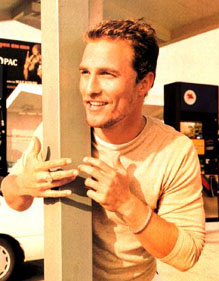
mmmm. He showed up in the preview. Well anyway, here's Matthew:
0 Replies
Letty
1
Reply
Sun 4 Nov, 2007 12:18 pm
There she is, Eastern Standard time and all. Thanks, Raggedy for another great collage.
Saw Sahara again last evening with Matthew, PA. Most disappointing movie EVER.
Before we play a tribute to Art, I suggest that all our audience watch Robin Williams in The Night Listener. It's more than a psychological thriller, it's based on a true event.
For you, Art.
Chorus:
We sing the song of the sewer
Of the sewer we sing this song.
Together we stand
With shovels in hand
To keep things floating along.
I work in the sewer,
It's a pretty hard job.
You know they don't hire
Just any old slob.
You don't have to wear
A tie or a coat.
You just gotta know
How to float.
I work in the sewer
With a guy named Bruce.
We're in charge
Of all the refuse.
I go down first
While he holds the lid.
Gee, I'm telling you
What a sweet kid.
A funny thing happened
To Bruce yesterday.
The tide came up
He got carried away.
He ended up in Jersey.
But that's O.K. now.
Cause that's where
He lives anyhow.
My father he worked
In the sewer Uptown.
I followed his footsteps
And worked my way down.
That's how I got started
In this here industry.
I just sort of fell into it.
Sheesh, lucky me.
Love it!
0 Replies
edgarblythe
1
Reply
Sun 4 Nov, 2007 07:35 pm
Harry Belafonte, two song medley
Forever Young, written by Bob Dylan
Siyani Bngelela, an African lyric
Siyani bngelela
Nina nonke banto bakithi mamelani masi
Khuluma nani sithi
Mmmmmaye ye ye ye
Siyani binggeleta
Nina nonke banto bakithi
Niphile phakade maye
Niphile phakade
May god bless and keep you always
May your wishes all come true
May you always do for others
And let others do for you
May you build a ladder to the stars
And climb on every rung
May you stay forever young
(forever young, forever young)
May you stay forever young
May you grow up to be righteous
May you grow up to be true
May you always know the truth
And see lights surrounding you
May you always be courageous
Stan upright and be strong
May you stay forever young
(forever young, forever young)
May you stay forever young
We babe noma
Siyani bingelela
Jabulani jabulani ma we thu
We babe noma
Niphile phakade maye maye
Niphile phakade
May your hands always be busy
May your feet always be swift
May you have a strong foundation
When the winds of changes shift
May your heart always be sung
May you stay forever young
(forever young, forever young)
May you stay forever young
0 Replies
Letty
1
Reply
Sun 4 Nov, 2007 08:25 pm
Awesome, edgar. I tried all evening to find the lyrics to Zulu, and kept running into snags.
Well, folks, I have had company all day and it's time for Letty to be in bed.
Ever been sent to camp? Well, I have and remember these songs but don't know why.
Sera Spunda
Boys:
Bunda, bunda, bunda...
Girls:
Sera spunda, sera spunda, sera spunda ra tza tza.
Sera spunda, sera spunda, sera spunda ra tza tza.
All:
A doreo, a dore bundeo,
A dore bunde ra tza tza,
At tze patze oh.
Show Me the Way To Go Home
Show me the way to go home
I'm tired and I want to go to bed
I had a little bitty drink about an hour ago
and it went right to my head, bum, bum, bum
Wherever we may roam,
On land or sea or foam
You can always hear me singing this song
Show me the way to go home
Now in English!
Indicate the way to my habitual abode
I'm fatigued and I want to retire
I had an alcoholic beverage 60 minutes ago
and it went right to my cerebellum
Wherever we may perambulate
On land or sea or atmospheric vapor
You can always hear me chanting this melody
Indicate the way to my habitual abode
Now in mountain Talk!
Show me the way down the mountain
I'm tired and I gotta go to the bathroom
I had a canteen of water about a day ago
and it went right to my bladder
Wherever we may climb
On land or moss or rock
You can always hear me singing this song
_____, how much longer to the top?
Not much longer.
Goodnight, all
From Letty with love and a smile
0 Replies
edgarblythe
1
Reply
Mon 5 Nov, 2007 05:51 am
Though you vacation in Hawaii
Or go to Switzerland to ski
When you're scanning the snow covered mountain
Or fanning yourself by the sea
Don't dream of anybody but me
Though you may fly the Scottish Highlands
Or take a trip to some isle near Napoli
When you're whistling "The Campbells Are Coming"
Or humming "The Isle Of Capri"
Don't dream of anybody but me
In a cafe on the Rhine
Any place along the line
I'll forgive you when a stranger puts your little heart in danger
If his face resembles mine
When a guy at a mike in a nightclub
Begins bellowing something off-key
Won't even mind if suddenly he reminds you of me
No matter where you care to roam
Doesn't even matter whom you choose to see
Whenever your head hits that pillow
Whatever the hour may be
Don't dream of anybody but me
Don't dream of anybody but me
Don't dream of anybody but me
Bobby Darin
0 Replies
Letty
1
Reply
Mon 5 Nov, 2007 06:23 am
Good morning, WA2K.
I like that song by Bobby, edgar. It covers all the places that we'd like to see, especially the Blue Grotto and the Isle of Capri.
Oasis
Morning Glory
All your dreams are made when you're chained to the mirror and the razor blade
Today's the day that all the world will see
Another sunny afternoon, walking to the sound of your favorite tune
Tomorrow never knows what it doesn't know too soon
Need a little time to wake up, need a little time to wake up, wake up
Need a little time to wake up, need a little time to rest your mind
You know you should so I guess you might as well
What's the story morning glory, well
Need a little time to wake up, wake up well
What's the story morning glory, well
Need a little time to wake up, wake up
All your dreams are made, when you're chained to the mirror and the razor blade
Today's the day that all the world will see
Another sunny afternoon, walking to the sound of my favorite tune
Tomorrow doesn't know what it doesn't know too soon
Need a little time to wake up, need a little time to wake up, wake up
Need a little time to wake up, need a little time to rest your mind
You know you should so I guess that you might as well



 [IMG]http://www.nndb.com/people/583/000023514/mmc5-sized.jpg[/IMG