I wish I was a neutron bomb, for once I could go off.
I wish I was a sacrifice but somehow still lived on.
I wish I was a sentimental ornamnet you hung on
The christmas tree, I wish I was the star that went on top,
I wish I was the evidence
I wish I was the grounds for fifty million hands up raised and opened toward the sky.
I wish I was a sailor with someone who waited for me.
I wish I was as fortunate, as fortunate as me.
I wish I was a messenger, and all the news was good.
I wish I was the full moon shining off a camaro's hood.
I wish I was an alien, at home behind the sun,
I wish I was the souvenir you kept your house key on.
I wish I was the pedal break that you depended on.
I wish I was the verb to trust, and never let you down.
(to fade)
I wish I was the radio song, the one that you turned up,
I wish, I wish, I wish, I wish,
I guess it never stops.
0 Replies
djjd62
1
Reply
Tue 11 Sep, 2007 06:07 pm
Given To Fly
Pearl Jam
He could've tuned in, tuned in
But he tuned out
A bad time, nothing could save him
Alone in a corridor, waiting, locked out
He got up outta there, ran for hundreds of miles
He made it to the ocean, had a smoke in a tree
The wind rose up, set him down on his knee
A wave came crashing like a fist to the jaw
Delivered him wings, "Hey, look at him now"
Arms wide open with the sea as his floor
Oh, power, oh
He's.. flying
Whole
High.. wide, oh
He floated back down 'cause he wanted to share
His key to the locks on the chains he saw everywhere
But first he was stripped and then he was stabbed
By faceless men, well, f**kers
He still stands
And he still gives his love, he just gives it away
The love he receives is the love that is saved
And sometimes is seen a strange spot in the sky
A human being that was given to fly
while i ponder what calamity may befall me on my first substitute teacher assignment, here's the type of behavior i will not condone
(Spoken)
How you doin' out there? Y'ever seem to have one of those days
where it just seems like everybody's gettin' on your case, from
your teacher all the way down to your best girlfriend? Well,
y'know, I used to have 'em just about all the time. But I found
a way to get out of 'em. Let me tell you about it!
(Sung)
Sitting in the classroom Thinking it's a drag
Listening to the teacher rap Just ain't my bag
The noon bells ring You know that's my cue
I'm gonna meet the boys On floor number two!
Smokin' in the boys' room
Smokin' in the boys' room
Now, teacher, don't you fill me up with your rules
But everybody knows that smokin' ain't allowed in school.
A-checkin' out the halls Makin' sure the coast is clear
Lookin' in the stalls No, there ain't nobody here
Oh, my buddy Fang, and me and Paul
To get caught would surely be the death of us all
Smokin' in the boys' room
Smokin' in the boys' room
Now, teacher, don't you fill me up with your rules
But everybody knows that smokin' ain't allowed in school.
All right!
Oh, put me to work In the school book store
Check out counter And I got bored
Teacher was lookin' For me all around
Two hours later You know where I was found
Smokin' in the boys' room (Yes indeed, I was)
Smokin' in the boys' room
Now, teacher, don't you fill me up with your rules
But everybody knows that smokin' ain't allowed in school.
One mo'!
Smokin' in the boys' room
Oh, smokin' in the boys' room
Now, teacher, I am fully aware of the rules
But everybody knows that smokin' ain't allowed in school!
0 Replies
Letty
1
Reply
Tue 11 Sep, 2007 06:57 pm
dj, great to hear you again, buddy. I think most of us know Pearl Jam, but I was taken with Bright Eyes which appears to be the pen name for Conor Oberst. Hope I'm correct, Canada.
Hey, there's our substitute, honu, from the big island playing a great, but intolerable high school bad boy song. Love it, M.D.
I have a couple of songs to play as well. One from dj's Conor, and one to match M.D. high school boy's room.
0 Replies
Letty
1
Reply
Tue 11 Sep, 2007 07:06 pm
First, this one, listeners, and I see that Conor Oberst has been called the new Bob Dylan
Artist : Bright Eyes
Title : A Perfect Sonnet
Lately I've been wishing I had one desire
Something that would make me never want another
Something that would make it so that nothing matters
All would be clear then
But I guess I'll have to settle for a for a few brief moments
And watch it all dissolve into a single second
And try to write it down into a perfect sonnet
Or one foolish line
Cause that's all that you'll get
So you'll have to accept
You are here and then you're gone
But I believe that lovers should be tied together
Thrown into the ocean in the worst of weather
Left there to drown
Left there to drown in their innocence
But as for me I'm coming to the final chapter
I read all of the pages and there's still no answer
Only all that was before I know must soon come after
That's the only way it can be
So I stand in the sun
And I breathe with my lungs
Trying to spare me the weight of the truth
Saying everything you've ever seen was just a mirror
You've spent your whole life sweating in an endless fever
And laying in a bathtub full of freezing water
Wishing you were a ghost
But once you knew a girl and you named her "Lover"
Danced with her in kitchens through the greenest summer
But autumn came, she disappeared, you can't remember
Where she said she was going to
But you know that she's gone
Cause she left you a song
That you don't want to sing
Singing, I believe that lovers should be chained together
Thrown into a fire with their songs and letters
Left there to burn
Left there to burn in their arrogance
But as for me I'm coming to my final failure
I've killed myself with changes trying to make things better
And ended up becoming something other
than what I had planned to be
All right
I believe that lovers should be draped in flowers
And laid entwined together on a bed of clovers
Left there to sleep
Left there to dream of their happiness
Bright Eyes is the nom de plume of Conor Oberst.
0 Replies
Letty
1
Reply
Tue 11 Sep, 2007 07:10 pm
yitwail, my students told me that this should be my theme song.
Teacher I Need You
Music by Elton John
Lyrics by Bernie Taupin
I was sitting in the classroom
Trying to look intelligent
In case the teacher looked at me
She was long and she was lean
She's a middle-aged dream
And that lady means the whole world to me
It's a natural achievement
Conquering my homework
With her image pounding in my brain
She's an inspiration
For my graduation
And she helps to keep the classroom sane
Oh teacher I need you like a little child
You got something in you to drive a schoolboy wild
You give me education in the lovesick blues
Help me get straight come out and say
Teacher I, teacher I, teacher I, Teacher I need you
I have to write a letter
Tell about my feelings
Just to let her know the scene
Focus my attention
On some further education
In connection with the birdies and the bees
So I'm sitting in the classroom
I'm looking like a zombie
I'm waiting for the bell to ring
I've got John Wayne stances
I've got Erroll Flynn advances
And it doesn't mean a doggone thing
0 Replies
Letty
1
Reply
Tue 11 Sep, 2007 07:36 pm
As the jazz boys say, it's time for a set break. So this is your PD's goodnight song.
I'll see you in my dreams,
hold you in my dreams.
Someone took you out of my arms,
still I feel the thrill of your charms.
Lips that once were mine,
tender eyes that shine,
they will light my way tonight,
I'll see you in my dreams.
Thanks to you all, and goodnight.
From Letty with love
0 Replies
edgarblythe
1
Reply
Wed 12 Sep, 2007 04:54 am
Drowning At The Bottom (Allison, Solberg)
I walked through the door, baby
I see you're doin' the same old thing
Ya got the nerve to ask the children
Ask the children to pour you a drink
I began to wonder
Do you ever stop and think?
Baby, please don't make me ask
If I can see you drownin'
In the bottom of that glass
I tried so many times to tell you
But my plea has been in vain
It's not easy for the children
Your whole family feels the pain
(Instrumental & guitar solo)
Look at me, baby
Look deeply, look deeply in my eyes
See the tears runnin' down my face?
I know it's hard for you to realize
That's when it's all said and done
You're gonna still keep on drinkin'
The children will only remember
'Bout the hole they dug in the ground.
Luther Allison
0 Replies
Letty
1
Reply
Wed 12 Sep, 2007 05:29 am
Good morning, WA2K radio audience.
edgar, that's a rather sad song, buddy. Thanks for reminding us that the most addictive drug going is alcohol.
The Eagles are going to beat The Hawk this early morning, folks.
It's another tequila sunrise
Starin' slowly 'cross the sky, said goodbye
He was just a hired hand
Workin' on the dreams he planned to try
The days go by
Ev'ry night when the sun goes down
Just another lonely boy in town
And she's out runnin' 'round
She wasn't just another woman
And I couldn't keep from comin' on
It's been so long
Oh, and it's a hollow feelin' when
It comes down to dealin' friends
It never ends
Take another shot of courage
Wonder why the right words never come
You just get numb
It's another tequila sunrise,this old world
still looks the same,
Another frame, mm...
0 Replies
bobsmythhawk
1
Reply
Wed 12 Sep, 2007 06:24 am
H. L. Mencken
From Wikipedia, the free encyclopedia
Gender Male
Birth name Henry Louis Mencken
Born September 12, 1880
Birth place Baltimore, Maryland
Died January 29, 1956
in Baltimore, Maryland
Circumstances
Occupation Journalist, satirist
Marital status Widowered
Family August Mencken
Father
Spouse Sara Haardt
Ethnicity German American
Religious belief(s) Atheism/Agnosticism
Notable credit(s) Baltimore Sun
Henry Louis Mencken (September 12, 1880 - January 29, 1956), better known as H. L. Mencken, was a twentieth-century journalist, satirist, social critic, cynic, and freethinker, known as the "Sage of Baltimore". He is often regarded as one of the most influential American writers of the early 20th century.
Life
Mencken was born in Baltimore, Maryland, the son of August Mencken, a cigar factory owner of German extraction. Having moved into the new family home at 1524 Hollins Street (in the Union Square neighborhood) when he was three years old, he lived in the house for the rest of his life, apart from five years of married life. He became a reporter for the Baltimore Morning Herald in 1899 and moved to The Baltimore Sun in 1906. At this time, he had also begun writing editorial columns that demonstrated the author he would soon become. On the side, he wrote short stories, a novel, and even poetry (which he later reviled). In 1908, he became a literary critic for the magazine The Smart Set. Together with George Jean Nathan, Mencken founded and edited The American Mercury, published by Alfred A. Knopf, in January 1924. It soon had a national circulation and became highly influential on college campuses across America.
Mencken is perhaps best remembered today for The American Language, a multi-volume study of how the English language is spoken in the United States, and his satirical reporting on the prosecution, judge, jury, and venue of the Scopes trial, which he is credited for naming the "Monkey" trial.
Among Mencken's influences were Rudyard Kipling, Ambrose Bierce, Friedrich Nietzsche, Joseph Conrad, and especially Mark Twain.
In his capacity as editor and "man of ideas" Mencken became close friends with the leading literary figures of his time, including Theodore Dreiser, F. Scott Fitzgerald, and Alfred Knopf, as well as a mentor to several young reporters, including Alistair Cooke. He also championed artists whose works he considered worthy. For example, he asserted that books such as Caught Short! A Saga of Wailing Wall Street (1929), "by" Eddie Cantor (ghost written by David Freedman) did more to pull America out of The Depression than all government measures combined. He also mentored John Fante.
As a nationally syndicated columnist and author of numerous books he notably attacked fundamentalist Christianity and the "Booboisie," his word for the ignorant middle classes. In 1926, he was arrested for selling an issue of The American Mercury banned in Boston.[1] Mencken heaped scorn not only upon some public officials but the contemporary state of American democracy itself: in 1931, the Arkansas legislature passed a motion to pray for Mencken's soul after he had called the state the "apex of moronia."
Mencken sometimes took positions in his essays more for shock value than for deep-seated conviction, such as his essay arguing that the Anglo-Saxon race was demonstrably the most cowardly in human history, published at a time when much of his readership considered Anglo-Saxons the noble pinnacle of civilization.
Mencken married Sara Haardt, an Alabama writer and professor 18 years his junior, in 1930. Haardt was a professor of English at Goucher College in Baltimore who wrote short stories and had led efforts in Alabama to ratify the 19th Amendment[2]. The two met in 1923 after Mencken delivered a lecture at the college. Mencken promoted her short stories, and a seven-year courtship ensued[3]. The marriage made national headlines, and many were surprised that Mencken, who once called marriage "the end of hope," had gone to the altar. "The Holy Spirit informed and inspired me," Mencken said. "Like all other infidels, I am superstitious and always follow hunches: this one seemed to be a superb one." [4] Haardt was in poor health throughout their marriage, and died in 1935 of meningitis. Mencken later published Southern Album, a posthumous collection of her short stories.
Mencken suffered a cerebral thrombosis in 1948, from which he never fully recovered. The damage to his brain left him aware and fully conscious but unable to read or write. In his later years he enjoyed listening to classical music and talking with friends, but he sometimes referred to himself in the past tense as if already dead.
Mencken was, in fact, preoccupied with how he would be perceived after his death, and he spent this period of time organizing his papers, letters, newspaper clippings and columns. His personal materials were released in 1971, 1981, and 1991 (starting 15 years after his death), and were so thorough they even included grade-school report cards. Hundreds of thousands of letters were included - the only omissions were strictly personal letters received from women.
He died in 1956 at the age of seventy-five, and was interred in the Loudon Park Cemetery in Baltimore, Maryland. His epitaph reads:
If, after I depart this vale, you ever remember me and have thought to please my ghost, forgive some sinner, and wink your eye at some homely girl.
Mencken suggested this epitaph in The Smart Set. After his death, it was inscribed on a plaque in the lobby of The Baltimore Sun.
Mencken's papers as well as much of his library, which includes many books inscribed by major authors, are in the collections of the Enoch Pratt Free Library, in Baltimore. Some of the items are displayed in a special room in the 2003 wing of the library, the Mencken Room.
Style
Perhaps Mencken's most important contribution to American letters is his satirical style. Mencken, influenced heavily by Mark Twain and Jonathan Swift, believed the lampoon was more powerful than the lament; his hilariously overwrought indictments of nearly every subject (and more than a couple that were unmentionable at the time) are certainly worth reading as examples of fine craftsmanship.
The Mencken style influenced many writers; American author Richard Wright described the power of Mencken's technique (his exposure to Mencken would inspire him to become a writer himself). In his autobiographical Black Boy, Wright recalls his reaction to A Book of Prefaces and one of the volumes of the Prejudices series:
I was jarred and shocked by the clear, clean, sweeping sentences ... Why did he write like that? I pictured the man as a raging demon, slashing with his pen ... denouncing everything American ... laughing ... mocking God, authority ... This man was fighting, fighting with words. He was using words as a weapon, using them as one would use a club ... I read on and what amazed me was not what he said, but how on earth anybody had the courage to say it. (Quoted from Scruggs, pg. 1)
Mencken was at the top of his game in the 1920s, when a backlash against WWI-era superpatriotism and government expansion (exemplified in the Palmer Raids) produced many overtly anti-American protests by literati, among whom Mencken was arguably the most pugnacious. The "anti-American" label is an epithet today (and to a lesser degree in Mencken's time); the term is not used here to defame HLM. He would have delighted in being called "anti-American"; his contrarian spirit and envy of more cultured states (Germany especially) compelled him to mount unapologetically scathing attacks on nearly all aspects of American culture.
In his classic essay "On Being an American" (published in his Prejudices: Third Series), Mencken fires a salvo at American myths. The following choice quote displays his amusing take on why the United States is the "Land of Opportunity", and segues into a laundry-list of national pathologies as he sees them:
Here the business of getting a living ... is enormously easier than it is in any other Christian land?-so easy, in fact, that an educated and forehanded man who fails at it must actually make deliberate efforts to that end. Here the general average of intelligence, of knowledge, of competence, of integrity, of self-respect, of honor is so low that any man who knows his trade, does not fear ghosts, has read fifty good books, and practices the common decencies stands out as brilliantly as a wart on a bald head, and is thrown willy-nilly into a meager and exclusive aristocracy. And here, more than anywhere else I know of or have heard of, the daily panorama of human existence, of private and communal folly?-the unending procession of governmental extortions and chicaneries, of commercial brigandages and throat-slittings, of theological buffooneries, of aesthetic ribaldries, of legal swindles and harlotries, of miscellaneous rogueries, villainies, imbecilities, grotesqueries and extravagances?-is so inordinately gross and preposterous, so perfectly brought up to the highest conceivable amperage, so steadily enriched with an almost fabulous daring and originality, that only the man who was born with a petrified diaphragm can fail to laugh himself to sleep every night, and to awake every morning with all the eager, unflagging expectation of a Sunday-school superintendent touring the Paris peep-shows.
Whether the reader agrees with Mencken or finds him infuriatingly coarse and incorrect, all can observe his technique with profit; it is rare in contemporary discourse. The criticisms he poses are nearly the same as those of famous literary expatriates including Richard Wright, Ernest Hemingway, and F. Scott Fitzgerald; the injustices (or at least incongruities) are the same ones fought by period Muckraker journalists such as Lincoln Steffens and Ida Tarbell. However, instead of decrying the "daily panorama of human existence, of private and communal folly" and calling for reform or improvement, Mencken says he is "entertained" by them. On its face, this approach displays a crass indifference and total lack of compassion; Mencken admitted as much, as it was part of his personal philosophy: a kind of fierce libertarianism inspired by a Nietzschean contempt for the "improvers of mankind", a social Darwinist outlook derived from Herbert Spencer and William Graham Sumner, and a "Tory" elitism.
The power of satire comes from the transformation of enemies and villains into a source of entertainment; they are reduced from powerful people to be contended with into farcical creatures deserving of mockery. Black journalist and Mencken contemporary James Weldon Johnson celebrated this technique as a way of fighting racism without stooping to the level of Jim Crow enforcers and the Ku Klux Klan:
Mr. Mencken's favorite method of showing people the truth is to attack falsehood with ridicule. He shatters the walls of foolish pride and prejudice and hypocrisy merely by laughing at them; and he is more effective against them than most writers who hurl heavily loaded shells of protest and imprecation.
What could be more disconcerting and overwhelming to a man posing as everybody's superior than to find that everybody was laughing at his pretensions? Protest would only swell up his self-importance. (quoted from Scruggs, pg. 57)
Mencken, in "On Being an American" called the United States "... incomparably the best show on Earth..."; he clearly took joy in covering religious controversies, political conventions, and unearthing new "quackeries" (among his favorite targets are the Baptist and Methodist churches, Christian Science, Chiropractics, and most of all, Puritanism, which he defined as "the haunting fear that someone, somewhere, might be happy"). Although he attacked every President of the United States who served during the years of his career as a writer and critic, from Taft to Truman, Mencken reserved a special ire for his attacks on Woodrow Wilson, whose administration he saw as epitomizing the moralistic, Puritanical impulses of American life. Mencken's snipes at Wilson resulted in Mencken being singled out by the Bureau of Investigation (the predecessor of the FBI) and other law enforcement agencies as a potential subversive during Wilson's administration.
It is no coincidence he regarded Adventures of Huckleberry Finn to be the finest work of American literature; much of that book details episodes of gullible and ignorant people being swindled by Confidence Men like the (deliberately) pathetic "Duke" and "Dauphin" roustabouts with whom Huck and Jim travel down the Mississippi River. These scam-artists swindle country "boobs" (as Mencken referred to them); by posing as enlightened speakers on temperance (to obtain the funds to get roaring drunk), pious "saved" men seeking funds for far off evangelistic missions (to pirates on the high seas, no less), and learned doctors of phrenology (who can barely spell). The book can be read as a story of America's hilarious dark side, a place where democracy, as defined by Mencken, is "... the worship of Jackals by Jackasses."
One of the disadvantages of slashing satire is that it does only that: slash. Alfred Kazin called Mencken's criticisms impotent since "Every Babbitt read him gleefully and pronounced his neighbor a Babbitt" -- they permitted a circular firing squad of self-righteous viciousness. ("Babbitt" is a now-rare epithet derived from the Sinclair Lewis book of the same name; it can be loosely defined as an uncultured, "square", typically middle-aged and middle-class businessman characterized by timidity and ignorance of their philistinism. It is a very similar concept to the more commonly used German terms Spiesser and Spiessbürger.) Critics must walk a thin line between declaring "The Emperor has no clothes" (a fine service to all), and going too far by furiously tearing the clothes off of undeserving bystanders. Mencken tended to go too far as matter-of-course; consequently he was the first to say what needed to be said in his criticisms of lynching, World War I-era civil liberties abuses, and especially the dismally moral and philistine American arts. On the other hand, this extremism left him with a body of work filled with unsubtle reviews of the subtle and scores of openly vicious statements about all ethnicities.
This viciousness was summed up in the play Inherit the Wind, a fictionalized version of the Scopes Monkey Trial. As the story ends, the protagonist tells Hornbeck (the character representing Mencken):
You never push a noun against a verb without trying to blow up something.
In a 26 July 1920 article in the Baltimore Evening Sun, Mencken wrote about the difficulties of good men reaching national office when such campaigns must necessarily be conducted remotely:
The larger the mob, the harder the test. In small areas, before small electorates, a first-rate man occasionally fights his way through, carrying even the mob with him by force of his personality. But when the field is nationwide, and the fight must be waged chiefly at second and third hand, and the force of personality cannot so readily make itself felt, then all the odds are on the man who is, intrinsically, the most devious and mediocre ?- the man who can most easily adeptly disperse the notion that his mind is a virtual vacuum.
The Presidency tends, year by year, to go to such men. As democracy is perfected, the office represents, more and more closely, the inner soul of the people. We move toward a lofty ideal. On some great and glorious day the plain folks of the land will reach their heart's desire at last, and the White House will be adorned by a downright moron.
Mencken's paper published his "secret diary" in 1989, kept sealed for 25 years after his death in 1956, on his instructions. According to an item in the South Bay (California) Daily Breeze [1] on December 5, 1989, titled "Mencken's Secret Diary Shows Racist Leanings," Mencken's views shocked even the "sympathetic scholar who edited it," Charles A. Fecher of Baltimore. There was a club in Baltimore called the Maryland Club which had one Jewish member, and that member died. Mencken said "There is no other Jew in Baltimore who seems suitable," according to the article. And the diary quoted him as saying of blacks, in 1943, "...it is impossible to talk anything resembling discretion or judgment to a colored woman..." The Diary of H. L. Mencken was published by Alfred A. Knopf.
Elitism
Instead of arguing that one race or group was superior to another, Mencken believed that every community?- whether the community of train porters, African-Americans, newspapermen, or artists ?- produced a few people of clear superiority. He considered groupings on a par with hierarchies, which led to a kind of natural elitism and natural aristocracy. "Superior" individuals, in Mencken's view, were those wrongly oppressed and disdained by their own communities, but nevertheless distinguished by their will and personal achievement ?-not by race or birth. Of course, based on his heritage, achievement, and work ethic, Mencken considered himself a member of this group.
Mencken's The Negro as Author began as a straightforward critique of a fictional work of a black author writing with racial themes as a focus:
The Shadow, by Mary White Ovington, is a bad novel, but it is interesting as a first attempt by a colored writer to plunge into fiction in the grand manner.
In fact Mary White Ovington was not "colored," as Mencken conveniently pretends not to know. He instead uses this omission as a means to single out her work as an example of sympathetic, liberal-esque anti-racist activism (among educated whites) which in the end only turned out bad writing that undercut the public image of genuine emerging black authors. Within this humorous context, Mencken then commented positively on the future of black writing:
The thing we need is a realistic picture of this inner life of the negro by one who sees the race from within--a self portrait as vivid and accurate as Dostoyevsky's portrait of the Russian or Thackeray's of the Englishman. The action should be kept within the normal range of negro experience. it should extend over a long enough range of years to show some development in character and circumstance. It should be presented against a background made vivid by innumerable small details.
Mencken, in his legendary salvo against Southern American culture, "The Sahara of the Bozart" ("Bozart" being a mock misspelling of "Beaux-Arts"), argued that the whole Confederate region fell into cultureless savagery and backwardness after the Civil War?- with the exception of the African-American community. In what was an audacious (and seriously intended) argument, Mencken claimed Southern blacks were actually the heirs and descendants of the talented aristocrats?- by way of African-American mistresses of Caucasian men. Further Mencken opined that this community was the only site of cultural vitality or activity whatsoever, in spite of being hindered by the barbaric oppression of a culture that condoned and enforced Jim Crow laws and still tacitly sanctioned lynching.
The most authoritative work on this subject is Charles Scruggs' book, The Sage in Harlem ?- a survey of Mencken's influence on and support of African-American intellectuals. Mencken, as the editor and main creative force behind The American Mercury magazine, was responsible for publishing more black authors than any other publication of its stature ?-certainly more than any other white dominated publication. The articles by African-Americans ranged from a Pullman Porter's account of life in that occupation to sophisticated articles by important black thinkers.
Democracy
Mencken's views on democracy were well-known by his familiar readers. Rather than simply dismissing democracy as a popular fallacy (like Nietzsche, for example) or treating it with open contempt, Mencken's response to it was a publicized sense of amusement.
His feelings on this subject (like his casual feelings on many other such subjects) are sprinkled throughout his writings over the years, very occasionally taking center-stage with the full force of Mencken's prose:
[D]emocracy gives [the beatification of mediocrity] a certain appearance of objective and demonstrable truth. The mob man, functioning as citizen, gets a feeling that he is really important to the world - that he is genuinely running things. Out of his maudlin herding after rogues and mountebanks there comes to him a sense of vast and mysterious power?-which is what makes archbishops, police sergeants, the grand goblins of the Ku Klux and other such magnificoes happy. And out of it there comes, too, a conviction that he is somehow wise, that his views are taken seriously by his betters - which is what makes United States Senators, fortune tellers and Young Intellectuals happy. Finally, there comes out of it a glowing consciousness of a high duty triumphantly done which is what makes hangmen and husbands happy.
This sentiment[2] is, of course, fairly consistent with Mencken's distaste for common notions and the philosophical outlook he unabashedly set down throughout his life as a writer (drawing on Friedrich Nietzsche and Herbert Spencer, among others).
Also, much of Mencken's enthusiasm for Kaiser Wilhelm's Germany was based upon that nation's inward autocracy, despite a nominally representative system.
Perceived racial issues
Most commentators regard his views as libertarian - yet some of Mencken's writing displays elitism, and contemporaneously fashionable Social Darwinist thinking. In addition to these allegations, Mencken has been referred to as anti-Semitic and misogynistic. In a letter to Upton Sinclair published in the American Mercury, Mencken described Hitler as "hardly more than a common Ku Kluxer"[5] (which, given his disgust with the Ku Klux Klan, is a rather nasty insult). Another allegation levelled against him was that he was frequently obsessed with the importance of social status or class. For example, Mencken broke off a relationship of many years with his lover, Marion Bloom, when they were arranging to be married. Critics saw this as being due to Bloom being insufficiently wealthy, upper-class, and sophisticated for him. Mencken, however, claimed he ended the relationship because she converted to Christian Science.
While Mencken's essays are sprinkled liberally with racial epithets ("blackamoor," "niggero," "coon," "prehensile kikes,") Mencken considered the African-American intellectual George Schuyler to be a life-long friend ?- rare in any case, considering Mencken's infamous capacity for personal criticism. On the other hand, while Mencken was fair to individuals, he was deeply negative in regard to social groups and other groupings of people, and ethnic groups were no exception. Writing an introduction to The Antichrist by Nietzsche, Mencken displays sentiments which some have characterized "indisputably anti-semitic"[6]:
On the Continent, the day is saved by the fact that the plutocracy tends to become more and more Jewish. Here the intellectual cynicism of the Jew almost counterbalances his social unpleasantness. If he is destined to lead the plutocracy of the world out of Little Bethel he will fail, of course, to turn it into an aristocracy--i. e., a caste of gentlemen--, but he will at least make it clever, and hence worthy of consideration. The case against the Jews is long and damning; it would justify ten thousand times as many pogroms as now go on in the world. But whenever you find a Davidsbündlerschaft making practise against the Philistines, there you will find a Jew laying on. Maybe it was this fact that caused Nietzsche to speak up for the children of Israel quite as often as he spoke against them. He was not blind to their faults, but when he set them beside Christians he could not deny their general superiority. Perhaps in America and England, as on the Continent, the increasing Jewishness of the plutocracy, while cutting it off from all chance of ever developing into an aristocracy, will yet lift it to such a dignity that it will at least deserve a certain grudging respect.[7]
H.L. Mencken House
Mencken's home at 1524 Hollins Street in Baltimore's Union Square neighborhood was bequeathed to the University of Maryland, Baltimore on the death of Mencken's younger brother August in 1967. The City of Baltimore acquired the property in 1983 and the "H. L. Mencken House" became part of the City Life Museums. The house has been closed to general admission since 1997, but is opened for special events and group visits by arrangement.
The H. L. Mencken Room & Collection
The H. L. Mencken Room and Collection is located at the Central branch of the Enoch Pratt Free Library on Cathedral Street in Baltimore.
Shortly after World War II, Mencken expressed his intention of bequeathing his books and papers to the Pratt Library. At the time of his death in 1956, most of the present large collection had been received by the Library and a special room on the third floor was being prepared to house the collection suitably. The Mencken Room was dedicated on April 17, 1956.
The collection contains Mencken's typescripts, his newspaper and magazine contributions, his published books, family documents and memorabilia, personal clipping books, a large collection of presentation volumes, a file of correspondence with prominent Marylanders, and the research material used in preparing The American Language.
There are additional collections of Mencken memorabilia at Dartmouth College, Harvard University, Princeton University, and Yale University. The Sara Haardt Mencken collection is held at Goucher College. The New York Public Library has collections of Mencken's vast literary correspondence.
0 Replies
bobsmythhawk
1
Reply
Wed 12 Sep, 2007 06:30 am
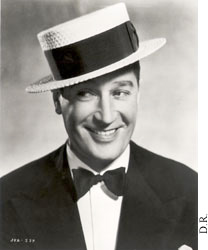
Maurice Chevalier
From Wikipedia, the free encyclopedia
Birth name Maurice Auguste Chevalier
Born September 12, 1888
Paris, France
Died January 1, 1972 (aged 83)
Paris, France
Spouse(s) Yvonne Vallée (1927-1933) (divorced)
Nita Ray (1937-1946)
[show]Awards
Academy Awards
Nominated: Best Actor
1930 The Love Parade
1930 The Big Pond
Academy Honorary Award
Life Achievement Award (1959)
Golden Globe Awards
Nominated: Best Actor - Motion Picture Musical/Comedy
1958 Love in the Afternoon
1959 Gigi
Cecil B. DeMille Award (1959)
Nominated: Best Actor - Motion Picture Drama
1962 Fanny
Tony Awards
Special Tony Award (1968)
Maurice Chevalier (September 12, 1888 - January 1, 1972) was a Belgian-French actor, singer, and popular entertainer. Chevalier's signature songs included "Louise", "Mimi", and "Valentine." His trademark was a casual straw hat, which he always wore on stage with his tuxedo.
Early life
He was born Maurice Auguste Chevalier in Paris in 1888. His father was a house painter. His mother was of Belgian descent. Maurice made his name as a star of musical comedy, appearing in public as a singer and dancer at an early age.
It was in 1901 that he first began in show business at the age of 13. He was singing, unpaid, at a café when a well-known member of the theatre saw him and suggested that he try out for a local musical. He did so, and got the part. Chevalier got a name as imitator and singer. His act in l' Alcazar in Marseille was so successful he made a triumphant rearrival in Paris.
In 1909, he became the partner of the biggest female star in France at the time, Fréhel. However, due to her alcohol and drug addiction their liaison ended in 1911. Chevalier then started a relationship with the 36 year old Mistinguett at the Folies Bergère; they would eventually play out a very public romance.
World War I
When in 1914 World War I broke out, Chevalier was in the middle of his national service, so was already in the front line, where he got shrapnel in the back in the first weeks of combat and taken as a prisoner of war in Germany for two years. In 1916, he was released through the top-secret intervention of Mistinguett's admirer King Alfonso of Spain, the only king of a neutral country who was a cousin of both the British and German royal families.
In 1917, he became a star in le Casino de Paris and played before a public of British soldiers and Americans. He discovered jazz and ragtime and started thinking about touring in the United States. In prison camp, he studied English and therefore had a certain advantage over other French artists. He went to London where he found new success, though still singing his repertoire in French.
Hollywood
After the war, Chevalier went back to Paris and created several famous songs that are still known today, such as ?'Valentine' (1924). He played in a few pictures and made a huge impression in the operetta, Dédé. He met the American composers George Gershwin and Irving Berlin and brought Dédé to Broadway in 1922. It was not a success and Chevalier returned to France where he tried to commit suicide[citation needed] in 1924 because of this failure. The same year he met Yvonne Vallée, a young dancer, who became his wife in 1927.
Meanwhile his film potential had been spotted by Douglas Fairbanks, who offered him star billing opposite Mary Pickford. But Chevalier doubted his own talent for silent movies (in Paris, he'd made a couple that failed). When sound made its entrée in the film world, however, he returned to Hollywood in 1928 and this time he became very successful. He signed a contract with Paramount Pictures and played his first American role in Innocents of Paris. In 1930 he was nominated for the Academy Award for Best Actor, for two roles, The Love Parade (1929) and The Big Pond (1930). The Big Pond garnered Chevalier his first big American hit song, "Livin' In the Sunlight - Lovin' In the Moonlight" with words and music by Al Lewis and Al Sherman, as well as 'A New Kind of Love' (or 'The Nightingales'). He collaborated with film director Ernst Lubitsch. While under contract with Paramount, Chevalier's name was so universally recognized that his passport was featured in the Marx Brothers film Monkey Business (1931), with each brother attempting to sneak off the ocean liner where they were stowaways by claiming to be the singer. In 1931, Chevalier starred in a musical called The Smiling Lieutenant along with Claudette Colbert. Despite the disdain audiences held for musicals in 1931[1], it proved to be a very successful film.
In 1932, he starred with Jeanette MacDonald in Paramount's classic film musical, One Hour With You which became a huge box-office success and became one of the films instrumental in making musicals popular with the public once again. Due to its popularity, Paramount quickly starred Maurice Chevalier in another musical called Love Me Tonight, which was also released in 1932 and also co-starred Jeanette MacDonald. It is about a tailor who falls in love with a princess when he goes to a castle to collect a debt and is mistaken for a baron. Featuring songs by Richard Rodgers and Lorenz Hart, it was directed by Rouben Mamoulian, who, with the help of the songwriters, was able to put his ideas of the "integrated musical" (a musical which blends songs and dialogue seamlessly so that the songs seem to advance the plot). It has since come to be considered one of the greatest film musicals of all time.[2]
In 1934, he starred in the first sound film version of the Franz Lehar operetta The Merry Widow, one of his best-known films. He became one of the big stars in Hollywood, very rare for French artists in those days. In 1935, he signed with MGM and returned to France later that year.
In 1937, he divorced his wife and married the dancer Nita Ray. He had several successes such as his revue Paris en Joie in the Casino de Paris. A year later, he performed in Amours de Paris. His songs remained big hits, such as Prosper (1935), Ma Pomme (1936) and Ça fait d'excellents français (1939)
Maurice Chevalier also appeared in the Lucy-Desi Comedy Hour in 1958.
World War II
During World War II, Chevalier kept performing for audiences, even German soldiers. He admired Philippe Pétain, who led the collaborating Vichy regime during the war. (It must be stated that many Frenchmen at that time admired Pétain for his victories in World War I.) He moved to Cannes where he and his Jewish girlfriend, Nita Ray, lived and where he gave several performances.
In 1941, he performed a new revue in the Casino de Paris: Bonjour Paris, which was another smash success. Songs like "Ça sent si bon la France" and "La Chanson du maçon" became other new hits. The Nazis asked Chevalier if he wanted to perform in Berlin and sing for the collaborating radio station Radio-Paris. He refused, but did give several performances in front of prisoners of war in Germany where he succeeded in liberating ten people in exchange.
In 1942 he returned to Bocca, near Cannes, but returned to the French capital city in September. In 1944 when the Allied forces freed France, Chevalier was accused of collaborationism. Even though he was formally acquitted of these charges, the English-speaking press remained very hostile and he was refused a visa for several years.
After World War II
In his own country, however, he was still very popular. In 1946, he split-up from Nita Ray and started writing his memoirs, which took him many years to complete.
He started to paint and collect things and acted in Le Silence est d'Or (1946) by René Clair. He still toured throughout the United States and other parts of the world and returned to France in 1948.
In 1949, he performed in Stockholm in a communist benefit against nuclear arms. (In 1944, he had already participated in a communist demonstration in Paris). Joseph McCarthy's anti-communist efforts in the USA made him less popular in that country during the early fifties. In 1951, he was refused re-entry into the U.S. because he had earlier signed an anti-nuclear petition known as the Stockholm Appeal.
In 1952, he bought a large property in Marnes-la-Coquette, near Paris and named it ?'La Louque', as a homage to his mother's nickname. He started a new relationship in 1952 with Janie Michels, a young divorced mother with three children. Being a painter herself she encouraged Chevalier's artistic hobby.
In 1954 after McCarthy's downfall, Chevalier was welcomed back in the United States. He made a success in the Billy Wilder film Love in the Afternoon (1957) with Audrey Hepburn and Gary Cooper, and rediscovered his popularity with new audiences, appearing in the movie musical, Gigi (1958) with Leslie Caron and Hermione Gingold, with whom he shared the song "I Remember It Well", and several Walt Disney films. The great success of Gigi prompted Hollywood to give him an Honorary Academy Award that same year for his lifetime achievements in the field of entertainment. Also in Gigi, the song "Thank Heaven for Little Girls" became a signature song for him.
Final years
Chevalier continued to work up until very old age with energy and enthusiasm. In the early 1960s, he toured the United States and between 1960 and 1963 he made eight films. When he returned to France, he was invited by president Charles de Gaulle for a meal.
In 1965, at the age of 77 he made another world tour and visited the US again and other countries like South Africa. In 1967 he toured in Latin America, again the US, Europe and Canada.
In 1968, on October 1, he announced his official farewell tour. Tired but nonetheless still able to entertain people he stopped twenty days later.
In 1970, he sang the title song of the Disney film The Aristocats. During a tour in the US he decided to stay there. However in December 1971 he fell ill and had to be taken to a hospital.
Maurice Chevalier died on January 1, 1972, aged 83, and was interred in the cemetery of Marnes-la-Coquette in Hauts-de-Seine, outside Paris, France.
Trivia
Chevalier has a star on the Hollywood Walk of Fame at 1651 Vine Street.
Maurice Chevalier's trademark laugh is transcribed as "Onh-onh-onh".
Maurice Chevalier's trademark laugh is referenced satirically in the Mel Brooks film "History of the World, Part I".
When he was Hollywood's highest-paid star, he objected to paying 10 cents a day to park his car at Paramount. After some argument, the studio settled for 5 cents.
0 Replies
bobsmythhawk
1
Reply
Wed 12 Sep, 2007 06:34 am
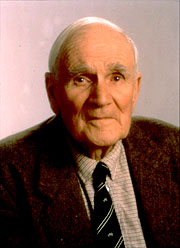
Desmond Llewelyn
From Wikipedia, the free encyclopedia
Birth name Desmond Wilkinson Llewelyn
Born 12 September 1913(1913-09-12)
Newport, Wales
Died 19 December 1999 (aged 86)
Firle, East Sussex, England
Years active 1950-1999
Desmond Wilkinson Llewelyn (12 September 1913[1] or 1914[2][3] ?- 19 December 1999) was a Welsh actor, famous for playing the fictional character of Q in the James Bond series of films.
Biography
Early life
Llewelyn was born in Newport, Wales, the son of Mia and Ivor Llewelyn,[4] a coal mining engineer. He originally wanted to be a minister but during his education at Radley College he worked as a stagehand in the school's productions and then picked up sporadic small parts.
The outbreak of World War II in September 1939 halted his acting career, and Llewelyn was commissioned as a second lieutenant in the British army, serving with the Royal Welch Fusiliers. In 1940, he was captured by the German army in France, and was held as a POW for five years. During this period he appeared in a number of theatrical productions as well as taking part in attempted escape activities.[citation needed]
Career
Since 1963's From Russia with Love, Llewelyn has appeared as Q (the quartermaster of the MI6 gadget lab known as Q-branch) in every James Bond film, except Dr No (1962) and Live and Let Die (1973), until The World Is Not Enough (1999). He had originally been chosen for the role as he had previously worked with the director Terence Young on the 1950 war film They Were Not Divided. In the 2002 film Die Another Day, John Cleese, who played the character R, the assistant to Q in The World Is Not Enough, was promoted to the head of Q-branch, thus taking on the title of Q. In all, Llewelyn appeared in 17 Bond films, more than any other actor, and worked with the first five James Bond actors. He also portrayed Q in a 1967 made-for-television special (produced by EON Productions) entitled, Welcome to Japan, Mr. Bond which was included in the 2006 special edition DVD release of You Only Live Twice.
Llewelyn appeared in other films such as the 1981 PBS production of Doctor Jekyll and Mister Hyde and also a small appearance in the famous musical Chitty Chitty Bang Bang (1968) and in the Ealing comedy The Lavender Hill Mob (1951). He acted on stage and appeared in the British television series Follyfoot - his commitments filming that series was one of the reasons why he did not appear in Live and Let Die.
Llewelyn's final Bond film, The World Is Not Enough, had been released only a few weeks before his death, and in his final scene in the picture he is shown being lowered into the ground beside a BMW Z8 at the Scotland headquarters while saying the line, "Always have an escape plan". Although the film had alluded to Q's retirement, which Bond hoped wouldn't be anytime soon, and introduced John Cleese's character as heir presumptive, Llewelyn had stated not long before his death that he had no plans to retire and that he would continue playing Q "as long as the producers want me and the Almighty doesn't."[5].
Personal life & death
Although one of British cinema's most recognisable characters and an important and long-standing element in the 'Bond' franchise, 'Q' did not make Desmond Llewelyn rich: the actor was merely paid 'by the day' for his few hours of work on-set, and did not share in the money made by the films. Contrary to his gadget-expert character in the Bond films, Llewelyn always maintained that he was totally lost in the world of technology, a trait that also plagued his successor, John Cleese.
Llewelyn was killed in a road accident on December 19, 1999 after returning home from a friend's house. His Renault Megane car without other occupants collided head-on with a 35-year-old man driving a bronze Fiat Bravo company car on the A27 road near the village of Berwick, East Sussex. He died shortly afterwards. He was 85. The other driver was seriously injured.[6] Roger Moore, who had appeared with Llewelyn in six Bond movies, spoke at his funeral.
0 Replies
bobsmythhawk
1
Reply
Wed 12 Sep, 2007 06:36 am
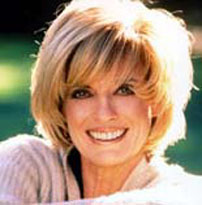
Linda Gray
From Wikipedia, the free encyclopedia
Linda Ann Gray (born September 12, 1940 in Santa Monica, California) is an American actress, best known for her role as Larry Hagman's long-suffering wife, Sue Ellen Ewing on the television soap opera Dallas as a recurring character in the series first season in the spring of 1978, and as a regular cast member from 1978 to 1989. She was also a director of the popular show. She returned to the role in the series finale in 1991 and again in the reunion films "J.R. Returns" in 1996 and "The War of the Ewings" in 1998.
Linda Gray was married to Ed Thrasher for twenty-one years. The marriage resulted in two children: Jeff Thrasher and Kehly Sloane. Gray also has two grandsons, Ryder and Jack Sloane. Gray's younger sister, Betty, died in 1989 from breast cancer.
She later starred in the short-lived FOX soap opera, Models, Inc., which was a spin-off of Melrose Place. She also had a recurring role in The Bold and the Beautiful (she played Priscilla Kelly in 2004 and 2005).
In 2001, Gray portrayed Mrs. Robinson in the West End production of Charles Webb's The Graduate. Coincidentally, Gray was the model whose stockinged leg appeared in the promotional poster for the film version of The Graduate 34 years earlier.
Gray's legs made another appearance in a BVD underwear commercial in the 1980s. Her Dallas co-star Larry Hagman had earned an endorsement contract for the garment maker, having him dressed in J.R. Ewing attire (while not actually posing as J.R. due to contractual obligations with CBS). In one commercial, he looks at an unseen woman's legs exiting from a luxury car, then looks into the camera and says "You know, there's just some things I can't get enough of!" The legs from the car belonged to Gray.
In 2006 Linda co-starred in the short film "Reflections of a Life," which was written, directed by and starring Kathi Carey. She plays the best friend of a woman undergoing treatment for breast cancer.
She is said to be related by marriage to fellow actress Lindsay Wagner [citation needed].
0 Replies
bobsmythhawk
1
Reply
Wed 12 Sep, 2007 06:40 am
Barry White
From Wikipedia, the free encyclopedia
Background information
Birth name Barrence Eugene Carter
Also known as The Walrus of Love
Born September 12, 1944(1944-09-12)
Galveston, TX
Died July 4, 2003 (aged 58)
Los Angeles, CA
Genre(s) Soul
Disco
Instrument(s) Piano, Keyboards, Vocals
Years active 1972 to 2003
Label(s) 20th Century
A&M
Mercury Records
Associated
acts Love Unlimited Orchestra
Barry Eugene White (born Barrence Eugene Carter, September 12, 1944(1944-09-12) - July 4, 2003) was a Grammy Award winning American record producer, songwriter and singer responsible for the creation of numerous hit soul and disco songs. He released numerous gold and platinum albums, numerous gold singles and platinum singles.[citation needed] All inclusive, record sales of White's music with singles, albums, are in excess of 50 million.
He created the Love Unlimited Orchestra, which included string and percussion players. Records featuring White's deep bass voice and suave delivery were used by couples wishing to create a romantic ambience, and indeed many of his fans in later years could boast that they had conceived children, or been conceived themselves, to the sound of a Barry White recording. Considered handsome and deeply romantic by his many female fans and admired for the unique blend of soul and classical orchestral musical elements he created, White was often affectionately referred to as the "Maestro" or "The Man with the Velvet Voice". His portly physical stature led some in the popular press to refer to him as the "Walrus of Love" (a moniker not appreciated by some fans). Barry was also know as "The Sultan of Smooth Soul."
Biography
Early life and career
White was born in Galveston, Texas,[1] and grew up in the high-crime areas of South Los Angeles, where he joined a gang at the age of 10. At 17 he was jailed for four months for stealing $10,000 worth of tires.
While in jail, White listened to Elvis Presley singing "It's Now or Never" on the radio, an experience he later credited with changing the course of his life.[citation needed] After his release, he left gang life and began a musical career at the dawn of the 1960s in singing groups before going out on his own in the middle of the decade. The marginal success he had to that point was as a songwriter; his songs were recorded by rock singer Bobby Fuller and TV bubblegum act The Banana Splits. He was also responsible in 1963 for arranging "Harlem Shuffle" for Bob & Earl, which became a hit in the UK in 1969.
Success
In 1969, he got his break backing up three talented singers in a girl group called Love Unlimited. Formed in imitation of the legendary Motown girl group The Supremes, the group members honed their talents with White for the next two years until they all signed contracts with 20th Century Records. White produced, wrote and arranged the classic soul ballad "Walking in the Rain (With The One I Love)", which hit the Top 20 of the pop charts. The group would score more hits throughout the '70s and White eventually married the lead singer of the group, Glodean James.
While working on a few demos for a male singer, the record label suggested White step out in front of the microphone, to which he reluctantly agreed. His first solo chart hit, 1973's "I'm Gonna Love You Just a Little More Baby", rose to #1 R&B and #3 Pop. That same year, the Love Unlimited Orchestra's recording of White's composition "Love's Theme" reached #1 Pop in 1974, one of only two instrumental recordings ever to do so. Some regard "Love's Theme" as the first disco hit ever.
Other chart hits by White include "Never, Never Gonna Give You Up" (1973), "Can't Get Enough of Your Love, Babe" (1974), "You're the First, the Last, My Everything" (1974), "What Am I Gonna Do With You" (1975), "Let the Music Play" (1976), "It's Ecstasy When You Lay Down Next To Me" (1977), "Your Sweetness is My Weakness" (1978), and "Change" (1982).
Comebacks
Although White's success on the pop charts slowed down as the disco era came to an end, he maintained a loyal following throughout his career. In the 1990s, he mounted an effective comeback with the albums The Icon Is Love (1994), whose biggest hit, "Practice What You Preach" reached the top of the charts, and Staying Power (1999), for which he won 2 Grammy Awards.
Death
White had been ill with chronically high blood pressure for some time, which resulted in renal failure in the autumn of 2002 . He suffered a stroke in May 2003, after which he was forced to retire from public life. On July 4, 2003, he died at Cedars-Sinai Medical Center in West Hollywood, at the age of 58 from renal failure. White was cremated, and his ashes were scattered by his family off the California coast. He was a very good friend to Pavarotti, who confirmed in an interview that White would be missed.
Barry White's death bed words were, "Leave me alone - I'm fine."[citation needed] On September 20, 2004, he was posthumously inducted into the Dance Music Hall of Fame at a ceremony held in New York.
Recently however local California tabloids have reported alleged 'sightings' of White, leading some of his more extreme fans to believe that the musical role model lives on.
Musical style
White's recordings featured a distinctive sound that combined orchestral instrumentation (string section, woodwinds, horns, harpsichords, etc.) with a steady drumbeat and as many as five electric guitars. His arrangements were influential on the emerging sound of disco music in the early 1970s.
A distinctive feature of White's music was the steamy spoken introductions and interludes that appeared in many of his songs. Perhaps the most notorious of these appeared in the track "Love Serenade (Part 1)", from his 1975 album Just Another Way to Say I Love You:
Take it off Deb. . . Baby, take it all off . . . I want you the way you came into the world . . . I don't wanna feel no clothes . . . I don't wanna see no panties . . . Take off that brassiere, my dear . . . Everybody's gone . . . We're gonna take the receiver off the phone . . . because baby, you and me, heh . . . this night, we're gonna get it on . . .
Acting
Over the course of his career White occasionally did work as a voice actor. He voiced the character Bear in the 1975 film Coonskin (and also played the character Sampson in the movie's live-action segments). He was featured in several episodes of The Simpsons including "Whacking Day", in which he used his deep bass voice played through speakers placed on the ground to attract snakes. He also did the voice of a rabbit in a Good Seasons salad dressing mix commercial, singing a song called You Can't Bottle Love.[citation needed] White had been offered the chance to play the voice of Chef in the cartoon series South Park (who had been modeled after White), but declined; as a devout Christian, White was uncomfortable with South Park's often irreverent humor. The part was eventually played by Isaac Hayes.
Cultural references
White's music was frequently showcased on the late-1990s television show Ally McBeal; the show often used esoteric references to what was going on inside characters' heads. For example, John Cage (played by Peter MacNicol) would hear "You're the First, the Last, My Everything" play inside his head, in order to increase his confidence, often accompanied with a dance routine. The use of White's music on the show revitalized his career, and he eventually made a guest appearance during the show's second season and again in the series finale.
In the film Bruce Almighty, Bruce (played by Jim Carrey) has been given God-like powers and makes the stereo play "Never, Never Gonna Give You Up" in order to seduce Jennifer Aniston's character. In the movie "Money Talks" Chris Tucker played (My First, My Last, and My Everything).
White enjoys tremendous popularity in Georgia.
0 Replies
bobsmythhawk
1
Reply
Wed 12 Sep, 2007 06:43 am
Rachel Ward
From Wikipedia, the free encyclopedia
Rachel Claire Ward, AM, (born at Chipping Norton, Oxfordshire, September 12, 1957), granddaughter of the 3rd Earl of Dudley and of the cricketer Giles Baring, is an English actress (and more recently, a director) who has made most of her career in Australia. She attended the Byam Shaw School of Art in London before leaving at 16 to become a top fashion model. In 1983 she was voted one of the ten most beautiful women in the United States.
She became well known when she starred opposite Richard Chamberlain as the lead role portraying Meggie Cleary in the television mini-series The Thorn Birds. She disappeared from pictures for three years and studied acting. Ward then reappeared in 1987, playing opposite her husband, Bryan Brown (whom she met on the set of The Thorn Birds), in The Good Wife. Married since 1983, they have three children: Rose (Rosie), Matilda (who has followed her parents into the acting profession), and Joe.
She briefly dated David Kennedy, son of Robert F Kennedy. In 2003, a portrait of Rachel Ward by artist Jan Williamson won the Packing Room award at the Archibald Prize competition.
2007 sees Rachel's highly anticipated return to television, where she will headline new ABC Drama "Rain Shadow", playing country vet Kate, a free spirit who comes across personal and professional obstacles in a rural, drought-affected town.
In 2005, she was made a Member of the Order of Australia "for service to raising awareness of social justice through lobbying, mentoring and advocacy for the rights of disadvantaged and at-risk young people, and support for the Australian film and television industry." [1]
0 Replies
bobsmythhawk
1
Reply
Wed 12 Sep, 2007 06:45 am
Farmer and the Trooper
After pulling a farmer over for speeding, a state trooper started to lecture him about his speed, pompously implying that the farmer didn't know any better and trying to make him feel as uncomfortable as possible. He finally started writing out the ticket, but had to keep swatting at some flies buzzing around his head.
The farmer said, "Having some problems with circle flies there are ya?"
The trooper paused to take another swat and said, "Well, yes, if that's what they are. I've never heard of circle flies."
The farmer was pleased to enlighten the cop. "Circle flies are common on farms. They're called circle flies because you almost always find them circling the back end of a horse."
The trooper continues writing for a moment, then says," Hey, are you trying to call me a horse's behind?"
"Oh no, officer." The farmer replies. "I have too much respect for law enforcement and police officers for that."
"That's a good thing," the officer says rudely, then goes back to writing the ticket.
After a long pause, the farmer added, "Hard to fool them flies, though."
0 Replies
Letty
1
Reply
Wed 12 Sep, 2007 09:22 am
Hey, Bob of Boston. Thanks once again for the great celebs, buddy.
Love that farmer, folks. There's nothing like getting a cop and he doesn't know he's been got.
Well, folks, Today we'll try a new approach on our cyber radio and feature one celeb a day so that our Raggedy can play.
How about Barry White.
Barry White
Can't Get Enough of Your Love, Babe
(spoken)
I've heard people say that
Too much of anything is not good for you, baby
Oh no
But I don't know about that
There's many times that we've loved
We've shared love and made love
It doesn't seem to me like it's enough
There's just not enough of it
There's just not enough
Oh oh, babe
(sung)
My darling, I can't get enough of your love babe
Girl, I don't know, I don't know why
Can't get enough of your love babe
Oh, some things I can't get used to
No matter how I try
Just like the more you give, the more I want
And baby, that's no lie
Oh no, babe
Tell me, what can I say?
What am I gonna do?
How should I feel when everything is you?
What kind of love is this that you're givin' me?
Is it in your kiss or just because you're sweet?
Girl, all I know is every time you're here
I feel the change
Somethin' moves
I scream your name
Do whatcha got to do (?)
Darling, I can't get enough of your love babe
Girl, I don't know, I don't know, I don't know why
I can't get enough of your love babe
Oh no, babe
Girl, if I could only make you see
And make you understand
Girl, your love for me is all I need
And more than I can stand
Oh well, babe
How can I explain all the things I feel?
You've given me so much
Girl, you're so unreal
Still I keep loving you
More and more each time
Girl, what am I gonna do
Because you blow my mind
I get the same old feelin' every time you're here
I feel the change
Somethin' moves
I scream your name
Do whatcha got to do
Darling, I can't get enough of your love babe
Oh no, babe
(spoken)
Baby, let me take all of my life to find you
But you can believe it's gonna take the rest of my life to keep you
(sung)
Oh no, babe
My darling, I can't get enough of your love babe
Yeah, I don't know, I don't know, I don't know why
Can't get enough of your love babe
Oh my darling, I can't get enough of your love babe
Oh babe
I don't know, I don't know, I don't know why
I can't get enough of your love babe
Oh babe
0 Replies
Raggedyaggie
1
Reply
Wed 12 Sep, 2007 09:30 am
Giving it a whirl without previewing.
0 Replies
Raggedyaggie
1
Reply
Wed 12 Sep, 2007 09:32 am
Another whirl:
0 Replies
Letty
1
Reply
Wed 12 Sep, 2007 09:48 am
Well, I'll be, Raggedy. Perhaps the preview is the culprit. Great to have you back with the marvelous montage, PA.
Ok, folks, how about this duet from Gigi
I REMEMBER IT WELL
From "Gigi" (1958)
(Lyrics : Alan Jay Lerner / Frederick Loewe)
H: We met at nine
M: We met at eight
H: I was on time
M: No, you were late
H: Ah, yes, I remember it well
We dined with friends
M: We dined alone
H: A tenor sang
M: A baritone
H: Ah, yes, I remember it well
That dazzling April moon!
M: There was none that night
And the month was June
H: That's right. That's right.
M: It warms my heart to know that you
remember still the way you do
H: Ah, yes, I remember it well
H: How often I've thought of that Friday
M: Monday
H: night when we had our last rendezvous
And somehow I foolishly wondered if you might
By some chance be thinking of it too?
That carriage ride
M: You walked me home
H: You lost a glove
M: I lost a comb
H: Ah, yes, I remember it well
That brilliant sky
M: We had some rain
H: Those Russian songs
M: From sunny Spain
H: You wore a gown of gold
M: I was all in blue
H: Am I getting old?
M: Oh, no, not you
How strong you were
How young and gay
A prince of love
In every way
H: Ah, yes, I remember it well