Shania Twain
From Wikipedia, the free encyclopedia
Background information
Birth name Eilleen Regina Edwards
Also known as Eilleen Twain (1967-1992)
Shania Twain (1993-present)
Born August 28, 1965 (1965-08-28) (age 42)
Origin Born: Windsor, ON, Canada
Raised: Timmins, ON, Canada
Genre(s) country pop, pop, Pop/Rock, Country, Country-Rock
Label(s) Universal Music Group, Polydor (1992-1996), Mercury (1997-)
Website ShaniaTwain.com
Shania Twain, OC (born Eilleen Regina Edwards, August 28, 1965, Windsor, Ontario) is a Canadian singer and songwriter in the country and pop music genres. Her third album Come on Over is the biggest-selling album of all time by a female artist, and the best-selling album in the history of country music.[1] She is the only female artist to have three albums certified Diamond by the Recording Industry Association of America, and has received five Grammy awards and nearly forty BMI Songwriter awards. She has sold over 73 million albums worldwide.[citation needed]
Early years
Twain was the daughter of Sharon and Clarence Edwards, who divorced when she was two. Her mother then moved Eilleen and her sister Jill to Timmins, Ontario where her mother met and married Jerry Twain, a native Ojibwa Indian. He then adopted Eilleen, and her name was changed to Eilleen Twain.
One of five children, Eilleen Twain had a hard childhood in Timmins, Ontario. Her parents earned little, and there was often a shortage of food and money in the household. In the remote, rugged community she learned to hunt and to chop wood. [citation needed] Twain began to earn money by singing in local clubs and bars from a very young age to support her family. At one point, while Jerry was at work, her mother drove the family 425 miles to a Toronto homeless shelter for assistance (source: Shania's interview in Readers Digest). [citation needed]
Career as "Eilleen"
At the age of 13, Eilleen Twain was invited to perform on CBC television's Tommy Hunter Show. While attending Timmins High and Vocational School in Timmins, Ontario, she was the vocalist for a local band called "Longshot" which covered Top 40 music.[citation needed]
In 1984, she sang a duet performance on an album by Canadian artist (and present-day CKTB radio personality) Tim Denis.[2]
When her mother and adoptive father died in a car accident on November 1, 1987, the 22-year-old Twain put her musical career on hold and took care of her family.[citation needed] She and her half-brothers Mark and Darryl, and sister Carrie-Ann moved to Huntsville, Ontario, where she supported them by performing at the nearby Deerhurst Resort.[citation needed]
After "Eilleen" becomes "Shania"
1993: Shania Twain
In 1991, she was invited to record a demo tape.[citation needed] That led to her first recording contract with entertainment lawyer Richard Frank, whereupon she changed her name to Shania [Shu-nye-uh] an Ojibwa word which means "On my way".
Twain co-wrote only one of the songs ("God Ain't Gonna Getcha for That") on her self-titled debut album. The album's first two singles, "What Made You Say That" and "Dance with the One That Brought You" peaked at #55 on the Billboard Country Charts. By the end of 1993 the album had sold less than 250,000 copies.
That same year, Twain sang harmony vocals on Sammy Kershaw's Haunted Heart album.
1995?-1996: The Woman in Me
When rock producer, Robert John "Mutt" Lange, heard Twain's original songs and singing, he offered to produce her and to write songs with her. After many telephone conversations, they met in person at Nashville's Fan Fair in June 1993.[citation needed]
Lange and Twain started working on a second album, and in 1995 The Woman in Me produced her first #1 single, "Any Man of Mine". The album topped the country charts for months and crossed over to mainstream charts, peaking at No. 5. As of 2007 it has sold over 12 million copies. The Woman in Me went on to win the Grammy Award for Best Country Album as well as the Academy of Country Music award for Album of the Year; the latter group also awarded Twain as Best New Female Vocalist.
1997?-2000: Come on Over
In 1997, Twain released her follow-up album, Come on Over. This was the album that established Twain as a successful crossover artist. Slowly, the album started racking up sales. It never hit the top spot, but with the multi-chart hit single "You're Still the One", sales skyrocketed. Songs like "Don't Be Stupid", "Honey, I'm Home", "Man! I Feel like a Woman!", "That Don't Impress Me Much" and "From This Moment On" joined the 12 songs that eventually saw release as singles.
Over the next two years, the album stayed on the charts. When the dust finally settled, Come on Over had sold 20 million copies in the United States and 34 million worldwide, making it the biggest-selling album of all time by a female artist, and the biggest-selling country album of all time.[1]
Songs from the album won four Grammy Awards over the next two years, including Best Country Song for Twain and Lange for "You're Still the One" and "Come on Over" and Best Female Country Performance for "You're Still the One" and "Man! I Feel Like a Woman!".
Despite the album's sale record it wasn't able to top the Billboard 200, reaching a peak of #2. It did however top the charts for 11 weeks in the UK. Additionally, the album set the record for the longest ever stay in the Top 20 of The Billboard 200, remaining in the Top 20 for 99 weeks.
Twain's mainstream pop acceptance was further helped by her appearance in the 1998 first edition of the VH1 Divas concert, where she sang alongside Mariah Carey, Céline Dion, Gloria Estefan and Aretha Franklin and by VH1's 1999 heavily-aired Behind the Music treatment of her, which concentrated on the tragic aspects of her early life as well as her physical attractiveness and Nashville's early resistance to her bared-midriff music videos.
In 1998, Twain launched her first major concert tour, aided by her manager Jon Landau, a veteran of many large-scale tours with Bruce Springsteen. The Come on Over Tour shows were enthusiastically received by audiences around the globe and answered critics[attribution needed] who speculated that she could not perform live.
2002?-2004: Up!
After a two year break, Twain went back into the studio, along with a management change (Twain dropped Landau and went with QPrime), and recorded her latest CD. Up! was released on November 19, 2002. About a year later, she staged the Up! Tour to promote it.
Up! was released as a double album, with three different "remix" discs - pop (a red CD), country (a green CD) and Indian/Asian (a blue CD). For North American markets, the pop disc was paired with the country disc and in international markets, the pop disc was paired with the Indian/Latin disc. The Indian/Latin disc was recorded in Mumbai, India. Up! was given 4 out of 5 stars by Rolling Stone magazine, and debuted at No. 1 on the Billboard albums chart, selling 874,000 in the first week alone. It charted at the top for five weeks.
The first single from the album "I'm Gonna Getcha Good!", became a modest country hit that did not do much on the pop charts, apart from the UK where it peaked at #4 in the UK singles chart. The follow-up single "Up!" reached the top 15 in the country charts but failed to reach the pop top 40.
The third single from the album would be the most successful. The romantic ballad "Forever and for Always" was released as a single in April 2003 and peaked at number four on the country chart and number one on the Adult Contemporary chart, spending six weeks there. "She's Not Just a Pretty Face" was a country top-ten hit, while the last North American single, "It Only Hurts When I'm Breathing", made the top 20 on both Country and AC.
To date , Up! has sold 5.5 million copies in the U.S. (Certified by the RIAA as 11 times platinum due to the organization's rules regarding double albums, which are counted as 2 units for certifications) and over 17 million copies worldwide.
In 2003, Twain participated in the Dolly Parton tribute album, Just Because I'm a Woman, covering Parton's classic "Coat of Many Colors".
During the Super Bowl XXXVII halftime show Twain performed two songs, "Man! I Feel Like a Woman!" and "Up!".
2004?-present: Greatest Hits
In 2004, she released the Greatest Hits album, with three new tracks. To date , it has sold over 3.5 million copies in the U.S., and over 7.5 million worldwide. The first single, the multi-format duet "Party for Two", made the country top ten with Billy Currington, while the pop version with Sugar Ray lead singer Mark McGrath made top ten in the United Kingdom and Germany. The follow-up singles, "Don't!" and "I Ain't No Quitter" didn't fare as well, the former made top twenty AC, while the latter didn't gain enough airplay to even crack the country top 40.
In August 2005, when Twain hit 40, she released the single "Shoes" from the Desperate Housewives soundtrack; it barely entered the top 30 on the country charts and did not chart elsewhere due to the lack of a video or promotion from Twain.
At the Academy of Country Music Awards in Las Vegas on May 16, 2007, Twain said that she was currently writing songs for a new album, and that she is doing a "lot of soul searching" and "indulging in the writing". When asked with new music will come out she said "next year".[3]
Shania Twain will be featured on a duet with Canadian country star Anne Murray on her upcoming duets album.[4]
0 Replies
bobsmythhawk
1
Reply
Tue 28 Aug, 2007 08:57 am
Q. Why isn't your nose 12 inches long?
A. Because then it would be a foot.
Q. How do fish travel to work?
A. In a carp pool.
Q. Why didn't the frog sit on the toad stool?
A. There wasn't mushroom.
Q. How do you cut a wave?
A. With a sea saw.
Q. Why did Sally put sugar in her pillow?
A. So she would have sweet dreams.
Q. Why are garden flowers so lazy?
A. Because they are always in beds.
Q. How do you find your way around a dark castle?
A. Use a knight light.
Q. Who has the right of way when 4 vehicles approach a 4-way stop sign
at the same time?
A. The pick-up truck with the gun rack and the bumper sticker saying,
'Guns don't kill people, I do.'
Q. Where did the tree trimmer apply for a loan?
A. At the branch office.
Q. Why are movie stars so cool?
A. Because they have many fans.
Q. What washes up on small beaches?
A. Microwaves.
Q. What is the difference betwee mass and weight?
A. Mass is where Catholics go on Sundays. Weight is where sundaes go
on Catholics.
0 Replies
Letty
1
Reply
Tue 28 Aug, 2007 09:27 am
Well, folks, we know that our hawkman has completed his bio's when he leaves us with questions that end in puns.
Thanks, Bob, for the bios and the smile. I particularly like the one about mass and catholics and sundaes.
Boston Bob always inspires us to go searching. First this song by Shania Twain.
From This Moment On
(I do swear that I'll always be there. I'd give anything
and everything and I will always care. Through weakness
and strength, happiness and sorrow, for better, for worse,
I will love you with every beat of my heart.)
From this moment life has begun
From this moment you are the one
Right beside you is where I belong
From this moment on
From this moment I have been blessed
I live only for your happiness
And for your love I'd give my last breath
From this moment on
I give my hand to you with all my heart
Can't wait to live my life with you, can't wait to start
You and I will never be apart
My dreams came true because of you
From this moment as long as I live
I will love you, I promise you this
There is nothing I wouldn't give
From this moment on
You're the reason I believe in love
And you're the answer to my prayers from up above
All we need is just the two of us
My dreams came true because of you
From this moment as long as I live
I will love you, I promise you this
There is nothing I wouldn't give
From this moment
I will love you as long as I live
From this moment on
And here, folks, is an intriguing site that was awesome to me.
As always, we shall await our prancing puppy to do her photo thing.
0 Replies
Raggedyaggie
1
Reply
Tue 28 Aug, 2007 11:11 am
Sorry I'm so late. Those late night snacks I've been indulging in are really putting me out of commission.
I like Bob's "sugar under the pillow" pun.
I also like Charles Boyer (not in "Gaslight", though):
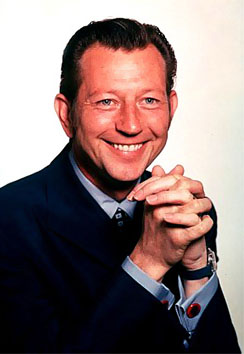
Charles Boyer (must have been in the sun too long), Donald O'Connor (him, too); Ben Gazzara; David Soul (the way he was); Daniel Stern and Shania Twain
0 Replies
Letty
1
Reply
Tue 28 Aug, 2007 11:22 am
Well, Puppy. Running is the way to work off those extra pounds. Love it, PA.
Great photo's for our gallery as usual, and you right, Raggedy. I do believe Charles and Donald have been colorized.
However, folks, Donald can still make 'em laugh.
Make 'em laugh
Make 'em laugh
Don't you know everyone wants to laugh?
My dad said "Be an actor, my son, but be a comical one."
They'll be standing in lines for those old honky-tonk monkeyshines
Now, you can study Shakspeare and be quite elite
And you could charm the critics and have nothing to eat
Just slip on a banana peel, the world's at your feet
Make 'em laugh
Make 'em laugh
Make 'em laugh
Make--
Make 'em laugh
Don't you know everyone wants to laugh?
My grandpa said "Go out and tell them a joke, but give it plenty of hope"
Make 'em roar
Make 'em scream
Take a fall, butt a wall, split a seam
You could start by pretending your a dancer with grace
Then you wiggle 'till they're giggling all over the place
Then you get a great big custard pie in the face
Make 'em laugh
Make 'em laugh
Make 'em laugh
Make 'em--
What?--
My Dad--
They'll be standing in lines for those old honky-tonk monkeyshines
Make 'em laugh
Make 'em laugh
Make 'em laugh
Make 'em laugh!
0 Replies
bobsmythhawk
1
Reply
Tue 28 Aug, 2007 12:10 pm
What a wonderful song from what many regard as the best musical ever Singing in the Rain. Allow me to play another.
Moses Supposes lyrics
Artist - Gene Kelly
Album - Various Songs
Lyrics - Moses Supposes
Moses supposes his toeses are Roses,
But Moses supposes Erroneously,
For Moses he knowses his toeses aren't roses,
As Moses supposes his toeses to be!
Moses supposes his toeses are Roses,
But Moses supposes Erroneously,
A mose is a mose!
A rose is a rose!
A toes a toes!
Hooptie doodie doodle
Moses supposes his toeses are Roses,
But Moses supposes Erroneously,
For Moses he knowses his toeses arent roses,
As Moses supposes his toeses to be!
Moses
(Moses supposes his toeses are roses)
Moses
(Moses supposes erroneously)
Moses
(Moses he knowses his toeses aren't roses)
As Moses supposes his toeses to be!
A Rose is a rose is a rose is a rose is
A rose is what Moses supposes his toes is
Couldn't be a lily or a taffi daphi dilli
It's gotta be a rose cuz it rhymes with mose!
Moses!
Moses!
Moses!
(Dance Sequence)
AAAAAAAAAAAAA!!!!!
0 Replies
Letty
1
Reply
Tue 28 Aug, 2007 12:52 pm
Hey, Bob. Never heard that one but I love it, Boston.
Here's one that Donald O'Connor sang, but this version is by a man from The Moulin Rouge and with Jane instead of Ethel.
Ewan McGregor
I hear singing and there's no one there
I smell blossoms and the trees are bare
All day long I seem to walk on air
I wonder why
I wonder why
I keep tossing in my sleep at night
And what's more, I lost my appetite
Stars that used to twinkle in the skies
Are twinkling in my eyes
I wonder why
Jane Horrocks:
You don't need analyzing
It is not so surprising
That you feel very strange, but nice
Your heart goes pitter-patter
I know just what's the matter
'Cause I've been there once or twice
Put your head on my shoulder
You need someone who's older
A red dove with a velvet glove
There is nothing you can take
To relieve this pleasant ache
You're not sick!
You're just in love
0 Replies
hamburger
1
Reply
Tue 28 Aug, 2007 05:04 pm
no music all afternoon ?
all gone to have a snooze ?
this should wake you up !
AND SHAKE YOU UP !
Quote:
Mama's Losin' a Mighty Good Chance
(Johnson - Allen)
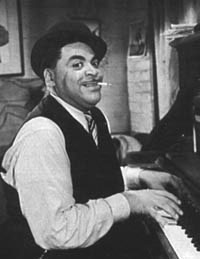
Transcribed from vocals by Caroline Johnson, accompanied by Fats Waller, recorded 4/23/1924.
From Fats Waller 1922-1926; The Chronogical Classics, 664.
Daddy, let me tell to you
Just why Mama's feeling blue,
It's forever on my mind,
I'm undecided what to do;
Mama's got to let it out,
You should know without a doubt,
Just what's driving me insane,
Now here's what it's all about:
Mama's losin' a mighty good chance,
Fooling 'long with you.
Mama should have told you long in advance,
But she didn't know what you'd do.
I could-a had a ring, a fur coat, too.
A sweet lovin' daddy who could do, do, do;
Mama's losin' a mighty good chance,
Fooling 'long with you.
Mama's losin' a mighty good chance,
Fooling 'long with you,
Mama should have told you long in advance,
But she didn't know what you'd do,
I could-a had a flat, money he'd bring,
A sweet, loving daddy, who could shake that thing;
Mama's losin' a mighty good chance,
Fooling 'long with you,
You big mistreater!
Fooling 'long with you,
You long mosquito!
Fooling 'long with you!
0 Replies
hamburger
1
Reply
Tue 28 Aug, 2007 05:32 pm
WAKEY ! WAKEY ! shake a leg , will ya !
Quote:
Refrigeratin' Papa
(Mama's Gonna Warm You Up)
(Wasserman)
Transcribed from vocals by Ethel Waters and an unknown vocalist, recorded February 17, 1926.
From Ethel Waters 1925-1926, The Chronogical Classics, vol. 672.
I'm gonna tell you, folks, all about
A certain red-hot gal;
She runs an institute in the South
For all her polar pals;
She teaches papas who treat her cool,
They're always hot when they leave her school;
But she's got a secret she won't let out,
But I just heard her shout:
Refrigeratin' papa, Mama's gonna make you hot,
Yes, make you hot!
Refrigeratin' papa, heat is something you ain't got,
No, you ain't got!
A red-hot papa's nice and warm,
But cold ones don't run true to form;
I always make a papa what he's got,
I change a frigid papa to a hottentot!
Refrigeratin' papa, Mama's gonna warm you up!
Yes, warm you up!
'Cause when it comes to lovin',
I win most every lovin' cup,
For lovin' up;
I had a papa once so cold he nearly froze,
But Mama made him holler, "Please, burn up my clothes!"
Refrigeratin' papa, Mama's gonna make you hot!
Refrigeratin' papa, Mama's gonna make you hot!
Yes, make you hot!
Refrigeratin' papa, heat is what I like a lot!
Yes, like a lot!
I'm gonna teach you from the start,
That you can't trifle with my heart;
You'll have to learn the fundamental facts,
Or else your mama's gonna pile you up in stacks.
Refrigeratin' papa, Mama's gonna warm you up!
Yes, warm you up!
'Cause when it comes to lovin',
I win most every lovin' cup,
For lovin' up;
I hate the kind of man who always aggravates,
I make their hearts of stone begin to palpitate!
Refrigeratin' papa, Mama's gonna make you hot!
Red hot!
0 Replies
Letty
1
Reply
Tue 28 Aug, 2007 06:02 pm
Thanks, hbg, for getting us back on the air. Love your Fats song, buddy.
Hmmm, I think our search folks are becoming too independent, so maybe Fats knows why
A Little Bit Independent
There's nothing like you in Paris or New York
You're awfully easy on the eyes
A little bit independent when we dance
A little bit independent toward romance
A bit of sophistication in your glance
And yet you're easy on the eyes
Whenever I'm with you alone
You weave a magic spell
And though it be a danger zone
I only know that you're swell
A little bit independent with your smile
A little bit independent in your style
But how can I help but love you all the while
When you're so easy on the eyes
and, because your PD is a little fussy today, here's another from Mr. Waller
Cross patch how can anyone be so cross
Won't you tumble off your high horse
You know you love to be loved
Cross patch, if you feel the wind change, they say
[these lyrics are found on http://www.songlyrics.com]
It will make your face stay that way
And then you'll never be loved
Cultivate a smile sweet and sunny
You can catch a fly with honey
You're actin so spoiled
Shame, shame... everybody knows your name
Cross patch don't you know it takes two to fight
Won't you kiss and make up tonight
You know you love to be loved
0 Replies
edgarblythe
1
Reply
Tue 28 Aug, 2007 06:26 pm
A poem, by
William Carlos Williams
Portrait of a Lady
Your thighs are appletrees
whose blossoms touch the sky.
Which sky? The sky
where Watteau hung a lady's
slipper. Your knees
are a southern breeze -- or
a gust of snow. Agh! what
sort of man was Fragonard?
-- As if that answered
anything. -- Ah, yes. Below
the knees, since the tune
drops that way, it is
one of those white summer days,
the tall grass of your ankles
flickers upon the shore --
Which shore? --
the sand clings to my lips --
Which shore?
Agh, petals maybe. How
should I know?
Which shore? Which shore?
-- the petals from some hidden
appletree -- Which shore?
I said petals from an appletree
0 Replies
Letty
1
Reply
Tue 28 Aug, 2007 06:33 pm
Lovely poem by W.C.W., edgar. It is a poetry type of evening, right?
Hope our listeners enjoy these two as well.
Aaron Stark
Withal a meagre man was Aaron Stark, --
Cursed and unkempt, shrewd, shrivelled, and morose.
A miser was he, with a miser's nose,
And eyes like little dollars in the dark.
His thin, pinched mouth was nothing but a mark;
And when he spoke there came like sullen blows
Through scattered fangs a few snarled words and close,
As if a cur were chary of its bark.
Glad for the murmur of his hard renown,
Year after year he shambled through the town, --
A loveless exile moving with a staff;
And oftentimes there crept into his ears
A sound of alien pity, touched with tears, --
And then (and only then) did Aaron laugh.
-- Edwin Arlington Robinson
The Red Wheelbarrow
William Carlos Williams
so much depends
upon
a red wheel
barrow
glazed with rain
water
beside the white
chickens.
0 Replies
edgarblythe
1
Reply
Wed 29 Aug, 2007 05:22 am
Mother's Little Helper
The Rolling Stones
[Written by Jagger, Richard]
What a drag it is getting old
"Kids are different today"
I hear ev'ry mother say
Mother needs something today to calm her down
And though she's not really ill
There's a little yellow pill
She goes running for the shelter of a mother's little helper
And it helps her on her way, gets her through her busy day
"Things are different today"
I hear ev'ry mother say
Cooking fresh food for a husband's just a drag
So she buys an instant cake and she burns her frozen steak
And goes running for the shelter of a mother's little helper
And two help her on her way, get her through her busy day
Doctor, please, some more of these
Outside the door, she took four more
What a drag it is getting old
"Men just aren't the same today"
I hear ev'ry mother say
They just don't appreciate that you get tired
They're so hard to satisfy. You can tranquilise your mind
So go running for the shelter of a mother's little helper
And four help you through the night, help to minimise your plight
Doctor,plese, some more of these
Outside the door, she took four more
What a drag it is getting old
Life's just much too hard today"
I hear ev'ry mother say
The pursuit of happiness just seems a bore
And if you take more of those, you will get an overdose
No more running to the shelter of a mother's little helper
They just helped you on your way through your busy dying day
0 Replies
Letty
1
Reply
Wed 29 Aug, 2007 05:54 am
Good morning, WA2K.
edgar, here's a response to your Mick and I had forgotten this oldie, buddy.
Kids!
I don't know what's wrong with these kids today!
Kids!
Who can understand anything they say?
Kids!
They a disobedient, disrespectful oafs!
Noisy, crazy, dirty, lazy, loafers!
While we're on the subject:
Kids!
You can talk and talk till your face is blue!
Kids!
But they still just do what they want to do!
Why can't they be like we were,
Perfect in every way?
What's the matter with kids today?
Kids!
I've tried to raise him the best I could
Kids! Kids!
Laughing, singing, dancing, grinning, morons!
And while we're on the subject!
Kids! They are just impossible to control!
Kids! With their awful clothes and their rock an' roll!
Why can't they dance like we did
What's wrong with Sammy Caine?
What's the matter with kids today!
er, just who is Sammy Caine?
0 Replies
bobsmythhawk
1
Reply
Wed 29 Aug, 2007 07:37 am
Barry Sullivan
From Wikipedia, the free encyclopedia
Born August 29, 1912
New York City, New York, USA
Died June 6, 1994 aged 81
Sherman Oaks, California, USA
Barry Sullivan (August 29, 1912 - June 6, 1994) was an American movie actor who appeared in over 100 movies from the 1930s to the 1980s.
Born in New York City, Sullivan was a Broadway actor before breaking into films in the 1930s. One of his most memorable roles was playing a movie director in The Bad and the Beautiful.
In 1950, Sullivan took over the role of Leslie Charteris' Simon Templar from Vincent Price on The Saint NBC Radio show. Unfortunately, Sullivan only lasted two episodes before the show was cancelled, and then resurrected five weeks later with Vincent Price once again playing the starring role.
In 1960 Sullivan played frontier sheriff Pat Garrett opposite Clu Gulager as outlaw Billy the Kid in the western television series The Tall Man (although the series ran for 75 episodes, the one in which Garrett kills Billy was never filmed). He also cameoed in Sam Peckinpah's Pat Garrett & Billy the Kid (1973) as John Chisum, but his scene was excised from the release print (though later restored to the film).
Sullian has two stars on the Hollywood Walk of Fame: one at 1500 Vine St. for his work in television, and another at 6160 Hollywood Blvd for motion pictures.
His daughter Jenny Sullivan wrote the play J for J (Journals for John) after she found a packet of unsent letters (in 1995) written by Barry decades earlier to her older brother, Johnny, who was mentally disabled. The play premiered on October 20, 2001. John Ritter, who in real life had a handicapped brother, played Johnny, Jenny played herself, and actor Jeff Kober portrayed Barry.
0 Replies
bobsmythhawk
1
Reply
Wed 29 Aug, 2007 07:56 am
Ingrid Bergman
From Wikipedia, the free encyclopedia
Born August 29, 1915(1915-08-29)
Stockholm, Sweden
Died August 29, 1982, her 67th birthday
London, United Kingdom
Years active 1935-1982
Spouse(s) Dr. Aron Petter Lindström (1937-1950)
Roberto Rossellini (1950-1957)
Lars Schmidt (1958-1975)
Children Pia Lindström (b.1938)
Roberto Ingmar Rosselini (b.1950)
Isabella Rossellini (b.1952)
Ingrid Rossellini(b.1952)
[show]Awards
Academy Awards
Best Actress
1944 Gaslight
1956 Anastasia
Best Supporting Actress
1974 Murder on the Orient Express
BAFTA Awards
Best Supporting Actress
1974 Murder on the Orient Express
César Awards
Honorary César
1976 Lifetime Achievement
Emmy Awards
Outstanding Lead Actress - Miniseries/Movie
1960 Turn of the Screw
1982 A Woman Called Golda
Golden Globe Awards
Best Actress - Motion Picture Drama
1945 Gaslight
1946 The Bells of St. Mary's
1957 Anastasia
Best Actress - Miniseries
1983 A Woman Called Golda
Tony Awards
Best Leading Actress in a Play
1947 Joan of Lorraine
Other Awards
NYFCC Award for Best Actress
1945 Spellbound ; The Bells of St. Mary's
1956 Anastasia
1978 Autumn Sonata
Ingrid Bergman (help·info) (pronounced [ˈbærjman] in Swedish, but usually [ˈbɝgmən] in English, IPA notation) (August 29, 1915 - August 29, 1982) was a three-time Academy Award-winning and two-time Emmy Award-winning Swedish actress. She also won the Tony Award for Best Actress in the first Tony Award ceremony in 1947. She is ranked as the fourth greatest female star of all time by the American Film Institute.[1]
Biography
Early years: 1915-1938
Bergman, named after Princess Ingrid of Sweden [2], was born in Stockholm, Sweden on August 29, 1915 to a Swedish father, Justus Samuel Bergman, and a German mother, Friedel Adler Bergman. When she was three years old, her mother died. Her father passed away when she was thirteen. She was then sent off to live with an aunt, who died of heart complications only six months later. Afterwards she was raised by another aunt and uncle, who had five children.
At the age of 17, Ingrid Bergman auditioned for and was accepted to the Royal Dramatic Theatre in Stockholm. During her first summer break, she was hired at a Swedish film studio, which consequently led to her leaving the Royal Dramatic Theater to work in films full time, after having attended for only one year. Her first film role after leaving the Royal Dramatic Theater was a small part in 1935's Munkbrogreven (She had previously been an extra in the 1932 film Landskamp).
On July 10, 1937, at the age of 21, she married a dentist, Petter Lindström (who would later become a neurosurgeon). On September 20, 1938, she gave birth to a daughter, Pia Lindström.
After a dozen films in Sweden (including En kvinnas ansikte which would later be remade as A Woman's Face with Joan Crawford) and one in Germany, Bergman was signed by Hollywood producer David O. Selznick to star in the 1939 English language remake of her 1936 Swedish language film, Intermezzo. It was an enormous success and Bergman became a star, described as "Sweden's illustrious gift to Hollywood". Some things that set her apart from other female stars in Hollywood at that time were that she did not change her name, her appearance was entirely natural with little to no makeup, and that she was one of the tallest leading ladies.
Hollywood period: 1938-1949
After completing one last film in Sweden and appearing in three moderately successful films in the United States, Bergman joined Humphrey Bogart in the 1942 classic film Casablanca, which remains her best known role.
That same year, she received her first Academy Award nomination for Best Actress for For Whom the Bell Tolls (1943), which was also her first color film. The following year, she won the Academy Award for Best Actress for Gaslight (1944). She received a third consecutive nomination for Best Actress with her performance as a nun in The Bells of St. Mary's (1945).
Later, she would receive another Best Actress nomination for Joan of Arc (1948), an independent film produced by Walter Wanger and initially released through RKO. Bergman had championed the role since her arrival in Hollywood, which is one of the reasons she had played it on the Broadway stage in Maxwell Anderson's Joan of Lorraine. Partly because of the scandal with Rossellini, the film, based on the Anderson play, was not a big hit, and received disastrous reviews. It was subsequently shorn of 45 minutes, and it was not until its restoration to full length in 1998 and its 2004 appearance on DVD that later audiences could see it as it was intended to be shown.
Bergman also starred in the Alfred Hitchcock films Spellbound (1945), Notorious (1946), and Under Capricorn (1949). Under Capricorn was a slow costume drama unlike earlier Hitchcock films -- the New York Times reviewer wrote that the audience had to wait 100 minutes for any suspense -- so that Bergman's reputation and the film's release suffered from this, and from the gathering adverse publicity over Bergman's affair with Rossellini.
Between motion pictures, Bergman appeared in the stage plays Liliom, Anna Christie, and Joan of Lorraine. Furthermore, during a press conference in Washington, D.C. for the promotion of Joan of Lorraine, she protested against segregation after seeing it first hand at the theater she was acting in. This led to a lot of publicity and some hate mail.
Ingrid Bergman also went to Alaska during World War II in order to entertain troops. Soon after the war ended, she also went to Europe for the same purpose, where she was able to see the devastation caused by the war. It was also during this time that she began a relationship with the famous photographer Robert Capa.
Italian period: 1949-1957
In 1949, Bergman met Italian director Roberto Rossellini in order to make the film Stromboli (1950), after having been a fan of two of his previous films that she had seen while in the United States. During the making of this movie, she fell in love with him and became pregnant with a son, Roberto Ingmar Rossellini (born February 7, 1950).
The pregnancy caused a huge scandal in the United States. It even led to her being denounced on the floor of the U.S. Senate by Edwin C. Johnson, a senator from Colorado, who referred to her as "a horrible example of womanhood and a powerful influence for evil." In addition, there was a floor vote, which resulted in her being made persona non grata. The scandal forced Ingrid Bergman to exile herself to Italy, leaving her husband and daughter in the United States. Her husband, Dr. Petter Lindström, eventually sued for desertion and waged a custody battle for their daughter.
Ingrid Bergman married Roberto Rossellini on May 24, 1950. On June 18, 1952, she gave birth to twin daughters, Isabella Rossellini, who is a famous actress and model, and Isotta Ingrid Rossellini. Over the next few years, she appeared in several Italian films for Rossellini, including Giovanna d'Arco al rogo (Jeanne d'Arc au bûcher, Joan of Arc at the Stake, 1954), a 1935 dramatic oratorio by Arthur Honegger about Joan of Arc. Their marriage ended in divorce on November 7, 1957.
After separating from Rossellini, she starred in Jean Renoir's Elena and Her Men (Elena et les Hommes, 1956), a romantic comedy where she played a Polish princess caught in political intrigue. Although the film wasn't a success, it has since come to be regarded as one of her best performances.
During her time in Italy, anger over her private life had continued unabated in the United States, with Ed Sullivan at one point infamously polling his TV show audience as to whether she should be forgiven.
Later years: 1957-1982
With her starring role in 1956's Anastasia, Bergman made a triumphant return to the American screen and won the Academy Award for Best Actress for a second time. The award was accepted for her by her friend Cary Grant.[3] Bergman would not make her first post-scandal public appearance in Hollywood until the 1958 Academy Awards, when she was the presenter of the Academy Award for Best Picture.[4] Furthermore, after being introduced by Cary Grant and walking out on stage to present, she was given a standing ovation.
Bergman would continue to alternate between performances in American and European films for the rest of her career and also made occasional appearances in television dramas such as a 1959 production of The Turn of the Screw for Startime for which she won an Emmy Award for Outstanding Single Performance by an Actress.
During this time, she also performed in several stage plays. In addition, she married the producer Lars Schmidt, a fellow Swede, on December 21, 1958. This marriage ultimately led to divorce in 1975.
In 1972, Senator Charles H. Percy entered an apology into the Congressional Record for the attack made on her 22 years earlier by Edwin C. Johnson.
Bergman received her third Academy Award (and first for Best Supporting Actress) for her performance in Murder on the Orient Express (1974), but she publicly declared at the Academy Awards telecast that year that the award rightfully belonged to Italian actress Valentina Cortese for Day for Night by concluding her acceptance speech with "Please forgive me, Valentina. I didn't mean to."[5]
In 1978, she played in Ingmar Bergman's Höstsonaten (Autumn Sonata) for which she received her seventh Academy Award nomination and made her final performance on the big screen. In the film, Bergman plays a celebrity pianist who returns to Sweden to visit her neglected daughter, played by Liv Ullmann. The film was shot in Norway. It is considered by many to be among her best performances.
She was honored posthumously with her second Emmy Award for Best Actress in 1982 for the television mini-series A Woman Called Golda, about the late Israeli prime minister Golda Meir. It was her final acting role.
Death
Ingrid Bergman died in 1982 on her 67th birthday in London, England, following a long battle with breast cancer. Her body was cremated in Sweden. Most of her ashes were scattered in the sea with the remainder being interred in the Norra begravningsplatsen in Stockholm next to her parents. A single violin played the song "As Time Goes By", the theme from Casablanca, recalling her most famous role, that of Ilsa Lund.
Autobiography
In 1980, Bergman's autobiography was published under the title Ingrid Bergman: My Story. It was written with the help of Alan Burgess, who had written the book The Small Woman, on which the film The Inn of the Sixth Happiness was based. In the book, she discusses her childhood, her early career, her life during her time in Hollywood, the Rossellini scandal and subsequent events. The book was written after her children warned her that she would only be known through rumors and interviews if she did not tell her own story. It was through this autobiography that her affair with Robert Capa became known.
Legacy
For her contributions to the motion picture industry, Ingrid Bergman has a star on the Hollywood Walk of Fame at 6759 Hollywood Blvd. She continues to be a cultural icon - not only for her role in Casablanca, but for her career as a whole and for her innocent, natural beauty. In addition, she is considered by many to be one of the foremost actresses of the 20th century.
Trivia
There is a hybrid tea rose named after her.[6]
She became a smoker after needing to smoke for her role in Arch of Triumph.[7]
She was the President of the Jury at the 1973 Cannes Film Festival.[8]
Bergman could speak Swedish (her native language), German (her second language), English (learned when brought over to United States), Italian (learned while exiled in Italy through osmosis from previous knowledge of French[citation needed]), and French (learned formally from language teachers) fluently. In addition, she acted in each of these languages at various times. Fellow actor John Gielgud, who had acted with her in Murder on the Orient Express and who had directed her in the play The Constant Wife, playfully mocked this ability when he remarked, "She speaks five languages and can't act in any of them."[9]
She was the topic of a Woody Guthrie song entitled "Ingrid Bergman," which was composed in the year 1950. At the request of Woody's daughter Nora Guthrie, English folk-rocker Billy Bragg and the alternative country group Wilco set these lyrics to music and placed the song on the 1998 hit album "Mermaid Avenue."[10]
She hosted the AFI's Life Achievement Award Ceremony for Alfred Hitchcock in 1979.[11]
After losing to Ingrid Bergman for the 1944 Best Actress Academy Award, Barbara Stanwyck told the press she was a "member of The Ingrid Bergman Fan Club", "I don't feel at all bad about the Award because my favorite actress won it and has earned it by all her performances."[12]
Ingrid Bergman was a student of the acting coach Michael Chekhov during the 1940s. Coincidentally, it was his role in Spellbound, of which she was a star, that he received his only nomination for an Academy Award.[13]
Bergman didn't think much of Casablanca, and was somewhat irritated when asked about the film. "I made so many films which were more important, but the only one people ever want to talk about is that one with Bogart." About Bogart, she said "I never really knew him. I kissed him, but I didn't know him."[14]
Although they worked together, Bergman is not related to fellow Swedish director Ingmar Bergman. The fact that Ingmar Bergman married Ingrid von Rosen who subsequently took the name Ingrid Bergman sometimes further contributes to confusion about their relation.
Quotes
" A kiss is a lovely trick designed by nature to stop speech when words become superfluous. "
?-Ingrid Bergman
" Happiness is good health and a bad memory. "
?-Ingrid Bergman
" I've gone from saint to whore and back to saint again, all in one lifetime. "
?-Ingrid Bergman
" I've never sought success in order to get fame and money; it's the talent and the passion that count in success. "
?-Ingrid Bergman
0 Replies
bobsmythhawk
1
Reply
Wed 29 Aug, 2007 07:58 am
George Montgomery
From Wikipedia, the free encyclopedia
Birth name George Montgomery Letz
Born August 29, 1916
Brady, Montana
Died December 12, 2000 (aged 84)
Rancho Mirage, California
Spouse(s) Dinah Shore (1943-1962)
Children Melissa Montgomery
John David Montgomery (adopted)
George Montgomery (August 29, 1916 - December 12, 2000) was an American painter, sculptor, furniture craftsman, and stuntman who is best known as an actor in western style film and television.
Born George Montgomery Letz to Ukrainian immigrant parents in Brady, Montana, he was the youngest of fifteen children. He was raised on a large ranch where as a part of daily life he learned to ride horses and work cattle. Letz studied at the University of Montana but because he was more interested in a career in film, he left after a year to go to Hollywood. At Republic Pictures, his cowboy skills got him stunt work and a small acting part in the 1935 western film, The Singing Vagabond. He followed this with several more bit parts and additional stunt work using his own name George Letz in mostly low-budget films. He was frequently cast in western films starring their number one box office draw, the singing cowboy, Gene Autry. Elevated to more important secondary roles, in 1938 George Letz appeared as one of the five rangers in The Lone Ranger. He remained with Republic Pictures until 1940 when he signed with 20th Century Fox who dropped the Letz from his name, billing him as George Montgomery.
At 20th Century Fox, Montgomery appeared in more westerns including The Cisco Kid and the Lady (1940) with Cesar Romero. In 1942, he played opposite jazz musician Glenn Miller in Orchestra Wives (whicht marked the non-credited debut of an aspiring actress named Dale Evans) and Ginger Rogers in Roxie Hart. The following year, Montgomery starred with Betty Grable in the Walter Lang-directed film, Coney Island. However, World War II interrupted his film career when he joined the United States Army Air Corps in 1943. On December 5 of that year he married Dinah Shore with whom he would have two children during a marriage that lasted until 1962. In 1963, Montgomery's private life made media headlines when his housekeeper was charged with a failed attempt to kill him. Allegedly suffering from a fanatical attraction to her employer, the deranged woman planned to shoot Montgomery then take her own life.
As a boy, George Montgomery had developed excellent craftsmanship with wood and as an adult pastime he began building furniture; first for himself and then for a few friends. His skill was such that his hobby became a full-fledged cabinetmaking business, employing as many as twenty craftsmen.
Montgomery oversaw the furniture making business for more than forty years and expanded his interest to house design that saw him involved with the building of eleven homes for friends and family. His artistic instincts also included learning how to sculpt in bronze. Self-taught, he sculpted upwards of fifty bronze sculptures including those of John Wayne, Clint Eastwood, Gene Autry, Randolph Scott, and future U.S. president, Ronald Reagan. His sculpture of ex-wife Dinah Shore and their children is at the Mission Hills Country Club in Rancho Mirage, California home to the LPGA Dinah Shore Golf Tournament.
Through to the early 1970s, Montgomery acted regularly in films and made guest appearances on a number of television shows, including the popular western drama, Bonanza. For two seasons in 1958 and 1959 he also starred in his own television series, Cimarron City. After a career that included more than eighty feature films, Montgomery retired in 1972, making only two more minor appearances in film until his death at his home in Rancho Mirage, California in 2000.
After cremation, Montgomery's ashes were divided and interred at Forest Lawn Cemetery (Cathedral City) near his Palm Springs, California home and at the Highland Cemetery in Great Falls, Montana near his birthplace.
For his contribution to the television industry, George Montgomery has a star on the Hollywood Walk of Fame at 6301 Hollywood Blvd.
0 Replies
bobsmythhawk
1
Reply
Wed 29 Aug, 2007 08:08 am
Charlie Parker
From Wikipedia, the free encyclopedia
Background information
Birth name Charles Parker, Jr.
Also known as Yardbird, Bird
Born 29 August 1920
Kansas City, Kansas
Origin Kansas City, Missouri
Died 12 March 1955 (aged 34)
New York City, New York
Genre(s) Jazz, Bebop
Occupation(s) Saxophonist, Composer
Instrument(s) Saxophone
Years active 1937 - 1955
Label(s) Savoy, Dial, Verve
Website Official Site
Charles "Bird" Parker, Jr. (August 29, 1920 - March 12, 1955) was an American jazz saxophonist and composer. Early in his career Parker was dubbed "Yardbird" (there are many contradictory stories of the name's origin [1]). It was later shortened to "Bird" and remained Parker's nickname for the rest of his life and inspiration for the titles of his works, such as "Yardbird Suite," "Ornithology," and "Bird Feathers".
Place in jazz history
Parker is commonly considered one of the greatest jazz musicians, ranked with such players as Louis Armstrong and Duke Ellington. Jazz critic Scott Yanow speaks for many jazz fans and musicians when he states that "Parker was arguably the greatest saxophonist of all time."[2] A founding father of bebop, Parker's innovative approaches to melody, rhythm, and harmony were enormously influential on his contemporaries, and his music remains an inspiration and resource for musicians in jazz as well as in other genres. Several of Parker's songs have become standards, such as "Billie's Bounce," "Anthropology," "Ornithology," and "Confirmation".
Parker also became an icon for the Beat generation, and was a pivotal figure in the evolving conception of the jazz musician as an uncompromising artist and intellectual, rather than just a popular entertainer. At various times, Parker fused jazz with other musical styles, from classical (seeking to study with Edgard Varèse and Stefan Wolpe) to Latin music (recordings with Machito), blazing paths followed later by others.
Parker's soaring, fast, rhythmically asymmetrical improvisations could amaze the listener. His harmonic ideas were revolutionary, introducing a new tonal vocabulary employing 9ths, 11ths and 13ths of chords, rapidly implied passing chords, and new variants of altered chords and chord substitutions. His tone was clean and penetrating, but sweet and plaintive on ballads. Although many Parker recordings demonstrate dazzling virtuoso technique and complex melodic lines ?- such as "Koko," "Kim," and "Leap Frog" ?- he was also one of the great blues players. His themeless blues improvisation "Parker's Mood" represents one of the most deeply affecting recordings in jazz, as fundamental as Armstrong's "West End Blues."
Biography
Childhood
Charlie Parker was born in Kansas City, Kansas and raised in Kansas City, Missouri. He was the only child of Charles and Addie Parker. Charles was often absent because of his alcoholic lifestyle. A persistent myth, repeated by many reputable sources, including the Encyclopædia Britannica, is that Christopher was Parker's second Christian name.
Charlie Parker displayed no sign of musical talent as a child. Parker's father presumably provided some musical influence; he was a pianist, dancer and singer on the T.O.B.A. circuit, although he later became a Pullman waiter or chef on the railways. His mother worked nights at the local Western Union. His biggest influence however was a young trombone player who taught him the basics of improvisation.
Parker began playing the saxophone at age 11 and then at age 14 he joined his school's band using a rented school instrument. One story goes that Parker, having never been taught formally, was terrible, and thrown out of the band. Experiencing occasional discouragements of this sort, at one point Parker broke off his already constant practicing. In 1937 Parker played at a concert that included Jo Jones on drums, who tossed a cymbal at Parker's feet in impatience with his playing, and to remove him from the stand. Exasperated and determined, from that point Parker improved the quality of practicing, learning the blues, "Cherokee" and "rhythm changes" in all twelve keys, and eventually become a virtuoso through sheer hard work. In an interview with Paul Desmond he said he spent 3-4 years practicing up to 15 hours a day.[3] Rumor has it that he used to play the same melodies in all twelve keys. The story, whilst uncited, would help to explain the fact that Parker often played in unconventional concert pitch key signatures, like E (which transposes down to C# for the alto sax). Groups led by Count Basie and Bennie Moten were the leading Kansas City ensembles, and doubtless influenced Parker. He continued to play with local bands in jazz clubs around Kansas City, Missouri, where he perfected his technique with the assistance of Buster Smith, whose dynamic transitions to double and triple time certainly influenced Parker's developing style. In 1937 Parker joined pianist Jay McShann's territory band,[4] and was able to tour with him to the nightclubs and other venues of the southwest region of the USA, as well as Chicago and New York City.[5][6] Parker made his recording debut with McShann's band.
In NYC
In 1939, Parker moved to New York City. There he pursued a career in music, but held several other jobs as well. One of these was as a dishwasher, making $9 a week, at Jimmie's Chicken Shack, a restaurant where famous pianist Art Tatum was playing at the time. (Parker's later style was in some ways reminiscent of Tatum's, with dazzling, high-speed arpeggios and sophisticated use of harmony.)
In 1942 Parker left McShann's band and played with Earl Hines for seven months. The early history of bebop is difficult to document because of the strike of 1942-1943 by the American Federation of Musicians, during which there were no official recordings. Nevertheless we know that Parker was one of a group of young musicians who congregated in after-hours clubs in Harlem such as Minton's Playhouse and Clark Monroe's Uptown House. These young iconoclasts included trumpeter Dizzy Gillespie, pianist Thelonious Monk, guitarist Charlie Christian, and drummers Max Roach and Kenny 'Klook' Clarke. The beboppers' attitude was summed up in a famous quotation attributed to Monk by Mary Lou Williams: "We wanted a music that they couldn't play" ?- "they" being either the (white) bandleaders who had taken over and profited from swing music and or unwelcome fellow musicians wishing to jam with Parker, Gillespie and others. The group played in venues on the now famous 52nd Street including Three Deuces and The Onyx. In his time in NYC, he also learned much from notable music teacher Maury Deutsch.
Bebop
By now, Parker was emerging as a leading figure in the emerging bebop scene. According to an interview Parker gave in the 1950s, one night in 1939, he was playing "Cherokee" in a jam session with guitarist William 'Biddy' Fleet when he hit upon a method for developing his solos that enabled him to play what he had been hearing in his head for some time, by building on the chords' extended intervals, such as ninths, elevenths, and thirteenths.
Early in its development, this new type of jazz was rejected and disdained by many older, more established jazz musicians, whom the beboppers, in response, called 'moldy figs'. However, some musicians, such as Coleman Hawkins and Benny Goodman, were more positive about its emergence. It was not until 1945 that Parker's collaborations with Dizzy Gillespie had a substantial effect on the jazz world. One of their first (and greatest) small-group performances together was only discovered and issued in 2005: a concert in New York's Town Hall on June 22, 1945 (now available on Uptown Records).
On November 26, 1945 Parker led a record date for the Savoy label, which was once marketed, during the LP era, as the "greatest Jazz session ever". Although this may have been hyperbole, the Savoy sessions produced an astounding collection of recordings ?- in spite of Dizzy Gillespie having to deputize on piano for some of the tracks. Among the tracks recorded during this session are "Koko" (based on the chords of "Cherokee"), "Now's the Time" (a twelve bar blues incorporating a riff later used in the late 1949 R&B dance hit "The Hucklebuck"), "Billie's Bounce", and "Thriving on a Riff."
Shortly afterwards, a trip to Los Angeles by the Parker/Gillespie band to fulfill an engagement at Billy Berg's club was less than successful. Most of the band soon decided to return to New York. Parker, though, stayed in California, where his self-destructive lifestyle was to catch up with him.[specify]
Addiction
As a teenager, he had developed a morphine addiction while in a hospital after an automobile accident, and subsequently became addicted to heroin, which was to haunt him throughout his life and to ultimately contribute to his death. Parker's habit was to cause him to miss gigs and to be fired for being high. To continue his "buzz" he frequently resorted to busking on the streets for drug money. Parker's example was typical of the strong connection between narcotics and jazz at the time.
Although he produced many brilliant recordings during this period, Parker's behavior became increasingly erratic. Heroin was difficult to obtain after his dealer was arrested, and Parker began to drink heavily to compensate for this. A recording for the Dial label from July 29, 1946 provides evidence of his condition. Prior to this session Parker drank about a quart of whiskey. According to the liner notes of, Bird on Dial Volume 1 Parker missed most of the first two bars of his first chorus on the track, "Max is making wax". When he finally did come in, he swayed wildly and once spun all the way around, going badly off mic. On the next tune, "Lover Man", Ross Russell was enlisted to hold Parker in place in front of the microphone. On the final track recorded that evening, Parker begins a solo with a solid first eight bars. On his second eight bars, however, Parker begins to struggle, and a desperate Howard McGhee, playing trumpet on the session, shouts, "Blow!" at Parker. McGhee's bellow is audible on the recording. Some, including Charles Mingus, consider this version of "Lover Man" to be among his greater recordings despite its flaws. Nevertheless, Bird hated the recording and never forgave his producer Ross Russell for releasing the sub-par record (and re-recorded the tune in 1953 for Verve, this time in stellar form, but perhaps lacking some of the passionate emotion in the earlier, problematic attempt).
The night of the "Lover Man" session, Parker was drinking in his hotel room. He went down to the hotel lobby stark naked and asked to use the phone, several times. He was refused on each attempt and the hotel manager eventually locked him in his room. At some point in the night he set fire to his mattress with a cigarette, then ran through the hotel lobby wearing only his socks. He was arrested and committed to Camarillo State Hospital, where he remained for six months.
Coming out of the hospital, Parker was initially clean and healthy, and proceeded to do some of the best playing and recording of his career. Before leaving California, he recorded "Relaxin' at Camarillo," in reference to his hospital stay. He returned to New York and recorded dozens of sides for the Savoy and Dial labels that remain some of the high points of his recorded output. Many of these were with his so-called "classic quintet" that included trumpeter Miles Davis and drummer Max Roach. The highlights of these sessions include a series of slower-tempo performances of American popular songs including "Embraceable You" and "Bird of Paradise" (based on "All the Things You Are").
Despite many of the compositions which bear his name being based on earlier pieces from the American songbook, Parker's legacy as a deviser of jazz standards is significant. Such pieces include "Anthropology", "Confirmation", and "Yardbird Suite", which have been performed by numerous other musicians. Like his solos, his compositions are characterised by long, complex melodic lines and a minimum of repetition - generally speaking, an eight-bar segment will not contain any repeated motifs or sequences.
Charlie Parker With Strings
On November 3rd, 1949 Norman Granz arranged for Charlie Parker, a leader of bebop jazz, and a group of professional chamber orchestra musicians to record an album of ballads.[1] The instrumentation breakdown goes as follows: Charlie Parker on alto saxophone, Mitch Miller on oboe and English horn, Bronislaw Gimpel, Max Hollander, and Milton Lamask on violin, Frank Brieff on viola, Frank Miller on cello, Meyer Rosen on Harp, Stan Freeman on Piano, Ray Brown on bass, Buddy Rich on drums, and Jimmy Carroll as arranger and conductor.[2] Six songs came out of this recording session Just Friends, Everything Happens to Me, April in Paris, Summertime, I Didn't Know What Time It Was, and If I Should Lose You. The sound of these recordings is an interesting mix of romantic era string music, similar to the work of Tchaikovsky, and cool jazz before it became popular. While using classical music instrumentation with jazz musicians was not entirely original, this was the first major work where a composer of bebop was pitted with a string orchestra. While the musicianship was regarded as being at a high standard Ross Russell notes in his book that "The scores by Jimmy Carroll were glib and without distinction... the freedom that he (Parker) had enjoyed within the intimate, flexible setting of the Quintet, so essential to inspiration and real improvisation, had been lost."[3]
Stardom
By 1950, much of the jazz world was under Parker's sway. His solos were transcribed and copied; legions of saxophonists imitated his playing note-for-note (in response to these pretenders, Parker's erstwhile bandmate Charles Mingus titled a song "Gunslinging Bird" (meaning "If Charlie Parker were a gunslinger, there'd be a whole lot of dead copycats") featured on the album Mingus Dynasty. In this regard, he is perhaps only comparable to Louis Armstrong: both men set the standard for their instruments for decades, and very few escaped their influence.
In 1953, Parker was invited to perform at Massey Hall in Toronto, Canada, where he was joined by Gillespie, Charles Mingus, Bud Powell and Max Roach. Unfortunately, the concert clashed with a televised heavyweight boxing match between Rocky Marciano and Jersey Joe Walcott and as a result was poorly attended. Thankfully, for the sake of posterity, Mingus recorded the concert, and the album Jazz at Massey Hall is often cited as one of the finest recordings of a live jazz performance.
One of Parker's longstanding desires was to perform with a string section as he was a keen student of classical music. Contemporaries reported that he was most interested in the music and formal innovations of Igor Stravinsky, and longed to engage in a project akin to what became known as "Third Stream Music"; a new kind of music, incorporating both jazz and Euro-classical elements as opposed to merely incorporating a string section into performance of jazz standards. When he did record and perform with strings, some fans thought it was a "sell out" and a pandering to popular tastes. Time demonstrated Parker's move a wise one: Charlie Parker with Strings sold better than his other releases, and his version of "Just Friends" is seen as one of his best performances. In an interview, he considered it to be his best recording to date.
Parker was known for often showing up to performances without an instrument and borrowing someone else's at the last moment. At more than one venue he played on a plastic Grafton saxophone; later, saxophonist Ornette Coleman used this brand of plastic sax in his early career. On one particular occasion before a concert in Toronto, Canada, he had sold his saxophone to buy drugs, and at the last minute, he, Dizzy Gillespie and other members of Charlie's entourage went running around Toronto trying to find a saxophone. After scouring all the downtown pawnshops open at the time, they were only able to find a Grafton, which Parker proceeded to use at the concert that night. This concert is documented on the album "The Quintet, Live at Massey Hall". The album is considered one of the greatest live recordings in Jazz history.
Death
Parker died while watching Tommy Dorsey on television in the suite at the Stanhope Hotel belonging to his friend and patroness Nica de Koenigswarter. Though the official cause of death was (lobar) pneumonia and a bleeding ulcer, his death was hastened by his drug and alcohol abuse. The 34-year-old Parker was so haggard that the coroner mistakenly estimated Parker's age to be between 50 and 60.
Parker left a widow, Chan Parker, a stepdaughter, Kim Parker, who is also a musician, and a son, Baird Parker; their later lives are chronicled in Chan Parker's autobiography, "My Life in E Flat."
In 1984, Parker was posthumously awarded a Grammy Award for Lifetime Achievement.
The mythic Charlie "Bird" Parker
During his lifetime, tribute was paid to Parker when a new nightclub in New York was named Birdland in his honor in 1949.
Three years later, George Shearing wrote "Lullaby of Birdland," which was named for both Parker and the nightclub.
The legend "Bird Lives" first appeared as graffiti in New York City subways a few hours after Parker's passing. For this, the poet Ted Joans is usually credited.
Charlie Parker has been an inspiration to countless jazz musicians, non-jazz musicians (such as the classical cellist Yo-Yo Ma and the Rolling Stones' drummer Charlie Watts), painters, poets, and writers throughout the world.
Memorials and tributes
A memorial to Parker was dedicated in 1999 in Kansas City at 17th Terrace and the Paseo, next to the American Jazz Museum featuring a 10-foot tall bronze head sculpted by Robert Graham.
In New York City, Avenue B between 7th and 10th Streets was renamed Charlie Parker Place in 1992. The townhouse in which Parker had lived with Chan and their children, on Avenue B between 9th and 10th streets, was added to the National Register of Historic Places in 1994.[7]
Every August, the Tribes Gallery in New York's Lower East Side sponsors a Charlie Parker Festival that includes musical performances, art exhibits, poetry readings, and culminates with a street festival and outdoor concert on August 29 (Parker's birthday) in Tompkins Square Park, which is located on Charlie Parker Place (see above).
Every weekday morning, disc jockey Phil Schaap plays Parker's music on WKCR in New York. His show, called Birdflight, is devoted to Parker's music and has been running since 1981.
Musical tributes
Lennie Tristano's overdubbed solo piano piece "Requiem" was recorded in tribute to Parker shortly after his death. It begins with a classically-tinged introduction, and then turns into a slow blues that gradually accumulates layers of overdubbing ?- one of the earliest experiments in jazz with multiple overdubbing.
Deeply touched by Charlie Parker's death, Moondog wrote his famous "Bird's Lament" in his memory. Moondog affirmed that he had met Charlie Parker in the streets of New York and that they had planned to jam together.
The Californian ensemble Supersax has harmonized many of Parker's improvisations for a five-piece saxophone section, which to many listeners bring new life to them, whereas others consider the arrangements as somewhat constructed.
Saxophonist Phil Woods recorded a tribute concert for Parker, and in an interview stated that he thought Parker had said everything he needed to say.
Weather Report's jazz fusion track and highly acclaimed big band standard "Birdland", from the Heavy Weather album (1977), was a dedication by bandleader Joe Zawinul to both Charlie Parker and the New York 52nd Street club itself. The piece featured Jaco Pastorius playing electric fretless bass. (Pastorius had made a name for himself when he included on his debut solo album an astounding rendition of the Charlie Parker and Miles Davis standard "Donna Lee".) The Manhattan Transfer made a vocalese cover version of the composition set to lyrics by Jon Hendricks.
Other tributes
A biographical film called Bird, starring Forest Whitaker as Parker and directed by Clint Eastwood, was released in 1988.[8]
In 1984, legendary modern dance choreographer Alvin Ailey created a piece entitled "For Bird--With Love" in honor of Parker. The piece chronicles his life, from his early career to his failing health.
In 2005, the Selmer Paris saxophone manufacturer commissioned a special "Tribute to Bird" alto saxophone, commemorating the 50th anniversary of the death of Charlie Parker (1955-2005). This saxophone will be built until 2010, each one featuring a unique engraving and an original design.
Parker's performances of "I Remember You" and "Parker's Mood" were selected by Harold Bloom for inclusion on his short list of the "twentieth-century American Sublime", the greatest works of American art produced in the 20th century.
The Oris Watch Company created a limited edition timepiece in Charlie Parker's name. The watch features the word "bird" at the 4 o'clock hour, in honor of Parker's nickname and signifying "Jazz, until 4 in the morning".
Charlie Parker in popular culture
Charlie Parker has become an icon of popular culture. His name is dropped by rock musicians and he has appeared in comics.
Music
A biographical song entitled "Parker's Band" was recorded by Steely Dan on their 1974 album Pretzel Logic.
The avant-garde trombonist George Lewis released Homage to Charles Parker in 1979, an album that offers a unique combination of electronic music and the blues.
TISM's The White Albun (2004) contains a song titled "Tonight Harry's Practice Visits The Home Of Charlie "Bird" Parker". The song focuses on celebrity resentment and the possibility that taking drugs, like Parker did, will make the otherwise dull celebrities more interesting. The title of the song refers to Australian television show Harry's Practice and, more specifically, the segment where Dr. Harry Cooper would visit a celebrity, in this case, the visit is to Charlie "Bird" Parker's house.
Duane Allman devised a unique slide guitar technique that enabled him to mimic the sounds of chirping birds, stating in at least one interview that this was his tribute to Bird. This can be heard in numerous live recordings, most notably "Mountain Jam" on The Allman Brothers Band's CDs Eat a Peach and The Fillmore Concerts (shortly before the drum interlude). Another, more delicate, version is in the song "Finding Her" on Boz Scaggs' self-titled debut album, first released in 1969.
The Only World by poet Lynda Hull includes a poem titled "Ornithology" about Charlie Parker.
The poem "Song for Bird and Myself" by Jack Spicer was written in memory of Charlie Parker.
Other
A Far Side cartoon entitled "Charlie Parker's private hell" shows him locked in a recording booth while a whistling devil pipes in nothing but new age music.
Charley Parker, the real name of comic book character Golden Eagle, is a reference to Parker. [citation needed]
0 Replies
bobsmythhawk
1
Reply
Wed 29 Aug, 2007 08:12 am
Richard Attenborough
From Wikipedia, the free encyclopedia
Birth name Richard Samuel Attenborough
Born August 29, 1923 (1923-08-29) (age 84)
Cambridge, England
Spouse(s) Sheila Sim (1945-)
[show]Awards
Academy Awards
Best Director
1982 Gandhi
Best Picture
1982 Gandhi
BAFTA Awards
Best Actor
1964 Guns at Batasi ; Seance on a Wet Afternoon
Best Direction
1982 Gandhi
Best Film
1982 Gandhi
1993 Shadowlands
Golden Globe Awards
Best Supporting Actor - Motion Picture
1967 The Sand Pebbles
1968 Doctor Dolittle
Best Director - Motion Picture
1983 Gandhi
Sir Richard Samuel Attenborough, Baron Attenborough, CBE (born August 29, 1923) is an English actor, director, producer, and entrepreneur. Attenborough has won an Academy Award, BAFTA and three Golden Globes.
Acting career
Born in Cambridge, England, he was educated at Wyggeston Grammar School for Boys in Leicester and at the Royal Academy of Dramatic Art (RADA).
His film career began in 1942 as a deserting sailor in In Which We Serve, a role which would help to type-cast him for many years as spivs or cowards in films like London Belongs to Me (1948), Morning Departure (1950), and his breakthrough role as a psychopathic young gangster in the film of Graham Greene's novel Brighton Rock (1947). During World War II Attenborough served in the Royal Air Force.
He worked prolifically in British films for the next thirty years, and in the 1950s appeared in several successful comedies for John and Roy Boulting, including Private's Progress (1956) and I'm All Right Jack (1959). Early in his stage career, Attenborough starred in the London West End production of Agatha Christie's The Mousetrap, which went on to become one of the world's longest running stage productions. Both he and his wife were among the original cast members of the production, which opened in 1952 and as of 2007 is still running.
In the 1960s he expanded his range of character roles in films such as Seance on a Wet Afternoon (1964) and Guns at Batasi (1964), for which he won the BAFTA Award for Best Actor for his portrayal of the regimental Sergeant Major. In 1963 he appeared in the ensemble cast of The Great Escape, as Squadron Leader Roger Bartlett ("Big X"), the head of the escape committee. As of August 2007, he is one of only three surviving major stars of the film, the others being James Garner and David McCallum.
In 1967 and 1968, he won back-to-back Golden Globe Awards in the category of Best Supporting Actor, the first time for The Sand Pebbles starring Steve McQueen, and the second time for Doctor Dolittle starring Rex Harrison. He would win another Golden Globe for Best Director, for Gandhi, in 1983. He has never been nominated for an Academy Award in an acting category.
He took no acting roles following his appearance in Otto Preminger's version of The Human Factor in 1979, until his appearance as the eccentric developer John Hammond in Steven Spielberg's Jurassic Park in 1993. The following year he starred in the remake of Miracle on 34th Street as Kris Kringle. Since then he has made occasional appearances in supporting roles including the 1998 historical drama Elizabeth as Sir William Cecil.
Producer and director
In the late 1950s Attenborough formed a production company, Beaver Films, with Bryan Forbes and began to build a profile as a producer on projects including The League of Gentlemen (1959), The Angry Silence (1960) and Whistle Down the Wind (1961), also appearing in the first two of these as an actor.
His feature film directorial debut was the all-star screen version of the hit musical Oh! What a Lovely War (1969), and his acting appearances became more sporadic - the most notable being his portrayal of serial killer John Christie in 10 Rillington Place (1971). He later directed two epic period films: Young Winston (1972), based on the early life of Winston Churchill, and A Bridge Too Far (1977), an all-star account of Operation Market Garden in World War II. He won the 1982 Academy Award for Directing for his historical epic, Gandhi, a project he had been attempting to get made for many years. As the film's producer, he also won the Academy Award for Best Picture. His most recent films as director and producer include Chaplin (1992) starring Robert Downey, Jr. as Charlie Chaplin and Shadowlands (1993), based on the relationship between C.S. Lewis and Joy Gresham. Both films starred Anthony Hopkins, who also appeared in three other films for Attenborough: Young Winston, A Bridge Too Far and the thriller Magic (1978).
Attenborough also directed the screen version of the musical A Chorus Line (1985); and the apartheid drama Cry Freedom based on the experiences of Donald Woods. He was nominated for a Golden Globe Award for Best Director for both films. His most recent film as director was another biographical film, Grey Owl (1999), starring Pierce Brosnan.
Current projects
Attenborough has been in Belfast, Northern Ireland filming his latest film, Closing the Ring, set in Belfast in the Second World War.
He is the President of RADA, Chairman of Capital Radio, President of BAFTA, President of the Gandhi Foundation, and President of the British National Film and Television School.
He is also the patron of the UWC movement (United World Colleges) wherby he continually contributes greatly to the colleges that are part of the organization. He has frequented the United World College of Southern Africa(UWCSA) Waterford Kamhlaba. His wife and he founded the Richard and Sheila Attenborough Visual Arts Center. He also founded the Jane Holland Creative Center for Learning at Waterford Kamhlaba in Swaziland in memory of his daughter who died in the Tsunami on Boxing day, 2004. He passionately believes in education, primarily education that does not judge upon colour, race, creed or religion. His attachment to Waterford is his passion for non-racial education, which were the grounds on which Waterford Kamhlaba was founded. Waterford was one of his inspirations for directing the Cry Freedom motion picture based on the life of Steve Biko.
He was elected to the post of Chancellor of the University of Sussex on 20 March 1998, replacing the Duke of Richmond and Gordon. A lifelong supporter of Chelsea Football Club, Attenborough served as a director of the club from 1969-1982 and since 1993 has held the honorary position of Life Vice President. He is also a patron for the United World Colleges movement.
He is also the head of the consortium "Dragon International", which are currently constructing a film and television studio complex in Llanilid, Wales, often referred to as "Valleywood".
Honours
In 1967, he was made a Commander of the Order of the British Empire (CBE). He was knighted in 1976 and in 1993 he was made a life peer as Baron Attenborough, of Richmond in the London Borough of Richmond upon Thames.
On 13 July 2006, Attenborough, along with his brother David, were awarded the titles of Distinguished Honorary Fellows of the University of Leicester "in recognition of a record of continuing distinguished service to the University." [1] & [2].
Family
He has been married to English actress Sheila Sim since 1945. They had three children. In December 2004, his elder daughter, Jane Holland, as well as her daughter, Lucy, and her mother-in-law, also named Jane, were killed in the 2004 Indian Ocean earthquake. [3] A memorial service was held on 8 March 2005, and Attenborough read a lesson at the national memorial service on 11 May 2005. His grandson Samuel Holland and granddaughter Alice Holland also read in the service.
Attenborough's father, Frederick Attenborough, was principal of University College, Leicester, now the city's university. This has resulted in a long association with the university, with Lord Attenborough a patron. A commemorative plaque was placed in the floor of Richmond Parish Church. The university's Richard Attenborough Centre for Disability and the Arts, which opened in 1997, is named in his honour.
His son, Michael Attenborough, is also a director.
He has two younger brothers, the famous naturalist Sir David Attenborough; and John Attenborough, who has made a career in the motor trade.
He has collected Picasso ceramics since the 1950s. More than 100 items went on display at the New Walk Museum and Art Gallery in Leicester in 2007; the exhibition is dedicated to his family members lost in the tsunami.[1] [2]
0 Replies
bobsmythhawk
1
Reply
Wed 29 Aug, 2007 08:14 am
Dinah Washington
From Wikipedia, the free encyclopedia
Background information
Birth name Ruth Lee Jones
Also known as Queen of the Blues
Born August 29, 1924
Origin Tuscaloosa, Alabama, USA
Died December 14, 1963 (age 39)
Genre(s) Blues, R&B, Jazz
Occupation(s) Singer
Years active 1943 - 1963
Label(s) Keynote, Mercury,
EmArcy, Roulette
Dinah Washington (August 29, 1924 - December 14, 1963) was a blues, R&B and jazz singer. Because of her strong voice and emotional singing, she is known as the Queen of the Blues.[1] Despite dying at the early age of 39, Washington became one of the most influential vocalists of the twentieth century,[2] [3] credited among others as a major influence on Aretha Franklin. [4] [5]
Early life
Washington was born Ruth Lee Jones in Tuscaloosa, Alabama. Her family moved to Chicago while she was still a child. As a child in Chicago she played piano and directed her church choir. She later studied in Walter Dyett's renowned music program at DuSable High School. There was a period when she both performed in clubs as Dinah Washington while singing and playing piano in Sallie Martin's gospel choir as Ruth Jones.
Her penetrating voice, excellent timing, and crystal-clear enunciation added her own distinctive style to every piece she undertook. While making extraordinary recordings in jazz, blues, R&B and light pop contexts, Washington refused to record gospel music despite her obvious talent in singing it. She believed it wrong to mix the secular and spiritual, and after she had entered the non-religious professional music world she refused to include gospel in her repertoire. Washington began performing in 1942 and soon joined Lionel Hampton's band. There is some dispute about the origin of her name. Some sources say the manager of the Garrick Stage Bar gave her the name Dinah Washington, while others say Hampton selected it.
Rise to fame
In 1943 she began recording for Keynote Records and released "Evil Gal Blues", her first hit. By 1955 she had released numerous hit songs on the R&B charts, including "Baby, Get Lost", "Trouble in Mind", "You Don't Know What Love Is" (arranged by Quincy Jones), and a cover of "Cold, Cold Heart" by Hank Williams. In March of 1957 she married tenor saxophonist Eddie Chamblee, (formerly on tour with Lionel Hampton) who led the band behind her. In 1958 she made a well-received appearance at the Newport Jazz Festival.
With "What a Diff'rence a Day Makes" 1959, Washington won a Grammy Award for Best Rhythm and Blues Performance. The song was her biggest hit, reaching #8 on the Billboard Hot 100. The commercially driven album of the same name, with its heavy reliance on strings and wordless choruses, was slammed by jazz and blues critics as being far too commercial and not in keeping with her blues roots. Despite this, the album was a huge success and Washington continued to favor more commercial, pop-oriented songs rather than traditional blues and jazz songs. Along with a string of other hits, she followed this with "September In The Rain", which reached number 35 in the UK in November 1961 and #23 in the US. In 1960, she also had two top 10 hit duets with Brook Benton: "Baby (You've Got What It Takes)" and "A Rockin' Good Way (To Mess Around and Fall In Love)". She also dealt in torch songs; her rendition of the popular standard "Smoke Gets In Your Eyes" was well regarded.
Queen of the Blues
Her vocal style has influenced many of her successors, and can still move modern listeners. [citation needed] She was married seven times, and divorced six times while having several lovers, including Quincy Jones, her young arranger. She was refined, highly intelligent, deeply spiritual, and infinitely tasteful in her style. She was a liberated woman before such a term existed. Legend has it that she wore mink in all weathers and carried two .45 pistols with her. Although she had a reputation as imperious and demanding, many found her loving, funny, generous and forgiving. Audiences sensed this remarkable combination of qualities and loved her. In London she once declared, "...there is only one heaven, one earth and one queen...Queen Elizabeth is an impostor", but the crowd loved it.
About six months after her marriage to football player Dick "Night Train" Lane, she died from an accidental overdose of prescription sleeping medication ingested on an empty stomach. Washington, who was just 5'2" tall and had fought a weight problem all her life, was dieting to lose weight before a New Year's Eve party she was giving with her friend Bea Buck.
In 2007, R&B platinum-selling singer Deborah Cox reinterpreted the classic songs of Dinah Washington on her fourth album Destination Moon.
A recent surge in popularity can be credited to a promo being run by Doubletree Hotels which features "Relax Max", a catchy tune from the The Swingin' Miss "D" album.