Raggedy, we met so many delightful folks when we RVed, but more importantly, we leared about other cultures.
Well, listeners, if you have any "on the road" stories, feel free to share them with us on our cyber radio.
For all those who travel, one by The Eagles.
All alone at the end of the of the evening
And the bright lights have faded to blue
I was thinking 'bout a woman who might have
Loved me and I never knew
You know I've always been a dreamer
(spent my life running 'round)
And it's so hard to change
(Can't seem to settle down)
But the dreams I've seen lately
Keep on turning out and burning out
And turning out the same
So put me on a highway
And show me a sign
And take it to the limit one more time
You can spend all your time making money
You can spend all your love making time
If it all fell to pieces tomorrow
Would you still be mine?
And when you're looking for your freedom
(Nobody seems to care)
And you can't find the door
(Can't find it anywhere)
When there's nothing to believe in
Still you're coming back, you're running back
for more
So put me on a highway
And show me a sign
And take it to the limit one more time
Take it to the limit
Take it to the limit
Take it to the limit one more time
0 Replies
edgarblythe
1
Reply
Sat 11 Aug, 2007 04:36 pm
When It's Springtime In Alaska (It's Forty Below)
Johnny Horton
Written by Tillman B. Franks and Johnny Horton
Not released as a single
I mushed from Point Barrow through a blizzard of snow
Been out prospectin' for two years or so
Pulled into Fairbanks, the city was a-boom
So I took a little stroll to the Red Dog Sea-loon
As I walked in the door, the music was clear
The purtiest voice I had heard in two years
The song she was singin' made a man's blood run cold
When it's Springtime in Alaska, it's forty below
(When it's Springtime in Alaska, it's forty below)
It was redheaded Lil who was singin' so sweet
I reached down and took the snow packs off my feet
I reached for the gal who was singin' the tune
We did the Eskeemo Hop all around the sea-loon
With a Caribou Crawl and a Grizzly Bear Hug
We did our dance on a Kodiak rug
The song she kept singin' made a man's blood run cold
When it's Springtime in Alaska, it's forty below
I was as innocent as I could be
I didn't know Lil was Big Ed's wife-to-be
He took out his knife and he gave it a throw
When it's Springtime in Alaska, I'll be six feet below
(When it's Springtime in Alaska, he'll be six feet below)
0 Replies
Letty
1
Reply
Sat 11 Aug, 2007 05:05 pm
Great one, edgar, and I could play "Springtime in the Rockies," but we are too darn hot here in Florida and Alaska sounds pretty good.
Incidentally, folks, that song came from the musical, Kiss Me Kate, which came from Shakespeare which leads us to play this one.
Kate
Song: Brush up Your Shakespeare
MOBSTERS:
The girls today in society
Go for classical poetry,
So to win their hearts one must quote with ease
Aeschylus and Euripides.
But the poet of them all
Who will start 'em simply ravin'
Is the poet people call
The bard of Stratford-on-Avon.
Brush up your Shakespeare,
Start quoting him now.
Brush up your Shakespeare
And the women you will wow.
Just declaim a few lines from "Othella"
And they think you're a helluva fella.
If your blonde won't respond when you flatter 'er
Tell her what Tony told Cleopaterer ,
If she fights when her clothes you are mussing,
What are clothes? "Much Ado About Nussing."
Brush up your Shakespeare
And they'll all kowtow.
With the wife of the British embessida
Try a crack out of "Troilus and Cressida,"
If she says she won't buy it or tike it
Make her tike it, what's more, "As You Like It."
If she says your behavior is heinous
Kick her right in the "Coriolanus."
Brush up your Shakespeare
And they'll all kowtow,
And they'll all kowtow,
And they'll all kowtow.
0 Replies
gustavratzenhofer
1
Reply
Sat 11 Aug, 2007 05:09 pm
I like that, Letty. I'm not sure why.
0 Replies
Dutchy
1
Reply
Sat 11 Aug, 2007 05:15 pm
I know why Gus, because she says " your behavior is heinous "
0 Replies
Letty
1
Reply
Sat 11 Aug, 2007 05:25 pm
Gus, welcome back, honey. It's always delightful to see you here. Don't we always wonder why we like certain songs and not others?
Well, my goodness there's our little Dutch boy back again. We've missed you, too, heinous or no.
Shucks, folks, I wanted to play "Wonder why, I'm not myself of late, I'm feeling strangely great, I wonder why?" but I cannot remember all the lyrics, so this one will have to do.
Lately I find myself
Amazed
At all around me
Everything I see
Like all of life's ablaze
With light
That suddenly I see
Only now I see
The wonder
The wonder
Of it all
Wonder everywhere
More than we know
Heaven's not up there
But on earth below
The wonder
The wonder
Of it all
Wonder everywhere
More than we know
Heaven's not up there
But on earth below
Don't know if God exists
But there's some magic out there
So much we're not aware
And sometimes suddenly
I hear (I hear)
A harmony sing
Of each and everything
The wonder
The wonder
Of it all
Wonder everywhere
More than we know
Heaven's not up there
But on earth below
The wonder
The wonder
Of it all
Wonder everywhere
More than we know
Heaven's not up there
But on earth below
0 Replies
hamburger
1
Reply
Sat 11 Aug, 2007 05:46 pm
and here is another one of frank's songs :
Quote:
Up in the mornin'
Out on the job
Work like the devil for my pay
But that lucky old sun got nothin' to do
But roll around heaven all day.
Fuss with my woman, toil for my kids
Sweat till I'm wrinkled and gray
While that lucky old sun got nothin' to do
But roll around heaven all day
Dear Lord above, can't you know I'm pining, tears all in my eyes
Send down that cloud with a silver lining, lift me to Paradise
Show me that river, take me across
Wash all my troubles away
Like that lucky old sun, give me nothing to do
But roll around heaven all day
Send down that cloud with a silver lining, lift me to Paradise
Show me that river, take me across
Wash all my troubles away
Like that lucky old sun, give me nothing to do
But roll around heaven all day
0 Replies
Letty
1
Reply
Sat 11 Aug, 2007 06:05 pm
hbg, I like that song, but I am not sure why.
I thought Frankie Laine had done that one, but was I surprised to find out that he did a lot of songs that others did. I always recall this song as having been done by Nat Cole, but it seems that The Wild Goose man did it as well.
ANSWER ME.
ANSWER ME OH MY LOVE
JUST WHAT SIN HAVE I BEEN GUILTY OF
TELL ME HOW I CAME TO LOSE YOUR LOVE
PLEASE ANSWER ME MY LOVE
YOU WERE MINE YESTERDAY
I BELIEVED THAT LOVE WAS HERE TO STAY
WON'T YOU TELL ME WHERE I'VE GONE ASTRAY
PLEASE ANSWER ME MY LOVE
IF YOU'RE HAPPIER WITHOUT ME
I'LL TRY NOT TO CARE
BUT IF YOU STILL THINK ABOUT ME
PLEASE LISTEN TO MY PRAYER
YOU MUST KNOW I'VE BEEN TRUE
WON'T YOU SAY THAT WE CAN START ANEW
IN MY SORROW NOW I TURN TO YOU
PLEASE ANSWER ME MY LOVE.
0 Replies
hamburger
1
Reply
Sat 11 Aug, 2007 07:17 pm
and here's ETHEL WATERS singing :
I FOUND A NEW BABY !
Quote:
Everybody look at me,
Happy girlie, you will see,
I've got someone nice, oh, gee!
Oh, joy, what bliss!
Just the treasure that I need,
Pure as gold and guaranteed,
Is he handsome? Yes, indeed!
Let me tell you this:
I found a new baby,
A sweet honey boy;
My fashion-plate baby
Has thrilled me with joy!
His new way of lovin'
Has made me his slave;
His sweet turtle dovin'
Is all that I crave!
Sweetest kiss, what a kiss, full of bliss, can't resist, somehow!
Tells me lies, but he's wise, naughty eyes mesmerize, I vow and how!
I don't mean maybe,
I just had to fall;
I found a new baby,
A new baby, that's all!
I found a new baby,
A sweet honey boy;
My fashion-plate baby
Has thrilled me with joy!
His new way of lovin'
Has made me his slave;
His sweet turtle dovin'
Is all that I crave!
Sweetest kiss, what a kiss, full of bliss, can't resist, somehow!
Tells me lies, but he's wise, naughty eyes mesmerize, I vow and how!
I don't mean maybe,
I just had to fall;
I found a new baby,
A new baby, that's all!
0 Replies
Letty
1
Reply
Sat 11 Aug, 2007 07:52 pm
What a brave and wonderful musician was Ethel Water, hbg, and that is an upbeat song, buddy. Thanks for reminding us of the folks who "...walked the untrodden ways...." and made a clear path for others to follow.
It has been a wonderful evening with you all, but I must say goodnight.
I would like to do so with this poem by James Joyce
All day I hear the noise of waters
Making moan,
Sad as the sea-bird is when, going
Forth alone,
He hears the winds cry to the water's
Monotone.
The grey winds, the cold winds are blowing
Where I go.
I hear the noise of many waters
Far below.
All day, all night, I hear them flowing
To and fro.
No poem that lovely can be sad.
Goodnight
From Letty with love
0 Replies
yitwail
1
Reply
Sat 11 Aug, 2007 07:57 pm
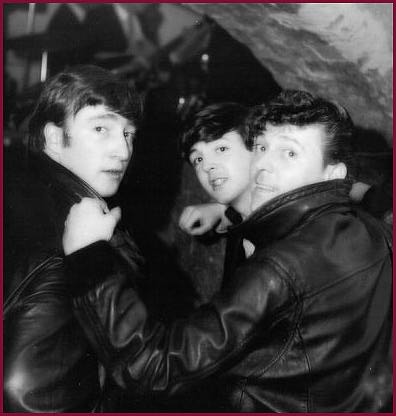
related lyrics by Gene Vincent (pictured with 2 band members)
Well Be Bop A Lula she's my baby
Be Bop A Lula I don't mean maybe
Be Bop A Lula she's my baby
Be Bop A Lula I don't mean maybe
Be Bop A Lula she's my baby doll, my baby doll, my baby doll.
Well, she's the gal in the red blue jeans
She's the queen of all the teens
She's the woman that I know
She's the woman that (scream) loves me so.
Be Bop A Lula she's my baby
Be Bop A Lula I don't mean maybe
Be Bop A Lula she's my baby doll, my baby doll, my baby doll.
(Let's rock)
Well, now she's the woman that's got that beat
She's the woman with the flyin' feet
She's the woman that walks around the store
She's the woman that yells (scream) more, more, more, more.
Be Bop A Lula she's my baby
Be Bop A Lula I don't mean maybe
Be Bop A Lula she's my baby doll, my baby doll, my baby doll.
(Let's rock again, now)
Well Be Bop A Lula she's my baby
Be Bop A Lula I don't mean maybe
Be Bop A Lula she's my baby
Be Bop A Lula I don't mean maybe
Be Bop A Lula she's my baby doll, my baby doll, my baby doll.
0 Replies
edgarblythe
1
Reply
Sat 11 Aug, 2007 08:11 pm
Spanish Leather
Oh, I'm sailin' away my own true love,
I'm sailin' away in the morning.
Is there something I can send you from across the sea,
From the place that I'll be landing?
No, there's nothin' you can send me, my own true love,
There's nothin' I'm wishin to be ownin'.
Just carry yourself back to me unspoiled,
From across that lonesome ocean.
Oh, but I just thought you might want something fine
Made of silver or of golden,
Either from the mountains of Madrid
Or from the coast of Barcelona.
Oh, but if I had the stars from the darkest night
And the diamonds from the deepest ocean,
I'd forsake them all for your sweet kiss,
For that's all I'm wishin' to be ownin'.
But I might be gone a long old time
And it's only that I'm askin',
Is there something I can send you to remember me by,
To make your time more easy passin'.
Oh, how can, how can you ask me again,
If it only brings me sorrow.
The same thing I would want from you today,
I would want again tomorrow.
I got a letter on a lonesome day,
It was from her ship a-sailin',
Saying I don't know when I'll be comin' back again,
It depends on how I'm a-feelin'.
Well, if you, my love, must think that-a-way,
I'm sure your mind is roamin'.
I'm sure your heart is not with me,
What with the country to where you're goin'.
So take heed, take heed of the western wind,
Take heed of the stormy weather.
And yes, there's something you can send back to me,
Spanish boots of Spanish leather.
Bob Dylan
0 Replies
Letty
1
Reply
Sun 12 Aug, 2007 04:37 am
Good morning, WA2K listeners and contributors.
Please remind your PD not to go looking for Arcade Fire lyrics. They are a voodoo bunch that wreaks havoc with our studio equipment.
Welcome back, O man of the island. I recall that song, M.D., but I had to look up info about Gene Vincent. Sad case when a man of thirty six dies of a bleeding ulcer. Found out that he based that song on Little Lulu.
edgar, your Spanish Leather by Bob Dylan reminded me of this one.
Farewell and adieu unto you Spanish ladies,
Farewell and adieu to you ladies of Spain;
For it's we've received orders for to sail for old England,
But we hope very soon we shall see you again.
Chorus:
We'll rant and we'll roar like true British sailors,
We'll rant and we'll roar across the salt seas,
Until we strike soundings in the Channel of old England,
From Ushant to Scilly is thirty-five leagues.
Then we hove our ship to the wind at sou'-west, my boys,
We hove our ship to our soundings for to see;
So we rounded and sounded, and got forty-five fathoms,
We squared our main yard, up channel steered we.
Chorus:
Now the first land we made it is called the Deadman,
Then Ram Head off Plymouth, Start, Portland and Wight;
We sailed by Beachy, by Fairlee and Dungeness,
Until we came abreast of the South Foreland Light.
Chorus:
Then the signal was made for the grand fleet for to anchor,
All in the downs that night for to meet;
Then it's stand by your stoppers, see clear your shank-painters,
Haul all your clew garnets, stick out tacks and sheets.
Chorus:
Now let every man toss off a full bumper,
And let every man toss off a full bowl;
And we'll drink and be merry and drown melancholy,
Singing, here's a good health to all true-hearted souls.
0 Replies
bobsmythhawk
1
Reply
Sun 12 Aug, 2007 05:50 am
Jane Wyatt
From Wikipedia, the free encyclopedia
Birth name Jane Waddington Wyatt
Born August 12, 1910
Campgaw, New Jersey
Died October 20, 2006, age 96
Bel-Air, Los Angeles, California
Jane Waddington Wyatt (August 12, 1910 - October 20, 2006) was an American actress in films and television.
Her most famous role was as Ronald Colman's love interest in Frank Capra's Lost Horizon (1937). Other film appearances included 1947's Gentleman's Agreement (with Gregory Peck), None but the Lonely Heart (with Cary Grant), and Boomerang (with Dana Andrews).
For many people, she is best remembered for her television roles, as Margaret Anderson, the mother in the 1950s television comedy Father Knows Best; and as Amanda Grayson, Mr. Spock's mother, in the 1967 episode Journey To Babel of the original Star Trek series and the 1986 film Star Trek IV: The Voyage Home.[1] Late in her career, she played Katherine Auschlander, the wife of hospital administrator Dr. Daniel Auschlander (Norman Lloyd), on the 1980s medical drama St. Elsewhere. Wyatt was once quoted as saying her fan mail for the first two roles exceeded that for her appearance in Lost Horizon.
One of four siblings, Wyatt was born in Campgaw (now part of Mahwah), Bergen County, New Jersey, but raised in New York City. Her father, Christopher Billop Wyatt, Jr., was a Wall Street investment banker, and her mother, the former Euphemia Van Rensselaer Waddington, was a drama critic for the Catholic World.
One of her ancestors, Rufus King, was a signer of the U.S. Constitution, a U.S. Senator and ambassador, and the Federalist candidate in the 1816 presidential election.
She had three siblings: Christopher III, Elizabeth, and Monica. She was also a distant cousin of Eleanor Roosevelt and the poet Harry Crosby, through their shared descent from Philip Livingston, a signer of the Declaration of Independence.
Her mother was a Catholic convert, and her father and husband ultimately converted as well, although Jane did not attend Catholic schools.
Wyatt was raised from the age of three months in New York City, attended the fashionable Chapin School and later Barnard College. After two years of college, she left to join the apprentice school of the Berkshire Playhouse at Stockbridge, Massachusetts, where for six months she played a varied assortment of roles.
One of her first jobs on Broadway was as understudy to Rose Hobart in a production of Trade Winds - a career move that cost her her listing in the New York Social Register (she later was relisted upon her marriage). Receiving favorable notices on Broadway and celebrated for her understated beauty, Wyatt made the transition from stage to screen and was placed under contract at Universal, where she co-starred in Frank Capra's Columbia film Lost Horizon. Of her experience in Lost Horizon, she noted in an article in the St. Anthony Messenger newsletter, "During the war, they cut out all the pacifist parts of the film?-the High Lama talking about peace in the world. All that was cut because they were trying to inspire those G.I.'s to get out there and go 'bang! bang! bang!' which sort of ruined the film."
Though one of her early suitors was John D. Rockefeller III, on November 9, 1935, Wyatt married investment broker Edgar Bethune Ward. He died on November 8, 2000, the day before what would have been their 65th wedding anniversary. The couple met in the late 1920s, when both were weekend houseguests of Franklin D. Roosevelt at Hyde Park. The Wards had two surviving sons. According to Wyatt's obituary in The Washington Post, a third son died in infancy in the early 1940s.
From 1954 to 1960, she co-starred with Robert Young in Father Knows Best, the classic TV show chronicling the life and times of the Anderson family in the Midwestern town of Springfield. She won the Emmy for best actress in a comedy for three years in a row for her role as Margaret Anderson.
Her film career suffered because of her outspoken opposition to Senator Joseph McCarthy, the chief figure in the anti-Communist investigations of that era. Her career was temporarily damaged for having assisted in hosting a performance by the Bolshoi Ballet during the Second World War, even though it was at President Roosevelt's request ([1]). As a result, she returned to her roots on the New York stage for a time and appeared in such plays as Lillian Hellman's The Autumn Garden opposite Fredric March.
Wyatt died on October 20, 2006 of natural causes at her home in Bel-Air, California, at the age of 96. Her funeral mass was held on Friday, October 27, at the Church of St. Martin of Tours in Brentwood, California.
She is survived by sons Christopher Ward of Piedmont, California and Michael Ward of Los Angeles; three grandchildren, Nicholas, Andrew and Laura; and five great-grandchildren
0 Replies
bobsmythhawk
1
Reply
Sun 12 Aug, 2007 05:56 am
Cantinflas
From Wikipedia, the free encyclopedia
Birth name Mario Moreno Reyes
Born August 12, 1911
Mexico City, Mexico
Died April 20, 1993
Mexico City, Mexico
Spouse(s) Valentina Ivanova (1936-1966)
[show]Awards
Golden Globe Awards
Best Actor - Motion Picture Musical/Comedy
1957 Around the World in Eighty Days
Special Award (1961)
Fortino Mario Alfonso Moreno Reyes (August 12, 1911 - April 20, 1993) was a comedian of the Mexican theatre and film industry. He earned wide popularity with his interpretation of the character Cantinflas, an impoverished campesino cum slumdweller that originated in the pelado. The character came to be associated with the national identity of Mexico, and allowed Moreno to establish a long, successful film career that included a foray into Hollywood. Charlie Chaplin once called him "the greatest comedian in the world," and Moreno is often referred to as the "Charlie Chaplin of Mexico".[1]
While some of films were dubbed into English for American audiences, and his work found some favor among the people of France, the wordplay of his Spanish-language humor did not translate particularly well into other languages. However, he was wildly successful in Spanish-speaking Latin America, where he still has many devoted fans.
As a pioneer of the cinema of Mexico, Moreno helped usher in its golden era. His success, as part of Mexico's cinematic blossoming, helped establish Mexico as the entertainment capital of Latin America. In addition to being a business leader, he also became involved in Mexico's tangled and often dangerous labor politics. Although he was himself politically conservative, his reputation as a spokesperson for the downtrodden gave his actions authenticity and became important in the early struggle against charrismo, the one-party government's practice of coopting and controlling unions.
Moreover, his character Cantinflas, whose identity became enmeshed with his own, was examined by media critics, philosophers, anthropologists, and linguists, who saw him variably as a danger to Mexican society, a bourgeois puppet, a kind philanthropist, a venture capitalist, a transgressor of gender roles, a pious Catholic, a verbal innovator, and a picaresque underdog.
In effect, Moreno was all of these. His character Cantinflas, in attempting to encompass the identity of an entire nation, developed the contradictions and complexities inherent in any attempt to epitomize a country as complex and contradictory as Mexico.
Personal life
Born the sixth of twelve children. Four died due to miscarriages. Eight survived, Pedro, Jose "Pepe", Edwardo, Mario, Esperanza, Catalina, Enrique and Roberto) to Sr. Pedro Moreno Esquivel, an impoverished mail carrier, and Sra. Soledad Guizar Reyes de Moreno. Fortino Mario Alfonso Moreno Reyes was born in the the Santa María la Redonda neighborhood of Mexico City, and grew up in the rough Tepito barrio.[2] He made it through difficult situations with the quick wit and street smarts that he would later apply in his films. After an unsuccessful attempt to enter the United States through California, he became a prizefighter in his teens as a source of income.[3] His comic personality led him to a circus tent show, and from there to legitimate theatre and film.
He married Valentina Ivanova Zubareff, of Russian ethnicity, on October 27, 1936, and remained with her until her death in January, 1966. A son was born to Moreno in 1961 by another woman[4]; the child was adopted by Valentina Ivanova and was named Mario Arturo Moreno Ivanova, causing some references to erroneously refer to him as "Cantinflas' adopted son."[5]
He served as president of the Mexican actor's guild known as Asociación Nacional de Actores (ANDA, "National Association of Actors") and as first secretary general of the independent filmworkers' union Sindicato de Trabajadores de la Producción Cinematográfica (STPC).
Following his retirement, Moreno devoted his life to helping others through charity and humanitarian organizations, especially those dedicated to helping children. His contributions to the Roman Catholic Church and orphanages made him a folk hero in Mexico.
In 1993, after his death in Mexico City from lung cancer, thousands appeared on the rainy day for his funeral. The ceremony was a national event, lasting three days. His body lay in state in the Rotonda de los Hombres Ilustres (Rotunda of Distinguished Men) and he was honored by many heads of state and the United States Senate, which held a moment of silence for him.
After his death, a 12-year legal battle ensued between Mario Moreno Ivanova, Cantinflas' son and heir to his estate, and the actor's blood nephew, Eduardo Moreno Laparade over the control of 34 of films made by Cantinflas. The nephew claimed his uncle gave him a written notice to the rights for movies on his deathbed. Moreno Ivanova argued he is the direct heir of Cantinflas and the rights belong to him. Moreno Laparade won the lawsuit twice [6], but Moreno Ivanova eventually triumphed after two appeals. [7]
At the same time, another legal battle ensued between Columbia Pictures and Moreno Ivanova over control of these films. Columbia claims that it bought the rights to the 34 films four decades ago with the court noting several discrepancies in the papers. Moreno Ivanova wanted the rights to the films to remain his and more generally, Mexico's, as a national treasure. On June 2, 2001 the eight year battle was resolved with Columbia retaining ownership over the 34 disputed films. [8]
Origin of name
As a young man, Cantinflas performed a variety of acts in travelling tents. It was also in the tents that he earned the nickname "Cantinflas"; however, the origin of the name is obscured by legend. According to one obituary, "Cantinflas" is a meaningless name invented to prevent his parents from knowing he was in the entertainment business, which they considered a shameful occupation. In another version, the Mexican media critic and theorist Carlos Monsiváis cites a legendary account of the origin of Cantinflas' characteristic speech:
According to a legend that he agrees with, a young Mario Moreno, overwhelmed by stage fright, once, in the Ofelia carpa, forgets his original monologue. He begins to say what comes to mind in a complete emancipation of phrases and words, and what comes to mind is an incoherent brilliance. His assistants recite his attack on syntax, and Mario becomes aware of it: destiny has placed in his hands the distinctive characteristic, the style that is manipulation of chaos. Weeks later, the name that will mark the invention is invented. Someone, taken in by the nonsense, screams: "Cuanto inflas!" [C' ntinflas] (You're annoying!) or "En la cantina inflas!" (You become egotistical in the barroom). The contraction catches on and becomes proof of the baptism that the character needs.[9]
Entertainment career
Before starting his professional life in entertainment, he explored a number of possible careers, such as medicine and professional boxing, before joining the entertainment world as a dancer. By 1930 he was involved in Mexico City's carpa (travelling tent) circuit, performing in succession with the Ofelia, Sotelo of Azcapotzalco, and finally the Valentina carpa, where he met his future wife. At first he tried to imitate Al Jolson by smearing his face with black paint, but later separated himself to form his own identity as an impoverished slum dweller with baggy pants, a rope for a belt, and a distinct mustache.[3] In the tents, he danced, performed acrobatics, and performed in the roles of several different professions.
Cantinflismo
In 1936, Moreno made his debut in Mexico City's Folies Bergères Theater. Now removed from the lower-class environment that pandered to baser humor, cantinflismo, the political joke that challenged the notion that Cantinflas' nonsense was vacuous, was born. In 1937, the politician Vicente Lombardo Toledano responded to a political rival: "If [labor leader Luis] Morones has decided to show his dialectical prowess, let him argue with Cantinflas." Now directly invoked in the debate, Cantinflas responded:
Ah! but let me make one thing clear, I have moments of lucidity, and I speak very clearly. And now I will speak with clarity...Friends! There are moments in my life that are really momentary...And it's not because one says it, but we must see it! What do we see? that's what we must see...because, what a coincidence, friends, that supposing that in the case?-let's not say what it could be?-but we must think about it and understand the psychology of life to make an analogy of the synthesis of humanity. Right? Well, that's the point![10]
Media figures and intellectuals fleshed out the definition and applications of cantinflismo in subsequent publications. Monsiváis interprets it in the context of the left-leaning presidency of Lázaro Cárdenas, calling it a "mock[ery] of proletariat discourse from glorious senselessness".[11] But perhaps the contemporary writer Miguel del Río's elaboration is the most eloquent:
It's as if Cantinflas were, more than anyone, the Mexican dictator of optimism ... he flirts with politics as if he were the most experienced politician. He becomes a leader and a proletariat, with only the change of a hat or a phrase.[12]
The political bent of Moreno's work was a marked turn, and his comedic innocence no longer sufficed to shield him from the criticism that political involvement entailed.
Film career
In the mid-1930s, Cantinflas met Russian producer Jacques Gelman and subsequently partnered with him to form their own film production venture. Gelman produced, directed, and distributed, while Cantinflas acted. Cantinflas made his film debut in 1936 with No te engañes corazón but the film received little attention. He established Posa Films in 1939, producing short films that allowed him to develop the Cantinflas character, but it was in 1940 that he finally became a movie star, after shooting Ahí está el detalle ("There's the rub," literally "There lies the detail"). The phrase that gave that movie its name became a Cantinflas catch phrase for the rest of his career. The film was a breakthrough in Latin America and was later recognized by Somos magazine as the 10th greatest film produced largely in Mexico.[13]
In 1941 Moreno first played the role of a police officer on film in El gendarme desconocido ("The unknown police officer" a play of words on "The Unknown Soldier). By this time he had sufficiently distinguished the peladito character from the 1920s-era pelado, and his character flowed comfortably from the disenfranchised, marginalized, underclassman to the empowered public servant. The political nature of the rhetoric of cantinflismo facilitated this fluidity. He would reprise the role of Agent 777 and be honored by police forces throughout Latin America for his positive portrayal of law enforcement.
Ni sangre, ni arena ("Neither Blood, nor Sand" a play on words on the bullfighter/gladiator phrase "Blood and Sand"), the 1941 satirical film on bullfighting, broke box-office records for Mexican-made films throughout Spanish-speaking countries. In 1942, Moreno teamed up with Miguel M. Delgado and Jaime Salvador to produce a series of low-quality parodies, including an interpretation of Chaplin's The Circus.
The 1940s and 1950s were Cantinflas' heyday. In 1946, he rejected Mexican film companies and instead signed with Columbia Pictures. [3] By this time, his popularity was such that he was able to lend his prestige to the cause of Mexican labor, representing the National Association of Actors in talks with President Manuel Ávila Camacho. The talks did not go well, however, and, in the resulting scandal, Moreno took his act back to the theatre.
On August 30, 1953, Cantinflas began performing his theatrical work Yo Colón ("I, Columbus") in the Teatro de los Insurgentes, the same theatre that had earlier been embroiled in a controversy over a Diego Rivera mural incorporating Cantinflas and the Virgin of Guadalupe. Critics, including the PAN and archbishop Luis María Martínez, called the mural blasphemous, and it was eventually painted without the image of the Virgin.
Yo Colón placed Cantinflas in the character of Christopher Columbus, who, while continually "discovering America", made comical historical and contemporary observations from fresh perspectives. The jokes changed nightly, and Moreno continued to employ his word games and double entendres to jab at politicians.
In 1956, Around the World in Eighty Days, Cantinflas' American debut earned him a Golden Globe for Best Actor in a musical or comedy. [14] Variety magazine said in 1956 that his Chaplinesque quality made a big contribution to the success of the film.[15] The film ultimately made an unadjusted $42 million dollars at the box office[16]. While Niven was billed as the lead in English-speaking nations, Cantinflas was billed as the lead elsewhere. As a result of the film, Cantinflas became the world's most highly paid actor. [17]
Moreno's second Hollywood feature, Pepe, attempted to replicate the success of his first. The film had cameo appearances by Frank Sinatra, Judy Garland, and other stars. His humor, deeply rooted in the Spanish language, did not translate well for the American audience and the movie was a notorious box office disappointment. He still earned a Golden Globe nomination for his part. Later in a 1992 American interview, Moreno cited the language barrier as the biggest impediment to his making it big in the United States. [18]
After returning to Mexico, Cantinflas created his own company, Cantinflas Films and continued making movies until his last, El Barrendero, in 1982.
Like Charlie Chaplin, Cantinflas was a social satirist. He played el pelado, an impoverished Everyman, with hopes to succeed. With mutual admiration, Cantinflas was influenced by Chaplin's earlier films and ideology. El Circo (the circus) was a "shadow" of Chaplin's silent film, The Circus and Si yo fuera diputado ("If I Were a Congressman") had many similarities with the 1940 film, The Great Dictator.
Cantinflas' films, to this day, still generate revenue for Columbia Pictures. In 2000, Columbia reported in an estimated USD$4 million in foreign distribution from the films. [3]
Impact
Among the things that endeared him to his public was his comic use of language in his films; his characters (all of which were really variations of the main "Cantinflas" persona but cast in different social roles and circumstances) would strike up a normal conversation and then complicate it to the point where no one understood what they were talking about. The Cantinflas character was particularly adept at obfuscating the conversation when he owed somebody money, was courting an attractive young woman, or was trying to talk his way out of trouble with authorities, whom he managed to humiliate without their even being able to tell. This manner of talking became known as Cantinfleada, and it became common parlance for Spanish speakers to say "¡estás cantinfleando!" (loosely translated as you're pulling a "Cantinflas!" or you're "Cantinflassing!") whenever someone became hard to understand in conversation. The Real Academia Española officially included the verb cantinflear, cantinflas, and cantinflada[19] in its dictionary in 1992.
In the visual arts, Mexican artists such as Rufino Tamayo and Diego Rivera painted Cantinflas as a symbol of the Mexican everyman. The American punk band Mindless Self Indulgence released a song about Cantinflas called "Whipstickagostop".
Cantinflas' style and the content of his films have led scholars to conclude that he influenced the many teatros that spread the message of the Chicano Movement during the 1960s-1970s in the United States, the most important of which was El Teatro Campesino. The teatro movement was an important part of the cultural renaissance that was the social counterpart of the political movement for the civil rights of Mexican Americans. Cantinflas' use of social themes and style is seen as a precursor to Chicano theater.[20]
A cartoon series, the Cantinflas Show, was made in the 1970s starring an animated Cantinflas. The show was targeted for children and was intended to be educational. [21] The animated character was known as "Little Amigo" and concentrated on a wide range of subjects intended to educate children, from the origin of soccer to the reasons behind the International Date Line.
Although Cantinflas never achieved the same success in the United States as in Mexico, he was honored with a star in the Hollywood Walk of Fame. He earned two Golden Globe nominations for best actor and the Mexican Academy of Film Lifetime Achievement Award. [22] [1]
The Mario Moreno "Cantinflas" Award is handed out annually for entertainers who "represent the Latino community with the same humor and distinction as the legendary Mario Moreno "Cantinflas" and who, like Cantinflas, utilizes his power to help those most in need." [23]
In 2002, Salvadorean-American (although self-described Chicano) artist, comedian, and Culture Clash member Herbert Sigüenza began performing a one-man show based on Cantinflas that toured nationally. The play, in both English and Spanish, incorporated motifs common in many of Cantinflas' films, and Sigüenza recreated many of the actor's physical comedy routines, such as his characteristic walk.[24]
Cantinflas films are distributed in North America by Laguna Films.
Critical response
Cantinflas is sometimes seen as a Mexican Groucho Marx character, one who uses his skill with words to puncture the pretensions of the wealthy and powerful, the police and the government. Historian and author of Cantinflas and the Chaos of Mexican Modernity, writes, "Cantinflas symbolized the underdog who triumphed through trickery over more powerful opponents" and presents Cantinflas as a self image of a transitional Mexico. Gregorio Luke, executive director of the Museum of Latin American Art said, "To understand Cantinflas is to understand what happened in Mexico during the last century." [25] [3]
For his part, Monsiváis interprets the Moreno's portrayals in terms of the importance of the spoken word in the context of Mexico's "reigning illiteracy" (70% in 1930). Particularly in the film El Analfabeto, (The Illiterate), "Cantinflas is the illiterate who takes control of the language by whatever means he can."[26]
The journalist Salvador Novo interprets the role of Moreno's character entirely in terms of Cantinflismo: "En condensarlos: en entregar a la saludable carcajada del pueblo la esencia demagógica de su vacuo confusionismo, estriba el mérito y se asegura la gloria de este hijo cazurro de la ciudad ladina y burlona de México, que es Cantinflas". ("In condensing them [the leaders of the world and of Mexico], in the giving back to the healthy laughter of the people the demagogic state of their empty confusion, merit is sustained and glory is ensured for the self-contained son of the Spanish-speaking mocker of Mexico, who is Cantinflas.")[27]
In his biography of the comic, the scholar of Mexican culture Jeffrey M. Pilcher views Cantinflas as a metaphor for "the chaos of Mexican modernity", a modernity that was just out of reach for the majority of Mexicans: "His nonsense language eloquently expressed the contradictions of modernity as 'the palpitating moment of everything that wants to be that which it cannot be'."[28] Likewise, "Social hierarchies, speech patterns, ethnic identities, and masculine forms of behavior all crumbled before his chaotic humor, to be reformulated in revolutionary new ways."[29]
0 Replies
bobsmythhawk
1
Reply
Sun 12 Aug, 2007 05:58 am
John Derek
From Wikipedia, the free encyclopedia
Birth name Derek Delevan Harris
Born August 12, 1926
Hollywood, California, USA
Died May 22, 1998
Santa Monica, California, USA
John Derek (August 12, 1926 - May 22, 1998) was an American actor, director and photographer most famous for the gorgeous women to whom he was married.
Born Derek Delevan Harris in Hollywood, California, he was first married to actress Pati Behrs (1922-2004), grand-niece of Leo Tolstoy and mother of his two children, Russell & Sean.
His matinee-idol good looks quickly got him supporting roles, most notably as Broderick Crawford's son in All the Kings Men (1949), but he also enjoyed leads such as "Nick Romano" in Knock on Any Door (1949) opposite Humphrey Bogart (who told him, "You look great, but kid, that's not enough"), and as Robin Hood in Rogues of Sherwood Forest (1950) with Alan Hale.
Perhaps Derek's most memorable film appearance was in a supporting role in the 1956 epic film, as the noble Joshua in The Ten Commandments.
Derek had a minor role as a film director. He directed his fourth wife, Bo Derek, in four movies. The 1990 film Ghosts Can't Do It was his last attempt in the director's chair. He also directed two hit music videos for Shania Twain, "Whose Bed Have Your Boots Been Under?" and "Any Man of Mine".
His last three wives seemed to be nearly identical in appearance, especially Linda Evans and Bo Derek. Derek took photos of all three, at different times, for Playboy magazine. He died from cardiovascular disease in Santa Maria, California at the age of 71.
Derek was married to:
Pati Behrs (1951-1957)
Ursula Andress (1957-1966)
Linda Evans (1968-1974)
Bo Derek (1976-1998)
0 Replies
bobsmythhawk
1
Reply
Sun 12 Aug, 2007 06:01 am
Porter Wagoner
From Wikipedia, the free encyclopedia
Background information
Birth name Porter Wagoner
Also known as Mr. Grand Ole Opry
Born August 12, 1927 (1927-08-12) (age 79)
Origin West Plains, Missouri, USA
Genre(s) Country Music
Occupation(s) Country music artist
Instrument(s) Acoustic Guitar
Years active 1951 - Present
Website www.porterwagoner.com
Members
Country Music Hall of Fame
Grand Ole Opry
Notable instrument(s)
Acoustic Guitar
Porter Wagoner (born August 12, 1927, in West Plains, Missouri, in the Ozark Mountains) is an American country music singer. Famous for his flashy Nudie suits and blond pompadour, Wagoner introduced a young Dolly Parton to his long-running television show. Together, "Porter and Dolly" were a well-known duet team for many years. After they split, Parton wrote the song "I Will Always Love You" about him.
His first band, The Blue Ridge Boys, performed on radio station KWPM from a butcher shop in West Plains, Missouri where Wagoner cut meat. Wagoner's big break came in 1951, when he was hired as a performer by station KWTO in Springfield, Missouri. This led to a contract with RCA Records. With lagging sales, Wagoner and his trio played schoolhouses for the gate proceeds.
In 1953, his song entitled "Trademark" became a hit for Carl Smith, followed by a few hits of his own on RCA. He was a featured performer on ABC's Ozark Mountain Jubilee and moved to Nashville and joined the Grand Ole Opry in 1957.
Television show
The Porter Wagoner Show ran on syndicated television from 1960 to 1979. There were 686 thirty minute episodes filmed, the first 104 being shot in black and white, the remainder in color. At its peak, it was featured in over 100 markets, with three million-plus viewers.
The Regular Cast Included
Singer Norma Jean (Beasler) 1960-1967
Singer Dolly Parton 1967-1974
Singer Mel Tillis
Comedian Speck Rhodes
Announcer Don Howser
The house band, The Wagonmasters
Buck Trent on banjo and guitar
George McCormick on rhythm guitar
Don Warden on steel guitar
Mack Magaha on fiddle
Michael Treadwell on bass
Chart success
Wagoner was elected to the Country Music Hall of Fame in 2002. His 81 charted records include "Misery Loves Company" (#1, 1962), "I've Enjoyed As Much of This As I Can Stand" (#7, 1962-1963), "Sorrow on the Rocks" (#5, 1964), "Green, Green Grass of Home" (#4, 1965), "Skid Row Joe" (#3, 1965-1966), "The Cold Hard Facts of Life" (#2, 1967), and "The Carroll County Accident" (#2, 1968-1969). Among his hit duets with Dolly Parton were a cover of Tom Paxton's "The Last Thing on My Mind" (1967), "We'll Get Ahead Someday" (1968), and "Better Move it on Home" (1970). He also won three Grammy Awards for gospel recordings.
Later career
He has produced many records and appeared in the Clint Eastwood film Honkytonk Man. Wagoner's positive attitude and engaging persona have made him an ambassador for country music. He appears regularly on the Grand Ole Opry and tours actively as he approaches 80 years of age. He also made a guest appearance on the HBO comedy series "Da Ali G Show", being interviewed by the fictional character Borat in its second season. Though Parton's departure caused some animosity on both sides, the two reconciled in the late 1980s and have appeared together a number of times in the years since; Parton inducted Wagoner into the Country Music Hall of Fame in 2002.
On July 14, 2006, Wagoner was hospitalized and underwent surgery for an abdominal aneurysm.
On June 05, 2007, Wagoner released his latest album called "Wagonmaster". The album is produced by Marty Stuart for the Anti-label.
0 Replies
bobsmythhawk
1
Reply
Sun 12 Aug, 2007 06:04 am
Buck Owens
From Wikipedia, the free encyclopedia
Background information
Birth name Alvis Edgar Owens Jr.
Born August 12, 1929
Origin Sherman, Texas
Died March 25, 2006
Genre(s) Bakersfield Sound
Occupation(s) country singer
Instrument(s) Guitar/Singing
Years active 1950s-2006
Label(s) Capitol Records, Warner Bros. Records, Rhino
Associated
acts Susan Raye, Rose Maddox, Dwight Yoakam, Roy Clark, Merle Haggard
Website Buck Owens Official Website
Alvis Edgar "Buck" Owens, Jr., (August 12, 1929 - March 25, 2006) was an American singer and guitarist, with twenty number-one hits on the Billboard magazine country music charts. Both as a solo artist and with his band, the Buckaroos (so named by Merle Haggard, a former bandmate), Buck Owens pioneered what has come to be called the Bakersfield sound?-a reference to Bakersfield, California, the city Owens called home and from which he drew inspiration for what he preferred to call "American Music".[1]
A consummate bandleader, Buck Owens pioneered a unique and fresh sound: clean and crisp, characterized by sharp staccato guitar riffs, and pedal steel guitar solos, with straightforward lyrics. It was far more streamlined than the honky tonk music of the late '40s and early 1950s with its fiddles and back up singer arrangements. While Owens originally used fiddle and retained pedal steel into the 1970s, his sound on records and onstage was always more stripped-down and elemental, incorporating elements of rock and roll. The sound Owens developed with the Buckaroos depended on his camaraderie with and the talents of his best friend, Don Rich, whom he met while in Tacoma. Rich can be heard harmonizing on all of Owens hits until his untimely death in 1974, when Rich lost control of his motorcycle and struck a guard rail on Highway 99 north of Bakersfield as he made his way to join his family for a vacation on the coast at Morro Bay. The loss of his best friend devastated Owens for years and abruptly halted his singing successes and career until Owens performed with Dwight Yoakam in the late-1980s.
Owens co-hosted the popular and groundbreaking Hee Haw program with Roy Clark. Hee Haw, originally envisioned as country music's answer to Laugh-In, outlived that show and ran for twenty-four seasons. Owens was co-host from 1969 until he left the cast in 1986, convinced that the show's exposure had obscured his immense musical legacy.
Biography
Owens was born in Sherman, Texas to Maicie Azel Ellington and Alvis Edgar Owens, Sr.[2] (U.S. Highway 82 through Sherman was named "Buck Owens Freeway" in his honor). "'Buck' was a mule on the Owens farm," Rich Kienzle wrote in About Buck, the biography at Owens' official website adapted from Kienzle's notes for Rhino Records' 1992 "The Buck Owens Collection" box set. "When Alvis, Jr., was three or four years old, he walked into the house and announced that his name was also Buck. That was fine with the family; the boy was Buck from then on."[3]
In 1937, his family migrated to Mesa, Arizona, during the Dust Bowl and the Great Depression.
In 1945, Owens co-hosted a radio show called "Buck and Britt". In the late 1940s, Owens became a truck driver and discovered the San Joaquin Valley of California. He was impressed by Bakersfield, where he and his wife settled in 1950.
The Buck Owens in Japan album.Soon, Owens was frequently traveling to Hollywood for session recording jobs at Capitol Records, playing backup for Tennessee Ernie Ford, Sonny James, Wanda Jackson, Del Reeves, Tommy Sands, Tommy Collins, Faron Young and Gene Vincent, and many others.
During the Rock and Roll craze of the 1950s, Owens recorded a rockabilly record called "Hot Dog" for the Pep label, using the pseudonym Corky Jones. He used the pseudonym because he did not want the fact he recorded a rock n' roll tune to hurt his country music career. Buck loved rock n' roll virtually from the start and it influenced his style of country from then on.
Buck's career took off in 1959, when his song "Second Fiddle" hit number 24 on the Billboard country chart. A few months later, "Under Your Spell Again" hit number 4, and then "Above and Beyond" hit #3.
In the early 1960s, the "countrypolitan" sound was popular, with smooth, string-laden, pop-influenced styles used by Eddy Arnold, Jim Reeves, and Patsy Cline, among others. Owens went against the trend, utilizing pure and raw honky-tonk hillbilly feel, mixed idiosyncratically with the Mexican polkas he had heard on border radio stations while growing up.
Owens was named the most promising country and western singer of 1960 by Billboard and his Top-10-charting duets with Rose Maddox in 1961 earned them awards as vocal team of the year.
1963's "Act Naturally" became Buck Owens and the Buckaroos first #1 hit. The Beatles later did a straight cover of it in 1965. It appears on their "Help" album. Ringo Starr later re-recorded the song as a duet with Buck Owens in 1988.
The 1966 album Carnegie Hall Concert was a smash hit and further cemented Buck Owens and the Buckaroos as more than just another honky tonk country band. Buck Owens and the Buckaroos achieved cross over success on to the pop charts.
In 1967, Owens and the Buckaroos toured Japan, a then-rare occurrence for a country musician. The subsequent live album, appropriately named Buck Owens and His Buckaroos in Japan, is the first country music album recorded outside the United States.[4]
At the White House the following year, Owens and the Buckaroos performed for President Lyndon Baines Johnson.
Creedence Clearwater Revival, one of the biggest American rock bands of the period, often demonstrated a country flavor and even mentioned Owens in the hit, "Lookin' Out My Back Door":
A dinosaur Victrola
List'nin' to Buck Owens
Doo, doo, doo
Lookin' out my back door
Hee Haw hit the television airwaves in 1969, keeping Owens busy throughout the 1970s and 1980s.
In the 1970s, he enjoyed a string of hit duets with a protege, Susan Raye, who subsequentally became a popular solo artist, with recordings produced by Owens.
In 1971 the Buckaroos bass gutarist Doyle Holly left the band to pursue a solo career. The departure of Doyle was a blow to the band as Doyle had received the "Bass Player of the Year" award from the Academy of Country and Western Music the year beofore in 1970. Doyle Holly went on to recored two solo records in the 1970s, both were top 20 hits. Doyle Holly has subsequently been honored with a Block in the Walkway of Stars at the Country Music Hall of Fame as a solo artist and as a member of the legendary band Buck Owens and the Buckaroos.
In 1972 Buck Owens and the Buckaroos had another #1 hit, "Made in Japan".
On July 17, 1974, his guitarist of the Buckaroos and best friend Don Rich was killed in a motorcycle accident. Owens was devastated and never really recovered from the loss. "He was like a brother, a son and a best friend," he said in the late 1990s. "Something I never said before, maybe I couldn't, but I think my music life ended when he did. Oh yeah, I carried on and I existed, but the real joy and love, the real lightning and thunder is gone forever." [1]
KUZZ Radio logo featuring a depiction of Owens' trademark guitarBefore the 1960s were done, Owens?-with the help of manager Jack McFadden?-began to concentrate on his financial future. He bought several radio stations, including KNIX AM and FM in Phoenix and KUZZ in Bakersfield. In 1999, Owens sold the KNIX duo stations to Clear Channel Communications, but he maintained ownership of KUZZ until his death.
Owens established Buck Owens Enterprises and produced records by several artists.
Owens recorded for Warner Bros. Records, but Owens and his longtime fans were less than happy with the results; the recordings, made in Nashville, reflected the very type of bland country music he had always assailed. His spirit broken by the depression of Rich's death, he simply allowed himself to be led. He was no longer recording by the 1980s, devoting his time to overseeing his business empire from Bakersfield. Slowly, during that time, he recovered his equilibrium. Time allowed him to realize that, despite the excellent pay and friendships he'd developed on Hee-Haw, the show effectively ruined his musical career by redefining him as a comedian, to the point that many who tuned in knew nothing of his phenomenal country music career or his classic hit recordings. He left the show in 1986.
Dwight Yoakam was largely influenced by Owens' style of music and eventually teamed up with him for a duet of "Streets of Bakersfield" in 1988. Their duet was Owens' first #1 single in 16 years.
The 1990's saw a flood of reissues of his Capitol recordings on compact disc. In 1974, Owens had bought back publishing rights to all of his Capitol recordings, as part of his final contract with the label. His albums had been out of print for nearly 15 years, when he released a retrospective box set in 1990. Encouraged by brisk sales, Owens struck a distribution deal with "Sundazed Records" of New York, which specializes in reissuing obscure recordings. A bulk of his Capitol catalog was reissued on CD in 1995, 1997 and recently in 2005. Sometime in the 1970's, Owens had also purchased the remaining copies of his original LP albums from Capitol's distribution warehouses across the country. Many of those records(still in the shrinkwrap) were stored by Owens for decades. He often gave them away as gifts and sold them at his nightclub for a premium price some 35 years later!
In August of 1999 an historical event occurred in Country Music, Buck Owens brought back together his original Buckaroo Band to help him celebrate his 70th Birthday. They performed at Buck's Crystal Palace in Bakersfield. All the original Buckaroos were there with the exception of Don Rich who died in 1974. Buck Owens, Doyle Holly, Tom Brumley, and Wille Cantu performed old hits from their heyday including "Tiger by the Tail" and "Act Naturally."
Owens was inducted into the Country Music Hall of Fame in 1996. He was ranked #12 in CMT's 40 Greatest Men of Country Music in 2003.
CMT (Country Music Television) named the Buckaroos as 2nd greatest country music band in history.
Buck Owens' trademark was a red, white and blue acoustic guitar, along with a 1974 Pontiac convertible, adorned with pistols and silver dollars. The car is now enshrined behind the bar at Owens' Crystal Palace Nightclub in Bakersfield, California.
Owens would hand out replicas of his trademark guitar to friends, acquaintences and fans. Each would contain a gold plaque with the name of the recipient. Some of these guitars cost $1000 and up.
Death
Buck Owens died in his sleep of an apparent heart attack on March 25, 2006, only hours after performing at his Crystal Palace restaurant, club and museum in Bakersfield. He had successfully recovered from oral cancer in the early 1990s, but had additional health problems near the end of the 1990s and the beginning of the 21st century, including pneumonia and a minor stroke suffered in 2004. These health problems had forced him to curtail his regular weekly performances with the Buckaroos at his Crystal Palace.
The Los Angeles Times interviewed longtime Owens spokesman (and Buckaroos keyboard player) Jim Shaw, who said Owens "had come to the club early and had a chicken-fried steak dinner and bragged that it's his favorite meal." Afterwards, Owens told band members that he wasn't feeling well and was going to skip that night's performance. Shaw said a group of fans introduced themselves while Owens was preparing to drive home; when they told him that they had traveled from Oregon to hear him perform, Owens changed his mind and took the stage anyway.
Shaw recalled Owens telling the audience, "'If somebody's come all that way, I'm gonna do the show and give it my best shot. I might groan and squeak, but I'll see what I can do.'" Shaw added, "So, he had his favorite meal, played a show and died in his sleep. We thought, that's not too bad."[5]
Owens left behind three ex-wives and three sons: Buddy Alan (who charted several hits as a Capitol recording artist in the early 1970s), Michael and Johnny Owens.
The front of the mausoleum where Owens is buried is inscribed "The Buck Owens Family" with the word's "Buck's Place" beneath.
His first wife, country singer Bonnie Owens, died in April of the same year that Buck Owens' died.
0 Replies
bobsmythhawk
1
Reply
Sun 12 Aug, 2007 06:07 am
George Hamilton
From Wikipedia, the free encyclopedia
George Hamilton (born George Stevens Hamilton IV on August 12, 1939) is an American film and television actor and occasional film director who lives in Malibu, California.
Life and career
Hamilton was born in Memphis, Tennessee to Anne Stevens and George W. "Spike" Hamilton.[1] Hamilton began his movie career in 1952. As an actor, he is often compared to (and sometimes confused with) Warren Beatty. He is noted for his perpetual, chestnut-colored suntan and his colorful private life. He is also known for his close personal friendship with Imelda Marcos, erstwhile first lady of the Philippines.
Hamilton was married to actress Alana Stewart from 1970 to 1975. Their son, Ashley Hamilton, was born in 1974. He has a younger son, George Thomas Hamilton, with Kimberly Blackford.
In the mid-1980s he starred in the 6th season of the ABC Aaron Spelling-produced nighttime television serial and Dallas imitator, Dynasty.
Hamilton was a semi-regular panelist on the 1998 revival of Match Game.
In 2003, George hosted The Family, a reality television series on ABC spanning one season in 2003. It starred ten members from a traditional Italian-American family, who were each fighting for a $1,000,000 prize.
In 2006, the debonair actor competed in the second season of ABC's Dancing with the Stars and was voted off in round 6. At age 66 and recovering from knee injuries, Hamilton, unable to match the limber dance moves of his younger competitors, charmed the audience and judges with endearingly silly dances utilizing props including a Zorro mask and sword from his 1981 film Zorro, The Gay Blade.
Hamilton is also recently noted for his appearances in Ritz Cracker and Wheat Thins Toasted Chips commercials and ads with Stacy Keibler, who in Dancing with the Stars, was his off-screen "sweetheart", with the tag line "I know toasted".
Along with a successful movie career, his style of dress is one of the reasons why his career has had stamina and may explain his continued notoriety. At one point he was known for having 100 bespoke suits in his closet. It has been said that his favorite tailor is in Panama. His reputation as 'the real James Bond' was noted as far back as 1981 in the movie The Cannonball Run, when a woman confuses Roger Moore, who played Bond at the time, with Hamilton.
In April of 2006, Hamilton served as Grand Marshall for the 79th Annual Shenandoah Apple Blossom Festival in Winchester, Virginia.
In 2006, it was rumored Hamilton will replace Bob Barker on The Price is Right. He did an audition and in March 2007, TMZ reported that Hamilton was a frontrunner to replace Barker. At 67, Hamilton would be the oldest contender for the position, although it would not be an unprecedented move since other game show hosts (such as Who Wants to Be a Millionaire host Regis Philbin) have debuted at about the same age. According to Reuters, Hamilton is one of the final 3 contenders to host the show, alongside Mark Steines and Todd Newton.[1] The New York Post reported in July 2007 an unconfirmed report that Hamilton was no longer in consideration and that Steines and Newton were the two remaining contenders. Soon thereafter, Drew Carey was named as Barker's successor.
0 Replies
bobsmythhawk
1
Reply
Sun 12 Aug, 2007 06:08 am
Deborah Walley
From Wikipedia, the free encyclopedia
Deborah Walley (August 12, 1943 - May 10, 2001) was an American actress.
Born in Bridgeport, Connecticut, at fourteen she was playing summer-stock theatre. She studied acting at New York City's American Academy of Dramatic Arts. She began working on stage in the city and made her Hollywood film debut in 1961's Gidget Goes Hawaiian, a role for which she is most remembered. From then until 1974 she appeared in fifteen feature length films, including several of the "Beach Party" films produced by American International Pictures. On television, she was known as Suzie Hubbard Buell on the short-lived comedy, The Mothers-in-Law; Eve Arden played her mother; while Kaye Ballard played her in-law.
After retiring to a home in Arizona she continued to make occasional guest appearances on television. While living there, she co-founded two children's theater companies and became involved with native-American culture and folklore, writing and creating plays about their lives.
Deborah Walley died of esophageal cancer, aged 57, in Sedona, Arizona in 2001.