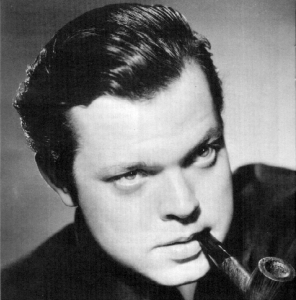
Orson Welles
From Wikipedia, the free encyclopedia
Birth name George Orson Welles
Born May 6, 1915
Kenosha, Wisconsin, United States
Died October 10, 1985 (aged 70)
Los Angeles, California, United States
Academy Awards
Writing, Original Screenplay
1941: Citizen Kane
George Orson Welles (May 6, 1915 - October 10, 1985) was an Academy Award-winning American screenwriter, a film and theatre director, a film producer and an actor in film, theatre and radio.
Welles first gained wide notoriety for his October 30, 1938 radio broadcast of H. G. Wells' The War of the Worlds. Adapted to sound like a contemporary news broadcast, it caused a large number of listeners to panic. Welles and his biographers subsequently claimed he was exposing the gullibility of American audiences in the tense preamble to the Second World War. In the mid-1930s his New York theatre adaptations of a voodoo Macbeth and a contemporary Julius Caesar became legendary. Welles was also an accomplished magician, starring in troop variety spectacles in the war years. During this period he became a serious political activist and commentator through journalism, radio and public appearances closely associated with Franklin D. Roosevelt. In 1941, he co-wrote, directed, produced and starred in Citizen Kane, most often chosen in polls of American film critics as the greatest film ever made.
Welles received a 1975 American Film Institute Lifetime Achievement award, the third person to do so after John Ford and James Cagney. Despite this accolade, Welles's artistic ambitions as a producer and director were frustrated by Hollywood movie studios. His one Hollywood film that remains as he conceived it is Citizen Kane, and only because its contract guaranteed him final cut. Although Welles remained on the margins of the main studios as a director/producer, his larger-than-life personality made him a bankable actor. In his latter years he struggled against a Hollywood system that refused to finance his independent film projects, making a living largely through acting, commercials and voice-over work.
Critical appreciation for Welles has increased since his death. He is now widely acknowledged as one of the most important dramatic artists of the 20th century. In 1999, the American Film Institute ranked Welles as the 16th greatest male star of all time.
Biography
Youth and early career (1915 to 1934)
Welles was born in 1915 in Kenosha, Wisconsin, the second son of Richard Head Welles, a wealthy inventor in the bicycle lamp trade, and Beatrice Ives, a concert pianist and suffragette. He was raised a Roman Catholic. He was declared a child prodigy by Dr. Maurice Bernstein, a Chicago physician infatuated with his mother Beatrice. She was a major influence on forming Welles's character, teaching him Shakespeare, as well as the piano and violin. By way of contrast, he learned magic from vaudevillians in the raffish company of his father. When Welles was six, his parents divorced and they and Dr. Maurice Bernstein moved to Chicago. There, Beatrice and Welles attended the opera, theatre and concerts.
Chicago was at the forefront of creative life in America at the time and visited constantly by important European composers and artists. Beatrice Welles died of jaundice on May 10, 1924 in a Chicago hospital, four days after Welles' ninth birthday. After his mother's death, Welles would no longer pursue his interests in music. Richard Welles became an alcoholic and died when Orson was 15, the summer after his graduation from the Todd School for Boys in Woodstock, Illinois. Welles later revealed in interviews that he felt that he had neglected and betrayed his father, and a feeling of guilt haunted him for the rest of his life. Maurice Bernstein became his guardian.
At Todd, Welles came under the positive influence and guidance of Roger Hill, a teacher who later became Todd's headmaster. Hill provided Welles with a free educational environment that proved invaluable to his creative experience, allowing Welles to concentrate on subjects that interested him. Welles performed and staged his first theatrical experiments and productions there.
On his father's death, Welles travelled to Europe with the aid of a small inheritance. While on a walking and painting trip through Ireland, he strode into the Gate Theatre in Dublin and claimed he was a Broadway star. Gate manager Hilton Edwards later claimed he didn't believe him but was impressed by his brashness and some impassioned quality in his audition. Welles made his stage debut at the Gate Theatre of Dublin in 1931, appearing in Jew Suss as the Duke to great acclaim that reached the United States, and subsequently in smaller supporting roles. On returning to the United States he found his brief fame ephemeral and turned to a writing project at Todd that would become the immensely successful Everybody's Shakespeare, and subsequently, The Mercury Shakespeare. Welles traveled to North Africa while working on thousands of illustrations for this series of educational books that remained in print for decades.
On return, an introduction by Thornton Wilder led Welles towards the New York stage. He toured in three off Broadway productions with Katharine Cornell's company. When the planned Broadway opening of Romeo and Juliet was cancelled, restless and impatient, Welles staged a drama festival of his own with the Todd School, inviting Micheal MacLiammoir and Hilton Edwards from Dublin's Gate Theatre to appear, along with New York stage luminaries. It was a roaring success. The subsequent revival of Romeo and Juliet brought Welles to the notice of John Houseman, who was then casting for an unusual lead actor and about to take a lead role in the The Federal Theatre Project. Houseman was paradoxically attracted to Welles' youth, wed to what appeared to be an overabundant creative certainty and drive. By 1935 Welles was supplementing his earnings as a radio actor in New York City, working with many of the actors who would later form the core of his Mercury Theatre. He married actress and socialite Virginia Nicholson in 1934 (they would have one daughter, Christopher, a children's book illustrator known as Chris Welles Feder). Welles also shot an eight-minute silent short film, The Hearts of Age, with Nicholson.
Renown in theatre and radio (1936 to 1939)
In 1936, the Federal Theatre Project (part of Roosevelt's Works Progress Administration), put unemployed theatre performers and employees to work. Welles was hired by John Houseman and assigned to direct a project for Harlem's American Negro Theater. Wanting to give his all-black cast a chance to play classics, he offered them Macbeth, moved to Haiti at the court of King Henri Christophe (and with a setting of voodoo witch doctors). Jack Carter played Macbeth. The play was rapturously received and later toured the nation. It is considered a landmark of African-American theatre. At 20 Welles was hailed as a prodigy.
After the success of Macbeth, Welles mounted the absurd farce Horse Eats Hat. He consolidated his "White Hope" reputation with Dr Faustus. This was even more ground-breaking theatre than Macbeth, using light as a prime unifying scenic element in a nearly blacked-out stage. In 1937, he rehearsed Marc Blitzstein's pro-union 'labour opera' The Cradle Will Rock. Because of severe federal cutbacks and perhaps rumoured Congressional worries about communist propaganda in the Federal Theatre, the show's premiere at the Maxine Elliott Theatre was canceled and the theatre locked and guarded by National Guardsmen. In a last-minute theatrical coup Welles announced to waiting ticket-holders that the show was being transferred to the Venice, about twenty blocks away. Cast, crew and audience walked the distance on foot. Since the unions forbade the actors and musicians performing from the stage, The Cradle Will Rock began with Blitzstein introducing the show and playing the piano accompaniment on stage, with the cast performing their parts from the audience. This impromptu performance was a tremendous hit.
Resigning from the Federal Theatre, Welles and Houseman formed their own company, the Mercury Theatre, which included actors such as Agnes Moorehead, Joseph Cotten, Ray Collins, George Coulouris, Frank Readick, Everett Sloane, Eustace Wyatt and Erskine Sanford, all of whom would continue to work for Welles for years. The first Mercury Theatre production was a melodramatic and heavily edited version of Shakespeare's Julius Caesar, set in a contemporary frame of fascist Italy. Cinna the Poet dies at the hands not of a mob but a secret police force. According to Norman Lloyd, who played Cinna, "it stopped the show." The applause lasted more than 3 minutes and the production was widely acclaimed.
Welles was increasingly active on radio, as an actor and soon as a director and producer. He played Hamlet for CBS on The Columbia Workshop, adapting and directing the play himself. The Mutual Network gave him a seven-week series to adapt Les Misérables, which he did with great success. Welles was chosen to anonymously play Lamont Cranston, The Shadow, in late 1937 (again for Mutual) and in the summer of 1938 CBS gave him (and the Mercury Theatre) a weekly hour-long show to broadcast radio plays based on classic literary works. The show was titled The Mercury Theatre on the Air, with original music by Bernard Herrmann, who would continue working with Welles on radio and in films for years.
Their October 30 broadcast, H. G. Wells' The War of the Worlds, brought Welles notoriety and instant fame on both a national and international level. The fortuitous mixture of news bulletin format with the between-breaks dial spinning habits of listeners from the rival and far more popular Edgar Bergen/Charlie McCarthy program, created widespread confusion among late tuners. Panic spread among many listeners who believed the news reports of an actual Martian invasion. The resulting panic was duly reported around the world and disparagingly mentioned by Adolf Hitler in a public speech a few months later. Welles' growing fame soon drew Hollywood offers, lures which the independent-minded Welles resisted at first. However, The Mercury Theatre on the Air, which had been a 'sustaining show' (without sponsorship) was picked up by Campbell Soup and renamed The Campbell Playhouse.
Welles in Hollywood (1939 to 1948)
RKO Pictures president George Schaefer eventually offered Welles what is generally considered the greatest contract ever offered to an untried director: complete artistic control. RKO signed Welles in a two-picture deal; including script, cast, crew, and most important, final cut. With this contract in hand, Welles (and nearly the entire Mercury Theatre) moved to Hollywood. He commuted weekly to New York to maintain his The Campbell Playhouse commitment.
Welles toyed with various ideas for his first project for RKO Pictures, settling on an adaptation of Joseph Conrad's Heart of Darkness, which he worked on in great detail. He planned to film the action with a subjective camera from the protagonist's point of view. However, as the international political climate darkened this created marketing restrictions across Europe. When a budget was drawn up, RKO's enthusiasm cooled. The anti-fascist tenor of the story was now suddenly problematic. RKO also declined to approve another Welles' project, The Smiler with the Knife, for similar political reasons and ostensibly because they lacked faith in Lucille Ball's ability to carry the leading lady role.
In a sign of things to come, Welles left The Campbell Playhouse in 1940, due to creative differences with the sponsor. The show continued without him, produced by John Houseman.
Welles found a suitable film project in an idea he conceived with screenwriter Herman J. Mankiewicz (who was then writing radio plays for The Campbell Playhouse.) Initially called American, it would eventually become Welles's first feature film, Citizen Kane (1941).
Mankiewicz based his original notion on an expose of the life of William Randolph Hearst, whom he knew socially but now hated, having once been great friends with Hearst's mistress, Marion Davies. Mankiewicz was now banished from her company because of his perpetual drunkenness. This "larger-than-life" character was also loosely modeled on Robert McCormick and Joseph Pulitzer, because Welles' wanted to create a broad, complex character, intending to show him in the same scenes from several points of view. Supplying Mankiewicz with 300 pages of notes Welles urged him to write the first drafts of a screenplay under the watchful nursing of John Houseman, who was posted to insure Mankiewicz stayed on the wagon. On Welles's instruction, Houseman wrote the opening narration as a pastiche of The March of Time newsreels. Taking these drafts, Welles drastically condensed and rearranged them, then added scenes of his own.
The resulting character of Charles Foster Kane is loosely based on parts of Hearst's life. Nonetheless, with perhaps sly and barely disguised malice towards their young boss, Mankiewicz and Houseman cunningly worked in autobiographical allusions to Welles himself, most noticeably in the treatment of Kane's childhood. Welles then added features from other famous American lives to create a general and mysterious personality rather than the narrow journalistic portrait intended by Mankiewicz, whose first drafts included scandalous claims about the death of the film director Thomas Ince, killed on an excursion on a Hearst yacht. Ironically, Mankiewicz later argued, probably astutely, that if this material had been left in Hearst would never have dared to make the public connection to his own life and would have left the film alone.
Once scripting was completed Welles attracted some of Hollywood's best technicians, including Gregg Toland, considered one of the finest cinematographers of the time, who walked into his office and announced he wanted to work on the picture. For the cast, Welles primarily used actors from his Mercury Theatre. Grasping that films were a collaboration, he invited suggestions from everyone, but only if they were directed through him.
There was little concern over the Hearst connection when Welles completed production on the film. However, Mankiewicz handed a copy of the final shooting script to his friend Charles Lederer, now husband of Welles' ex-wife Virginia Nicholson and nephew of Hearst's mistress Marion Davies. Hearst found out about the existence of the movie and sent his gossip columnist, Louella Parsons, to a screening with the express instruction to stop the film. Parsons, realizing immediately that the film was based on features of Hearst's life, reported this back to him and threatened to give "Hollywood, Private Lives" if that was what it wanted. Thus began the struggle over the attempted suppression of Citizen Kane.
Hearst's media empire boycotted the film. It exerted enormous pressure on the Hollywood film community by threatening to expose 15 years of suppressed scandals and the fact that most of the studio bosses were Jewish. At one point, the heads of the major studios jointly offered RKO the cost of the film in exchange for the negative and all existing prints, for the express purpose of burning it. RKO declined, and the film was given a limited release. Meanwhile, Hearst successfully intimidated theatre chains by threatening to ban advertising for any of their other films in any of his papers if they showed Citizen Kane. RKO didn't own many theatres, so few movie houses actually dared to screen Citizen Kane.
While the film was critically well-received, by the time it reached the general public the positive tide of publicity had waned. It garnered nine Academy Award nominations but won only for Best Original Screenplay, shared by Mankiewicz and Welles. The delay in its release and its uneven distribution contributed to its poor result at the box-office, initially losing RKO most of its $800,000 investment. The fact that it ignored many Hollywood conventions also meant that Citizen Kane was not immediately embraced by the 40s cinema public. However, through re-release, television, home video and DVD, it has established a "Classic" status and recouped its costs.
The 1996 documentary The Battle Over Citizen Kane chronicles the battle between Welles and Hearst.
After Citizen Kane
Welles' second film for RKO was The Magnificent Ambersons, adapted from the Pulitzer Prize-winning novel by Booth Tarkington. George Schaefer hoped to make back the money lost by Citizen Kane. Ambersons had already been adapted for The Campbell Playhouse by Welles, who wrote the screen adaptation himself. Toland was not available, so Stanley Cortez was named cinematographer. The meticulous Cortez, however, was slow and the film lagged behind schedule and over budget.
At RKO's request, simultaneously, Welles worked on an adaptation of Eric Ambler's spy thriller, Journey Into Fear, which he co-wrote with Joseph Cotten. In addition to acting in the film, Welles was also producer. Direction was credited solely to Norman Foster. Welles later stated that they were in such a rush that the director of each scene was whoever was closest to the camera.
Welles was then offered a new radio series by CBS. Called The Orson Welles Show, it was a half-hour variety show of short stories, comedy skits, poetry and musical numbers. Joining the original Mercury Theatre cast was Jiminy Cricket, "on loan from Walt Disney". The variety format was unpopular with the listeners, and Welles was soon forced into full half-hour stories instead.
To further complicate matters during the production of Ambersons and Journey into Fear, Welles was approached by Nelson Rockefeller and Jock Whitney to produce a documentary film about South America. This was at the behest of the federal government's Good Neighbor Policy, a wartime propaganda effort designed to prevent Latin America from allying with the Axis Powers. Welles saw his involvement as a form of national service, because his physical condition excused him from direct military service.
Expected to film the Carnival in Rio de Janeiro, Brazil, Welles rushed to finish the editing on Ambersons and his acting scenes in Journey into Fear. Ending his CBS radio show, he lashed together a rough cut of Ambersons with Robert Wise, who had edited Citizen Kane, and left for Brazil. Unfortunately, to get Ambersons made, Welles had renegotiated away his original contract for final cut.
Wise was to join him in Rio to complete the film but never arrived. Other moves were afoot at RKO. A provisional final cut arranged via phone call, telegram, and shortwave radio was previewed without Welles' approval in Pomona in a double bill, to a mostly negative audience response, in particular to the character of Aunt Fanny played by Agnes Moorehead.
Whereas Schaefer argued that Welles be allowed to complete his own version of the film, and that an archival copy be kept with the Museum of Modern Art in New York City, RKO was in no mood for such aesthetic niceties.
RKO studio management was in turmoil as Charles Koerner staged a management coup against Schaefer. It took control of the film, formed a committee which was ordered to remove fifty minutes of Welles' footage, re-shot sequences, rearranged the scene order, and tacked on a happy ending. Schaefer was replaced as RKO President by Koerner, who released the shortened film on the bottom of a double-bill with the Lupe Velez comedy Mexican Spitfire Sees a Ghost, thus providing the last nail in the coffin for both Welles's and Schaefer's careers. Ambersons was an expensive flop for RKO, though Agnes Moorehead did receive a Best Supporting Actress Oscar nomination for her performance.
Welles' South American documentary, titled It's All True, budgeted at one million dollars with half of its budget coming from the US Government upon completion, was treated scarcely better by RKO. They closed down the production, withdrew most of the crew and kicked the Mercury staff out of the studio while Welles was still in Brazil.
In It's All True, Welles recreated the journey of the jangadeiros, four poor fisherman who had made a 1500-mile journey on their open raft to petition Brazilian President Vargas about their working conditions. The four had become national folk heroes, Welles first read of their journey in Time. Despite their leader, Jacare, dying during a filming mishap, Welles begged to be able to finish the film. He was given a limited amount of black-and-white stock and a silent camera. He completed the sequence, but RKO refused to let him complete the film. Surviving footage was released in 1993, including a rough reconstruction of the Four Men on a Raft segment. Meanwhile, RKO launched a premeditated publicity campaign against Welles, falsely claiming he had gone to Brazil without a screenplay, and that he had squandered a million dollars. Their official company slogan was pointedly changed to "Showmanship in place of Genius." These then were the new Medici.
Unable to continue work as a film director after the twin disasters of The Magnificent Ambersons and It's All True, Welles worked on radio. CBS offered him two weekly series, Hello Americans, based on the research he'd done in Brazil, and Ceiling Unlimited, sponsored by Lockheed, a wartime salute to advances in aviation. Both featured several members of his original Mercury Theatre. Within a few months, Hello Americans was canceled and Welles was replaced as host of Ceiling Unlimited by Joseph Cotten. Welles guest-starred on a great variety of shows, notably guest-hosting Jack Benny's show for a month in 1943. He took an increasingly active role in American and international politics and used journalism to communicate his forceful ideas widely.
In 1943 Welles married Rita Hayworth. They had one child, Rebecca Welles, and divorced five years later in 1948. In between, Welles found work as an actor in other directors' films. He starred in the 1943 film adaptation of Jane Eyre, trading credit as associate producer for top billing over Joan Fontaine. He also had a cameo in the 1944 wartime salute Follow the Boys, in which he performed his Mercury Wonder Show magic act and sawed Marlene Dietrich in half after Columbia Pictures head Harry Cohn refused to allow Hayworth to perform.
In 1944 Welles was offered a new radio show, broadcast only in California. Orson Welles' Almanac was another half-hour variety show, with Mobil Oil as sponsor. After the success of his stand-in hosting on The Jack Benny Show, the focus was primarily on comedy. His hosting on Jack Benny included several self-depreciating jokes and story lines about his being a "genius" and overriding any ideas advanced by other cast members. The trade papers were not eager to accept Welles as a comedian, and Welles often complained on-air about the poor quality of the scripts. When Welles started his Mercury Wonder Show a few months later, traveling to Armed Forces camps and performing magic tricks and doing comedy, the radio show was broadcast live from the camps and the material took a decidedly wartime flavor. Of his original Mercury actors, only Agnes Moorehead was left. The series was canceled by year's end due to poor ratings.
While his suitability as a film director remained in question, Welles' popularity as an actor continued. Pabst Blue Ribbon gave Welles their radio series This Is My Best to direct, but after one month he was fired for creative differences. He started writing a political column for the New York Post, again called Orson Welles Almanac. While the paper wanted Welles to write about Hollywood gossip, Welles explored serious political issues. His activism for world peace took considerable amounts of his time. The Post column eventually failed in syndication because of contradictory expectations and was dropped by the Post.
After World War II Work (1946-1948)
In 1946, International Pictures released Welles' film The Stranger, starring Edward G. Robinson, Loretta Young and Welles. Sam Spiegel produced the film, which follows the hunt for a Nazi war criminal living under an alias in America. While Anthony Veiller was credited with the screenplay, it had been rewritten by Welles and John Huston. Welles' most imaginative work on the film was cut out by Spiegel, and the result apart from some bravura sequences on the clock tower or evoking the small town atmosphere, was a comparatively conventional Hollywood thriller. It was successful at the box office but Welles resolved not to have a career as a cog in a Hollywood studio. He resumed his struggle for the creative control which had originally brought him to Hollywood.
In the summer of 1946 Welles directed a musical stage version of Around the World in Eighty Days, with a comedic and ironic rewriting of the Jules Verne novel by Welles, incidental music and songs by Cole Porter, and production by Mike Todd, who would later produce the successful film version with David Niven. When Todd pulled out from the lavish and expensive production, Welles supported the finances himself. When he ran out of money at one point, he convinced Columbia president Harry Cohn to send him enough to continue the show, and in exchange Welles promised to write, produce, direct and star in a film for Cohn for no further fee. The stage show would soon fail due to poor box-office, with Welles unable to claim the losses on his taxes. He wound up owing the IRS several hundred thousand dollars, and in a few years time Welles would seek tax-shelter in Europe.
At the same time in 1946 he began two new radio series, The Mercury Summer Theatre for CBS and Orson Welles Commentaries for ABC. While Summer Theatre featured half-hour adaptations of some of the classic Mercury radio shows from the 1930s, the first episode was a condensation of his Around the World stage play, and remains the only record of Cole Porter's music for the project. Several original Mercury actors returned for the series, as well as Bernard Herrmann. It was only scheduled for the summer months, and Welles invested his earnings into his failing stage play. Commentaries was a political soap-box, continuing the themes from his New York Post column. Again Welles lacked a clear focus, until the NAACP brought to his attention the case of Isaac Woodward. Welles devoted the rest of the run of the series to Woodward's cause, was the first broadcaster to bring it to national attention, and caused shock waves across the nation. Soon Welles was being hung in effigy in the South and The Stranger was banned in several southern states. ABC was unable to find a sponsor for the radio show and soon canceled it. Welles never had a regular radio show in America again and would never direct another anywhere.
The film for Cohn wound up being The Lady from Shanghai, filmed in 1947 for Columbia Pictures. Intended to be a modest thriller, the budget skyrocketed after Cohn suggested that Welles' then-estranged second wife Rita Hayworth co-star. Cohn was enraged by Welles' rough-cut, in particular the confusing plot and lack of close-ups, and ordered extensive editing and re-shoots. After heavy editing by the studio, approximately one hour of Welles' first cut had been removed. While expressing dismay at the cuts, Welles was particularly appalled by the soundtrack, objecting to the musical score he thought more suitable for a Disney cartoon and the lack of the ambient soundscape he had designed. The film was considered a disaster in America at the time of release. Welles recalled people refusing to speak to him about it to save him embarrassment. Not long after release, Welles and Hayworth finalized their divorce. Though the film was acclaimed in Europe, it was not embraced in the US for several decades.
Unable to find work as a director at any of the major studios, in 1948 Welles convinced Republic Pictures to let him direct a low-budget version of Macbeth, which featured paper maché sets, cardboard crowns and a cast of actors lip-syncing to a prerecorded soundtrack. Republic did not care for the Scottish accents on the soundtrack and held up release for almost a year. Welles left for Europe, while his co-producer and life-long supporter Richard Wilson reworked the soundtrack. Welles ultimately returned and cut twenty minutes from the film at Republic's request and recorded narration to cover the gaps. The film was decried as another disaster. In the late 1970s, Macbeth was restored to Welles' original version.
Welles in Europe (1948 to 1956)
Welles left Hollywood for Europe in late 1947, enigmatically saying he had chosen "freedom". This must refer to both acting offers and the possibility of directing and producing films again. There is now compelling evidence that Welles was blacklisted in Hollywood, after years of propaganda by the Hearst empire labeling him a communist and years of FBI investigations prompted by J. Edgar Hoover.
In Italy he starred as Cagliostro in the 1948 film Black Magic. His co-star, Akim Tamiroff, impressed Welles so much that he appeared in four of Welles' own productions during the 1950s and 1960s.
The following year, Welles appeared as Harry Lime in The Third Man, written by Graham Greene, directed by Carol Reed, starring Mercury Theatre alumnus Joseph Cotten, and with a memorable zither score by Anton Karas. The film was an international smash hit, but Welles unfortunately turned down a percentage of the gross in exchange for a lump-sum advance. A few years later British radio producer Harry Alan Towers would resurrect the Lime character for radio in the series The Lives of Harry Lime. The 1951 series included new recordings by Karas, was very successful, and ran for 52 weeks. Welles claimed to write a handful of episodes -- a claim disputed by Towers, who maintains they were written by Ernest Borneman -- which would later serve as the basis for the screenplay of Welles' Mr. Arkadin (1955).
Welles also appeared as Cesare Borgia in the 1949 Italian film Prince of Foxes, with Tyrone Power and Mercury Theatre alumnus Everett Sloane, and as the Mongol warrior Bayan in the 1950 film version of the novel The Black Rose (again with Tyrone Power). During this time, Welles was channeling his money from acting jobs into a self-financed film version of Shakespeare's play Othello.
Othello, which earned Welles a Palme d'Or.From 1949 to 1951, Welles worked on Othello, filming on location in Europe and Morocco. The film featured Micheál MacLiammóir as Iago and Hilton Edwards as Desdemona's father Brabantio (Edwards and MacLiammóir ran the Gate Theatre in Ireland and had given Welles his first professional job as actor in 1931). Suzanne Cloutier starred as Desdemona and Campbell Playhouse alumnus Robert Coote appeared as Iago's lackey Roderigo.
Filming was suspended several times over the years as Welles ran out of funds and left to find other acting jobs, accounted in detail in MacLiammóir's published memoir Put Money in Thy Purse. When it premiered at the Cannes Film Festival it won the Palme d'Or, but was not given a general release in the United States until 1955 (by which time Welles had re-cut the first reel and re-dubbed most of the film, removing Cloutier's voice entirely, and played only in New York and Los Angeles. The American release prints had a technically flawed soundtrack, suffering from a complete drop-out of sound at every quiet moment, and it was one of these flawed prints that was restored by Welles's daughter Beatrice Welles-Smith in 1992 for a wide re-release. The restoration included reconstructing Francesco Lavagnino's original musical score (which was inaudible) and adding ambient stereo sound effects (which weren't in the original film). Though still active in Italy, Lavagnino was not consulted. The subject of great controversy among film scholars, the restoration went on to a successful theatrical run in America. A print of the US version was released on laser-disc in 1995 and soon withdrawn after a legal challenge by Beatrice Welles-Smith. The original Cannes version has survived but is not commercially available.
In 1952 Welles continued finding work in England, after the success of the Harry Lime radio show. Harry Alan Towers offered Welles another series, The Black Museum, with Welles as host and narrator, and this would also run 52 weeks. Director Herbert Wilcox offered him the part of the murdered victim in Trent's Last Case, based on the novel by E. C. Bentley. And in 1953 the BBC hired Welles to read an hour of selections from Walt Whitman's epic poem Song of Myself. Towers hired Welles again, to play Professor Moriarty in the radio series The Adventures of Sherlock Holmes, starring John Gielgud, and Ralph Richardson.
Late in 1953, Welles returned to America to star in a live CBS Omnibus television presentation of Shakespeare's King Lear. The cast included Micheál MacLiammóir and Alan Badel. While Welles received good notices, he was guarded by IRS agents, prohibited to leave his hotel room when not at the studio, prevented from making any purchases, and the entire sum (less expenses) he earned went to his tax bill. Welles returned to England after the broadcast.
In 1954, director George More O'Ferrall offered Welles the title role in the Lord Mountdrago segment of Three Cases of Murder, costarring Alan Badel. Director Herbert Wilcox cast him as the antagonist in Trouble in Glen opposite Margaret Lockwood, Forrest Tucker and Victor McLaglen. And director John Huston cast him as Father Mapple in his film adaptation of Herman Melville's Moby Dick, starring Gregory Peck.
Welles' next turn as director was the film Mr. Arkadin (1955), produced by Louis Dolivet, Welles' political mentor from the 1940s. It was filmed in France, Germany, Spain and Italy. Based on several episodes of the Harry Lime radio show, it stars Welles as a paranoid billionaire who hires a petty smuggler to delve into the secrets of his seedy past. Welles' absurd and obvious makeup has been the subject of much derision, but it may have been the intent to show a character who was in disguise and hiding his true identity. The film stars Robert Arden, who had worked on the Harry Lime series, Welles' third wife Paola Mori, whose voice was completely dubbed by actress Billie Whitelaw, and guest stars including Akim Tamiroff, Michael Redgrave, Katina Paxinou, and Mischa Auer. Frustrated by Welles' slow progress in the editing room, producer Dolivet removed Welles from the project and finished the film without him. Eventually five different versions of the film would be released, two in Spanish and three in English. The version which Dolivet completed was retitled Confidential Report and was the version furthest from Welles's original intention. In 2005 Stefan Droessler of the Munich Filmmuseum oversaw a reconstruction of what might have been Welles' original intention. It was released by the Criterion Company on DVD and is considered by Welles scholar and director Peter Bogdanovich to be the best version available.
Also in 1955 Welles directed two television series for the BBC. The first was Orson Welles' Sketchbook, a series of six 15-minute shows featuring Welles drawing in a sketchbook to illustrate his reminiscences for the camera (including such topics as the filming of It's All True and the Isaac Woodward case), and the second was Around the World with Orson Welles, a series of six travelogues set in different locations around Europe (such as Venice, the Basque Country between France and Spain, and England). Welles served as host and interviewer, his commentary including documentary facts and his own personal observations (a technique he would continue to explore). A seventh episode of this series, based on the Gaston Dominici case, was suppressed at the time by the French government, but was reconstructed after Welles's death and released to video in 1999.
In 1956 Welles completed Portrait of Gina, posthumously aired on German television under the title 'Viva Italia', a 30-minute personal essay on Gina Lollobrigida and the general subject of Italian sex symbols. Dissatisfied with the results -- Welles recalled he had worked on it a lot and the result was something that looked as though it had been worked on a lot -- he left the only print behind at the Hotel Ritz in Paris. The film cans would remain in a lost and found locker at the hotel for several decades, where they were rediscovered after Welles' death.
Return to Hollywood (1956 to 1959)
In 1956, Welles returned to Hollywood, guesting on radio shows (notably as narrator of Tomorrow, a nuclear holocaust drama produced by the Federal Civil Defense Administration). He guest starred on television shows, including I Love Lucy and began filming a projected pilot for Desilu, owned by his former protégé Lucille Ball and her husband Desi Arnaz, who had recently purchased the defunct RKO studios. The film was The Fountain of Youth, based on a story by John Collier. Originally deemed not viable as a pilot, the film wasn't aired until 1958. It won the Peabody Award for excellence.
Welles' next feature film role was in Man in the Shadow for Universal Pictures in 1957, starring Jeff Chandler.
Welles stayed on at Universal to costar with Charlton Heston in the 1958 film of Whit Masterson's novel Badge of Evil (which Welles famously claimed never to have read). Originally only hired as an actor, Welles was promoted to director by Universal Studios at the suggestion (and insistence) of Charlton Heston. Reuniting many actors and technicians with whom he'd worked in Hollywood in the 1940s (including cameraman Russell Metty [The Stranger], make-up artist Maurice Siederman (Citizen Kane), and actors Joseph Cotten, Marlene Dietrich, and Akim Tamiroff), filming proceeded smoothly, with Welles finishing on schedule and on budget, and the studio bosses praising the daily rushes. Out of the blue, the studio wrested Touch of Evil from Welles' hands, re-edited it, re-shot scenes, and shot new exposition scenes to clarify the plot. Despite the trauma of having the film ripped from his creative control for no ostensible reason, Welles wrote a 58-page memo outlining suggestions and objections. The studio followed a few of the ideas, but cut another 30 minutes from the film and released it. Even in this state, the film was widely praised across Europe, awarded the top prize at the Brussels World's Fair.
In 1978, the long preview version of the film was rediscovered and released. In 1998, editor Walter Murch and producer Rick Schmidlin, consulting the original memo, used a workprint version to attempt to restore the film as close as possible to the memo. This is at best a compromise that should not be mistaken for Welles' original intent. Welles stated in that memo that the film was no longer his version ?- it was the studio's, but as such, he was still prepared to help them with it.
As Universal reworked Evil, Welles began filming his adaptation of Miguel Cervantes' novel Don Quixote in Mexico, starring Mischa Auer as Quixote and Akim Tamiroff as Sancho Panza. While filming would continue in fits and starts for several years, Welles would never complete the project.
Welles continued acting, notably in The Long, Hot Summer (1958) and Compulsion (1959), but soon returned to Europe to continue his pattern of self-producing low budget films over which he would have creative control and final cut.
Return to Europe (1959 to 1970)
Welles returned to Europe and resumed acting jobs. He continued shooting Don Quixote in Spain, but replaced Mischa Auer with Francisco Reiguera.
In Italy in 1959, Welles directed his own scenes as King Saul in Richard Pottier's film David and Goliath. In Hong Kong he costarred with Curt Jurgens in Lewis Gilbert's film Ferry to Hong Kong.
In 1960 in Paris he costarred in Richard Fleischer's film Crack in the Mirror. In Yugoslavia he starred in Richard Thorpe's film The Tartars. He also staged a play at the Gate Theatre in Dublin which compressed five of Shakespeare's history plays in order to focus on the story of Falstaff. Keith Baxter played Prince Hal and Welles called the adaptation Chimes at Midnight.
By this time he had completed filming on Quixote. Though he would continue toying with the editing well into the 1970s, he never completed the film. On the scenes he did complete, Welles voiced all the actors and provided the narration. In 1992 a version of the film was completed by director Jess Franco, though not all the footage Welles shot was available to him. What was available had decayed badly. While the Welles footage was greeted with interest, the post-production by Franco was met with harsh criticism.
In 1961 Welles directed In the Land of Don Quixote, a series of eight half-hour episodes for the Italian television network RAI. Similar to the Around the World with Orson Welles series, they presented travelogues of Spain and included Welles' wife, Paola, and their daughter, Beatrice. Though fluent in Italian, the network was not interested in Welles providing Italian narration because of his accent, and the series sat unreleased until 1964, by which time the network had added Italian narration of its own. Ultimately, the episodes were restored with the original musical score Welles had approved, but sans narration.
In 1962 Welles directed his adaptation of The Trial, based on the novel by Franz Kafka and produced by Alexander Salkind and Michael Salkind. The cast included Anthony Perkins as Josef K, Jeanne Moreau, Romy Schneider, Paola Mori and Akim Tamiroff. While filming exteriors in Zagreb, Welles was informed that the Salkinds had run out of money, meaning that there could be no set construction. No stranger to shooting on found locations, Welles soon filmed the interiors in the Gare d'Orsay, at that time an abandoned railway station in Paris. Welles thought the location possessed a "Jules Verne modernism" and a melancholy sense of "waiting", both suitable for Kafka. The film failed at the box-office. Peter Bogdanovich would later observe that Welles found the film riotously funny. During the filming, Welles met Oja Kodar, who would later become his muse, star and partner for 20 years.
Welles continued taking what work he could find acting, narrating or hosting other people's work, and began filming Chimes at Midnight, which was completed in 1966. Filmed in Spain, it was a condensation of five Shakespeare plays, telling the story of Falstaff and his relationship with Prince Hal. The cast included Keith Baxter, John Gielgud, Jeanne Moreau and Margaret Rutherford, with narration by Ralph Richardson. Music was again by Francesco Lavagnino. Jess Franco served as second unit director.
In 1966, Welles directed a film for French television, an adaptation of The Immortal Story, by Isak Dinesen. Released in 1968, it stars Jeanne Moreau, Roger Coggio and Norman Eshley. The film had a successful run in French theaters. At this time Welles met Kodar again, and gave her a letter he had written to her and had been keeping for four years; they would not be parted again. They immediately began a collaboration both personal and professional, which would continue for the rest of his life. The first of these was an adaptation of Isak Dinesen's The Heroine, meant to be a companion piece to The Immortal Story and starring Kodar. Unfortunately, funding disappeared after one day's shooting. After completing this film, he appeared in a brief cameo as Cardinal Wolsey in Fred Zinnemann's adaptation of A Man for All Seasons -- a role for which he won considerable acclaim.
In 1967 Welles began directing The Deep, based on the novel Dead Calm by Charles F. Williams and filmed off the shore of Yugoslavia. The cast included Jeanne Moreau, Laurence Harvey and Kodar. Personally financed by Welles and Kodar, they could not obtain the funds to complete the project, and it was abandoned a few years later after the death of Harvey. The surviving footage was eventually restored by the Filmmuseum München.
In 1968 Welles began filming a TV special for CBS under the title Orson's Bag, combining travelogue, comedy skits and a condensation of Shakespeare's play The Merchant of Venice with Welles as Shylock. Funding for the show sent by CBS to Welles in Switzerland was seized by the IRS, reputedly due to the anger of Richard Nixon over a record Welles had not written but had narrated, the political satire The Begatting of the President. Without funding, the show was not completed. The surviving portions were eventually restored by the Filmmuseum München.
In 1969, Welles authorized the use of his name for a movie theatre in Cambridge, Massachusetts. The Orson Welles Cinema remained in operation until 1986, with Welles making a personal appearance there in 1977.
Drawn by the numerous offers he received to work in television and films, and upset by a tabloid scandal reporting his affair with Kodar, Welles abandoned the editing of Don Quixote and moved back to America in 1970.
Return to United States and final years (1970 to 1985)
Welles returned to Hollywood, where he continued to self-finance his own film and television projects. While offers to act, narrate and host continued, Welles also found himself in great demand on talk shows, and made frequent appearances for Dick Cavett, Johnny Carson, and Dean Martin. Welles's primary focus in this period was filming The Other Side of the Wind, a project that took six years to film but has remained unfinished and unreleased.
In 1971 Welles directed a short adaptation of Moby Dick, a one-man performance on a bare stage, reminiscent of his stage production Moby Dick - Rehearsed from the 1950s. Never completed, it was eventually restored by the Filmmuseum München.
In 1971 the Academy of Motion Picture Arts and Sciences gave him an honorary award "For superlative artistry and versatility in the creation of motion pictures". Welles pretended to be out of town and sent John Huston to claim the award. Huston criticized the Academy for awarding Welles while they refused to give him any work.
In 1973 Welles completed F for Fake, a personal essay film about art forger Elmyr d'Hory and the biographer Clifford Irving. Based on an existing documentary by Francois Reichenbach, it included new material with Oja Kodar, Joseph Cotten, Paul Stewart and William Alland.
Working again for British producer Harry Alan Towers, Welles played Long John Silver in director John Hough's 1973 adaptation of Robert Louis Stevenson's novel Treasure Island, which had been the second story broadcast by The Mercury Theatre on the Air in 1938. Welles also contributed to the script, his writing credit was attributed to the pseudonym 'O. W. Jeeves'.
In 1975, the American Film Institute presented Welles with their third Lifetime Achievement Award (the first two going to director John Ford and actor James Cagney). At the ceremony, Welles screened two scenes from the nearly finished The Other Side of the Wind. By 1976. Welles had almost completed the film. Financed by Iranian backers, ownership of the film fell into a legal quagmire after the Shah of Iran was deposed. Written by Welles, the story told of a destructive old film director looking for funds to complete his final film. It starred John Huston and the cast included Peter Bogdanovich, Susan Strasberg, Norman Foster, Edmond O'Brien, Cameron Mitchell, and Dennis Hopper. As of 2006, all legal challenges concerning ownership of the film have been settled and end money for completing the film is being sought, in part from the Showtime cable network.
In 1979 Welles completed his documentary Filming Othello, which featured Michael MacLiammoir and Hilton Edwards. Made for West German television, it was also released in theaters. That same year, Welles completed his self-produced pilot for The Orson Welles Show television series, featuring interviews with Burt Reynolds, Jim Henson and Frank Oz and guest-starring The Muppets and Angie Dickinson. Unable to find network interest, the pilot was never broadcast.
Beginning in the late 1970s, Welles participated in a series of famous television commercial advertisements, acting as the on-camera spokesman for the Paul Masson wine company. The sign-off phrase of the commercials ?- "We will sell no wine before its time" ?- became a national catchphrase.
In 1979 he also appeared in the biopic "The Secret Life of Nikola Tesla."
In 1980 the BBC broadcast The Orson Welles Story for the Arena series. Interviewed by Leslie Megahey, Welles examined his past in great detail, and several people from his professional past were interviewed as well.
During the 1980s, Welles worked on such film projects as The Dreamers, based on two stories by Isak Dinesen and starring Oja Kodar, and The Orson Welles Magic Show, which reused material from his failed TV pilot. Another project he worked on was Filming The Trial, the second in a proposed series of documentaries examining his feature films. While much was shot for these projects, none of them were completed. All of them were eventually restored by the Filmmuseum München.
Welles in his later years was unable to get funding for his many film scripts, but came close with The Big Brass Ring and The Cradle Will Rock: Arnon Milchan had agreed to produce The Big Brass Ring if any one of six actors - Warren Beatty, Clint Eastwood, Paul Newman, Jack Nicholson, Robert Redford, or Burt Reynolds - would sign on to star. All six declined for various reasons. Independent funding for The Cradle Will Rock had been obtained and actors had signed on, including Rupert Everett to play the young Orson Welles, location filming was to be done in New York City with studio work in Italy. While pre-production went without a problem, three weeks before filming was to begin the money fell through. Allegedly Welles approached Steven Spielberg to ask for assistance in rescuing the film, but Spielberg declined. The scripts to both films were published posthumously. After a studio auction, he complained that Steven Spielberg spent $50,000 for the Rosebud sled used in Citizen Kane, but would not give him a dime to make a picture. Welles retaliated by publicly announcing the sled to be a fake, the original having been burned in the film, but he later recanted the claim.
Welles died of a heart attack at his home in Hollywood, California at age 70 on October 10, 1985. He had various projects underway, including a planned film adaptation of King Lear, The Orson Welles Magic Show, and The Dreamers. His final interview had been recorded the day before, on The Merv Griffin Show and with his biographer Barbara Leaming. The last film roles before his death included voice work in the animated films Transformers: The Movie (as the villainous transformer Unicron) and The Enchanted Journey and on-screen in Henry Jaglom's film Someone to Love, released in 1987.
According to Welles' associates Gary Graver and Oja Kodar, Welles did not wish to be cremated, but his wife Paola and daughter Beatrice had the cremation performed, and his ashes were eventually placed in a dry well at a friend's estate in Ronda, Spain. According to some reports, some of his ashes have been scattered in the town's famous Plaza de Toros, the oldest bullfighting ring in Spain still in use.
Unfinished projects
Welles' exile from Hollywood and reliance on independent production meant that many of his later projects were filmed piecemeal or were not completed. In the mid-1950s, Welles began work on the Cervantes' masterpiece Don Quixote, initially a commission from CBS television. Welles expanded the film to feature length, developing the screenplay to take Quixote and Sancho Panza into the modern age. Filming stopped with the death of Francisco Reiguera, the actor playing Quixote, in 1969. Orson Welles continued editing the film through the next few decades and had supposedly completed a rough cut in the mid 1970s. By his death however, the footage of many scenes had been lost around the world during Welles travels. A search continues for Orson Welles' later edits and other missing footage but they likely no longer exist. An incomplete version of the film was released in 1992.
In 1970 Welles began shooting The Other Side of the Wind, about the effort of a film director (played by John Huston) to complete his last Hollywood picture, and is largely set at a lavish party. Although in 1972 the film was reported by Welles as being "96% complete", the negative remained in a Paris vault until 2004, when Peter Bogdanovich (who also acted in the film) announced his intention to complete the production. Footage is included in the documentary Working with Orson Welles (1993).
Other unfinished projects include The Deep, an adaptation of Charles Williams' Dead Calm?-abandoned in 1970 one scene short of completion due to the death of star Laurence Harvey?-and The Big Brass Ring, the script of which was adapted and filmed by George Hickenlooper in 1999.
The 1995 documentary Orson Welles: One-Man Band, included on the Criterion Collection DVD release of F for Fake, features scenes from several of these unfinished projects, as well as footage from an adaptation of The Merchant of Venice starring Welles that was never aired due to vital footage being allegedly stolen; several short subjects such as the titular One-Man Band, a Monty Python-esque spoof in which Welles plays all but one of the characters (including two characters in drag); footage of Welles reading chapters from Moby Dick; and a comedy skit taking place in a tailor shop and co-starring Charles Gray. One short, also included in the documentary, is a comedy routine in which Welles (filmed in the 1970s) plays a reporter interviewing a king, also played by Welles, but in footage shot in the 1960s; Welles finished the skit and edited it together years later. The documentary is built around a college lecture given by Welles not long before his death, in which he displays frustration at being unable to complete so many projects. According to Oja Kodar, interviewed in the documentary, Welles always traveled with camera equipment and would shoot film whenever the mood struck him, even if there were no immediate prospects for commercial release of such material.
Trivia
Welles, an avid comic book fan, made a guest appearance in Issue 62 of Superman, "Black Magic on Mars!", in which Welles and Superman teamed up against Martler, a fascist Martian.
In the '60's through the '80's, he was frequently seen around the likes of Dean Martin, Frank Sinatra, Jimmy Stewart, and Don Rickles. He was a frequent guest on the Dean Martin Show and participated in a lot of Martin's celebrity roasts.
He was the great grandson of Secretary of the Navy Gideon Welles. [see Orson Welles' July 27, 1970 interview on the Dick Cavett show at about 35 minutes into the show]
Orson Welles was Francis Ford Coppola's first choice to play Colonel Kurtz in Apocalypse Now (1979), based on the novel Heart of Darkness which Welles was planning to adapt before he wrote Citizen Kane.[citation needed]
He was dating Billie Holiday around the time he was making Citizen Kane. According to Holiday's autobiography, Lady Sings the Blues, she saw the film nine times before it ever played in a theater.
Welles had three daughters to three different mothers: children's author Chris Welles Feder, born 1937 (to mother Virginia Nicholson); Rebecca Welles Manning, 1944-2004 (to mother Rita Hayworth); and Beatrice Welles, born in November 1955 (to mother Paola Mori).
He has been portrayed by Vincent D'Onofrio with his voice dubbed by Maurice LaMarche in Ed Wood and the 2005 short film Five Minutes, Mr Welles, Angus Macfadyen in Cradle Will Rock, Liev Schreiber in RKO 281, Jean Guerin in Heavenly Creatures, Danny Huston in the upcoming Fade to Black, Paul Shenar in The Night That Panicked America, Eric Purcell in Malice in Wonderland, John Candy in Second City Television, David Benson in the Doctor Who audio drama Invaders From Mars and the voice of Maurice LaMarche in various animation and films.
Welles voiced original trailers for The Incredible Shrinking Man in 1957, Star Wars in 1977, and Star Trek: The Motion Picture in 1979 .
Welles was a close friend of the Domecq family and a great fan of their sherry, to the extent that he was happy to star in a series of TV commercials for their products in the 1970s.[citation needed]
He died the same day as his The Battle of Neretva co-star Yul Brynner.
The Brain, the genius lab mouse in the cartoon series Pinky and the Brain, was loosely based on Orson Welles. The Brain even parodies Welles' The War of the Worlds broadcast and his infamous radio commercial argument. Voice artist Maurice LaMarche provided the voice of The Brain, and would later portray a bloated Orson Welles at the low point of his television career in The Critic.[citation needed]
Welles performed the narration on two tracks on the 1987 CD version of the 1976 album Tales of Mystery and Imagination, by The Alan Parsons Project.
Welles performed narration for two songs by the heavy metal band Manowar, a favorite of his niece. The songs are "Dark Avenger" (from Battle Hymns, 1982) and "Defender" (from Fighting the World, 1987). Fighting the world was released two years after his death, Defender is among Welles's last performances.
He was the voice of Robin Masters, the famous writer/playboy who owned the mansion, Ferrari, etc., in the TV series Magnum, P.I.. Welles's sudden death forced the character to be largely written out of the series.
His last filmed appearance was on the television show Moonlighting. He recorded an introduction to an episode entitled "The Dream Sequence Always Rings Twice," which was partially filmed in black and white. The episode aired five days after his death and was dedicated to his memory.
His final role was the voice of the planet eating robot Unicron in Transformers: The Movie, released almost a year after his death on August 8, 1986.
Welles narrated "Drippy the Runaway Raindrop" by Sidney, Mary and Alexandra Sheldon which continues to be a popular English educational series in Japan.
The lyrics of the song "The Union Forever", on the White Stripes 2001 album "White Blood Cells", are almost entirely composed of dialogue from "Citizen Kane".
In issue 11 of DC Comics' The Shadow Strikes (1989), the Shadow teams up with a radio announcer named Grover Mills -- a character based on the young Orson Welles -- who has been impersonating the Shadow on the radio. The character's name is taken from Grover's Mill, New Jersey -- the name of the town where the Martians land in Welles's 1938 The War of the Worlds radio broadcast. The comic features several homages to Welles' films, including a climactic gunfight in a funhouse hall of mirrors, similar to the ending of The Lady From Shanghai.
He was originally considered for the voice of Darth Vader in Star Wars, but George Lucas thought Welles would be too easily recognized.[citation needed]
Bob Seger
From Wikipedia, the free encyclopedia
Background information
Birth name Robert Clark Seger
Born May 6, 1945 (1945-05-06) (age 61)
Dearborn, Michigan, USA
Genre(s) Rock and roll
Heartland rock
Occupation(s) Singer-songwriter, guitarist
Instrument(s) vocals, guitar, piano
Years active 1960s-present
Label(s) Capitol Records
Associated
acts Silver Bullet Band
Website BobSeger.com
Robert Clark Seger (born May 6, 1945) is a Rock and Roll musician from Michigan, who after years of local Detroit-area success starting in the mid-1960s, achieved his greatest national success starting in the mid-1970s, which extended into the 1980s, finally reaching its zenith in the 1990s.
Best known for his work with the Silver Bullet Band, a group he formed in 1974, Seger is a Midwestern roots rocker whose songs deal with blue-collar themes and who toured constantly in support of his frequent album releases. Seger has recorded many rock and roll hits, including "Turn the Page", "Night Moves", "We've Got Tonight", "Like a Rock", and his iconic signature song "Old Time Rock and Roll", named one of the Songs of the Century in 2001. He was inducted into the Rock and Roll Hall of Fame in 2004.
Biography
Early years
Bob Seger was born at the Henry Ford Hospital in Detroit. He was raised in the Detroit suburb of Dearborn until age 6, when his family moved to the college town of Ann Arbor, Michigan. When Seger was 10 years old, his father left the family and moved to California. Seger attended Tappan Middle School and Ann Arbor High School (now Pioneer High School) in Ann Arbor, graduating in 1963.
Regional favorite: 1966-1976
Seger started his musical career in 1961 in Detroit as a member of The Decibels and there met his future manager and record producer, Punch Andrews. Seger returned to Ann Arbor where he played with The Town Criers and then Doug Brown and the Omens. With them he released his first single in 1965, for the local Hideout Records label. In 1966 Seger sang on Doug Brown and the Omens' parody of the song "Ballad of the Green Berets", titled "Ballad of the Yellow Berets", which mocked draft dodgers. Soon after its release Barry Sadler and his record label threatened Seger with a lawsuit and the recording was withdrawn from the market.
In 1966 Seger left Brown's group but retained him as a producer. As Bob Seger and the Last Heard, Seger had his first big Detroit hit with "East Side Story", which sold more than 50,000 copies, almost all in Detroit and leading to a deal with Cameo-Parkway Records. Another of Seger's biggest early hit singles in the Detroit area was "Heavy Music" in 1967, which sold even more copies and had potential to break out nationally except that Cameo-Parkway folded. Nevertheless, "Heavy Music" would stay in his live act for many years to come. During these early Detroit years, Seger became friendly with Glenn Frey, who would later become one of the founding members of the Eagles.
In 1968, Bob Seger signed with major label Capitol Records and formed The Bob Seger System. This incarnation was essentially a Michigan proto-punk band not very unlike the SRC or The Frost. His and their first album was Ramblin' Gamblin' Man in 1969; the title song was a moderate hit, which made it to #17 on the national Billboard pop singles chart, while the album reached #62 on the Billboard pop albums chart. The same album's "2+2=?" is considered by some to be one of the most fiery anti-war songs ever written, and reflected a change in his political attitudes.
Seger was unable to follow up this early moderate success; the Seger System's follow-up album Noah failed to chart at all, leading Seger to briefly quit the music industry and attend college. Seger returned the following year, but his next few albums, released on Punch Andrews' Palladium label and distributed by Reprise Records, were stylistically erratic and appeared in the low 100s on the Billboard albums chart, if at all. These albums included Mongrel (1970), Brand New Morning (1971), Smokin' O.P.'s (1972 Currently the earliest release of a Bob Seger album on CD), and Back in '72 (1973). Back in '72 features a long list of known session musicians and work from J.J. Cale. It also has the studio version of his live classic Turn the Page(later covered by "Metallica"). Seger maintained his regional appeal in Detroit, and had built a modest following in Florida (necessitating many drives back and forth), but to the general music world was regarded as a one-hit wonder.
In 1974 Seger formed the Silver Bullet Band and put out the album Seven, which contained the Detroit-area hard-rock hit "Get Out of Denver". 1975 saw Beautiful Loser, whose single "Katmandu" was another Detroit-area hit and marked Seger's return to Capitol Records. In April 1976 Seger and the Silver Bullet Band came close to their breakthrough with Live Bullet, recorded over two nights in Detroit's Cobo Hall in September 1975. It contained Seger's rendition of Tina Turner's "Nutbush City Limits" as well as Seger's own classic take on life on the road, "Turn the Page", from Back in '72.
Critic Dave Marsh later wrote that "Live Bullet is one of the best live albums ever made ... In spots, particularly during the medley of 'Travelin' Man'/'Beautiful Loser', Seger sounds like a man with one last shot at the top." Live Bullet began to get attention in other parts of the country, and became his best-selling album since Ramblin' Gamblin' Man. In July 1976 he was a featured performer at the Pontiac Silverdome outside Detroit in front of nearly 80,000 fans. Yet three nights before in Chicago he had played before 50 people in a bar.
National success: 1976-1987
Seger finally achieved his commercial breakthrough with his October 1976 album Night Moves. The title song "Night Moves" was a highly evocative, nostalgic, time-spanning tale that was not only critically praised, but became a #4 hit single on the Billboard pop singles chart as well as a heavy album-oriented rock airplay mainstay. The album also contained "Mainstreet", a #24 hit ballad that emphasized Seger's heartland rock credentials, as well as the AOR anthem "Rock and Roll Never Forgets". Night Moves was Seger's first Top 10 album in the Billboard 200, and through late 2006 had sold over 6 million copies in the U.S. Furthermore it activated sales of Seger's recent back catalog, so that Beautiful Loser would eventually sell 2 million and Live Bullet 5 million copies in the U.S.
Seger followed this up strongly with 1978's Stranger in Town. First single "Still the Same" emphasized Seger's talent for mid-tempo numbers that revealed a sense of purpose, and made the Top 5 on the pop singles chart. "Hollywood Nights" was an up-tempo rocker Top 15 hit, while "We've Got Tonight" was a slow us-against-the-world ballad that not only was a Top 15 hit on its own, but would become an adult contemporary mainstay in years to come for both Seger and other artists. The final single, 1979's "Old Time Rock & Roll", was the least successful single from the album, reaching only the Top 30, but achieved substantial AOR airplay. Moreover, it would later became one of Seger's most recognizable songs following its memorable Tom Cruise-dancing-in-his-underwear use in the 1983 film Risky Business. Album tracks from Stranger in Town were equally strong, with "Feel Like a Number" being especially memorable for its raging powerless fury. Around this time Seger also co-wrote the Eagles' #1 hit song "Heartache Tonight" from their 1979 album The Long Run, their collaboration resulting from Seger and Glenn Frey's early days together in Detroit.
In 1980 Seger released Against the Wind; it became his first (and as of late 2006, only) #1 album on the Billboard 200. First single "Fire Lake" featured Eagles Don Henley, Timothy B. Schmit, and Frey on backing vocals and reached #6 on the singles chart, while title song "Against the Wind" reached #5 as a single. "You'll Accomp'ny Me" became the third hit single from the record. Against the Wind would also win two Grammy Awards. Through late 2006 both Stranger in Town and Against the Wind had sold over 5 million copies in the U.S., and were followed by the 1981 live album Nine Tonight which encapsulated this three-album peak of Seger's commercial career. Seger's take on Eugene Williams' "Tryin' to Live My Life Without You" became a Top 5 hit from Nine Tonight, which would go on to sell 4 million copies.
Seger released The Distance in 1982. Critically praised for representing a tougher sound than some of his recent material, the album spawned hits with "Shame on the Moon" (which also did moderately well as a country music song), "Even Now", and "Roll Me Away". But perhaps because Seger and his band were ill-equipped to exploit the new MTV era, Seger's album sales dropped noticeably, with The Distance only selling at the 1 million copies level. The following year country music superstar Kenny Rogers would team up with pop singer Sheena Easton to cover "We've Got Tonight". This version was a world wide hit and was so successful Rogers used it as the title cut to one of his own albums.
Seger was no longer as prolific and four years elapsed before his last studio album,1986's Like a Rock emerged. The fast-paced "American Storm" garnered both pop and rock airplay, and "Like a Rock" became yet another successful Seger ballad, later most familiar to many Americans through its association with a long-running Chevrolet ad campaign (something Seger explicitly chose to do to support struggling American automobile workers in Detroit). Seger's 1986-1987 American Storm Tour was his self-stated last major tour, playing 105 shows over 9 months and selling almost 1.5 million tickets. But yet again, despite all this promotion the album only reached the 1 million sales level in an era when Springsteen, Mellencamp, and Tom Petty, the other major heartland rockers, were at the peaks of their commercial powers. The following year Seger's "Shakedown", a somewhat uncharacteristic song off the 1987 film Beverly Hills Cop II's soundtrack, became his first and only #1 hit on the pop singles chart. Despite this, the era of Seger's commercial prime was over.
Later years: 1988-present
By the time of Seger's next record, 1991's The Fire Inside, Seger's brand of rock was completely out of vogue, with hair metal, grunge and alternative rock, and rap metal all taking the forefront. Seger still had enough hard-core fans to show decent sales, but his new music found little visibility on radio or elsewhere. A similar fate befell 1995's It's a Mystery. In between, however, his Greatest Hits compilation was a major success, achieving sales of over 8 million units through late 2006. Seger did go back on the road again for a 1996 tour, which was successful and sold the fourth-largest number of tickets of any North American tour that year.
In June 1997 Seger drove his automobile off the Trans-Canada Highway in Nipigon, Ontario.[1]
Seger took a sabbatical from the music business for about ten years to spend time with his wife and two young children. He was inducted into the Rock and Roll Hall of Fame on March 15, 2004; fellow Detroiter Kid Rock gave the induction speech, and Michigan Governor Jennifer Granholm proclaimed that date Bob Seger Day in his honor.[2]
Seger's first new album in 11 years, titled Face the Promise, was released on September 12, 2006. In its first 45 days, the album sold more than 400,000 copies, according to Soundscan. His supporting tour has also been eagerly anticipated, with many shows selling out within minutes. Showing that Seger's legendary appeal in Michigan had not diminished, all 15,000 tickets available for his first show at the Van Andel Arena sold out in under five minutes; three additional shows were subsequently added, each of which also sold out.[3]
On October 21, 2006 Seger performed "America the Beautiful" at the first game of the 2006 World Series between the St. Louis Cardinals and the Detroit Tigers.
Events in late March of 2007 suggested that Seger may move on from Capital records because those who had worked with him to this point are now gone from the label. The same press release also confirmed Seger's intention to release a live CD/DVD package chronicling his Face the Promise tour at some point in the fall.
Influences
Growing up, Seger listened to WLAC In Nashville. He especially liked James Brown saying that among him and his friends, Live at the Apollo was the absolute favorite record. "I learned how to sing 100 percent hard all the time, full beat stop and how to move from him." The first record he bought was "Come Go With Me" by The Del Vikings. Regarding Springsteen, Petty, Fogerty and Mellencamp, Seger said: "We all listen to each other. I think we all sound like each other at times." Mentioning Frankie Miller, Graham Parker, Bruce Springsteen, ....Seger said: "There's a whole little clique of male vocalists. We're just sort of all connected. I think every last one of us has a connection with Van Morrison."[4]
Silver Bullet Band
The Silver Bullet Band was formed in 1974. Its original members were:
Drew Abbott, guitar
Charlie Allen Martin, drums
Rick Mannassa, keyboards
Chris Campbell, bass guitar
Alto Reed (real name: Thomas Neal Cartmell[5][6]), saxophones and flute
Seger himself does all lead vocals and plays guitar and piano.
In 1982 Abbott was replaced by Dawayne Bailey on guitar. Around 1977 Martin was replaced by Dave Teegarden on drums, who in 1983 was replaced by Don Brewer. In 1975 Mannassa was replaced by Robyn Robbins on keyboards, who in 1980 was replaced by Craig Frost.
Seger has almost always used session musicians, most notably The Muscle Shoals Rhythm Section, on his albums as well.
George Clooney
From Wikipedia, the free encyclopedia
Birth name George Timothy Clooney
Born May 6, 1961 (1961-05-06) (age 46)
Lexington, Kentucky, USA
Spouse(s) Talia Balsam (1989-1993)
Notable roles Dr. Doug Ross in
ER
Daniel Ocean in
Ocean's Eleven / Twelve / Thirteen
Bob Barnes in
Syriana
Fred Friendly in
Good Night, and Good Luck
Academy Awards
Best Supporting Actor
2005 Syriana
Golden Globe Awards
Best Actor - Motion Picture Musical or Comedy
2000 O Brother, Where Art Thou?
Best Supporting Actor - Motion Picture
2005 Syriana
George Clooney (born May 6, 1961) is an Academy Award- and two-time Golden Globe winning American actor, director, producer and screenwriter, known for his role in the first five seasons of the long-running television drama ER (1994-99), and his rise as an "A-List" movie star in contemporary American cinema.
Clooney has balanced his cinematic performances in big-budget blockbusters with more modestly budgeted films on serious topics and more commercially risky projects, while expanding his prominence as a movie producer.
Early life
Clooney, an Irish American,[1] was born in Lexington, Kentucky. His mother was a former pageant queen while his father, Nick Clooney, was a journalist, anchorman, game show and American Movie Classics host, as well as a politician from the state of Kentucky. Clooney has a sister, Ada, and is the nephew of singer Rosemary Clooney and actor Jose Ferrer, as well as the cousin of their son Miguel Ferrer. From an early age, Clooney would hang around his father's sets, often participating in shows, where he proved to be a crowd favorite. Rosemary Clooney encouraged him to become a comedian.
Clooney spent his earlier years in Columbus, Ohio, living in St. Michael's elementary school. [2] Later, he attended Kentucky's Augusta High School, which he graduated in 1979, but was a poor student. George did excel in athletics; baseball in particular. He was invited to try out for the Cincinnati Reds in 1977, but was not offered a contract.
He briefly attended Northern Kentucky University from 1979-1981, but did not graduate, earning no more than freshman-level credits.[3] He also very briefly attended the University of Cincinnati, but again did not graduate.[4] His college time was spent mainly on girls and partying.[5]
Career
George Clooney spent most of his "struggling actor" years riding to auditions on a bicycle. His first major role came in 1984 in the television medical comedy/drama, E/R. Though it too takes place in a hospital, it should not be confused with ER, which Clooney more famously starred in several years later. Additionally, he played a handyman on the series The Facts of Life. His first significant break was a semi-regular supporting role in the sitcom Roseanne, playing Roseanne Barr's overbearing boss Booker Brooks, followed by the role of a construction worker on Baby Talk and then as a sexy detective on Sisters. Clooney achieved stardom when he was selected to play Dr. Doug Ross on the NBC hit drama ER.
Prior to his success on ER, he befriended Grant Heslov, a later close friend and frequent collaborator with whom Clooney co-wrote Good Night, and Good Luck. Heslov was also the president of Section 8 Entertainment, Clooney and director Steven Soderbergh's production company. On August 2006, Clooney and Heslov started a new company: Smoke House. Clooney said in an interview that he was driving an RV through the country with Heslov, who, at the time, was getting over a broken engagement, when he got a phone call from his agent telling him that NBC just picked up ER for a full season. Clooney said, "I think I just got my career."
It has been rumored that Clooney was the one to have circulated the videotape of The Spirit of Christmas (the video greeting card which would inspire South Park) around the Los Angeles area in 1995. He has always been a fan of South Park, and after calling Matt Stone and Trey Parker to tell them this, was invited to play a role in the show as the voice of Stan Marsh's gay dog Sparky in the episode Big Gay Al's Big Gay Boat Ride, a role with no dialogue except normal dog noises. He later appeared in the film South Park: Bigger, Longer & Uncut. Despite their history, the show's creators, Parker and Stone, lampooned Clooney for his outspoken political views in their feature film Team America: World Police. However, Clooney later said that he would have been offended if he hadn't been made fun of in the film.[6]
Initial success
Clooney continued to star in movies while appearing in ER, his first major hollywood role coming in From Dusk Till Dawn, directed by Robert Rodriguez. He followed its success with One Fine Day with Michelle Pfeiffer and The Peacemaker with Nicole Kidman, the latter being the initial release from Dreamworks SKG studio. Clooney was then cast as the new Batman, following Val Kilmer, in Batman & Robin. In 1998, he starred in Out of Sight, opposite Jennifer Lopez. This was the first of many times Clooney would collaborate with director Steven Soderbergh. He also starred in Three Kings during the last weeks of his contract with ER.
In 1999 he left the cast of ER to pursue his film career full-time, though, as a stipulation in his new contract, Clooney would return for occasional guest spots, which, to date, he has only done once.
Movie star
After leaving ER, Clooney starred in major Hollywood successes, such as, Three Kings, The Perfect Storm, and O Brother, Where Art Thou?. In 2001, he teamed up with Soderbergh again for Ocean's Eleven, a remake of the 1960s Rat Pack film Ocean's Eleven. Alongside Clooney the film also starred Brad Pitt, Matt Damon, Andy Garcia, Don Cheadle, Bernie Mac, and Julia Roberts. To this day, it remains Clooney's most commercially successful movie, earning approximately $444,200,000 worldwide. The film spawned two sequels, Ocean's Twelve in 2004 and Ocean's Thirteen which releases in 2007. In 2001, Clooney founded the production studio Section Eight Productions with Steven Soderbergh.
He made his debut as a director in the 2002 film Confessions of a Dangerous Mind, an adaptation of the autobiography of TV producer Chuck Barris. Though the movie didn't do well at the box office, Clooney's direction was praised among critics and general audiences, alike.
In 2005, Clooney starred in Syriana, which was based loosely on former Central Intelligence Agency agent Robert Baer and his memoirs of being an agent in the Middle East. The same year he directed, produced, and starred in Good Night, and Good Luck, a film about 1950s television journalist Edward R. Murrow's famous war of words with Senator McCarthy. Both films received critical acclaim and decent box-office returns despite being in limited release. At the 78th Academy Awards, Clooney was nominated for Best Director and Best Original Screenplay for Good Night, and Good Luck, as well as Best Supporting Actor for Syriana. He became the first person in Oscar history to be nominated for directing one movie and acting in another in the same year. He would go on to win for his role in Syriana.
After the success of Good Night, and Good Luck, Clooney said he plans to devote more of his energy to directing. He feels that the directing industry is "a great industry to grow old in," something that doesn't ring true with acting.
Most recently, he appeared in The Good German, a film-noir directed by frequent collaborator Steven Soderbergh. The film is set in post-World War II Germany.
Clooney is one of only two people to have been given the title of Sexiest Man Alive twice by People Magazine, first in 1997 and again in 2006. The other is Brad Pitt. Clooney also received the American Cinematheque Award in October 2006, an award that honors an extraordinary artist in the entertainment industry who is fully engaged in his or her work and is committed to making a significant contribution to the art of motion pictures.
Other ventures
On July 8, 2005, news reports said that Clooney would be working with Cindy Crawford's husband Rande Gerber to design and build a new casino hotel in Las Vegas. And, on August 29, the same year, Clooney officially announced his involvement with the Las Ramblas Resort project. However, the project never came to fruition, and the property on which the resort was to be built was sold in June 2006.
After serving as pitchman outside the U.S. for products like Fiat and Martini vermouth, Clooney lent his voice to a series of Budweiser ads beginning in 2005 (which were still running as of April 2007). Clooney was later criticized by actor Russell Crowe for such extracurricular pursuits. Clooney then responded by pointing out hypocrisy in the form of Crowe's frequent endorsements of his extracurricular rock and roll band.
George secretly financed and executive produced a political thriller short film called "The Endgame Study" in 2006
Personal life
Clooney's father, Nick Clooney, a politician, is noted for saying the following about himself,
" I spent the first part of my life being referred to as Rosemary Clooney's brother, and now I am spending the last part of my life being referred to as George Clooney's dad. "
Clooney had a 300 pound Vietnamese black bristled, potbellied pig, named Max, that had lived with him for 18 years. Max died on December 1, 2006.[7][8][9] He also had two bulldogs named Bud and Lou, after the famous comedy team, Abbott and Costello, who both passed away (one from a rattlesnake attack). [10][11]
Clooney has only been married once, to actress Talia Balsam from 1989 to 1993. He says he will never get married again, nor have any children, but Michelle Pfeiffer and Nicole Kidman both bet $10,000 each that he would be a father before he turned 40. They were both wrong, and each sent him a check. He returned the money, betting double or nothing that he won't have kids by age 50.[12]
Medical history
Clooney suffered from Bell's palsy for a time while he was in high school.[13]
Clooney injured himself on Syriana's set, during the torture scene, on 2004. He had some excruciating headaches and suffered short term memory loss. It took a few weeks for his doctors to find the reasons of his health problems. During The Good German's promotion (two years after), he revealed that he still had to wear a back brace due to this injury. [14]
Politics
Clooney is a self-described political liberal. Speaking about the Iraq war: "You can't beat your enemy anymore through wars; instead you create an entire generation of people seeking revenge. These days it only matters who's in charge. Right now that's us ?- for a while at least. Our opponents are going to resort to car bombs and suicide attacks because they have no other way to win.... I believe (Rumsfeld) thinks this is a war that can be won, but there is no such thing anymore. We can't beat anyone anymore."
Clooney is noted for his public criticisms of Jack Abramoff and other Republicans. On January 16, 2006, during his acceptance speech for the Golden Globe Award for Best Performance by an Actor in a Supporting Role for Syriana, Clooney paused to sarcastically thank the disgraced lobbyist Jack Abramoff before adding, "Who would name their kid Jack with the word ?'off' at the end of your last name? No wonder that guy is screwed up!"[15]
Clooney is active in advocating a resolution of the Darfur conflict.[16] His efforts include an episode of Oprah and speaking at the Save Darfur rally in Washington, D.C. on April 30, 2005.
There has been some movement to try to convince Clooney to run for political office in his home state of Kentucky, including talk of a Clooney candidacy for US Senate against incoming Minority Leader Mitch McConnell in 2008.[17] Clooney's remark on the possibility of his entering politics, however, has been: "Run for office? No. I've slept with too many women, I've done too many drugs, and I've been to too many parties."[18]
Clooney supports Barack Obama for a 2008 presidential run.[19]
Environmentalism
George Clooney owns the first Electric Tango Spied to be sold.[20]
Clooney has paid a deposit on a Tesla Roadster from Tesla Motors. It is a battery electric sportscar with a 250 mile range. He will be among the first hundred owners.[21]
Comment on Charlton Heston
Michelle Solomon wrote in her article Celebrity Chatter: Up-Close With George Clooney, published in Staff Writer (2/3/03) "On the same day we spoke, headlines had just broke that Clooney was at a dinner for film awards and made what some people perceived as an inappropriate remark about Charlton Heston. As first reported by syndicated columnist Liz Smith, Clooney was speaking at a National Board of Review event and said: "Charlton Heston announced again today that he is suffering from Alzheimer's." (...) "It was a joke," Clooney said. "They got the quote wrong. What I said was 'The head of the NRA announced today...' (Filmmaker) Michael Moore had just gotten an award. Anyway, Charlton Heston shows up with guns over his head after a school shooting and then says in the documentary it's because of ethnic diversity that we have problems with violence in America. I think he's going to have to take whatever hits he gets. It was just a joke. That was someone else trying to make a bigger story." [22]
When asked if he went too far with his comment, he said, "I don't care. Charlton Heston is the head of the National Rifle Association. He deserves whatever anyone says about him."[23]
Asked in an October 2003 CNN interview whether it was "in poor taste in retrospect," Clooney replied: "Yes, oh, yes. It was in poor taste. It was a funny joke.... I have a lot of good friends who ?- in fact, I have a very good friend who is dying of Alzheimer's. And it was just a funny joke."[24]
Charlton Heston's response, after noting the "class" of the actor's late aunt, singer-actress Rosemary Clooney: "It just goes to show that sometimes class does skip a generation."[25]
Then aged 79, the veteran movie star said further: "I don't know the man ?- never met him, never even spoken to him, but I feel sorry for George Clooney ?- one day he may get Alzheimer's disease. I served my country in World War II. I survived that ?- I guess I can survive some bad words from this fellow."[26
 ) for two-and-a-half hours of showtunes from the twenties to the present .