Good morning, WA2K listeners and contributors.
Thank you, Mr. Turtle, for the goodnight song. It was a wonderful dream land excursion.
Ah, The Lemon Tree. I'd tried to hear a sound clip, edgar, but no luck. Thanks, however, for the song, Texas. How about a May flower to begin the day.

I was surprised, folks, to learn that there are ninety-two versions of the ballad, Barbara Allen. The oldest is in Scottish, but let's listen to this version.
The Ballad of Barbara Allen
Was in the merry month of May
When green buds all were swelling,
Sweet William on his death bed lay
For love of Barbara Allen.
All in the merry month of May
When green buds all were swelling,
Sweet William on his death bed lay
For love of Barbara Allen.
He sent his servant to the town
To the place where she was dwelling,
Said you must come, to my master dear
If your name be Barbara Allen.
He sent his servant to the town
A place where she did dwell in,
Said master dear, has sent me here
If your name be Barbara Allen.
So slowly, slowly she got up
And slowly she drew nigh him,
And the only words to him did say
Young man I think you're dying.
Then slowly, slowly she got up
And slowly she went to him,
And all she said, when there she came
Young man I think you're dying.
He turned his face unto the wall
When we were in the tavern,
Good-bye, good-bye, to my friends all
Be good to Barbara Allen.
Don't you remember the other night
And death was in him welling,
You drank a toast to the ladies there
And slighted Barbara Allen.
When he was dead and laid in grave
She heard the death bells melling
And every stroke to her did say
Hard hearted Barbara Allen.
He turned his face unto the wall
He turned his back upon her,
Adieu, adieu, to all my friends
And be kind, be kind, to Barbara Allen.
Oh mother, oh mother go dig my grave
Make it both long and narrow,
Sweet William died of love for me
And I will die of sorrow.
As she was wandering by the fields
She heard the death bells melling
And every note did seem to say
Hard hearted Barbara Allen.
And father, oh father, go dig my grave
Make it both long and narrow,
Sweet William died on yesterday
And I will die tomorrow.
The more it tolled the more she grieved
She bursted out a crying,
Oh pick me up and carry me home
I feel that I am dying.
Barbara Allen was buried in the old churchyard
Sweet William was buried beside her,
Out of sweet William's heart, there grew a rose
From Barbara's a green briar.
They buried Willy in the old churchyard
And Barbara in the new one,
And from Willy's grave, there grew a rose
Out of Barbara Allen's a briar.
They grew and grew in the old churchyard
Till they could grow no higher
At the end they formed, a true lover's knot
And the rose grew round the briar.
Sung by Joan Baez
Audrey Hepburn
From Wikipedia, the free encyclopedia
Birth name Audrey Kathleen Ruston
Born May 4, 1929
Brussels, Belgium
Died January 20, 1993 (aged 63)
Tolochenaz, Switzerland
Other name(s) Edda van Heemstra
Years active 1948 - 1989
Spouse(s) Mel Ferrer (1954-1968)
Andrea Dotti (1969-1982)
Notable roles Princess Ann in
Roman Holiday
Holly Golightly in
Breakfast at Tiffany's
Eliza Doolittle in
My Fair Lady
Academy Awards
Best Actress
Won:
1953 Roman Holiday
Nominated:
1954 Sabrina
1959 The Nun's Story
1961 Breakfast at Tiffany's
1967 Wait Until Dark
The Jean Hersholt Humanitarian Award (1992)
Emmy Awards
Outstanding Individual Achievement - Informational Programming
1993 Gardens of the World with Audrey Hepburn
Tony Awards
Best Actress in a Play
1954 Ondine
1968 Special Achievement Award
Golden Globe Awards
Best Actress - Motion Picture Drama
1954 Roman Holiday
BAFTA Awards
Best Actress
1953 Roman Holiday
1959 The Nun's Story
1964 Charade
Screen Actors Guild Awards
Life Achievement Award (1992)
Audrey Hepburn (May 4, 1929 - January 20, 1993) was an Academy Award-winning actress of film and theatre, Broadway stage performer, ballerina, fashion model, and humanitarian.
Raised under Nazi rule in Arnhem, Netherlands during World War II, Hepburn trained extensively to become a ballerina, before deciding to pursue acting. She first gained notice for her starring role in the Broadway production of Gigi (1951). She was then cast in Roman Holiday (1953) as Princess Ann, the role for which she won an Academy Award. She was one of the leading Hollywood actresses during the 1950s and 1960s and received four more Academy Award nominations, including one for her iconic performance as Holly Golightly in Breakfast at Tiffany's (1961). In 1964, she played Eliza Doolittle in My Fair Lady, the critically acclaimed film adaptation of the play.
From 1988 until her death in 1993, she served as a UNICEF Goodwill Ambassador and was honored with the Presidential Medal of Freedom for her work. In 1999, she was ranked as the third greatest female star of all time by the American Film Institute in their list AFI's 100 Years... 100 Stars.
Early life
Born Audrey Kathleen Ruston[1] in Ixelles, a municipality in Brussels, Belgium, she was the only child of Joseph Victor Anthony Ruston,[2] an Englishman[2]and his second wife, the former Baroness Ella van Heemstra, a Dutch aristocrat who was a daughter of a former governor of Dutch Guiana.[2] The future actress's father later appended the surname of his maternal grandmother Kathleen Hepburn to the family's, and her surname became Hepburn-Ruston.[2] She had two half-brothers, Jonkheer Arnoud Robert Alexander "Alex" Quarles van Ufford[2] and Jonkheer Ian Edgar Bruce Quarles van Ufford,[2] by her mother's first marriage to a Dutch nobleman, Jonkheer Hendrik Gustaaf Adolf Quarles van Ufford.[2] She was a descendant of King Edward III of England[3] and Scottish consort James Hepburn, 4th Earl of Bothwell,[2] from whom Katharine Hepburn may have also descended.[4]
Hepburn's father's job with a British insurance company meant that the family travelled often between Brussels, England, and The Netherlands. From 1935 to 1938, Hepburn attended a private academy for girls in Kent. In 1935, her parents divorced and her father, a Nazi sympathizer,[5] left the family.[6] She later called this the most traumatic moment of her life. Years later, she located him in Dublin through the Red Cross. She stayed in contact with him and supported him financially until his death.[7] In 1939, her mother moved her and her two half-brothers to their grandfather's home in Arnhem, Netherlands. Ella believed the Netherlands would be safe from German attack. Hepburn attended the Arnhem Conservatory from 1939 to 1945 where she trained in ballet, along with the standard school curriculum.
In 1940, the Nazis invaded Arnhem. During the war, Hepburn adopted the pseudonym Edda van Heemstra, modifying her mother's documents, because an "English-sounding" name was considered dangerous. This was never her legal name. The name Edda was a version of her mother's name, Ella.[8]
By 1944, Hepburn had become a proficient ballerina. She secretly danced for groups of people to collect money for the underground movement. She later said, "the best audience I ever had made not a single sound at the end of my performance."[9]
After the landing of the Allied Forces on D-Day, things grew worse under the German occupiers. During the Dutch famine over the winter of 1944, the Germans confiscated the Dutch people's limited food and fuel supply for themselves. Without heat in their homes or food to eat, people starved and froze to death in the streets. Hepburn and many others resorted to making flour out of tulip bulbs to bake cakes and cookies.[5][10] Arnhem was devastated during allied bombing raids that were part of Operation Market-Garden. Hepburn's uncle and a cousin of her mother's were shot in front of Hepburn for being part of the Resistance. Hepburn's half-brother Ian van Ufford spent time in a German labor camp. Suffering from malnutrition, Hepburn developed acute anemia, respiratory problems, and edema--a swelling of the limbs.[11]
In 1991, Hepburn said, "I have memories. More than once I was at the station seeing trainloads of Jews being transported, seeing all these faces over the top of the wagon. I remember, very sharply, one little boy standing with his parents on the platform, very pale, very blond, wearing a coat that was much too big for him, and he stepped on to the train. I was a child observing a child."
Hepburn also noted the similarities between her and Anne Frank. "I was exactly the same age as Anne Frank. We were both 10 when war broke out and 15 when the war finished. I was given the book in Dutch, in galley form, in 1946 by a friend. I read it . . . and it destroyed me. It does this to many people when they first read it but I was not reading it as a book, as printed pages. This was my life. I didn't know what I was going to read. I've never been the same again, it affected me so deeply."
"We saw reprisals. We saw young men put against the wall and shot and they'd close the street and then open it and you could pass by again. If you read the diary, I've marked one place where she says, 'Five hostages shot today'. That was the day my uncle was shot. And in this child's words I was reading about what was inside me and is still there. It was a catharsis for me. This child who was locked up in four walls had written a full report of everything I'd experienced and felt."
These times were not all bad and she was able to enjoy some of her childhood. Again drawing parallels to Anne Frank's life, Hepburn said, "This spirit of survival is so strong in Anne Frank's words. One minute she says, 'I'm so depressed.' The next she is longing to ride a bicycle. She is certainly a symbol of the child in very difficult circumstances, which is what I devote all my time to. She transcends her death."
One way in which Audrey Hepburn passed the time was by drawing. Some of her childhood artwork can be seen today.[12]
When the country was liberated, United Nations Relief and Rehabilitation Administration trucks followed.[13] Hepburn said in an interview that she ate an entire can of condensed milk and then got sick from one of her first relief meals because she put too much sugar in her oatmeal.[14] This experience is what led her to become involved in UNICEF late in life.[5][10]
Early career
In 1945, after the war, Hepburn left the Arnhem Conservatory and moved to Amsterdam, where she took ballet lessons with Sonia Gaskell.[15] In 1948, Hepburn went to London and took dancing lessons with the renowned Marie Rambert, teacher of Vaslav Nijinsky, one of the greatest male dancers in history. Hepburn eventually asked Rambert about her future. Rambert assured her that she could continue to work there and have a great career, but that her height (5'7") coupled with her poor nutrition during the war would keep her from becoming a prima ballerina. Hepburn trusted Rambert's assessment and decided to pursue acting, a career in which she at least had a chance to excel.[16] After Hepburn became a star, Rambert said in an interview, "She was a wonderful learner. If she had wanted to persevere, she might have become an outstanding ballerina."[17] Unfortunately, Hepburn's mother was working menial jobs to support them. Hepburn had no money and needed to find a paying job. Since she had trained all her life to be a performer, acting seemed a sensible career. She said, "I needed the money; it paid ₤3 more than ballet jobs."[18]
Her acting career started with the educational film, Dutch in Seven Lessons. She then played in musical theatre in productions such as High Button Shoes and Sauce Piquante. Hepburn's first role in a motion picture was in the British film One Wild Oat, in which she played a hotel receptionist. She played several more minor roles in Young Wives' Tale, Laughter in Paradise, The Lavender Hill Mob and Monte Carlo Baby. During the filming of Monte Carlo Baby, Hepburn was chosen to play the lead character in the Broadway play Gigi that opened on 24 November 1951. The writer Sidonie-Gabrielle Colette upon first seeing Hepburn reportedly said, "Voilà! There's our Gigi!"[19] She won a Theatre World Award for her debut performance, and it had a successful six-month run in New York City.
From Hepburn's Roman Holiday screentest, which was also used in the promotional trailer for the film.Her first significant film performance was in the 1952 film Secret People, in which she played a prodigy ballerina. Naturally, Hepburn did all of her own dancing scenes. Hepburn's first starring role and first American film was opposite Gregory Peck in the Hollywood motion picture Roman Holiday. Producers initially wanted Elizabeth Taylor for the role, but director William Wyler was so impressed by Hepburn's screen test (the camera was left on and candid footage of Hepburn relaxing and answering questions was taken), that he cast her in the lead. Wyler said, "She had everything I was looking for: charm, innocence and talent. She also was very funny. She was absolutely enchanting, and we said, 'That's the girl!'"[20] The billing was to have Gregory Peck's name above the title in large font with "introducing Audrey Hepburn" beneath. After filming had been completed, Peck called his agent and had Hepburn's name given equal billing with his. He predicted that she would win the Oscar. Hepburn and Peck bonded during filming, and there were rumors that they were romantically involved; both denied it. Hepburn, however, added, "actually, you have to be a little bit in love with your leading man and vice versa. If you're going to portray love, you have to feel it. You can't do it any other way. But you don't carry it beyond the set."[21] Because of the instant celebrity that came with Roman Holiday, Hepburn's illustration was placed on the cover of TIME, September 7, 1953.
Hepburn's performance received much critical praise. "Although she is not precisely a newcomer to films, Audrey Hepburn, the British actress who is being starred for the first time as Princess Ann, is a slender, elfin, and wistful beauty, alternately regal and childlike in her profound appreciation of newly-found, simple pleasures and love. Although she bravely smiles her acknowledgment of the end of that affair, she remains a pitifully lonely figure facing a stuffy future." - A.H. Weiler, New York Times, August 28, 1953[22]
After filming Roman Holiday for four months, Hepburn went back to New York and did eight months of Gigi. The play was performed in Los Angeles and San Francisco in its last month. She was given a seven-picture contract with Paramount with twelve months in between films to allow her time for stage work.[23]
Hepburn would later call Roman Holiday her dearest movie, because it was the one that made her a star.
Hollywood stardom
After Roman Holiday she filmed Billy Wilder's Sabrina with Humphrey Bogart and William Holden. Hepburn was sent to fashion designer Givenchy to decide on her wardrobe. When told that "Miss Hepburn" was coming to see him, Givenchy famously expected to see Katharine Hepburn. He was not disappointed with Audrey, however, and they formed a lifelong friendship and partnership. During the filming of Sabrina, Hepburn and Holden became romantically involved and she hoped to marry him and have children. She broke off the relationship when Holden revealed that he had had a vasectomy.[24][25]
In 1954, Audrey went back to the stage to play the water sprite in Ondine in a performance with Mel Ferrer, whom she would wed later that year. During the run of the play, Hepburn was awarded the Golden Globe for "Best Motion Picture Actress" and the Academy Award for Best Actress, both for Roman Holiday. Six weeks after receiving the Oscar, Hepburn was awarded the Tony Award for Best Actress for Ondine. Hepburn is one of only three actresses to receive a Best Actress Oscar and Best Actress Tony in the same year. (The other two being Shirley Booth and Ellen Burstyn.)
By the mid 1950s, Hepburn was not only one of the biggest motion picture stars in Hollywood, but also a major style icon. Her gamine and elfin appearance and widely recognized sense of chic were both admired and imitated. In 1955, she was awarded the Golden Globe - World Film Favorite - Female.
Having become one of Hollywood's most popular box-office attractions, Audrey Hepburn co-starred with major actors such as Humphrey Bogart in Sabrina, Fred Astaire in Funny Face, Maurice Chevalier and Gary Cooper in Love in the Afternoon, George Peppard in Breakfast at Tiffany's, Cary Grant in the critically acclaimed hit Charade, Rex Harrison in My Fair Lady, Peter O'Toole in How to Steal a Million, and Sean Connery in Robin and Marian. Many of these leading men became very close to her. Rex Harrison called Audrey his favourite leading lady; Cary Grant loved to humor her and once said, "all I want for Christmas is another picture with Audrey Hepburn;"[26] and Gregory Peck became a lifelong friend. After her death, Peck went on camera and tearfully recited her favorite poem, "Unending Love" by Rabindranath Tagore.[27] Some believe Bogart and Hepburn did not get along, but this is untrue. Bogart got along better with Hepburn than anyone else on set. She later said, "Sometimes it's the so-called 'tough guys' that are the most tender hearted, as Bogey was with me."[28]
Funny Face in 1957 was one of Hepburn's favorite movies to film because she got to dance with Fred Astaire. 1959's The Nun's Story was one of her most daring roles. Films in Review stated, "her performance will forever silence those who have thought her less an actress than a symbol of the sophisticated child/woman. Her portrayal of Sister Luke is one of the great performances of the screen."[29]
Hepburn as Holly Golightly with Orangey the Cat in Breakfast at Tiffany'sHepburn's Holly Golightly in 1961's Breakfast at Tiffany's became an iconic character in 20th Century American cinema. She called the role, "the jazziest of my career."[30] Asked about the acting challenge of the role, she replied, "I'm an introvert. Playing the extroverted girl was the hardest thing I ever did."[31] She wore trendy clothing in the film designed by her and Givenchy and added blonde streaks to her brown hair, a look that she would keep off-screen as well.
Hepburn had established herself as one of Hollywood's most popular actresses. Marilyn Monroe was not the only one to sing "Happy Birthday, Mr. President" to President John F Kennedy on his birthday. For Kennedy's next (and last) birthday on May 29, 1963, Hepburn, the President's favourite actress, sang "Happy Birthday, dear Jack" to him.[32] Despite her stardom, Hepburn retained her humility. She preferred a more quiet living with family and nature. She lived in houses, not mansions, and she loved to garden.
In 1963, Hepburn starred in Charade, her first and only film with Cary Grant, who had previously withdrawn from the starring roles in Roman Holiday and Sabrina. In 1964, Hepburn starred in My Fair Lady which was said to be the most anticipated movie since Gone with the Wind.[33] Hepburn was cast as Eliza Doolittle instead of then-unknown Julie Andrews, who had originated the role on Broadway. The decision not to cast Andrews was made before Hepburn was chosen. Hepburn initially refused the role and asked Jack Warner to give it to Andrews, but when informed that it would either be her or Elizabeth Taylor, who was also vying for the part, she accepted the role. According to an article in Soundstage magazine, "everyone agreed that if Julie Andrews was not to be in the film, Audrey Hepburn was the perfect choice."[34] Julie Andrews had yet to make Mary Poppins, which was released within the same year as My Fair Lady. Hepburn recorded singing vocals for the role, but subsequently discovered a professional "singing double" Marni Nixon had overdubbed all of her songs. She walked off the set after being told, but returned early the next day to apologize for her behavior. Footage of several songs with Hepburn's original vocals still exist and have been included in documentaries and the DVD release of the film, though to date, only Nixon's renditions have been released on LP and CD. Some of her original vocals remained in the film, such as "Just You Wait" and snippets from "I Could Have Danced All Night." When asked about the dubbing of an actress with such distinctive vocal tones, Hepburn frowned and said, "you could tell, couldn't you? And there was Rex, recording all his songs as he acted...next time-" She then bit her lip to keep from saying any more.[35] Aside from the dubbing, many critics agreed that Hepburn's performance was excellent. Gene Ringgold said, "Audrey Hepburn is magnificent. She is Eliza for the ages."[36]
The controversy over Hepburn's casting reached its height at the 1964-65 Academy Awards season, when Hepburn was not nominated for best actress while Andrews was, for Mary Poppins. The media tried to play up the rivalry between the two actresses as the ceremony approached, even though both women denied any such bad feelings existed and got along well. Julie Andrews won the award.
Two for the Road was a non-linear and innovative movie about divorce. Director Stanley Donen said that Hepburn was more free and happy than he had ever seen her, and he credited that to Albert Finney.[37] Wait Until Dark in 1967 was a difficult film. It was an edgy thriller in which Hepburn played the part of a blind woman being terrorized. In addition, it was produced by Mel Ferrer and filmed on the brink of their divorce. Hepburn is said to have lost 15 pounds under the stress. On the bright side, she found co-star Richard Crenna to be very funny, and she had a lot to laugh about with director Terence Young. They both joked that he had shelled his favorite star 23 years before; he had been a British Army tank commander during the Battle of Arnhem. Hepburn's performance was nominated for an Academy Award.
From 1967 onward, after fifteen highly successful years in film, Hepburn acted only occasionally. After her divorce from Ferrer, she married Italian psychiatrist Dr. Andrea Dotti and had a second son, after a difficult pregnancy that required near-total bed rest. After her eventual separation from Dotti, she attempted a comeback, co-starring with Sean Connery in the period piece Robin and Marian in 1976, which was moderately successful. She reportedly turned down the tailor-made role of a former ballerina in The Turning Point. (Shirley MacLaine got the part.) Hepburn finally returned to cinema in 1979, taking the leading role in Sidney Sheldon's Bloodline. Author Sidney Sheldon revised his novel when it was reissued to tie into the film, making her character older to better match the actress' age. The film was a critical and box office failure.
Hepburn's last starring role in a cinematic film was with Ben Gazzara in the comedy They All Laughed, directed by Peter Bogdanovich. The film was overshadowed by the murder of one of its stars, Bogdanovich's girlfriend, Dorothy Stratten; the film was released after Stratten's death but only in limited runs. In 1987, she co-starred with Robert Wagner in a tongue-in-cheek made-for-television caper film, Love Among Thieves which borrowed elements from several of Hepburn's films, most notably Charade and How to Steal a Million. The TV-film, which also starred Jerry Orbach as a villain, was only a moderate success, with Hepburn being quoted that she appeared in it just for fun.
Hepburn's last film role, a cameo appearance, was an angel in Steven Spielberg's Always, filmed in 1988. This film was also only moderately successful. In the final months of her life, Hepburn completed two entertainment-related projects: she hosted a television documentary series entitled Gardens of the World with Audrey Hepburn, which debuted on PBS the day of her death, and she also recorded a spoken word album, Audrey Hepburn's Enchanted Tales featuring readings of classic children's stories, which would win her a posthumous Grammy Award for Best Spoken Word Album for Children.
She has a star on the Hollywood Walk of Fame at 1652 Vine Street.
Marriages, family, and later life
In the early 1950s she was engaged to the young James Hanson.[38] She called it "love at first sight;" however, after having her wedding dress fitted and the date set, she decided the marriage would not work, because of the demands of their careers that would keep them apart most of the time.[39].
Hepburn married twice: to American actor Mel Ferrer and to an Italian doctor, Andrea Dotti, and had a son with each?-Sean in 1960 by Ferrer, and Luca in 1970 by Dotti.
Hepburn met Mel Ferrer at a party hosted by Gregory Peck. She had seen him in the film Lili and was captivated by his performance. Ferrer later sent Hepburn the script for the play Ondine and Hepburn agreed to play the role. Rehearsals started in January 1954 and Hepburn and Ferrer were married on September 24.[40] Hepburn claimed that they were inseparable and were very happy together, despite the insistence from gossip columns that the marriage would not last. She did, however, admit that he had a bad temper.[41] Ferrer was rumored to be too controlling of Hepburn and was called her Svengali.[42] William Holden was quoted as saying, "I think Audrey allows Mel to think he influences her."
Before having their first child, Hepburn had two miscarriages, the first in March of 1955. In 1959, while filming The Unforgiven, she broke her back after falling off a horse onto a rock. She spent weeks in the hospital and later had a miscarriage that was said to have been induced by physical and mental stress. While she was resting at home, Mel Ferrer brought her the fawn from the movie Green Mansions to keep as a pet. They called him Ip, short for Pippin. In 1965, she had another miscarriage. Hepburn was much more careful when she was pregnant with Luca in 1969; she rested for months and passed the time by painting before delivering Luca by caesarean section. Hepburn had her final miscarriage in 1974.[43] Hepburn is famous for the poem "Time Tested Beauty Tips", which she used to recite to her sons. The poem includes verses such as, "For beautiful hair, let a child run his or her fingers through it once a day", and, "For a slim figure, share your food with the hungry." The poem is popularly attributed to her, but it was in fact written by Sam Levenson.
Hepburn had several pets, including a Yorkshire Terrier named Mr. Famous, who was hit by a car and killed. To cheer her up, Mel Ferrer got her another Yorkshire named Assam of Assam. She also kept Ip; they made a bed for him out of a bathtub. Sean Ferrer had a Cocker Spaniel named Cokey. When Hepburn was older, she had two Jack Russell Terriers.
The marriage to Ferrer lasted 14 years, until 5 December 1968; their son was quoted as saying that Hepburn had stayed in the marriage too long. In the later years of the marriage, Ferrer was rumored to have had a girlfriend on the side, while Hepburn was rumoured to have had an affair with her younger Two for the Road co-star Albert Finney. She denied the rumours, but director Stanley Donen said, "with Albert Finney, she was like a new woman. She and Albie have a wonderful thing together; they are like a couple of kids. When Mel wasn't on set, they sparkled. When Mel was there, it was funny. Audrey and Albie would go rather formal and a little awkward.[44] The couple separated before divorcing. During their separation, Hepburn lost weight. She met Italian psychiatrist Andrea Dotti on a cruise and fell in love with him on a trip to some Greek ruins. She believed she would have many children, and possibly stop working. She married him on 18 January 1969. Although Dotti loved Hepburn and was well-liked by Sean, who called him "fun", Dotti had affairs with younger women. The marriage lasted 13 years and ended in 1982, after Luca and Sean were old enough to handle life with a single mother. Though Hepburn had broken off all contact with Ferrer (she would only speak to him twice in the remainder of her life; at Sean's graduation and first wedding), she remained in touch with Dotti for the benefit of Luca.
At the time of her death, she was the companion of Robert Wolders, a handsome Dutch actor who was the widower of film star Merle Oberon. She met Wolders through a friend, in the later stage of her marriage to Dotti. After Hepburn's divorce was final, she and Wolders started their lives together, although they never married. In 1989, after nine years with him, she called them the happiest years of her life. "Took me long enough", she said in an interview with Barbara Walters. Walters then asked why they never married. Hepburn replied that they were married, just not formally. They planned UNICEF trips together. At every one of her speeches, he would watch and sometimes shed tears.
Work for UNICEF
Soon after Hepburn's final film role, she was appointed a special ambassador to the United Nations Children's Fund (UNICEF). Grateful for her own good fortune after enduring the German occupation as a child, she dedicated the remainder of her life to helping impoverished children in the poorest nations. Hepburn's travels were made easier by her wide knowledge of languages; she spoke French, Italian, English, Dutch/Flemish, and Spanish.
Though she had done work for UNICEF in the 1950s, starting in 1954 with radio presentations, this was a much higher level of dedication. Those close to her say that the thoughts of dying, helpless children consumed her for the rest of her life. Her first Field Mission was to Ethiopia in 1988. She visited an orphanage in Mek'ele that housed 500 starving children and had UNICEF send food. Of the trip, she said, "I have a broken heart. I feel desperate. I can't stand the idea that two million people are in imminent danger of starving to death, many of them children, [and] [sic] not because there isn't tons of food sitting in the northern port of Shoa. It can't be distributed. Last spring, Red Cross and UNICEF workers were ordered out of the northern provinces because of two simultaneous civil wars... I went into rebel country and saw mothers and their children who had walked for ten days, even three weeks, looking for food, settling onto the desert floor into makeshift camps where they may die. Horrible. That image is too much for me. The 'Third World' is a term I don't like very much, because we're all one world. I want people to know that the largest part of humanity is suffering."[45]
In August of 1988, Hepburn went to Turkey on an immunization campaign. She called Turkey "the loveliest example" of UNICEF's capabilities. Of the trip, she said, "the army gave us their trucks, the fishmongers gave their wagons for the vaccines, and once the date was set, it took ten days to vaccinate the whole country. Not bad."
In October, Hepburn went to South America. In Venezuela and Ecuador, Hepburn told Congress, "I saw tiny mountain communities, slums, and shantytowns receive water systems for the first time by some miracle ?- and the miracle is UNICEF. I watched boys build their own schoolhouse with bricks and cement provided by UNICEF."
Hepburn toured Central America in February, 1989, and met with leaders in Honduras, El Salvador, and Guatemala. In April, Hepburn visited Sudan with Wolders as part of a mission called "Operation Lifeline." Because of civil war, food from aid agencies had been cut off. The mission was to ferry food to southern Sudan. Hepburn said, "I saw but one glaring truth: These are not natural disasters but man-made tragedies for which there is only one man-made solution ?- peace."
In October, Hepburn and Wolders went to Bangladesh. John Isaac, a UN photographer, said, "Often the kids would have flies all over them, but she would just go hug them. I had never seen that. Other people had a certain amount of hesitation, but she would just grab them. Children would just come up to hold her hand, touch her ?- she was like the Pied Piper."
In October of 1990, Hepburn went to Vietnam in an effort to collaborate with the government for national UNICEF-supported immunization and clean water programs.
In September of 1992, four months before she died, Hepburn went to Somalia. Hepburn called it "apocalyptic" and said, "I walked into a nightmare. I have seen famine in Ethiopia and Bangladesh, but I have seen nothing like this ?- so much worse than I could possibly have imagined. I wasn't prepared for this." "The earth is red ?- an extraordinary sight ?- that deep terra-cotta red. And you see the villages, displacement camps and compounds, and the earth is all rippled around them like an ocean bed. And those were the graves. There are graves everywhere. Along the road, around the paths that you take, along the riverbeds, near every camp ?- there are graves everywhere."
Though scarred by what she had seen, Hepburn still had hope. "Taking care of children has nothing to do with politics. I think perhaps with time, instead of there being a politicization of humanitarian aid, there will be a humanization of politics." "Anyone who doesn't believe in miracles is not a realist. I have seen the miracle of water which UNICEF has helped to make a reality. Where for centuries young girls and women had to walk for miles to get water, now they have clean drinking water near their homes. Water is life, and clean water now means health for the children of this village." "People in these places don't know Audrey Hepburn, but they recognize the name UNICEF. When they see UNICEF their faces light up, because they know that something is happening. In the Sudan, for example, they call a water pump UNICEF."
In 1992, President George Bush presented her with the Presidential Medal of Freedom in recognition of her work with UNICEF, and the Academy of Motion Picture Arts and Sciences awarded her The Jean Hersholt Humanitarian Award for her contribution to humanity. This was awarded posthumously, with her son accepting on her behalf.
In 2006, the Sustainable Style Foundation inaugurated the "Style & Substance Award in Honor of Audrey Hepburn" to recognize high profile individuals that work to improve the quality of life for children around the world. The first award was given to Hepburn posthumously and received by the Audrey Hepburn Children's Fund.
Appendiceal cancer
In 1992, when Hepburn returned to Switzerland from her visit to Somalia, she began to feel abdominal pains. She went to specialists and received inconclusive results, so she decided to have it examined while on a trip to Los Angeles in October. On November 1, doctors conducted a laparoscopy surgery and discovered abdominal cancer that had spread from her appendix. The cancer had grown slowly over the course of several years, and metastasized not as a tumor, but as a thin encasing over her small intestine. The pains that Hepburn felt were a result of spasms in the ileum of her small intestine. The doctors removed one foot of intestine, and Hepburn was placed on an intravenous drip of total parenteral nutrition. After the intestinal scar had healed, Hepburn went through 5-fluorouracil Leucovorin chemotherapy. A few days later, she had an occlusion. Medication was not enough to dull the pain, so on December 1, she had a second surgery. After one hour, the surgeon decided that the cancer had spread too far and could not be removed.
As Hepburn was unable to tolerate a commercial flight, Givenchy arranged for socialite Bunny Mellon to send her private jet to L.A. and take Hepburn home to Switzerland. Mellon filled the cabin with flowers. Audrey Hepburn died of colon cancer (more specifically appendiceal cancer) on 20 January 1993, in Tolochenaz, Vaud, Switzerland, and was interred there. She was sixty-three.
Enduring popularity
Audrey Hepburn to this day is a beauty and fashion icon. She has often been called one of the most beautiful women of all time.[46][47] Her fashion styles also continue to be popular among women.[48] Contrary to her recent image, although Hepburn did enjoy fashion, she did not place much importance on it. She preferred casual, comfortable clothes.[49] In addition, she never considered herself to be very attractive. She said in a 1959 interview, "you can even say that I hated myself at certain periods. I was too fat, or maybe too tall, or maybe just plain too ugly
you can say my definiteness stems from underlying feelings of insecurity and inferiority. I couldn't conquer these feelings by acting indecisive. I found the only way to get the better of them was by adopting a forceful, concentrated drive."[50]
To date, only one biographical film based upon Audrey Hepburn's life has been attempted. The 2000 American made-for-television film, The Audrey Hepburn Story, starred Jennifer Love Hewitt as the actress. Hewitt also co-produced the film. It received poor reviews due to numerous factual errors and Hewitt's performance. The film concluded with footage of the real Audrey Hepburn, shot during one of her final missions for UNICEF. Several versions of the film exist; it was aired as a mini-series in some countries, and in a truncated version on America's ABC television network, which is also the version released on DVD in North America. Emmy Rossum, in one of her first film roles, portrayed Hepburn as a young teen in the film.
In 2003, the United States Postal Service issued a stamp illustrated by Michael J. Deas[51] honouring her as a Hollywood legend and humanitarian. It has a drawing of her which is based on a publicity photo from the movie Sabrina. Hepburn is one of the few non-Americans to be so honoured.
An advertisement for black tea in ChinaHepburn's image is still widely used in advertising campaigns across the world. In China, a series of commercials used colorized and digitally enhanced clips of Hepburn in Roman Holiday to advertise a black tea product. In the US, Hepburn was featured in a Gap commercial which ran from September 7, 2006 to October 5, 2006. It used clips of her dancing from Funny Face, set to AC/DC's "Back in Black", with the tagline "It's Back ?- The Skinny Black Pant." To celebrate its "Keep it Simple" campaign, the GAP made a sizeable donation to the Audrey Hepburn Children's Fund.[52] The commercial was popular, with approximately 200,000 users viewing it on YouTube.
The "little black dress" from Breakfast at Tiffany's, designed by Givenchy, sold at a Christie's auction on December 5, 2006, for £467,200 (approximately $920,000), almost seven times its £70,000 pre-sale estimate. This is the highest price paid for a dress from a film. The proceeds went to the "City of Joy Aid" charity to aid underprivileged children in India. The head of the charity said, "there are tears in my eyes. I am absolutely dumbfounded to believe that a piece of cloth which belonged to such a magical actress will now enable me to buy bricks and cement to put the most destitute children in the world into schools."[53] The dress auctioned off by Christie's was not the one that Hepburn actually wore in the movie.[54] Of the two dresses that Hepburn did wear, one is held in the Givenchy archives, while the other is displayed in the Museum of Costume in Madrid.[
Awards
She won the 1953 Academy Award for Best Actress for Roman Holiday. She was nominated for Best Actress four more times; for Sabrina, The Nun's Story, Breakfast at Tiffany's, and Wait Until Dark. She was not nominated for her performance as Eliza Doolittle in My Fair Lady, one of her most acclaimed performances.
For her 1967 nomination, the Academy chose her performance in Wait Until Dark over her critically acclaimed performance in Two for the Road. She lost to Katharine Hepburn (in Guess Who's Coming to Dinner).
Audrey Hepburn was one of the few people who have won an Emmy, a Grammy, an Oscar and a Tony Award.
Academy Award: Best Actress for Roman Holiday (1954) and posthumous The Jean Hersholt Humanitarian Award (1993).
Golden Globe award: Best Motion Picture Actress for Roman Holiday (1954).
Tony Award: Best Actress for Ondine (1954) and Special Achievement award (1968).
Grammy Award: Best Spoken Word Album for Children (1993) for Audrey Hepburn's Enchanted Tales (posthumous).
Emmy Award: Outstanding Individual Achievement - Informational Programming (1993) for the "Flower Gardens" episode of her documentary series, Gardens of the World (posthumous).
In addition, Hepburn won the Henrietta Award in 1955 for the world's favorite actress, the Cecil B. DeMille Award in 1990 and the Screen Actors Guild Life Achievement Award in 1992. Hepburn was posthumously awarded the Jean Hersholt Humanitarian Award later in 1993.[56]
In December 1992, one month before her death, Hepburn received the Presidential Medal of Freedom for her work in UNICEF.[57] This is one of the two highest awards a civilian can receive in the United States.[58][59]
Randy Travis
From Wikipedia, the free encyclopedia
Randy Bruce Traywick (born May 4, 1959 in Marshville, North Carolina), better known by his stage name, Randy Travis, is an American country singer and one of the most influential figures of Neotraditional Country.
Biography
While growing up, Travis was forced to take guitar lessons by his father, Harold Traywick and began performing at the age of eight with his brother, Ricky. Travis often fought with his father and soon dropped out of high school. He became a juvenile delinquent and was arrested for various offenses, including auto theft and burglary.
Harold Traywick entered Randy and Ricky in a talent contest at a nightclub called "Country City, USA" in Charlotte, North Carolina. Ricky, who also had brushes with the law, was sentenced to jail and Randy had to complete the contest alone, but he won anyway. The club's manager, Elizabeth "Lib" Hatcher, took an interest in Travis and gave him a job singing at the club. Travis began focusing on music. He first recorded for Paula Records and released two unsuccessful singles, "She's My Woman" and "Dreamin'".
Travis' legal troubles continued and he was due in court for probation violations. Hatcher pleaded with the judge and Travis was released in her custody with the warning that if the judge ever saw him again "he'd better bring his toothbrush, because he would be going to jail for a very long time."
Travis moved in with Hatcher. This put further strain on her already fragile marriage. She eventually left her husband and, in 1982, she and Travis moved to Nashville, Tennessee. Travis was soon turned down by every record label in town. His early demo tapes were criticized by Nashville record executives as being "too country." Hatcher took a job as manager of a nightclub, "The Nashville Palace" and hired Travis as a cook and singer.
In 1982, Travis recorded an independent album Randy Ray Live and Lib Hatcher used it to secure a deal with Warner Bros. Records. In 1985, Warner Brothers released Travis' single, "On the Other Hand," which topped out at 67 on the country charts. His next single, "1982," became a Top 10 hit followed by the re-release of "On the Other Hand" in 1986. The re-release became Travis' first number one hit.
His debut album, Storms of Life, went on to sell more than 4 million copies. In the late 1980s, he had a string of hits, including "No Place Like Home" and "Diggin' Up Bones." Another song from that album, "Forever and Ever, Amen" arguably launched the neo-traditionalist country era, boosting the popularity of country music beyond its traditional fan base. For two years in a row, Travis won the Grammy Award for Best Male Country Vocal Performance, for the albums Always & Forever in 1988, and for Old 8x10 in 1989. Always and Forever was No. 1 for 43 weeks.
Travis and Hatcher married in 1991. That year Travis took part in Voices That Care, a multi-artist project that featured other top names in music for a one-off single to raise money for the allied troops in the Gulf War. The project included fellow singers Garth Brooks, Kenny Rogers and Kathy Mattea. By 1992, Travis was no longer charting high, as Brooks, Clint Black and others had taken over Nashville. He took a break from music to concentrate on acting and landed roles in several Western genre films. He returned to recording with the1994 album This Is Me and the hit single "Whisper My Name."
In 1997, Travis parted ways with Warner Brothers. He moved to DreamWorks Nashville and recorded You and You Alone, which produced the top 10 hits "Out of My Bones" and "Spirit of a Boy, Wisdom of a Man." His latest albums are 2000's Inspirational Journey, 2002's Rise and Shine and 2003's Worship and Faith. The single "Three Wooden Crosses" from the Rise and Shine album reached No. 1 and won the CMA song of the year in 2003. Travis continues to act in film and television. His second most recent album, Passing Through, was released in November of 2004. It combines the country music of his earlier years, with a little gospel mixed in from more recent albums.
Pia Zadora
From Wikipedia, the free encyclopedia
Born: May 4, 1954
Hoboken, New Jersey, USA
Occupation: Actress
Pia Zadora (born May 4, 1954) is an American actress and singer.
Biography
Early life
Born Pia Alfreda Schipani in Hoboken, New Jersey, of part Polish and Italian descent. She adapted part of her mother's maiden name (Zadorowski) as her stage name. She appeared as a child actress with legendary Broadway star Tallulah Bankhead in Midgie Purvis.
She attended elementary and middle school in Forest Hills, New York, at Our Lady Queen of Martyrs, the same parochial school as Ray Romano and David Caruso.
Film career
Her first film appearance was in 1964's infamous Santa Claus Conquers the Martians, as Girmar, a young Martian girl. She won a Golden Globe as 1982's "Most Promising New Star," but also won "Worst New Star" in the 1982 Golden Raspberry Awards. She starred in the 1983 film The Lonely Lady. She won the now defunct "Best New Star of the Year" Golden Globe for the film Butterfly despite the fact that she actually made her acting debut eighteen years earlier. There were rumors that her husband, Israeli multimillionaire Meshulam Riklis (owner of McCrory's), who financed the movie, bribed the critics.[1]
Zadora garnered both attention and ridicule that year by posing for the press cavorting in a public fountain and wearing a Tanga Maillot swimsuit. This resulted in many photos of her and her shapely "can" (posterior) at the event with a seemingly appropriate homonym, the Cannes Film Festival. These photos appeared in various publications. In contrast, Newsweek published what they sarcastically referred to as a "rare head-on" photo of the actress.[2]
In 1988 she played a small role in John Waters' Hairspray as a beatnik. Waters has never been shy about expressing his ardent admiration for Pia Zadora's work, even interviewing her on one occasion.
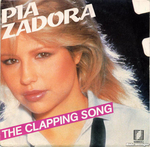
She has attained some success as a singer, and has had several hit singles throughout the world. In 1984, she received a nomination for a Grammy Award for Best Female Rock Vocal Performance. Her cover version of the Shirley Ellis hit, "The Clapping Song", reached the U.S. Top 40 in 1983, and she had a minor hit with a duet with Jermaine Jackson titled "When The Rain Begins To Fall" in 1984 (In Germany, this song was a #1 hit for four weeks, and in France it also was a major hit). She released Pia & Phil, an album of standards with the London Philharmonic in 1987. In 1988, she teamed with famed producers Jimmy Jam and Terry Lewis and released an album entitled "When the Lights Go Out."
Later in 1994 Zadora played a small role in Naked Gun 33 1/3 in the final act in a comedy sketch as she sang in the Academy Awards.
An urban legend has frequently been circulated that Zadora once starred in a production of The Diary of Anne Frank, in which her performance was so bad that an audience member yelled "She's in the attic!" when the Nazis showed up. Zadora has, in fact, never acted in a production of The Diary of Anne Frank.[1][3]
Private life
Zadora now lives with her children (from two former marriages) in wealthy retirement, thanks to ex-husband Meshulam Riklis. Zadora gained notoriety when she and Riklis bought the Beverly Hills landmark mansion Pickfair in January of 1988 and later demolished it. The mansion, former home of early movie stars Douglas Fairbanks and Mary Pickford, was one of Beverly Hills' most famous privately owned properties. To show his "love and affection", Riklis had an oil portrait commissioned of Zadora in the nude. Visitors to the Pickfair Mansion were greeted by the portrait.[1] Zadora is an active contributor to both Republican and Democratic candidates. [1]


 )
)


