A gorgeous young redhead goes into the doctor's office and says that her body hurts wherever she touches it. "Impossible," says the doctor. "Show me." The redhead takes her finger, pushes on her left breast and screams, then she pushes her elbow and screams in even more agony. She pushes her knee and screams; likewise she pushes her ankle and screams. Everywhere she touches makes her scream. The doctor says, "You're not really a redhead, are you? "Well, no" she says, "I'm actually a blonde." "I thought so," the doctor says. "Your finger is broken."
0 Replies
Letty
1
Reply
Mon 16 Oct, 2006 07:23 am
It's good to see our hawkman back, folks. Thanks, BioBob for the background on the great celebs, and especially the blonde/redhead funny. Yes, blondes do have fun, no? At least the general public has fun with them.
Raggedy, great photo's as usual, PA. Tim and Suzanne and Angela. A special thanks to Gus for Linda, plus a welcome back. Stick around Gus, and we'll play you a song.
Still concerned about our Tryagain. Should anyone know anything, let us know.
I think this song was done by Suzanne, folk, but I am not certain.
Writing in my diary
Right before I go to sleep
Trying to collect my thoughts
Of which are all in disarray
I write down love and hate and
Everything that's in between
Thoughts of incompetence find
Their way to routine secrets
Concealed between the pages
Are the lens through which I see
Everytime that I look back
I wish I acted differently
But when I remember then
There is no other way I see
Following you follow me
Discovering who we will be
I see in you what you see in me
That makes us only the lonely.
I want you to want to know me
I want you to call my name
Wish that you would know
There's more than meets the eye
There's more to find
I want you to start asking questions
I want you to understand
There's so many people around
And once again
I'm getting lonely.
0 Replies
Letty
1
Reply
Mon 16 Oct, 2006 03:47 pm
This temporary studio from which I am operating is much classier, folks. I can actually get instant music.
Here's another Suzanne:
Big Space Lyrics
Artist: Suzanne Vega
Album: Days Of Open Hand
He said you stand in your own shoes
I said I'd rather stand in someone else's
He said you look from your direction
I said I like to keep perspective
Close to the middle of the network
It seems we're looking for a center
What if it turns out to be hollow?
We could be fixing what is broken
Between the pen and the paperwork
There must be passion in the language
Between the muscle and the brain work
There must be feeling in the pipeline
Beyond the duty and the discipline
I know there's anger in a cold place
All feelings fall into the big space
Swept up like garbage on the week-
Between the pen and the paperwork
There must be passion in the language
Between the muscle and the brain work
There must be feeling in the pipeline
All feeling
Falls into the big space
All feeling
Swept into the
Avenues of angles
Between the pen and the paperwork
I'm sure there's passion in the language
Between the muscle and the brain work
I know there's feeling in the pipeline
0 Replies
edgarblythe
1
Reply
Mon 16 Oct, 2006 09:15 pm
Oh, well, I work hard every day
Can't hardly wait to draw my pay
It's Monday morning and I'm on the job
Do the same old thing, a-just working hard
Tuesday evening I'm at it again
I ain't had no rest since I don't know when
Wednesday morning, I can't hardly see
Man, this work is killing me
Thursday morning, I just can make it
Well, I don't know how long this boy can take it
Oh, well, I work hard every day
Can't hardly wait to draw my pay
It's Monday morning and I'm out on the job
Do the same old thing, I'm just a-workin' hard
Tuesday evening I'm at it again
I ain't had none of that rest since I don't know when
Wednesday morning, I can't hardly see
Man, this work is killing me
Thursday morning, I just can make it
Well, I don't know how long I can take it
Mmmm, ain't had none of that rest since I don't know when
Wednesday morning, can't hardly see
Man, this work is killing me
Thursday morning, I just can make it
Well, I don't know how long this boy can take it
Jerry Lee Lewis
0 Replies
bobsmythhawk
1
Reply
Tue 17 Oct, 2006 04:42 am
Jean Arthur
From Wikipedia, the free encyclopedia
Born 17 October 1900
Plattsburgh, New York, USA
Died 19 June 1991
Carmel, California, USA
Jean Arthur (October 17, 1900 - June 19, 1991) was an American actress.
Born Gladys Georgianna Greene in Plattsburgh, New York, she became one of Hollywood's favorite screen comediennes.
Career
The daughter of a photographer, Arthur became a fashion model early in life, then went on to work in films. She debuted in the silent film Cameo Kirby in 1923, directed by John Ford. Whatever self-confidence she may have built up was dashed when she was removed from the starring role of "Temple of Venus" (1923) after a few days of shooting. It was the first of many disappointments for the young actress, but she persevered and, by 1928, was being given co-starring roles at Paramount Pictures. (1928 was also the year she married her first husband, Julian Ancker, which was annulled after only one day.) She was selected as one of the WAMPAS Baby Stars in 1929 and briefly romanced David O. Selznick.
Arthur's curious voice, best described as being earnestly squeaky, ensured her work in talkies, but she was seldom used to full advantage in the early 30s. Dissatisfied with the vapid ingenue, society debutante, and damsel-in-distress parts she was getting (though she was chillingly effective as a murderess in 1930's "The Greene Murder Case"), Arthur left films for Broadway in 1932 to appear in ?'Foreign Affairs'. She starred in several Broadway productions and earned positive reviews. While back East she married Frank Ross, later a producer of some of her films.
In 1934, she signed with Columbia Pictures, where, at long last, her gift for combining fast-paced verbal comedy with truly moving pathos was fully utilised. In 1935 she starred opposite Edward G. Robinson in the gangster farce The Whole Town's Talking, and her popularity began to rise.
She was lucky enough to work with some of the most accomplished directors in Hollywood: Frank Capra (who called her his favourite actress and directed her in "Mr Deeds Goes to Town" in 1936, "You Can't Take It With You" in 1938 and "Mr Smith Goes to Washington" in 1939); John Ford ("The Whole Town's Talking" in 1935); and Howard Hawks ("Only Angels Have Wings" in 1939).
She was also one of the final four contenders for the role of Scarlett O'Hara in "Gone With the Wind" (1939).
Mercurial in her attitudes, terribly nervous both before and after filming a scene - she often threw up after her scene was finished - and so painfully shy that it was sometimes difficult for her to show up, she was equally fortunate that her co-workers were patient and understanding with her. She also looked better when photographed from the right side of her face, so, once she became a star, that was inevitably written into her contracts. Arthur could become hysterical when besieged by fans, and aloof and non-responsive to reporters.
In 1943, she received her only Oscar nomination for "The More the Merrier" (1943), the second of her two great 40s films directed by George Stevens ("The Talk of the Town" from 1942 was the first, Stevens referring to her as one of the greatest comediennes the screen had ever seen).
Because she often came to blows with studio head Harry Cohn over her parts and her salary, she only earned $50,000 for "The Talk of the Town", while her co-stars Cary Grant and Ronald Colman both earned exactly double that amount.
After her contract with Columbia ended in 1944, she celebrated by running through the streets, shouting "I'm free, I'm free!" She signed to star in the 1946 Broadway play ?'Born Yesterday' - only to succumb to a debilitating case of stage fright, forcing the producers to replace her at virtually the last moment with Judy Holliday.
After the forgettable comedy "The Impatient Years" in 1944, Arthur made only two more films: Billy Wilder's "A Foreign Affair" (1948), and George Stevens' classic "Shane" (1953; she was 50 years old during filming). She also played the lead in Leonard Bernstein's 1950 musical version of ?'Peter Pan', playing the Eternal Boy when she was almost fifty. Her co-star was Boris Karloff as Captain Hook. That same year she divorced Frank Ross; never remarried, no children.
Retirement
In the early 60s, the extremely reclusive Arthur tentatively returned to show business with a few stage appearances and as an attorney on ill-advised 1966 TV sitcom, ?'The Jean Arthur Show', which was mercifully cancelled mid-season after only 11 episodes.
Surprisingly, the ultra-introverted Arthur later decided to tackle the extroverted profession of teaching drama, first at Vassar College and then the North Carolina School of the Arts; one of her students at North Carolina remembered Arthur as odd and her lectures as somewhat whimsical and rambling. While at North Carolina she made front-page news by being arrested and tossed in jail for trespassing on a neighbor's property to console a dog she felt was being mistreated. An animal lover her entire life, Arthur said she trusted them more than people.
In 1975 the Broadway hit play ?'First Monday in October', about the first female Supreme Court judge, was written especially with Arthur in mind, but once again, she succumbed to extreme stage fright and quit the production shortly into its out-of-town run in Cleveland. She then retired for good, retreating to her ocean home in Carmel, California, steadfastly refusing interviews until her resistance was broken down by the author of a book on her one-time director Frank Capra (she once famously said that she'd rather have her throat slit than do an interview).
She died from heart failure in 1991 and had her ashes scattered at sea near Carmel.
She has a star on the Hollywood Walk of Fame at 6331 Hollywood Blvd.
0 Replies
bobsmythhawk
1
Reply
Tue 17 Oct, 2006 04:48 am
Rita Hayworth
From Wikipedia, the free encyclopedia
Rita Hayworth (October 17, 1918 - May 14, 1987), was an American actress of Spanish and English descent who reached fame during the 1940s as the era's leading sex symbol. She was sometimes called "The Love Goddess" or "The Great American Love Goddess," and was celebrated as an expert dancer and great beauty.
Biography
She was born Margarita Carmen Cansino, the daughter of Eduardo Cansino (Sr.) and Volga Haworth (sic) in Brooklyn, New York. The Cansinos, of Roma ancestry native to Spain, were a famous family of Spanish dancers working in vaudeville. Hayworth was trained as a dancer from childhood, and was on stage by the age of six.
Attracting the attention of film producers as part of the dance team "The Dancing Cansinos," Hayworth was signed first by Fox Studios in 1935, at the age of sixteen. When her option there was dropped, she freelanced at minor studios before signing with Columbia Pictures in 1937. After a name change from Rita Cansino to Rita Hayworth, two more years of working in B movies, and painful electrolysis to raise her hairline, Hollywood and the public began to take notice. Rita made a big splash as part of the ensemble cast headed by Cary Grant in Howard Hawks' Only Angels Have Wings (1939). Soon she was in great demand and was borrowed by other studios like Metro Goldwyn Mayer for George Cukor's Susan and God (1940) with Joan Crawford. The title role in Raoul Walsh's The Strawberry Blonde with James Cagney followed in 1941. Finally her sizzling "other woman" part in Rouben Mamoulian's Blood and Sand (1941) with Tyrone Power solidified her new-found stardom.
Hayworth's fame as a beautiful redhead arose from this Technicolor film. Incredibly photogenic, Rita was dazzling in Technicolor, and her head of long, flowing hair became her best remembered attribute. The "love goddess" image was cemented with Bob Landry's 1941 Life magazine photograph of her (kneeling on a bed in a silk and lace nightgown), which caused a sensation and became (at over five million copies) one of the most requested wartime pinups. During World War II she ranked with Betty Grable, Dorothy Lamour, Hedy Lamarr, and Lana Turner as the pinup girls most popular with servicemen. Rita would also become Columbia's biggest star of the 1940s, under the watchful eye of studio chief Harry Cohn, who recognized her value. After she made Tales of Manhattan (1942) opposite Charles Boyer, Cohn would not allow Hayworth to be loaned out to other studios.
Hayworth's well-known films include the musicals that made her famous: You'll Never Get Rich (1941) and You Were Never Lovelier (1942) (both with Fred Astaire, who wrote in his autobiography that Rita "danced with trained perfection and individuality"), My Gal Sal (1942) with Victor Mature, and her best known musical, Cover Girl (1944) with Gene Kelly. Although her singing voice was dubbed in her movies, Rita was one of Hollywood's best dancers, imbued with power, precision, tremendous enthusiasm, and an unearthly grace. Cohn continued to effectively showcase Hayworth's talents in Technicolor films: Tonight and Every Night (1945) with Lee Bowman, and Down to Earth (1947), with Larry Parks. Her erotic appeal was most notable in Gilda (1946), a black-and-white film noir directed by Charles Vidor, which encountered some difficulty with censors. This role ?- in which Hayworth in black satin performed a legendary one-glove striptease ?- made her into a cultural icon as the ultimate femme fatale. Alluding to her bombshell status, in 1946 her likeness was placed on the first nuclear bomb to be tested after World War II at Bikini Atoll in the Marshall Islands, as part of Operation Crossroads.
Hayworth gave one of her best peformances in the Orson Welles classic The Lady from Shanghai (1948), which failed at the box office in part because director/co-star Welles had Hayworth's famous red locks cut off and the rest dyed blonde for her role. Her next film, The Loves of Carmen (1948) with Glenn Ford was the first film co-produced by Columbia and Rita's own production company, The Beckworth Corporation (named for her daughter Rebecca). She received a percentage of the profits from this and all of her subsequent films until 1955, when Hayworth dissolved Beckworth to pay off debts she owed to Colombia.
Rita left her film career in 1948 to marry Prince Aly Khan and move to Europe, which caused a media frenzy, but after the marriage collapsed in 1951 she returned to America with great fanfare to film a string of hit films: Affair in Trinidad (1952) with favorite costar Glenn Ford, Salome (1953) with Charles Laughton and Stewart Granger, and Miss Sadie Thompson (1953) with Jose Ferrer and Aldo Ray, for which her perfomance won critical acclaim. Then she was off the big screen for another four years, due mainly to a tumultuous marriage to singer Dick Haymes. In 1957, after making Fire Down Below with Robert Mitchum and Jack Lemmon, and her last musical Pal Joey with Frank Sinatra and Kim Novak, Rita finally left Columbia. She got good reviews for her acting in such films as Separate Tables (1958) with Burt Lancaster and The Story on Page One (1960) with Anthony Franciosa, and continued working throughout the 1960s. Hayworth made her last film, The Wrath of God , in 1972.
Personal life
Naturally shy and reclusive, Hayworth was the antithesis of the characters she played. She once complained "Men go to bed with Gilda, but they wake up with me". She was close to her frequent co-star and next-door neighbour Glenn Ford.
According to Barbara Leaming's biography on Hayworth, If This Was Happiness, her relationships with men were often difficult due to the physical, sexual and emotional abuse she endured from her father at a young age. These revelations were made during interviews with Orson Welles in later years. She confided in him about the incest in particular, as well as several beatings. At one point in the biography Welles recalls that when Cansino tried to visit he would always have to throw him out. "He was a terrible man," Welles recalls. "And she really hated him. She couldn't deal with him at all."
Hayworth was married five times: first to Edward C. Judson (1937-1943), followed by actor-director Orson Welles (1943-1948, one daughter Rebecca Welles), to Prince Aly Khan (1949-1953, one daughter Princess Yasmin Aga Khan), then to actor-singer Dick Haymes (1953-1955), and finally to director James Hill (1958-1961). She also had a nephew named Richard Cansino.
Final years
After about 1960, Hayworth suffered from extremely early onset of Alzheimer's disease, which was not diagnosed until 1980; she continued to act in films until the early 1970s and made a well-publicized appearance on The Carol Burnett Show near the end of her career. In 1977, Hayworth was the recepient of the National Screen Heritage Award Lynda Carter starred in a 1983 biopic of her life. She lived in an apartment at the San Remo in New York City.
Following her death from Alzheimer's in 1987 at age 68, she was interred in the Holy Cross Cemetery in Culver City, California.
One of the major fundraisers for the Alzheimer's Association is the annual Rita Hayworth Gala which are held in New York City and Chicago. Ms. Hayworth's daughter, Princess Yasmin Aga Khan has been the hostess for these events. Since 1985, the events have raised more than $42 million for the Association. [1]
Trivia
In the world famous comic book/strip The Phantom, the mother of the 21st Phantom, Maude Thorne McPatrick, is drawn to resemble Rita Hayworth. In one story, she even worked as Hayworth's stunt double in a movie.
Hayworth's natural hair color was dark brown.
A poster of Rita Hayworth was used as a plot device in Stephen King's short story, Rita Hayworth and Shawshank Redemption and later in the movie based on the story which starred Morgan Freeman and Tim Robbins.
Rita Hayworth placed 19th on the American Film Institute's list of the 25 greatest female movie stars of all time in 1999.
In 2005, the White Stripes wrote a song titled "Take, Take, Take" on their album Get Behind Me Satan which humorously describes a man meeting Hayworth in a bar and pestering her for an autograph and a picture. She is also briefly mentioned in the song "White Moon" from the same album.
Famously mentioned in Madonna's song "Vogue", in which she is described as giving "good face".
In Salvador Plascencia's The People of Paper, Rita Hayworth is a sad, disenfranchised character. In the novel, she was made infamous for having sex with a lettuce picker.
Quote by actor Joseph Cotten: "No matter how bad the film, when Rita danced it was like watching one of nature's wonders in motion."
Rita was the first dancer to partner with both Fred Astaire and Gene Kelly on film - others being Judy Garland, Cyd Charisse, Vera Ellen, and Leslie Caron.
Rita performed one of her best remembered dance routines, the samba from 1945's Tonight and Every Night while pregnant with her first child Rebecca Welles.
Famous films Rita missed out on making: Laura (1944), Dead Reckoning (1947), with Humphrey Bogart, Samson and Delilah (1949), Born Yesterday (1950), and From Here to Eternity (1953).
Joseph L. Mankiewicz, in writing and directing 1954's The Barefoot Contessa , was said to haved based his title character, Maria Vargas (played on film by Ava Gardner), on Rita's life and her marriage to Prince Aly Khan.
While not related by blood, Rita and Ginger Rogers did share an aunt and uncle by marriage.
0 Replies
bobsmythhawk
1
Reply
Tue 17 Oct, 2006 04:56 am
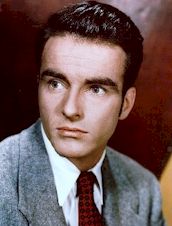
Montgomery Clift
From Wikipedia, the free encyclopedia
Edward Montgomery Clift (October 17, 1920 - July 23, 1966) was an American actor known by the stage name of Montgomery Clift.
Biography
Early life
Clift was born in Omaha, Nebraska, the son of Ethel Anderson Fogg Blair and William Brooks Clift, a banker with roots in the South. Clift had a twin sister, Roberta, and an older brother, Brooks, husband of Eleanor Clift, the columnist and political commentator, and father of their three children; Brooks also had a child by the late actress Kim Stanley. Later in life, he would describe his father as a drunken bigot who he was never on good terms with.
Film career
Appearing on Broadway at the age of thirteen, Clift achieved success on the stage and starred there for 10 years before moving to Hollywood, debuting in 1948's Red River opposite John Wayne. Clift was nominated for an Academy Award for Best Actor that same year for The Search. Clift was billed as a new kind of leading man: sensitive, intense and broodingly handsome, the kind of man women would want to take care of. He had a highly successful film career, performing in many Oscar-nominated roles and becoming a matinee idol because of his good looks and sex appeal. His love scenes with Elizabeth Taylor in A Place in the Sun (1951) set a new standard for romance in cinema. His roles in A Place in the Sun, the 1953 classic From Here to Eternity and The Young Lions (1958) are considered signatures of his career.
Clift and his screen rival, Marlon Brando, were popularly known in Hollywood as the "Golddust Twins" because of their rapid rise to stardom. Clift reportedly turned down the starring roles in Sunset Boulevard and East of Eden.
Car accident
On May 12, 1956, while filming Raintree County, he smashed his car into a tree after leaving a party at the home of his Raintree County co-star Elizabeth Taylor and her then-husband Michael Wilding. Hearing the sounds of the crash, Elizabeth Taylor raced to Clift's side and kept him from choking to death by removing two of his teeth, which had become lodged in his throat. Clift needed extensive reconstructive surgery on his face (although his broken nose was never repaired) and he returned after several weeks to finish the film, his handsome appearance permanently disfigured. The "before and after" face of Clift is apparent in the movie. By this time, Clift had become hooked on alcohol and pain pills, and his health deteriorated. Taylor and Clift remained close friends until his death.
Post-accident career
Subsequently, Clift, with Lee Remick, appeared in Elia Kazan's Wild River (1960), a film listed in the United States National Film Registry. He then costarred in John Huston's The Misfits (1961), which turned out to be the last film for both Marilyn Monroe and Clark Gable. By the time Clift was making John Huston's Freud (1962) his destructive lifestyle was affecting his health. Universal sued him for his frequent absences which caused the film to go over budget. The case was later settled due to the films success at the box office winning Clift a lucrative settlement.
Clift's last Oscar nomination was for best supporting actor for his riveting role in Judgment at Nuremberg (1961), a seven-minute part. The film also starred Spencer Tracy, Marlene Dietrich, Maximilian Schell, Burt Lancaster, and Judy Garland.
Death
Montgomery Clift died in 1966 at the age of 45 of complications brought on by his severe drug and alcohol addictions. He is interred in the Quaker Cemetery, Brooklyn, New York.
Miscellanea
Clift was brother-in-law to Newsweek reporter Eleanor Clift.
Marilyn Monroe, who was also having emotional problems while filming the The Misfits, described Clift as: "The only person I know who is in worse shape than I am."
His post-accident career has been referred to as the "longest suicide in Hollywood" because of his continued substance abuse.
The songs "Monty got a Raw Deal" by R.E.M. and "The Right Profile" by The Clash are about him, and The Clash's live album was named for one of his films (From Here to Eternity).
0 Replies
bobsmythhawk
1
Reply
Tue 17 Oct, 2006 05:02 am
Margot Kidder
From Wikipedia, the free encyclopedia
Margot Kidder (born Margaret Ruth Kidder on October 17, 1948 in Yellowknife, Northwest Territories) is a Canadian-American film actress who achieved her greatest fame playing Lois Lane in the Superman movies of the 1970s and 1980s.
Biography
Early life
Kidder was born in Yellowknife, Northwest Territories, Canada, one of five children of Jill and Kendall Kidder, an explosives expert. She has a sister, Annie, and three brothers, John, Michael and Peter. Kidder's niece, Janet Kidder, is also an actress.
Career
Among her early roles was an appearance as the barmaid in Nichols, a short-lived James Garner vehicle made for American television. She also appeared in a number of low-budget Canadian movies in the early 1970s before going on to star in the Brian de Palma psychological thriller Sisters (1973) and the horror film Black Christmas (1974). A nude pictorial of Kidder, photographed by Douglas Kirkland, was published in the March 1975 issue of Playboy. The accompanying article was written by her.
Kidder is best known for her role as Lois Lane in the 1978 movie Superman and its sequels. Kidder brought more depth to the role than previous actresses, portraying Lane as an ambitious and headstrong, yet vulnerable and emotionally lonely woman trying to make it in a man's world. After she publicly expressed her disgust to the producers, Alexander Salkind and Ilya Salkind, over the firing of Richard Donner from 1980's Superman II, her role in 1983's Superman III consisted of less than 5 minutes of footage. Her role in 1987's Superman IV: The Quest For Peace was more substantial.
In addition to the Superman movies, Kidder has starred in The Amityville Horror, Willie and Phil, and The Great Waldo Pepper opposite Robert Redford. She has also made uncredited cameo appearances in Maverick and Delirious.
In 1983, Kidder produced and starred as Eliza Doolittle in a TV version of Pygmalion with Peter O'Toole. She has also done extensive stage work, including The Vagina Monologues.
In 1994, Kidder played the "Broken Skull" bartender on a PC adventure game featuring Tex Murphy in Under a Killing Moon.
In 2004, Kidder briefly returned to the Superman franchise in two episodes of the television program Smallville, as Dr. Bridgette Crosby, an emissary of Dr. Swann (played by her Superman co-star, Christopher Reeve).
Also that year Kidder made an appearance on a short-lived Canadian sitcom, Robson Arms, set in an apartment block in Vancouver's west end. She played a quirky neighbor of the main cast members.
Personal life
In the past Kidder dated former Canadian prime minister Pierre Trudeau. She has been married and divorced three times: to American playwright Thomas McGuane (by whom she had her only child, daughter Maggie [now Maggie Kirn], in 1976); to actor John Heard; and to French film director Philippe de Broca (she suffered a miscarriage during that marriage). None of the marriages lasted longer than a year. Since her divorce from De Broca, she has said that she prefers the companionship of her dogs.
Kidder raised some hackles in the early 1990s during the first Gulf War, when she ridiculed the press and the military for not seeing the larger consequences of their actions. Despite the criticism, Kidder became a United States citizen on August 17, 2005, in Butte, Montana; she lives in nearby Livingston.
She said the reason for her decision to become an American citizen is to participate in the voting process, to continue her protests against U.S. intervention in Iraq, and at the same time to be free of worries about being deported.[1]
Kidder has bipolar disorder which led to a widely publicized manic breakdown in 1996. She is an advocate of orthomolecular medicine as a treatment for the disorder.
0 Replies
bobsmythhawk
1
Reply
Tue 17 Oct, 2006 05:06 am
Two Scottish nuns had just arrived to the US by boat when
one said to the other, "I heard that the occupants of this
country actually eat dogs."
"Odd," her companion replied, "but if we shall live in America,
we might as well do as the Americans do."
Nodding emphatically, the mother superior pointed to a hot
dog vendor and they both walked towards it.
"Two dogs, please," said one.
The vendor was only too pleased to oblige and he wrapped both
hot dogs in foil. Excited, the nuns hurried over to a bench
and began to unwrap their 'dogs.'
The mother superior was first to open hers, then, stared at
it for a moment, leaned over to the other nun and whispered
cautiously, "What part did you get?"
0 Replies
Letty
1
Reply
Tue 17 Oct, 2006 06:03 am
Good morning, WA2K radio friendly folks. Your PD is still operating from outside her home by the sea, so I will be acknowledging less frequently than usual.
Hey, edgar. Jerry Lee seems to be speaking for a lot of folks. Thanks, Texas, for the work song.
BioBob has finished his bio's, listeners, with his funny no nunsense joke. Well, hawkman, Hot Dog!
Our Raggedy should be along shortly, so I shall wait to comment further.
Here's a Ron Brown wake up song:
Good morning, good morning
Good morning to you.
Put a smile on your face,
It's a brand new day
Good morning, good morning
Good morning to you.
Each day is a new gift to open and use.
Good morning, good morning
Good morning to you.
It's a brand new day.
The sun's rising up warming all on the ground.
The birds in the trees are singing the sounds...
It's a new day! It's a new day!
Join me and say...
Good morning, good morning
Good morning to you.
Put a smile on your face,
It's a brand new day
Good morning, good morning
Good morning to you,
It's a brand new day.
Good morning!
Not one of my favorites, folks.
0 Replies
bobsmythhawk
1
Reply
Tue 17 Oct, 2006 07:05 am
Good Morning by Gene Kelly
Good Morning
Good Morning
We've talked the whole night through
Good Morning
Good Morning to you
Good Morning
Good Morning
It's great to stay up late
Good Morning
Good Morning to you
When the band began to play the stars were shinging bright
Now the milkman's on his way and it's too late to say good night
So, Good Morning
Good Morning
Sun beams will soon smile through
Good Morning
Good Morning to you and you and you and you
Good Morning
Good Morning
We've gabbed the whole night through
Good Morning
Good Morning to you
------------
In the morning
In the morning
It's great to stay up late
Good Morning
Good Morning to you
----------------------
When we left the movie show the future wasn't bright
But came the dawn
the show goes on and I don't want to say good night
So say good morning
Good Morning
Rainbows are shining through
Good Morning
Good Morning
Bonjour
Monsuier
Bonas Dies
Bunus Greas
Bonjourrrraaaaa
Artichonnnaaaa
Good Morgan
Licha Moana
Good Morning to you
0 Replies
Letty
1
Reply
Tue 17 Oct, 2006 07:19 am
Ah, Bob, the phases that creative folks go through. Rather like the phases of the moon, no?
From Cat (great chord changes on this song, incidentally)
Morning Has Broken
By: Cat Stevens
Morning has broken, like the first morning.
Blackbird has spoken, like the first bird.
Rraise for the singing, praise for the morning,
Praise for them springing fresh from the Word.
Sweet the rain's new fall, sunlight from heaven.
Like the first dewfall, on the first grass.
Praise for the sweetnes of the wet garden,
Sprung in completeness where His feet pass.
Mine is the sunlight, mine is the morning.
Born of the one light Eden saw play.
Praise with elation, praise every morning;
God's recreation of the new day.
Morning has broken, like the first morning.
Blackbird has spoken, like the first bird.
Praise for the singing, praise for the morning,
Praise for them springing fresh from the Word
0 Replies
Raggedyaggie
1
Reply
Tue 17 Oct, 2006 10:26 am
Good afternoon WA2K.
And today's birthday picture gallery:
0 Replies
Letty
1
Reply
Tue 17 Oct, 2006 10:59 am
Well, there's our Raggedy, folks. Love the quartet,PA. Hmmmm, there's Jean and Rita and Margot and Montgomery. (Let's call him Montie)
Well, listemers. I searched everywhere for a song to go with Rita, and what a delightful surprise to find one that matched not only the lovely lady but Somerset Maugham as well, so here it is:
Miss Sadie Thompson
Lyrics to "Blue Pacific Blues" ("Sadie Thompson's Song")
By: Lester Lee and Ned Washington
I'm gettin' the blue pacific blues
The feelin' ya get from real bad news
I wanna hear bells, I wanna see trains
I get in this mood whenever it rains
I'm gettin' the blues
Alone in the dark and sultry night
Ya'd think of the times ya ain't done right
To add to the fact your feelin' so bad
the cry of the birds keeps drivin' you mad
I got the blues
Ya lie awake and how you wish that it was mornin'
and then ya smoke a hundred cigarettes or more
That devil rain continues poundin' at your window
And the tropic winds, keep howlin' at your door
Because of all the rain and mud
The feel of the place gets in your blood
But deep in the night there comes unawares
the terrible thought that nobody cares
Your back with the blues-again
To be even more specific
You've got what they call-the blue pacific blues.
Also dedicated to those in Hawaii. <smile>
0 Replies
Raggedyaggie
1
Reply
Tue 17 Oct, 2006 11:43 am
I love that song, Letty, and that film adaptation of "Rain". But, don't forget Rita's great number from Gilda:
"Put the Blame on Mame"-
as sung to the audience (dubbed by Anita Ellis) in this scene:
"When they had the earthquake - in San Francisco-back in 19`6
They said that old mother nature - was up to her old tricks.
That's the story that went around, but here's the real lowdown-
Put the blame on mame boys, put the blame on mame
One night she started to - shim and shake-
that brought on the `Frisco quake
So you can, Put the blame on mame boys,
put the blame on mame.
They once had a shootin' -up in the Klondike when they got Dan McGrew
Folks were puttin' the blame on - the lady known as Lew
that's the story that went around, but here's the real lowdown-
Put the blame on mame boys,
put the blame on mame
Mame did a dance called the Hichy-koo,
that's the thing that slew McGrew
So you can, Put the blame on mame boys
PUT-THE-BLAME-ON-MAME"
0 Replies
Letty
1
Reply
Tue 17 Oct, 2006 11:57 am
Good grief, Raggedy. I know that song, gal, but I never knew why, now I do, thanks to you.
Quote for the day:
No tyranny is so irksome as petty tyranny: the officious demands of policemen, government clerks, and electromechanical gadgets.
- Edward Abbey
Love it, folks, especially when trying to drive someone else's car with whistles and bells casting electronic spells.
0 Replies
Letty
1
Reply
Tue 17 Oct, 2006 01:17 pm
Here's another Mame song, folks.
Song: MAME
::chorus:::
You coax the blues right out of the horn, Mame,
You charm the husk right off of the corn, Mame,
You've got that banjoes strummin'
And plunkin' out a tune to beat the band,
The whole plantation's hummin'
Since you brought Dixie back to Dixie land.
You make the cotton easy to pick, Mame,
You give my old mint julep a kick, Mame,
Who ever thought a Yankee would put
A little Dixie mouse to shame.
You've made us feel alive again,
You've given us the drive again,
To make the South revive again, Mame.
Beauregard Burnside:
You've brought the cake-walk back into style, Mame
You make the weepin' willow tree smile, Mame,
Your skin is Dixie satin,
There's rebel in your manner and your speech,
You may be from Manhattan,
But Georgia never had a sweeter peach.
All:
You make our black-eyed peas and our grits, Mame,
Seem like the bill of fare at the Ritz, Mame,
You came, you saw, you conquered
And absolutely nothing is the same.
You're special fascination'll prove to be inspirational,
We think you're just sensational, Mame.
Since you brought Dixie back to Dixie land.
Since you brought Dixie back to Dixie land.
You coax the blues right out of the horn, Mame,
You charm the husk right off of the corn, Mame,
You've got that banjoes strummin'
And plunkin' out a tune to beat the band,
The whole plantation's hummin'
Since you brought Dixie back to Dixie land.
You make the cotton easy to pick, Mame,
You give my old mint julep a kick, Mame,
Who ever thought a Yankee would put
A little Dixie mouse to shame.
You've made us feel alive again,
You've given us the drive again,
To make the South revive again, Mame.
Mame! Mame! Mame! Mame!
0 Replies
Tryagain
1
Reply
Tue 17 Oct, 2006 03:51 pm
Good afternoon all, it's good to be back after some technical problems.
AMERICA
By RAZORLIGHT Lyrics
What a drag it is
The shape i'm in
Well I go out somewhere
Then I come home again
I light a cigarette
'Cause I can't get no sleep
Theres nothing on the TV nothing on the radio
That means that much to me
All my life
Watching America
All my life
There's panic in America
Oh Oh Oh, Oh
There's trouble in America
Oh Oh Oh, Oh
Yesterday was easy
Happiness came and went
I got the movie script
But I don't know what it meant
I light a cigarette
'Cause I can't get no sleep
Theres nothing on the TV nothing on the radio
That means that much to me
Theres nothing on the TV nothing on the radio
That I can believe in
All my life
Watching America
All my life
There's panic in America
Oh Oh Oh, Oh
There's trouble in America
Oh Oh Oh, Oh
There's panic in America
Oh Oh Oh, Oh
Yesterday was easy
Yes I got the news
When you get it straight, but stand up you just can't lose
Give you my confidence, all my faith in life
Dont stand me up
Don't let me down
I need you tonight
To hold me, say you'll be here
To hold me, say you'll be here
To hold me, say you'll be here
To hold..
All my life
Watching America
All my life
There's panic in America
Oh Oh Oh, Oh
She's just in America
Oh Oh Oh, Oh
Tell me how does it feel
0 Replies
Letty
1
Reply
Tue 17 Oct, 2006 04:04 pm
Try, welcome back, buddy. We were truly concerned about you, honey. Love your song and this one follows yours, because.......
Up all night I could not sleep
The whiskey that I drank was cheap
With shakin' hands I went and I lit up my last cigarette
Well the sun came, night had fled
And sleepy eyed I reached my bed
I saw you sleepy dreamin' there all covered and warm
South City midnight lady
I'm much obliged indeed
You sure have saved this man whose soul was in need
I thought there was no reason
For all these things I do
But the smile that sent out returned with you
When day has left the night behind
And shadows roll across my mind
I sometimes find myself alone out walkin' the street
Yes, and when I'm feelin' down and blue
Then all I do is think of you
And all my foolish problems seem to fade away
South City midnight lady
I'm much obliged indeed
You sure have saved this man whose soul was in need
I thought there was no reason
For all these things I do
But the smile that I sent out returned with you.
Doobie Brothers.
Big smile for our Try, but no whiskey, just a wonderful, full-bodied wine.
0 Replies
Tryagain
1
Reply
Tue 17 Oct, 2006 05:10 pm
Good health
There's a tear in your eye,
And I'm wondering why,
For it never should be there at all.
With such pow'r in your smile,
Sure a stone you'd beguile,
So there's never a teardrop should fall.
When your sweet lilting laughter's
Like some fairy song,
And your eyes twinkle bright as can be;
You should laugh all the while
And all other times smile,
And now, smile a smile for me.
When Irish eyes are smiling,
Sure, 'tis like the morn in Spring.
In the lilt of Irish laughter
You can hear the angels sing.
When Irish hearts are happy,
All the world seems bright and gay.
And when Irish eyes are smiling,
Sure, they steal your heart away.
For your smile is a part
Of the love in your heart,
And it makes even sunshine more bright.
Like the linnet's sweet song,
Crooning all the day long,
Comes your laughter and light.
For the springtime of life
Is the sweetest of all
There is ne'er a real care or regret;
And while springtime is ours
Throughout all of youth's hours,
Let us smile each chance we get.
When Irish eyes are smiling,
Sure, 'tis like the morn in Spring.
In the lilt of Irish laughter
You can hear the angels sing.
When Irish hearts are happy,
All the world seems bright and gay.
And when Irish eyes are smiling,
Sure, they steal your heart away.