106
   

WA2K Radio is now on the air


bobsmythhawk
 
  1  
Reply Thu 11 May, 2006 06:03 pm
Night And Day :: Frank Sinatra

Night and day, you are the one
Only you 'neath the moon or under the sun
Whether near to me or far
It's no matter, darling, where you are
I think of you day and night

Night and day, why is it so
That this longin' for you follows wherever I go ?
In the roarin' traffic's boom
In the silence of my lonely room
I think of you day and night

Night and day, under the hide of me
There's an oh, such a hungry yearnin' burnin' inside of me
And its torment won't be through
Till you let me spend my life makin' love to you
Day and night, night and day

[Instrumental]

Night and day, you are the one
Only you 'neath the moon or under the sun
Whether near to me or far
It's no matter, baby, where you are
I think of you day and night

Night and day, why is it so
That this longin' for you follows wherever I go ?
In the roarin' traffic's boom
Silence of my lonely room
I think of you day and night

Night and day, under the hide of me
There's an oh, such a hungry burning inside of me
And its torment won't be through
Till you let me spend life makin' love to you
Day and night, night and day
0 Replies
 
hamburger
 
  1  
Reply Thu 11 May, 2006 06:05 pm
wa2k
letty :
the german translation reminds of danny kaye playing the german submarine-commander ...
...ach du meine guete , das verknackste suessholz ist unter den bismark-hering gefallen ... monokel in die scheisse gefallen , leider total zersplittert ... (oder so aehnlich !) . hbg
0 Replies
 
Letty
 
  1  
Reply Thu 11 May, 2006 06:19 pm
Hey, Hawkman. Is that a telling song?The verse to that is exceptionally lovely as well. Where is our turtleman? I know that he is safe at home.

hamburger, I am so glad that Walter and dys are away at wolf creek and can't hear that rather poor translation.

As Raggedy, my sister, and I love Danny Kaye, we would appreciate the English version. Of course, folks, we could listen to Day Bidet. Razz
0 Replies
 
yitwail
 
  1  
Reply Thu 11 May, 2006 06:51 pm
this is a little raunchy, but maybe a change of pace is ok Question

Mississippi Queen, If you know what I mean
Mississippi Queen, She taught me everything
Way down around Vicksburg, Around Louisiana way
Lived a cajun lady, we called her Mississippi Queen
You know she was a dancer
She moved better on wine

While the rest of them dudes were'a gettin' their kicks,
Buddy, beg your pardon, I was getting mine!

Mississippi Queen, If you know what I mean
Mississippi Queen, She taught me everything
This lady she asked me, If I would be her maaan
You know that I told her, I'd do what I can
To keep her looking pretty
Buy her dresses that shine

While the rest of them dudes were making their bread
Buddy, beg your pardon, I was losing mine!

----- Lead Guitar ----- {kick ***}

You know she was a dancer
She mooved better on wine

While the rest of them dudes were'a gettin' their kicks,
Brotha, beg your pardon, now I'm getting mine!

Yeeeaaaaah, Mississippi Queen!
0 Replies
 
Letty
 
  1  
Reply Thu 11 May, 2006 07:00 pm
Aha! there's our turtleman. Well, M.D. you returned just like D.M. Razz

Nothing ribald about that song, buddy. I guess it's the way boys become men. <smile>

But, folks, sometimes it's fate and often kismet so:

From Kismet


Dawn's promising skies
Petals on a pool drifting
Imagine these in one pair of eyes
And this is my beloved

Strange spice from the south
Honey through the comb sifting
Imagine these in one eager mouth
And this is my beloved

And when s/he speaks and when s/he talks to me
Music! Mystery!
And when s/he moves And when s/he walks with me
Paradise comes suddenly near

All that can stir All that can stun
All that's for the heart's lifting
Imagine these in one perfect one

And this is my beloved
0 Replies
 
hamburger
 
  1  
Reply Thu 11 May, 2006 07:15 pm
wa2k
(letty : i too am glad that walter is away , since he might not approve of my german either !). hbg
0 Replies
 
hamburger
 
  1  
Reply Thu 11 May, 2006 07:22 pm
a2k
letty : to make up for my bad behaviour , here is a true canadian "paddling" song .
notice that it refers to the moose and beaver , gotta be canaaajun ! hbg
----------------------------------------------------------------------------------
A true canadian paddling song with a more aboriginal perspective.

My paddle's keen and bright
Flashing with silver
Follow the wild goose flight
Dip, dip and swing
Dip, dip and swing her back
Flashing with silver
Swift as the wild goose flies
Dip, dip and swing
Land of the silver birch
Home of the beaver
Where still the mighty moose
Wanders at will
Blue lake and rocky shore
I will return once more
Boom-diddy-ah-da, Boom-diddy-ah-da, Boom-diddy-ah-da, bo-oo-oom

High on a rocky ledge
I¹ll build my wigwam
Close to the water¹s edge
Silent and still
Blue lake and rocky shore
I will return once more
Boom-diddy-ah-da, Boom-diddy-ah-da, Boom-diddy-ah-da, bo-oo-oom

My heart grows sick for thee
Here in the lowlands
I will return to thee hills of the north
Blue lake and rocky shore
I will return once more
Boom-diddy-ah-da, Boom-diddy-ah-da, Boom-diddy-ah-da, bo-oo-oom

Land of the silver birch
Home of the beaver
Where still the mighty moose
Wanders at will
Blue lake and rocky shore
I will return once more
Boom-diddy-ah-da, Boom-diddy-ah-da, Boom-diddy-ah-da, bo-oo-oom
0 Replies
 
Letty
 
  1  
Reply Thu 11 May, 2006 07:34 pm
hamburger, that was so lovely: it really brought tears to my eyes. I remember reading the speech of Chief Joseph and feeling his resolution and pain but with pride threaded through it all.

What a lovely song to end the evening, folks.

Goodnight.

From Letty with love.
0 Replies
 
bobsmythhawk
 
  1  
Reply Fri 12 May, 2006 01:23 am
Florence Nightingale
From Wikipedia, the free encyclopedia

Born
12 May 1820
Florence, Italy
Died
13 August 1910
London, England

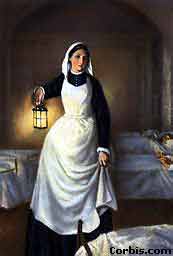
Florence Nightingale, OM (12 May 1820 - 13 August 1910), who came to be known as The Lady with the Lamp, was a pioneer of modern nursing. She was also a noted statistician.

Early life

Florence Nightingale was born into a wealthy and well-connected British family at the Villa Colombaia in Florence, Italy. She was named after the city of her birth, as was her older sister (named Parthenope, the Greek name for the city of Naples).

Inspired by what she understood to be a divine calling (first experienced in 1837 at the age of 17 at Embley Park and later throughout her life), Nightingale made a commitment to nursing. This decision demonstrated a strong will on her part; it constituted a rebellion against the expected role for a woman of her status, which was to become an obedient wife. At the time, nursing was a career with a poor reputation, filled mostly by poorer women, "hangers-on" who followed the armies; they were equally likely to function as cooks. Nightingale would announce her decision to enter nursing to her family in 1845, evoking intense anger and distress from her family, particularly her mother.

Nightingale was particularly concerned with the appalling conditions of medical care for the legions of the poor and indigent. In December 1844, in response to a pauper's death in a workhouse infirmary in London that became a public scandal, she became the leading advocate for improved medical care in the infirmaries and immediately engaged the support of Charles Villiers, then president of the Poor Law Board. This led to her active role in the reform of the Poor Laws, extending far beyond the provision of medical care.

In 1846 she visited Kaiserswerth, Germany, and learned more of its pioneering hospital established by Theodor Fliedner and managed by an order of Lutheran deaconesses. She was greatly impressed by the quality of medical care and by the commitment and practices of the deaconesses.

Nightingale was courted by politician and poet Richard Monckton Milnes, 1st Baron Houghton, but she rejected him, convinced that marriage would interfere with her ability to follow her calling to nursing. When in Rome in 1847, recovering from a mental breakdown precipitated by a continuing crisis of her relationship with Milnes, she met Sidney Herbert, a brilliant politician who had been Secretary at War (1845 - 1846), a position he would hold again (1852 - 1854) during the Crimean War. Herbert was already married, but he and Nightingale were immediately attracted to each other and they became life-long close friends. Herbert was instrumental in facilitating her pioneering work in Crimea and in the field of nursing, and she became a key advisor to him in his political career. In 1851 she rejected Milnes' marriage proposal, against her mother's wishes.

Nightingale's career in nursing began in earnest in 1851 when she received four months' training in Germany as a deaconess of Kaiserswerth. She undertook the training over strenuous family objections concerning the risks and social implications of such activity, and the Catholic foundations of the hospital. While at Kaiserswerth, she reported having her most important intense and compelling experience of her divine calling.

On August 12, 1853, Nightingale took a post of superintendent at the Institute for the Care of Sick Gentlewomen in Upper Harley Street, London, a position she held until October 1854. Her father had given her an annual income of £500 (roughly $50,000 in present terms) that allowed her to live comfortably and to pursue her career.


Crimean War


Florence Nightingale's most famous contribution came during the Crimean War, which became her central focus when reports began to filter back to Britain about the horrific conditions for the wounded. On October 21, 1854, she and a staff of 38 women volunteer nurses, trained by Nightingale and including her aunt Mai Smith, were sent (under the authorization of Sidney Herbert) to Turkey, some 545 km across the Black Sea from Balaklava in the Crimea, where the main British camp was based.

Nightingale arrived early in November 1854 in Scutari (modern-day Üsküdar in Istanbul). She and her nurses found wounded soldiers being badly cared for by overworked medical staff in the face of official indifference. Medicines were in short supply, hygiene was being neglected, and mass infections were common, many of them fatal. There was no equipment to process food for the patients.

Nightingale and her compatriots began by thoroughly cleaning the hospital and equipment and reorganizing patient care. However, during her time at Scutari, the death rate did not drop, on the contrary, it began to rise. The death count would be highest of all other hostpitals in the region. During her first winter at Scutari, 4077 soldiers died there, which is ten times more from illnesses such as typhus, typhoid, cholera and dysentry, than from battle wounds. Conditions at the hospital were so fatal to the patients because of overcrowding and the hospital's defective sewers and lack of ventilation. A sanitary commission had to be sent out by the British government to Scutari in March 1855, almost six months after Florence Nightingale had arrived, which flushed out the sewers and improved ventilation. Death rates were severly reduced.

Nightingale continued believing the death rates were due to poor nutrition and supplies and overworking of the soldiers. It was not until after she returned to Britain and began collecting evidence before the Royal Commission on the Health of the Army, that she came to believe that most of the soldiers at the hospital were killed by poor living conditions. This experience would influence her later career, when she advocated sanitary living conditions as of great importance. Consequently, she reduced deaths in the Army during peacetime and turned attention to the sanitary design of hospitals.

Return home

Florence Nightingale returned to Britain a heroine on August 7, 1857, and, according to the BBC, was arguably the most famous Victorian after Queen Victoria herself. Nightingale moved from her family home in Middle Claydon, Buckinghamshire to the Burlington Hotel in Piccadilly. However, she was stricken by a fever of possible psychosomatic origin, in part a delayed response to the stress of her work in the Crimean War and her bout with Crimean fever. She barred her mother and sister from her room and rarely left it. It has been suggested that she may have suffered from bipolar disorder.

In response to an invitation from Queen Victoria - and despite the limitations of confinement to her room - Nightingale played the central role in the establishment of the Royal Commission on the Health of the Army, of which Sidney Herbert became chairman. As a woman, Nightingale could not be appointed to the Royal Commission, but she wrote the Commission's 1,000-plus page report that included detailed statistical reports, and she was instrumental in the implementation of its recommendations. The report of the Royal Commission led to a major overhaul of army military care, and to the establishment of an Army Medical School and of a comprehensive system of army medical records.

It has also been suggested that Nightingale may have used her relationship with Queen Victoria to repress suggestions that Mary Seacole, another nurse working to treat the injured, should be honoured for her work. Seacole was, unlike Nightingale, actually based in the Crimea at Spring Hill, near Kadikoi, between Balaclava and Sevastopol. For further reading on the topic of Nightingale and Seacole see History Today, Volume: 55 Vol: 2 History Today.

Later career

While she was still in Turkey, on November 29, 1855, a public meeting to give recognition to Florence Nightingale for her work in the war led to the establishment of the Nightingale Fund for the training of nurses. There was an outpouring of generous donations. Sidney Herbert served as the honorary secretary of the fund, and the Duke of Cambridge was chairman.

By 1859 Nightingale had £45,000 at her disposal from the Nightingale Fund to set up the Nightingale Training School at St. Thomas' Hospital on July 9, 1860. (It is now called the Florence Nightingale School of Nursing and Midwifery and is part of King's College London.) The first trained Nightingale nurses began work on May 16 at the Liverpool Workhouse Infirmary. She also campaigned and raised funds for the Royal Buckinghamshire Hospital in Aylesbury, near her family home.

Nightingale wrote Notes on Nursing, which was published in 1860, a slim 136 page book that served as the cornerstone of the curriculum at the Nightingale School and other nursing schools established. Notes on Nursing also sold well to the general reading public and is considered a classic introduction to nursing. Nightingale would spend the rest of her life promoting the establishment and development of the nursing profession and organizing it into its modern form.

During her bedridden years, she also made pioneering work in the field of hospital planning, and her work propagated quickly across England and the world.

Nightingale's work served as an inspiration for nurses in the American Civil War. The Union government approached her for advice in organizing field medicine. Although her ideas met official resistance, they inspired the volunteer body of United States Sanitary Commission.

In 1869 Nightingale returned to England and, with Elizabeth Blackwell, opened the Women's Medical College.

By 1882 Nightingale nurses had a growing and influential presence in the embryonic nursing profession. Some had become matrons at several leading hospitals, including, in London, St Mary's Hospital, Westminster Hospital, St Marylebone Workhouse Infirmary and the Hospital for Incurables at Putney; and throughout Britain, e.g. Royal Victoria Hospital, Netley; Edinburgh Royal Infirmary; Cumberland Infirmary; Liverpool Royal Infirmary as well as at Sydney Hospital, in New South Wales, Australia.

In 1883 Nightingale was awarded the Royal Red Cross by Queen Victoria. In 1907 she became the first woman to be awarded the Order of Merit. In 1908 she was given the Honorary Freedom of the City of London.

Beginning in 1896 Florence Nightingale was not able to leave her bed. She died on August 13, 1910. The offer of burial in Westminster Abbey was declined by her relatives, and she is buried in the graveyard at St. Margaret Church in East Wellow, England.


Contributions to statistics

Florence Nightingale had exhibited a gift for mathematics from an early age and excelled in the subject under the tutorship of her father. She had a special interest in statistics, a field in which her father was an expert, and was a pioneer in the nascent field of epidemiology. She made extensive use of statistical analysis in the compilation, analysis and presentation of statistics on medical care and public health.

During the Crimean War, Nightingale invented a diagram she called the coxcomb or polar area chart?-equivalent to a modern circular histogram or rose diagram ?-to illustrate seasonal sources of patient mortality in the military field hospital she managed. These were essentially the first contributions to circular statistics. She made extensive use of the coxcomb to present reports on the nature and magnitude of the conditions of medical care in the Crimean War to Members of Parliament and civil servants who would have been unlikely to read or understand traditional statistical reports. As such, she was a pioneer in the visual presentation of information, also called Information graphics, and has earned high respect in the field of information ecology. In her later life Nightingale made a comprehensive statistical study of sanitation in Indian rural life and was the leading figure in the introduction of improved medical care and public health service in India. In 1858 Nightingale was elected the first female member of the Royal Statistical Society and she later became an honorary member of the American Statistical Association.


Legacy and memory


Florence Nightingale's lasting contribution has been her role in founding the nursing profession. She set a shining example for nurses everywhere of compassion, commitment to patient care, and diligent and thoughtful hospital administration.

The work of the Nightingale School of Nursing continues today. There is a Florence Nightingale Museum in London and another museum devoted to her at her family home, Claydon House. The International Nurses Day is celebrated on her birthday each year.

Several churches in the Anglican Communion commemorate Nightingale with a feast day on their liturgical calendars.

There are three hospitals in Istanbul named after Nightingale: F. N. Hastanesi in Şişli, (the biggest private hospital in Turkey), Metropolitan F.N. Hastanesi in Gayrettepe and Avrupa F.N. Hastanesi in Mecidiyeköy, all belonging to the Turkish Cardiology Foundation.

During the Vietnam War, Nightingale inspired many US Army nurses, sparking a renewal of interest in her life and work. Her admirers include Country Joe of Country Joe and the Fish, who has assembled an extensive web site in her honor.

The Agostino Gemelli Medical Centre in Rome, the first university-based hospital in Italy and one of its most respected medical centers, honored Nightingale's contribution to the nursing profession by giving the name "Bedside Florence" to a wireless computer system it has developed to assist nursing.

Trivia

When she first arrived in Turkey, Nightingale would travel on horseback to make inspections. She then transferred to a mule cart and was reported to have escaped serious injury when the cart was toppled in an accident. Following this episode, she used a solid Russian-built carriage, with a waterproof hood and curtains. The carriage was returned to England after the war and subsequently given to the Nightingale training school for nurses, which she founded at St Thomas's Hospital. The carriage was damaged when the hospital was bombed in the Blitz. It was later restored and transferred to the Army Museum in Aldershot.

Nightingale has long been believed to have been lesbian. She was known to have been in love with a cousin, Marianne Nicholson, and was once proposed to by Nicholson's brother, which she declined. [1] Nightingale later wrote "I have never loved but one person with passion in my life, and that was her". [2] She also wrote "I have lived and slept in the same bed with English Countesses and Prussian farm women... no woman has excited passions among women more than I have." [3]

http://en.wikipedia.org/wiki/Florence_Nightingale
0 Replies
 
bobsmythhawk
 
  1  
Reply Fri 12 May, 2006 01:40 am
Katharine Hepburn
From Wikipedia, the free encyclopedia


Katharine Houghton Hepburn (May 12, 1907 - June 29, 2003) was an iconic four-time Academy Award-winning American star of film, television and stage, widely recognized for her sharp wit, New England gentility and fierce independence.

A screen legend, Hepburn holds the record for the most Oscars won for Best Actress (Meryl Streep recently overtook the overall number, but that includes both Best Actress and Best Supporting Actress nominations). Hepburn received a record 12 Best Actress nominations. Hepburn won an Emmy Award in 1975 for her lead role in Love Among the Ruins, and was nominated for four other Emmys and two Tony Awards during the course of her more than 70-year acting career. In 1999, the American Film Institute ranked Hepburn as the number one female star in their Greatest American Screen Legends list (AFI's 100 Years... 100 Stars). Hepburn had a famous and longtime romance with Spencer Tracy, both on- and off-screen.


Hepburn's early years

Hepburn was born in Hartford, Connecticut, to Dr. Thomas Norval Hepburn, a successful urologist from Virginia, and Katharine Martha Houghton, a suffragette and birth control advocate, who, along with Margaret Sanger, helped to found the organization that became Planned Parenthood. Hepburn's father was a staunch proponent of publicizing the dangers of venereal disease in a time when such things were not discussed, and her mother campaigned for birth control and equal rights for women. The Hepburns demanded frequent familial discussions on these topics and more, and as a result the Hepburn children were well versed in social and political issues. The Hepburn children were never asked to leave a room no matter what the topic of conversation was. Once a very young Katharine Hepburn even accompanied her mother to a suffrage rally. The Hepburn children, at their parents' encouragement, were unafraid of expressing frank views on various topics, including sex. "We were snubbed by everyone, but we grew quite to enjoy that," Hepburn later said of her unabashedly liberal family, who she credited with giving her a sense of adventure and independence.

Her father insisted that his children be athletic, and encouraged swimming, riding, golf and tennis. Hepburn, eager to please her father, emerged as a fine athlete in her late teens, winning a bronze medal for figure skating from the Madison Square Garden skating club, shooting golf in the low eighties, and reaching the semifinal of the Connecticut Young Women's Golf Championship. Hepburn especially enjoyed swimming, and regularly took dips in the frigid waters that fronted her bayfront Connecticut home, generally believing that "the bitterer the medicine, the better it was for you." She continued her brisk swims well into her 80s. Hepburn would come to be recognized for her athletic physicality ?- she fearlessly performed her own pratfalls in films such as Bringing up Baby, which is now held up as an exemplar of screwball comedy.

When Hepburn was young, she found her older brother Tom, whom she idolized, hanging from the rafters by a rope, dead of an apparent suicide. Her family denied that it was self-inflicted, arguing that he had been a happy boy; rather, they insisted that it must have been an experimentation gone awry. It has also been speculated that the boy was trying to carry out a trick that his father had taught him. Hepburn was devastated by his death and sank into a depression. She shied away from children her own age and was mostly schooled at home. For many years she used Tom's birthday (November 8) as her own. It was not until she wrote her autobiography, Me: Stories of my Life, that Hepburn revealed her true birth date.

She was educated at Bryn Mawr College, receiving a degree in history and philosophy in 1928, the same year she debuted on Broadway after landing a bit part in Night Hostess.

A banner year for Hepburn, 1928 also marked her nuptials to socialite businessman Ludlow ("Luddy") Ogden Smith, whom she had met while attending Bryn Mawr and married after a short engagement. Hepburn and Smith's marriage was rocky from the start ?- she insisted he change his name to S. Ogden Ludlow so she would not be confused with well-known musician Kate Smith. They were divorced in Mexico in 1934. Fearing that the Mexican divorce was not legal, Ludlow got a second divorce in the United States in 1942 and a few days later he remarried. Although their marriage was a failure, Katharine Hepburn often expressed her gratitude toward Ludlow for his financial and moral support in the early days of her career. An intersting fact about Ludlow is that once, while taking a shower, Hepburn heard him screaming and went to see what was wrong. Luddy had caught on fire! People came to help him and Hepburn was telling people what to do. She did not even notice she was still naked until a young man came in, eager to help, and turned very red in the face.


Hepburn's acting career begins


Theater

Hepburn cut her acting teeth in plays at Bryn Mawr and later in revues staged by stock companies. During her last years at Bryn Mawr, Hepburn had met a young producer with a stock company in Baltimore, Maryland, who cast her in several small roles, including a production of The Czarina and The Cradle Snatchers.

Hepburn's first leading role was in a production of The Big Pond, which opened in Great Neck, New York. The producer had fired the play's original leading lady at the last minute, and asked Hepburn to assume the role. Terror stricken at the unexpected change, Hepburn arrived late and, once on stage, flubbed her lines, tripped over her feet and spoke so rapidly that she was almost incomprehensible. She was fired from the play, but continued to work in small stock company roles and as an understudy.

Later, Hepburn was cast in a speaking part in the Broadway play Art and Mrs. Bottle. Hepburn was fired from this role as well, though she was eventually rehired when the director could not find anyone to replace her. After another summer of stock companies, in 1932 Hepburn landed the role of Antiope the Amazon princess in The Warrior's Husband (an update of Lysistrata), which debuted to excellent reviews. Hepburn became the talk of New York City, and began getting noticed by Hollywood.

In the play, Hepburn entered the stage by leaping down a flight of steps while carrying a large stag on her shoulders ?- an RKO scout (Leland Hayward, whom she would later romance) was so impressed by this display of physicality that he asked her to do a screen test for the studio's next vehicle, A Bill of Divorcement, which starred John Barrymore and Billie Burke.

In true Hepburn fashion, she demanded an outlandish $1,500 per week for film work (at the time she was earning between $80 and $100 per week). After seeing her screen test, RKO agreed to her demands and cast her, launching her film career aside legendary actor John Barrymore and director George Cukor, who would become a lifetime friend and colleague. Hepburn, always strident, did not get along with Barrymore and told him "Mr. Barrymore, I am never going to act with you again." Barrymore replied "My dear, you still haven't."

Film

RKO was delighted by audience reaction to A Bill of Divorcement and signed Hepburn to a new contract after it wrapped. But her nonconformist, anti-Hollywood behavior offscreen, which would make her one of the silver screen's most beloved stars and a feminist icon, at the time made studio executives fret that she would never become a superstar. Off-set, Hepburn, who had begun to attract significant press attention, would wear overalls and ratty tennis shoes instead of glamorous clothing fit for a starlet, prompting RKO executives to confiscate her overalls when she refused to change her wardrobe. After RKO refused to return her clothing, Hepburn followed through with her threat to walk across the studio lot in her underwear in full view of several cameras. Embarrassed, the RKO executives confiscated all the photographs and gave her back her overalls.

Though she was headstrong, her work ethic and talent were undeniable, and the following year (1933), Hepburn won her first Oscar for best actress in Morning Glory. That same year, Hepburn played Jo in the screen adaptation of Little Women, which broke box-office records.

Intoxicated with her success ?- an Oscar followed by a smash hit at the box office ?- Hepburn felt it time to make her return to the theater. She chose The Lake, but was unable to obtain a release from RKO and instead went back to Hollywood to film the forgettable movie Spitfire in 1933. Having satisfied RKO, Hepburn went immediately back to Manhattan to begin the play, in which she played an English girl unhappy with her overbearing mother and wimpy father. Generally considered a flop, Hepburn's acting in The Lake resulted in Dorothy Parker's famous quip that the actress "ran the gamut of emotions from A to B."

In 1935, in the title role of the film Alice Adams, Hepburn earned her second Oscar nomination. By 1938 Hepburn was a bona fide star, and her foray into comedy with the films Bringing Up Baby and Stage Door was well-received critically. But audience response to the two films was tepid, and the good reviews from critics were not enough to rescue her from an earlier string of flops (The Little Minister, Spitfire, Break of Hearts, Sylvia Scarlett, A Woman Rebels, Mary of Scotland, Quality Street). Her career began to decline.

Box office poison


Some of what has made Hepburn greatly beloved today ?- her unconventional, straightforward, anti-Hollywood attitude ?- at the time began to turn audiences sour. Outspoken and intellectual with an acerbic tongue, she defied the era's "blonde bombshell" stereotypes, preferring to wear pantsuits and disdaining makeup. She also had a famously difficult relationship with the press, turning down most interviews, which did not help her exposure to the public. When she did speak with the press, occasionally she fed them lies to amuse herself. On her first outing with the Hollywood press corps after the success of A Bill of Divorcement, Hepburn talked with reporters who had invaded her and her husband's cabin aboard the ship City of Paris. A reporter asked if they were really married; Hepburn responded, "I don't remember." Following up, another reporter asked if they had any children; Hepburn's answer: "Two white and three colored." Hepburn's aversion to media attention did not thaw until 1973, when she appeared on The Dick Cavett Show for an extended two-day interview.

She could also be prickly with fans ?- though she relented as she aged, in her early career Hepburn often denied requests for autographs, feeling it an invasion of her privacy. On the set she was saddled with the label "difficult to work with", an attitude that earned her the nickname "Katharine of Arrogance", (an allusion to Catherine of Aragon), among directors and crew. Soon audiences began staying away from her movies.

Hepburn was already reeling from a devastating series of earlier flops when in 1938 she (along with Fred Astaire, Joan Crawford, Marlene Dietrich, and others) was voted "box office poison" in a poll taken by motion picture exhibitors. In 1939, Hepburn wanted the role of Scarlett O'Hara, but David O. Selznick insisted that she did not have the lustful, sexual appeal that the part needed. The night before the deadline, Selznick finally cast Vivien Leigh.

Yearning for a comeback on the stage, Hepburn returned to her roots on Broadway, appearing in The Philadelphia Story, a play written especially for her by Philip Barry, a year after Hepburn had starred in the movie version of his play Holiday. She played spoiled socialite Tracy Lord to rave reviews. With the help of Howard Hughes, who at one time had been her lover, she purchased the rights to the play and turned it into a hit movie. She was nominated for a Best Actress Oscar for her work in the movie, in which she appeared with Cary Grant and James Stewart. She enhanced James Stewart's performance; in turn he received his only Oscar. Her career was revived almost overnight.


Hepburn and Spencer Tracy


In 1942, Hepburn made her first appearance opposite Spencer Tracy in Woman of the Year. Behind the scenes the pair fell in love, beginning what would become one of the silver screen's most famous romances.

They are one of Hollywood's most recognizable pairs both on-screen and off, and have in large part become the standard by which other film romances are judged. Hepburn, with her agile mind and New England brogue, complemented Tracy's easy working-class machismo. Tracy seemed to be the only one Hepburn would allow to tame her. When Joseph Mankiewicz introduced the two, Hepburn, who was wearing special heels that added several inches to her lanky frame, said, "I'm afraid I'm too tall for you, Mr. Tracy." Mankiewicz retorted, "Don't worry, he'll soon cut you down to size."

As the Daily Telegraph observed in Hepburn's obituary, "Hepburn and Spencer Tracy were at their most seductive when their verbal fencing was sharpest: it was hard to say whether they delighted more in the battle or in each other."

The pair carefully hid their love from the public, using back entrances to studios and hotels and assiduously avoiding the press. Hepburn and Tracy were undeniably a couple for decades, but did not live together regularly until the last few years of Tracy's life. Even then, they maintained separate homes to keep up appearances. Tracy, a devout Roman Catholic, had been married to the former Louise Treadwell since 1923, and remained so until his death.

Hepburn appeared in a total of nine movies with Tracy, including Adam's Rib and Guess Who's Coming to Dinner, for which Hepburn won her second Best Actress Oscar.

Before Tracy, Hepburn had relationships with several Hollywood directors and personalities, including her agent Leland Hayward. Hepburn also had a famous affair with billionaire aviator Howard Hughes, as well as her Mary of Scotland director John Ford. Tracy, however, seemed to be her one true love. She was so heartbroken after he died that she never watched Guess Who's Coming to Dinner, saying it evoked memories of Tracy that were too painful.

Hepburn figures in Martin Scorsese's 2004 biopic of Hughes, The Aviator. However, the movie is a highly fictionalized portrayal of Hepburn and Hughes' courtship, and many portions of the movie involving their relationship are inaccurate. Hepburn did not, as noted in the film, leave Hughes for Tracy; Hepburn and Hughes had split up years before, in 1938. Hepburn was portrayed by Cate Blanchett, who won a Best Supporting Actress Oscar for her performance.


The African Queen


Hepburn is perhaps best remembered for her role in The African Queen (1951), for which she received her fifth Best Actress nomination, although she did not win (losing to Vivien Leigh in A Streetcar Named Desire). She played a prim spinster missionary in Africa who convinces Humphrey Bogart's character, a hard-drinking riverboat captain, to use his boat to attack a German ship.

Filmed mostly on location in Africa, almost all the cast and crew suffered from malaria and dysentery ?- except director John Huston and Bogart, neither of whom ever drank any water. Hepburn, ever the urologist's daughter, disapproved of the two men's boozing and piously drank gallons of water each day to spite them. She wound up so sick with dysentery that even months after she returned home the famously vigorous actress was still ill. The trip and the movie made such an impact on her that later in life she wrote a book about filming the movie: The Making of The African Queen: Or, How I Went to Africa With Bogart, Bacall and Huston and Almost Lost My Mind, which made her a best-selling author at the age of 77.


Later Film Career


Following The African Queen Hepburn often played spinsters, most notably in her Oscar-nominated performances for Summertime (1955) and The Rainmaker (1956), although at 49 some considered her too old for the role. She also received nominations for her performances in films adapted from stage dramas, namely as Mrs. Venable in Tennessee Williams' Suddenly Last Summer (1959) and as Mary Tyrone in the 1962 version of Eugene O'Neill's Long Day's Journey Into Night.

Hepburn received her second Best Actress Oscar for what some said was essentially a pedestrian role in Guess Who's Coming to Dinner. She always said she believed the award was meant to honor Spencer Tracy, who died shortly after filming of the movie was completed. The following year she won a record-breaking third Oscar for her role as Eleanor of Aquitaine in The Lion in Winter, an award shared that year with Barbra Streisand for her performance in Funny Girl.

Hepburn continued to do filmed stage dramas, including The Madwoman of Chaillot (1969), The Trojan Women (1971) by Euripides, and Edward Albee's A Delicate Balance (1973). In 1973 she first appeared in an original television production of Tennessee Williams's The Glass Menagerie.

Two years later Hepburn received an Emmy Award for Outstanding Lead Actress in a Special Program (Drama or Comedy) for Love Among the Ruins, which costarred Laurence Olivier and was directed by George Cukor. Hepburn also appeared opposite John Wayne in Rooster Cogburn, which was essentially The African Queen done as a western. Hepburn won her fourth Oscar for On Golden Pond (1981) opposite Henry Fonda. In 1994, Hepburn gave her final three movie performances ?- One Christmas, based on a short story by Truman Capote, as Ginny in the remake of Love Affair; and This Can't Be Love, directed by one of her close friends, Anthony Harvey (The Lion in Winter).


Hepburn's legacy


On June 29, 2003, Hepburn died of natural causes at Fenwick, the Hepburn family home in Old Saybrook, Connecticut. She was 96 years old. In honor of her extensive theater work, the bright lights of Broadway were dimmed for an hour.

Her autobiography, Me: Stories of My Life, was published in 1991. The book Kate Remembered, by A. Scott Berg, was published just 13 days after her death. It documents the friendship between the actress and Berg. The book bills itself as an authorized biography, but that has been called into question by The New York Times (see[[1]]).

Berg has been criticized for inserting himself into the book too much, including by a columnist for the Hartford Courant. New York Post columnist Liz Smith called the book a "self-promoting fakery," and suggested that Hepburn "would have despised it and his betrayal of her friendship" (see [[2]]).

Hepburn's professional legacy is today carried on within her family. Hepburn's niece is actress Katharine Houghton, who appeared with her in Guess Who's Coming to Dinner. Hepburn's grandniece is actress Schuyler Grant; the two appeared together in the 1988 television movie Laura Lansing Slept Here.

In 2004, in accordance with Hepburn's wishes, her personal effects were put up for auction with Sotheby's in New York. Hepburn had meticulously collected an extraordinary amount of material relating to her career and place in Hollywood over the years, as well as personal items such as a bust of Spencer Tracy she sculpted herself and her own oil paintings. The auction netted several million dollars, which Hepburn willed mostly to her family and close friends, including television journalist Cynthia McFadden.


Trivia

It is sometimes claimed that Audrey Hepburn and Katharine Hepburn were related. The truth is they were only very distantly related, and certainly had never met before the former's rise to prominence. The closest relationship that has been identified for them is 19th cousins once removed. It has also been claimed that Audrey chose the last name Hepburn in honor of Katharine when she became an actress, however the record shows that it was part of her family name for some time before she entered show business.

Katharine Hepburn lent her name to some liberal social and political causes, particularly family planning. On the subject of religion, she told a Ladies Home Journal reporter, "I'm an atheist and that's it. I believe there's nothing we can know except that we should be kind to each other and do what we can for other people." In 1985 she received the Humanist Arts Award of the American Humanist Association, presented by her friend Corliss Lamont.

There is a garden dedicated to Katharine Hepburn in New York City on East 49th Street and 2nd Ave. Hepburn lived in a brownstone on East 49th Street. The garden contains 12 stepping stones each enscribed with quotes. One reads "I remember walking as a child, it was not customary to say you were fatigued. It was customary to complete the goal of the expedition."

Katharine Hepburn always maintained that she never watched Guess Who's Coming to Dinner, because it was Spencer Tracy's last film. Out of respect for his wife and family, Katharine Hepburn did not attend Tracy's funeral.

http://en.wikipedia.org/wiki/Katharine_Hepburn
0 Replies
 
bobsmythhawk
 
  1  
Reply Fri 12 May, 2006 01:43 am
Farley Mowat
From Wikipedia, the free encyclopedia


Farley McGill Mowat OC , BA , D.Litt (born May 12, 1921 in Belleville, Ontario) is a conservationist and one of Canada's most widely-read authors. Many of his most popular works have been memoirs of his childhood, his war service, and his work as a naturalist. His works have been translated into 52 languages and he has sold more than 14 million copies of his books. Adding to that, a movie about his experiences with wolves, titled "Never Cry Wolf", was released to widespread popularity in 1983.

The Sea Shepherd Conservation Society ship "Farley Mowat" was named in honor of him, and he frequently visits it in order to assist it on its mission.


Childhood

Great-grand-nephew of Ontario premier Sir Oliver Mowat, Farley Mowat was born in 1921 in Belleville, Ontario. His father, Angus Mowat, had fought at Vimy Ridge, became a librarian, and enjoyed minor success as a novelist. Farley began writing informally while his family lived in Windsor, 1930-33.

At the height of the Great Depression, the family relocated to Saskatoon, Saskatchewan. As a boy, Mowat was fascinated by nature and animals. With his dog, Mutt (the hero of The Dog Who Wouldn't Be (1957)), Mowat explored the Saskatchewan countryside. He also kept a rattlesnake, a squirrel, an owl, a Florida alligator, several cats, and hundreds of insects as pets. With some of his friends, Mowat created the Beaver Club of Amateur Naturalists, and kept a museum in the Mowat basement, which included the joined skull of a two-headed calf, some stuffed birds and a bear cub. This museum eventually had to be moved after an invasion by moths and beetles.

At the age of 13, Mowat founded a nature newsletter, Nature Lore, and had a weekly column on birds in the Saskatoon Star-Phoenix. He used the money he gained from his writing to feed ducks and geese who would have otherwise died because they didn't migrate south for the winter. About this time, Mowat made his first trip to the Arctic with an uncle.


War Service

During the Second World War, Mowat was commissioned as a Second Lieutenant into the Second Battalion, Hastings and Prince Edwards Regiment, affectionately known as the Hasty Ps. He later went overseas as a reinforcement officer for that regiment, joining the Canadian Army in the UK. On 10 July 1943, he was a subaltern in command of a rifle platoon, and participated in the initial landings of Operation Husky, the Allied invasion of Sicily.1

Mowat served throughout the campaign as a platoon commander, and moved to Italy in September 1943, seeing further combat until December 1943. During the Moro River campaign, he suffered from battle stress, heightened after an incident on Christmas Day outside of Ortona, Italy when he was left weeping at the feet of an unconscious friend who had an enemy bullet in his head. He then accepted a job as Intelligence Officer at battalion headquarters, later moving to Brigade Headquarters. He stayed in Italy as a D-Day Dodger in the 1st Canadian Infantry Division for most of the war, eventually being promoted to the rank of captain.

He moved with the Division to Northwest Europe in early 1945. There, he worked as an intelligence agent in The Netherlands and went through enemy lines to start unofficial negotiations about food drops with General Blaskowitz. The food drops, under the codename Operation Manna, saved thousands of Dutch lives.

He also formed the 1st Canadian Army Museum Collection Team, according to his book My Father's Son, and arranged for the transport to Canada of several tons of German military equipment, including a V2 rocket and several armoured vehicles. (It is believed that some of these vehicles are on display today at the Canadian Forces Base Borden tank museum.)

Mowat was discharged at the conclusion of World War II in 1945 as a Captain, and was considered for promotion to Major, though he turned down the offer as it was incumbent on him volunteering to stay in the military until "no longer needed", which Mowat assumed to mean duty with the Canadian Army Occupation Force (CAOF) but might also have meant the conclusion of the war with Japan.2

Literary Career

Returning to Canada after the war, Mowat studied biology at the University of Toronto. During a field trip to the Arctic, Mowat became outraged at the plight of the Inuit people (which he attributed to misunderstanding by whites), which led him to publish his first book, People of the Deer (1952). This book made Mowat into a literary celebrity, and was largely responsible for a shift in the Canadian government's Inuit policy: the government began shipping meat and dry goods to a people they had previously denied existed.

This work was followed by a Governor General's Award-winning children's book, Lost in the Barrens (1956), which was about two children ?- one white, one Cree ?- lost in the Arctic. The children are able to combine their skills to survive for part of the winter, but ultimately, they almost die before being saved by an Inuit boy whose knowledge of the Arctic supplements their skills.

Mowat followed up these works with a series of personal memoirs: The Dog Who Wouldn't Be (1957) and Owls in the Family (1961) are hilarious memoirs about his childhood, while The Regiment (1961) recounted his experiences during the War.

Having been trained as a biologist, Mowat took a Canadian government job as biologist in the Arctic. At the time, the government was concerned that the size of caribou herds was shrinking, and they suspected that wolves were eating the caribou, so the best way to protect the caribou would be to kill wolves. Flying into the heart of the wilderness on a small plane, Farley set up an observation camp near a local wolf population. After months of observation, Mowat concluded that, contrary to the rancher's claims, the wolves mainly ate field mice and only ate old or sick caribou ?- by killing off the weakest of the caribou, wolves actually strengthened the caribou herd. The white men in the area were, according to Mowat, using the wolves as scapegoats for the decline of the animals, for which they themselves were responsible. Mowat set forth his findings in his 1963 book, Never Cry Wolf, a book which was widely read around the world, and which was one of the major reasons why the Soviet Union banned the killing of wolves.

Mowat then went through a phase of being very interested in Viking voyages to Canada, which resulted in the books West Viking (1965) and The Curse of the Viking Grave (1968).

Mowat then moved to Burgeo, Newfoundland, where he lived for 8 years. He published three books describing his evolving view of his Newfoundland neighbours: in The Rock Within the Sea (1968), he presents Newfoundlanders as a heroic people uncorrupted by modern technology; The Boat Who Wouldn't Float (1969) reflects his disillusionment with Newfoundlanders; and, completing his disillusionment, A Whale for the Killing (1972) presents the shooting of a trapped whale as an inhumane tragedy.

Mowat published a denunciation of "the destruction of animal life in the north Atlantic" entitled Sea of Slaughter in 1984. In 1985, as a part of the promotional tour for this book, Mowat accepted an invitation to speak at a university in Chico, California. However, U.S. customs officials at Lester B. Pearson International Airport in Toronto denied Mowat entry to the United States. They wouldn't tell him why specifically, but did tell him that it was because of a security file about him that indicated he should be denied entry "for violating any one of 33 statutes" (which ranged from being a member of the Communist Party to being a member of several other radical groups). The result was a media circus, which brought worldwide attention to Mowat. The negative publicity eventually forced the Reagan Administration to decide that Mowat was free to visit the U.S., but Mowat, peeved by being initially refused, declined to visit the U.S. Mowat speculated on the reasons why he was refused entry to the U.S. in his 1985 book, My Discovery of America.

Then, Mowat became very interested in Dian Fossey, the American ethologist who studied gorillas and who was brutally murdered in Rwanda in 1985. Mowat published two books about Fossey: Virunga: The Passion of Dian Fossey (1987) and Woman in the Mists (1987) (an allusion to Fossey's book Gorilla in the Mists (1983)).

In the 1990s and 2000s, Mowat's works have mainly consisted of recombinations of themes he had previously dealt with. Thus, he returns to his childhood in My Father's Son (1992) and Born Naked (1993). He returns to the Canadian Arctic in High Latitudes: An Arctic Journey (2002) (an account of a 1966 trek in northern Canada) and No Man's River (2004) (an account of an Arctic adventure he took in 1947). In Rescue the Earth: Conversations (1990), Mowat continued his work as an environmental advocate. In The Farfarers (2000), Mowat returned to the theme of pre-Columbian interactions between Europe and North America.

Mowat currently lives in Port Hope, Ontario and spends summers on a farm in Cape Breton, Nova Scotia.


Order of Canada

In 1981, he was made an Officer of the Order of Canada.


Criticism

Mowat has encountered criticism in the media, especially after he was in the forefront of protest against American cruise missile testing in Canada. His activism famously led Ronald Reagan's administration to deny him entry from Canada to the U.S. for a routine speaking engagement; but the resultant public outcry in the U.S. eventually forced the Reagan administration to back down.

The Toronto Star has written that Mowat's memoirs are at least partially fictional. In a 1968 interview with CBC Radio, Farley admitted that he doesn't let the facts get in the way of the truth (Canada Reads). Once, when Mowat said that he has spent two summers and a winter studying wolves, the Toronto Star wrote that Mowat had only spent 90 hours studying the wolves. This hurt Mowat's reputation badly.

An article in the May, 1996 issue of Saturday Night written by John Goddard lays out a somewhat more in-depth criticism of Farley's celebrated works, especially Never Cry Wolf. As a result of these kinds of persistent and recurring claims, it's difficult to say with authority whether some of Farley's books, billed by many as non-fiction, are just that.

http://en.wikipedia.org/wiki/Farley_Mowat
0 Replies
 
bobsmythhawk
 
  1  
Reply Fri 12 May, 2006 01:46 am
Burt Bacharach
From Wikipedia, the free encyclopedia

Burt Bacharach (born May 12, 1928 in Kansas City, Missouri) is a Jewish-American pianist and composer.


Biography

Bacharach studied music at McGill University and the Mannes School of Music. In the 1950s and the early 1960s he was the pianist, arranger and bandleader for Marlene Dietrich with whom he toured. He teamed with lyricist Hal David and others to write many popular songs in the 1960s and 1970s.

Bacharach's music has been sung by a number of popular singers including The Carpenters, Aretha Franklin, Jack Jones, Tom Jones, Dusty Springfield, Luther Vandross, and especially Dionne Warwick, who recorded his demos. His music, which is mostly classified as Easy listening has been praised for its distinctive melodies, sophisticated style, and light classical feel. He has a total of 52 Top 40 hits. In addition, many of his songs were adapted by jazz artists of the time, such as Stan Getz and Wes Montgomery. The Bacharach-David composition "My Little Red Book", originally recorded by Manfred Mann for the film What's New, Pussycat, and promptly covered by Love in 1965, has become a rock standard. Popular songwriter Jimmy Webb has acknowledged Bacharach's influence on his work.

He has been married four times, to Paula Stewart (1953-1958), to actress Angie Dickinson (1965-1980), to lyricist Carole Bayer Sager (1982-1991) - with whom he collaborated on a number of pieces - and (since 1993) Jane Hanson. He has a total of four children, two girls and two boys.

In 1998 he collaborated on an album called Painted From Memory with singer/songwriter Elvis Costello. His 2005 album At This Time features collaborations with Costello, Rufus Wainwright, and Dr. Dre (who provides bass-and-drum loops). [1]

Bacharach has had cameo roles in a number of Hollywood movies including all three Austin Powers movies. His music is also credited as providing inspiration for these movies.

On Status Quo's album Heavy Traffic, Track number 8 is named "Diggin' Burt Bacharach".

http://en.wikipedia.org/wiki/Burt_Bacharach
0 Replies
 
bobsmythhawk
 
  1  
Reply Fri 12 May, 2006 01:49 am
George Carlin
From Wikipedia, the free encyclopedia

Born
May 12, 1937
New York City, New York

George Dennis Carlin (born May 12, 1937) is a Grammy-winning American stand-up comedian, actor, and author, noted especially for his irreverent attitude and his observations on language, psychology and religion along with many taboo subjects. He is considered by many to be a successor to the late Lenny Bruce.


Biography

Born in New York City, George Carlin grew up on West 121st Street, in a neighborhood of Manhattan which he later said he and his friends called "White Harlem", because that sounded a lot tougher than its real name, "Morningside Heights." He was raised by his mother, who left his father when he was two years old. At age 17, Carlin dropped out of high school and joined the United States Air Force, training as a radar technician. He was stationed in Shreveport, Louisiana, where he began working as a disc jockey on KJOE, a local radio station. He did not complete his Air Force enlistment. On July 29, 1957, Carlin was discharged.

At the age of 18, he and Jack Burns, a new announcer at the station, assembled a comedy routine and began booking nightclubs. Soon the act broke up, but Carlin continued to work as a stand-up comic.

In the 1960s, Carlin began appearing on television variety shows, notably Rowan & Martin's Laugh-In. His most famous skits were:

* The Indian Sergeant ("You wit' the beads … get outta line").
* Stupid disc jockeys ("Wonderful WINO …") ?- "The Beatles' latest record, when played backwards at slow speed, says 'Dummy! You're playing it backwards at slow speed!"
* Al Sleet, the "hippie-dippie weatherman" ?- "Tonight's forecast: Dark. Continued mostly dark tonight, turning to widely scattered light in morning."
* Jon Carson ?- the "world never known, and never to be known"

In 1961, Carlin married Brenda Hosbrook (born August 5, 1936, died May 11, 1997), whom he had met while touring the previous year. The couple had a daughter, Kelly, in 1963.

During this period, Carlin became more popular. He became a frequent performer and guest host on The Tonight Show during the Johnny Carson era, becoming one of Carson's most frequent substitutes during the host's three-decade reign. Carlin was also cast on Away We Go, a 1967 comedy show.

Eventually, Carlin changed his routines, and his appearance. He lost some TV bookings by dressing as a hippie, sporting a beard and earrings, but regained his popularity as the public caught on to his sense of style. It is not clear that Carlin has ever lost his hippie sensibilities, as he retains his beard to this day and has often sported a ponytail.

In this period he also perfected what is perhaps his best-known routine, "Seven Words You Can Never Say on Television," recorded on Class Clown, a routine which offended some. In 1973, a man complained to the FCC that his son had heard a later, similar routine, "Filthy Words," from Occupation: Foole, broadcast one afternoon over WBAI, a Pacifica Foundation FM radio station in New York City. Pacifica received a citation from the FCC, which sought to fine Pacifica for allegedly violating FCC regulations which prohibited broadcasting "obscene" material. The U.S. Supreme Court upheld the FCC action, by a vote of 5 to 4, ruling that the routine was "indecent but not obscene," and the FCC had authority to prohibit such broadcasts during hours when children were likely to be among the audience. F.C.C. v. Pacifica Foundation, 438 U.S. 726 (1978).

The controversy only increased Carlin's fame (or notoriety). Carlin eventually expanded the dirty-words theme with a seemingly interminable end to a performance (ending with his voice fading out in one HBO version, and accompanying the credits in the Carlin at Carnegie special for the 1982-83 season), and a set of 49 web pages [3] organized by subject and embracing his "Incomplete List Of Impolite Words." Ironically, the court documents contain a complete transcript of the skit, in line with what Oliver Wendell Holmes, Jr. said: "you cannot define obscenity without being obscene."[4]


In December 2003, California U.S. Representative Doug Ose introduced a bill (H.R. 3687) to outlaw the broadcast of Carlin's seven "dirty words," including "compound use (including hyphenated compounds) of such words and phrases with each other or with other words or phrases, and other grammatical forms of such words and phrases (including verb, adjective, gerund, participle, and infinitive forms)." (The bill omits "tits", but includes "ass" and "asshole" which were not part of Carlin's original routine). Carlin was also arrested in Milwaukee, Wisconsin and charged with violating obscenity laws.

Carlin was the first-ever host of NBC's Saturday Night Live, debuting on October 11, 1975 (He also hosted SNL on November 10, 1984.) The following season, 1976-77, Carlin also appeared regularly on CBS Television's Tony Orlando & Dawn variety series.

In the 1970s, Carlin became known for unpredictable performances. He would walk off if no one laughed, verbally insult the audience, or simply not appear.

Carlin unexpectedly stopped performing regularly in 1976, when his career appeared to be at its height. For the next five years, he rarely appeared to perform stand-up, although it was at this time he began doing specials for HBO as part of its "On Location" series. His first two HBO specials aired in 1977 and 1978.

It was later revealed that Carlin had suffered the first of his three heart attacks during this layoff period.

In 1981 Carlin returned to the stage, releasing A Place For My Stuff, considered by many to be his best album since Class Clown, and making a triumphant return to HBO (and to his hometown) with the Carlin at Carnegie special videotaped at Carnegie Hall and airing during the 1982-83 season. Carlin continued doing HBO specials every year or every other year over the following decade and a half, and became as identified with the cable network's comedy offerings as the performer whose specials practically inaugurated the network, Robert Klein. All of Carlin's albums from this time forward are the HBO specials.

By 1989, Carlin had become popular with a new generation of teens when he was cast as the mentor, Rufus, in Bill & Ted's Excellent Adventure. In 1991, he provided the narrative voice for the American version of the children's show Thomas the Tank Engine, a role he continued until 1998.

Carlin began a weekly sitcom, The George Carlin Show, cast as "George," a cab driver, for the Fox Network in 1993. He quickly included a variation of the "Seven Words" in the plot. The show lasted 27 episodes before being cancelled in December, 1995.

In 1997, Brenda Carlin died of liver cancer. George Carlin did not work for a year following the death of his wife. Also in 1997, his first book, titled Braindroppings was released, which had sold over 750,000 copies as of 2001.

In 1999, Carlin returned with an appearance in Kevin Smith's film Dogma. He worked with Smith again with a cameo appearance in Jay and Silent Bob Strike Back, and a larger role in Jersey Girl.

In 2001, Carlin was given a Lifetime Achievement Award at the 15th Annual American Comedy Awards. In 2004, George Carlin was voted #2 on Comedy Central's list of the 100 greatest standups of all time, just behind Richard Pryor.

In December 2004, Carlin announced that he would be voluntarily entering a drug rehabilitation facility to receive treatment for his dependency on alcohol and painkillers.

Carlin performs regularly as a headliner in Las Vegas. He has currently begun a new tour through the first half of 2006, and had a new HBO Special on November 5th, 2005 entitled Life is Worth Losing. - [5], which was shown live from the Beacon Theatre in New York City. Topics covered included suicide, natural disasters (and the impulse to see them escalate in severity), cannibalism, genocide, human sacrifice, threats to civil liberties in America, and how an argument can be made that humans are inferior to animals.

On February 1st, 2006, Carlin mentioned to the crowd, during his Life is Worth Losing set at the Tachi Palace Casino in Lemoore, California, that he had been discharged from the hospital only six weeks previous for "heart failure" and "pneumonia," citing the appearance as his "first show back."


Religion

As a staunch atheist, Carlin has often denounced the idea of a god in interviews and performances, most notably with his "Invisible Man in the Sky" routine. In mockery he invented the parody religion Frisbeetarianism for a newspaper contest. He defined it as the belief that when one dies "his soul gets flung onto a roof, and just stays there", and cannot be retrieved.

Carlin has also said he might worship the Sun (because he can actually see it) but prays to Joe Pesci because "he's a good actor" and "he looks like a guy who can get things done!"


"Here for the show"

Carlin openly communicates in his shows and in his interviews that his purpose for existence is entertainment, that he is "here for the show." Admittedly, he acknowledges that this is a very selfish thing, especially since he includes large human catastrophes as entertainment.

In a late 1990s interview with Art Bell he remarked about his view of human life, "I think we're already circling the drain as a species, and I'd love to see the circles get a little faster and a little shorter."

In the same interview he recounts his experience of a California earthquake in the early 70s as "an amusement park ride. Really, I mean it's such a wonderful thing to realize that you have absolutely no control... and to see the dresser move across the bedroom floor unassisted... is just exciting." Later he summarizes, "I really think there's great human drama in destruction and nature unleashed and I don't get enough of it."

A 1990's Carlin bit focusing on airport security leads up to the statement: "Take a ******* chance! Don't people know a good show when they see it!?"

Carlin has always included politics as part of his material (along with the wordplay and sex jokes), but he has gained increasing respect over the past decade and a half as a perceptive social critic, in both his HBO specials and the book compilations of his material. His HBO viewers got an especially sharp taste of this in his take on the Ronald Reagan administration during the 1988 special What Am I Doing In New Jersey? broadcast live from the Park Theatre in Union City, New Jersey.

Quotes

"They're superstitious, they have these beliefs, these primitive, you know, people believe in a... I mean they're just really kind of credulous, and gullible. People believe in, for instance, hell and angels, okay, these are very primitive, very, very backward to me, backward sounding beliefs, these are child-like, and that's the key, because they get you when you're a kid, they get you when you're little, and they tell you there's a God, and if you can make people believe, I believe this, if you can make someone believe that there's an invisible man, living in the sky, who's watching everything you do, and keeping count of everything you do, which is good and which is bad, then you can make that person believe anything after that, you can add anything you want, the 4th of July **** just rolls right in, land of the free, home of the brave, the press is fair and impartial, justice is blind, all men are created equal, your vote is important, the United States government is on your side, the army is here to keep the peace, the police are on your side...Oh, and freedom of choice, this is the big one, the illusion of choice, we're led to feel free by the exercise of meaningless choices. There are, for instance, important things -- not too many choices, unimportant things-ice cream flavors, what do you want, we've got 31, the flavor of the week, the flavor of the month, but political parties-we're down to two, jeez. Sources of information, media companies down to five, banks, insurance companies, pharmaceuticals, chemical companies, oil companies-used to be seven, down to three, pretty soon it's gonna be two. But if you're lookin' for a bagel or a fuckin' donut, hey, what do you want-pineapple supreme, hazelnut; we've got everything you want. Cereals, I counted, personally in the store counted 192 different cereal choices, 192. 140 different cat foods, I counted, and that includes a tartar-control cat food for senior citizen cats, okay?" - George Carlin, appearance on Dennis Miller Live; [response to why Americans are so easily influenced by advertising]


"I'm a modern man, a man for the millennium, digital and smoke-free, a diversified multi-cultural post-modern deconstructionist, politcally, anatomically, and ecologically incorrect. I've been uplinked and downloaded, I've been inputed and outsourced, I know the upside of downsizing, I know the downside of upgrading. I'm a high-tech lowlife, a state-of-the-art bi-coastal multitasker, and I can give you a gigabyte in a nanosecond. I'm new wave, but I'm old school, and my inner child is outward bound. I'm a hot-wired, heat-seeking, warm-hearted cool customer, voice-activated and biodegradeble. I interface with my database, and my database is in cyberspace, so I'm interactive, I'm hyperactive, and from time to time, I'm radioactive. Behind the 8-ball, ahead of the curve, riding the wave, dodging the bullet, pushing the envelope. I'm on point, on task, on message, and off drugs. I got no need for coke and speed. I have no urge to binge and purge. I'm in the moment, on the edge, over the top, but under the radar. A high-concept, low-profile, medium-range ballistics missionary. A street-wise smart bomb, a top-gun bottom-feeder. I wear power ties, I tell power lies, I take power naps, I run victory laps. I'm a totally ongoing bigfoot slamdunk rainmaker with a proactive outreach. A raging workaholic, a working rageaholic, out of rehab and in denial. I got a personal trainer, a personal shopper, a personal assistant, and a personal agenda. You can't shut me up, you can't dumb me down, 'cause I'm tireless, and I'm wireless. I'm an alphamale on beta blockers. I'm a non-believer and an overacheiver, laid back, but fashion forward, up front, down home, low rent, high maintenance; super size, long lasting, high definition, fast acting, oven ready, and built to last. I'm a hands-on, footloose, kneejerk headcase, prematurly post-traumatic, and I have a love child who sends me hate mail. But I'm feeling, I'm caring, I'm healing, I'm sharing, a supportive, bonding, nurturing, primary caregiver. My output is down, but my income is up. I take a short position on a long bond, and my revenue stream has its own cash flow. I read junk mail, I eat junk food, I buy junk bonds, I watch trash sports. I'm gender specific, capital intensive, user friendly, and lactose intolerant. I like rough sex, I like tough love, I use the F-word in my e-mails, and the software on my hard drive is hardcore, no soft porn. I bought a microwave at a minimall, I bought a minivan at a megastore, I eat fast food in the the slow lane. I'm tollfree, bite size, ready to wear, and I come in all sizes. A fully equipped, factory authorized, hospital tested, clinically proven, scientifically formulated medical miracle. I've been prewashed, precooked, preheated, prescreened, preapproved, postdated, freeze dried, double wrapped, vacuum packed, and I have an unlimited broadband capacity. I'm a rude dude, but I'm the real deal, lean and mean, cocked, locked, and ready to rock; rough, tough, and hard to bluff. I take it slow, I go with the flow, I ride with the tide, I got glide in my stride. Drivin' and movin', sailin' and spinin', jivin' and movin', wailin' and winnin'. I don't snooze, so I don't lose. I keep the pedal to the metal and the rubber on the road. I party hardy, and lunch time is crunch time. I'm hangin' in, there ain't no doubt, and I'm hangin' tough, over and out." -George Carlin: Life is Worth Losing (2005) and When Will Jesus bring the porkchops


"I've begun worshipping the sun for a number of reasons. First of all, unlike some other gods I could mention, I can see the sun. It's there for me every day. And the things it brings me are quite apparent all the time: heat, light, food, a lovely day. There's no mystery, no one asks for money, I don't have to dress up, and there's no boring pageantry. And interestingly enough, I have found that the prayers I offer to the sun and the prayers I formerly offered to "God" are all answered at about the same 50-percent rate." -George Carlin: Brain Droppings


"I have to attend a funeral tomorrow. A friend of mine was beaten to death by a buggy full of amish people." - George Carlin: Personal Favorites (1996)


"I tried to get a job as a gynecologist, but....couldn't find an opening." - George Carlin: Personal Favorites (1996)


"Did you know that it's bad luck to kill a priest who's carrying a fountain pen?" - George Carlin: Personal Favorites (1996)


"Say, why don't they have hailstones the size of testicles?" - George Carlin: Personal Favorites (1996)


"I always feel sorry for homeless gay people. They have no closet to come out of." - George Carlin: Personal Favorites (1996)


"I bet there aren't too many people hooked on crack who can play the bagpipes." - George Carlin: Personal Favorites (1996)


"What do you think is more immoral: killing two 100lbs. people or killing one big, fat 300lbs. person?" - George Carlin: Personal Favorites (1996)


"Last week, they found a spot on my lung. Fortunately, it was barbecue sauce." - George Carlin: Personal Favorites (1996)


"Here's a safety tip: always wear a thick, leather glove when giving a porcupine a handjob." - George Carlin: Personal Favorites (1996)


"Say, did you ever stop to realize that right now, somewhere in the world, someone is getting ready to hang himself." - George Carlin: Personal Favorites (1996)


"If you love someone, set them free. If they come home, set them on fire." - George Carlin: Personal Favorites (1996)

http://en.wikipedia.org/wiki/George_Carlin
0 Replies
 
bobsmythhawk
 
  1  
Reply Fri 12 May, 2006 01:53 am
Emilio Estevez
From Wikipedia, the free encyclopedia

Emilio Estevez (born May 12, 1962 in New York, New York) is an American actor and director.

His father is actor Martin Sheen. His younger brothers are Charlie Sheen and Ramón Luis Estevez, and his younger sister is Renée Estevez. He is most famous as part of the 1980s Brat Pack group of actors, having starred in The Breakfast Club (1985) and St. Elmo's Fire (1985). He also appeared in the cult film Repo Man (1984), as the punk-rocker-turned-car-repossessor Otto. Estevez is probably most recognizable among younger audiences for his role in The Mighty Ducks series. Emilio is very proud of his Spanish and Irish heritage.

He has two children with ex-girlfriend, model Carey Salley, a son Taylor Levi (born in June 1984) and daughter Paloma Estevez (born 1986). Most recently, he has directed episodes of the TV series, Cold Case, Close to Home, The Guardian and CSI: NY.

He was briefly married to singer-choreographer Paula Abdul.

http://en.wikipedia.org/wiki/Emilio_Estevez
0 Replies
 
bobsmythhawk
 
  1  
Reply Fri 12 May, 2006 01:56 am
travel lingo:

In a Zurich hotel:
Because of the impropriety of entertaining guests of the
opposite sex in the bedroom, it is suggested that the lobby
be used for this purpose.

In an advertisement by a Hong Kong dentist:
Teeth extracted by the latest Methodists.

In a Rome laundry:
Ladies, leave your clothes here and spend the afternoon
having a good time.

In a Norwegian cocktail lounge:
Ladies are requested not to have children in the bar.

At a Budapest zoo:
Please do not feed the animals. If you have any suitable
foods, give it to the guard on duty.

At the office of a Rome doctor:
Specialist in women and other diseases.

At an Acapulco hotel:
The manager has personally passed all the water served here.

At a Tokyo shop:
Our nylons cost more than common, but you'll find they are
best in the long run.

A Japanese information booklet about using a hotel air
conditioner:
Cooles and Heates: If you want just condition of warm in your
room, please control yourself.

From a brochure of a car rental firm in Tokyo:
When passenger of foot heave in sight, tootle the horn.
Trumpet him melodiously at first, but if he still obstacles
your passage, then tootle him with vigor.

In a Bangkok temple:
It is forbidden to enter a woman even a foreigner if dressed
as a man.

In a Tokyo bar:
Special cocktails for the ladies with nuts.

In a Copenhagen airline ticket office:
We take your bags and send them in all directions.

On the door of a Moscow hotel room:
If this is your first visit to the USSR, you are welcome to it.
0 Replies
 
Letty
 
  1  
Reply Fri 12 May, 2006 06:02 am
Good morning, WA2K listeners and fans.

My,my, our hawkman is up early this morning with his background info on the celebs. Thanks, Boston.

George Carlin broke all the rules, right? There is something to be said for that as it's a type of rebellion against a rather stuffy establishment.

Ah, the signs and their implications. Love it. Although we all enjoy Burt's music, I feel, listeners, that this is an appropriate song for the morning.

Europe

Sign Of The Times

When the word is out from the other side
She turns around
Cause day and night she's waited patiently
Now a different kind of world out there
Is to be found
It's over now for everyone to see
This is the way it's meant to be

It's the way that we make things right
It's the way that we hold on tight
I know, it's the sign of the times
It's the way that we make things turn
It's the way that we live and learn
I know, it's the sign of the times

It wakes him up, he turns around
And now he's gone
He's been waitin' for this moment desperately
Now the time is right, he's turnin' back
He's going home
Yeah it's over now for everyone to see
This is the way it's meant to be

It's the way that we make things right...

And everytime it's on my mind
I feel so insecure
It worries me to end up here alone
But everytime I realize I need her more and more
I'd never make it on my own

It's the way that we make things right...
0 Replies
 
Raggedyaggie
 
  1  
Reply Fri 12 May, 2006 07:06 am
Good morning WA2K.

I would like to thank our PD for posting my favorite Borodin song from Kismet last evening.

And thank Bobsmythhawk for making me laugh this A.M. Very Happy

Some pictures of today's celebs:

http://www.satucket.com/lectionary/Florence_Nightingale3.jpghttp://www.cdshakedown.com/0999/carlin_photo.jpghttp://www.danacountryman.com/csm/back/Number26/burt_piano.jpg
http://www.cinescene.com/dash/images/katehep.jpghttp://www.randomhouse.de/specials/katharine_hepburn/images/hepburn1.jpg
0 Replies
 
Letty
 
  1  
Reply Fri 12 May, 2006 07:20 am
Well, there's our Raggedy, folks, with pictures of Burt, George, Kate, and Florence?

and, PA, you are most welcome for the Kismet song.

Longfellow first coined the expression, "Lady with the lamp." so let's see part of his poem:


SANTA FILOMENA
by Henry Wadsworth Longfellow
November 1857

Whene'er a noble deed is wrought,
Whene'er is spoken a noble thought,
Our hearts, in glad surprise,
To higher levels rise.

The tidal wave of deeper souls
Into our inmost being rolls,
And lifts us unawares
Out of all meaner cares.

Honor to those whose words or deeds
Thus help us in our daily needs,
And by their overflow
Raise us from what is low!

Thus thought I, as by night I read
Of the great army of the dead,
The trenches cold and damp,
The starved and frozen camp,?-

The wounded from the battle-plain,
In dreary hospitals of pain,
The cheerless corridors,
The cold and stony floors.

Lo! in that house of misery
A lady with a lamp I see
Pass through the glimmering gloom,
And flit from room to room.

Next, listeners, the PUNCH parody. <smile>
0 Replies
 
Letty
 
  1  
Reply Fri 12 May, 2006 01:17 pm
and, the parody, listeners:

A poem from the famous English satirical magazine Punch published during the time of the Crimean War, 1854-1856, when Miss Florence Nightingale and her nurses were nursing English Soldiers for the first time in English history. Since this poem is 150 years old, the language, the punctuation, and the spelling may be unfamiliar; you may need to use a dictionary.
The Nightingale's Song to the Sick Soldier

Listen, soldier, to the tale of the tender nightingale,
'Tis a charm that soon will ease your wounds so cruel,
Singing medicine for your pain, in a sympathetic strain,
With a jug, jug, jug of lemonade or gruel.

Singing bandages and lint; salve and cerate without stint,
Singing plenty both of liniment and lotion,
And your mixtures pushed about, and the pills for you served out,
With alacrity and promptitude of motion.

Singing light and gentle hands, and a nurse who understands
How to manage every sort of application,
From a poultice to a leech; whom you haven't got to teach
The way to make a poppy fomentation.

Singing pillow for you, smoothed; smart and ache and anguish smoothed,
By the readiness of feminine invention;
Singing fever's thirst allayed, and the bed you've tumbled made,
With a cheerful and considerate attention.

Singing succour to the brave, and a rescue from the grave,
Hear the nightingale that's come to the Crimea,
'Tis a nightingale as strong in her heart as in her song,
To carry out so gallant an idea.


.
0 Replies
 
Tryagain
 
  1  
Reply Fri 12 May, 2006 01:52 pm
Good day all. At a time when far more soldiers died of disease than were killed in battle, Florence and her new ways must have saved very many lives.


Wind Beneath my Wings ~ Lyrics


It must have been cold there in my shadow,
to never have sunlight on your face.
You were content to let me shine, that's your way.
You always walked a step behind.

So I was the one with all the glory,
while you were the one with all the strength.
A beautiful face without a name for so long.
A beautiful smile to hide the pain.

Did you ever know that you're my hero,
and everything I would like to be?
I can fly higher than an eagle,
for you are the wind beneath my wings.

It might have appeared to go unnoticed,
but I've got it all here in my heart.
I want you to know I know the truth,
Of course I know it.
I would be nothing without you.

Did you ever know that you're my hero?
You're everything I wish I could be.
I could fly higher than an eagle,
for you are the wind beneath my wings.

Did I ever tell you you're my hero?
You're everything, everything I wish I could be.
Oh, and I, I could fly higher than an eagle,
for you are the wind beneath my wings,
'cause you are the wind beneath my wings.

Oh, the wind beneath my wings.
You, you, you, you are the wind beneath my wings.
Fly, fly, fly away. You let me fly so high.
Oh, you, you, you, the wind beneath my wings.

Fly, fly, fly high against the sky,
so high I almost touch the sky.
Thank you, thank you,
thank God for you, the wind beneath my wings.
0 Replies


Related Topics

WA2K Radio is now on the air, Part 3 - Discussion by edgarblythe
 
Copyright © 2026 MadLab, LLC :: Terms of Service :: Privacy Policy :: Page generated in 0.26 seconds on 03/13/2026 at 12:34:32