@Carico,
Carico;66980 wrote:The only problem is that their "evidence" is nothing more than speculation based on observations.

Examples are drugs that are constantly recalled since they actually can increase death. Or having to constantly change claims like that fats are bad for you, carbs are good into fats are good for you, carbs are bad for you. Or claiming that in the 1970's we were headed into another age and now claiming that the planet is warming up, etc. :rollinglaugh:
So when scientists speculate incorrectly (which is more often than not), then they have to say;
"We now know that what we once thought was true is not true."
And that's why today's science will be archaic to tomorrow's science.
Scientists have to keep replacing their old lies with new ones. And as long as they reject God, they'll continue to do that until they all die.
And yet evolution has stood for 150+ years and is considered the backbone of modern biology.
The only thing that has happened since then is we've found more mechanism for evolution to occur.
YECs cannot even say anymore that no new species has evolved in front of our eyes, this is no longer true.
OBSERVED INSTANCES OF SPECIATION:
================================
5.1.1 Plants
(See also the discussion in de Wet 1971).
5.1.1.1 Evening Primrose (Oenothera gigas)
While studying the genetics of the evening primrose, Oenothera lamarckiana, de Vries (1905) found an unusual variant among his plants. O. lamarckiana has a chromosome number of 2N = 14. The variant had a chromosome number of 2N = 28. He found that he was unable to breed this variant with O. lamarckiana. He named this new species O. gigas.
5.1.1.2 Kew Primrose (Primula kewensis)
Digby (1912) crossed the primrose species Primula verticillata and P. floribunda to produce a sterile hybrid. Polyploidization occurred in a few of these plants to produce fertile offspring. The new species was named P. kewensis. Newton and Pellew (1929) note that spontaneous hybrids of P. verticillata and P. floribunda set tetraploid seed on at least three occasions. These happened in 1905, 1923 and 1926.
5.1.1.3 Tragopogon
Owenby (1950) demonstrated that two species in this genus were produced by polyploidization from hybrids. He showed that Tragopogon miscellus found in a colony in Moscow, Idaho was produced by hybridization of T. dubius and T. pratensis. He also showed that T. mirus found in a colony near Pullman, Washington was produced by hybridization of T. dubius and T. porrifolius. Evidence from chloroplast DNA suggests that T. mirus has originated independently by hybridization in eastern Washington and western Idaho at least three times (Soltis and Soltis 1989). The same study also shows multiple origins for T. micellus.
5.1.1.4 Raphanobrassica
The Russian cytologist Karpchenko (1927, 1928) crossed the radish, Raphanus sativus, with the cabbage, Brassica oleracea. Despite the fact that the plants were in different genera, he got a sterile hybrid. Some unreduced gametes were formed in the hybrids. This allowed for the production of seed. Plants grown from the seeds were interfertile with each other. They were not interfertile with either parental species. Unfortunately the new plant (genus Raphanobrassica) had the foliage of a radish and the root of a cabbage.
5.1.1.5 Hemp Nettle (Galeopsis tetrahit)
A species of hemp nettle, Galeopsis tetrahit, was hypothesized to be the result of a natural hybridization of two other species, G. pubescens and G. speciosa (Muntzing 1932). The two species were crossed. The hybrids matched G. tetrahit in both visible features and chromosome morphology.
5.1.1.6 Madia citrigracilis
Along similar lines, Clausen et al. (1945) hypothesized that Madia citrigracilis was a hexaploid hybrid of M. gracilis and M. citriodora As evidence they noted that the species have gametic chromosome numbers of n = 24, 16 and 8 respectively. Crossing M. gracilis and M. citriodora resulted in a highly sterile triploid with n = 24. The chromosomes formed almost no bivalents during meiosis. Artificially doubling the chromosome number using colchecine produced a hexaploid hybrid which closely resembled M. citrigracilis and was fertile.
5.1.1.7 Brassica
Frandsen (1943, 1947) was able to do this same sort of recreation of species in the genus Brassica (cabbage, etc.). His experiments showed that B. carinata (n = 17) may be recreated by hybridizing B. nigra (n = 8) and B. oleracea, B. juncea (n = 18) may be recreated by hybridizing B. nigra and B. campestris (n = 10), and B. napus (n = 19) may be recreated by hybridizing B. oleracea and B. campestris.
5.1.1.8 Maidenhair Fern (Adiantum pedatum)
Rabe and Haufler (1992) found a naturally occurring diploid sporophyte of maidenhair fern which produced unreduced (2N) spores. These spores resulted from a failure of the paired chromosomes to dissociate during the first division of meiosis. The spores germinated normally and grew into diploid gametophytes. These did not appear to produce antheridia. Nonetheless, a subsequent generation of tetraploid sporophytes was produced. When grown in the lab, the tetraploid sporophytes appear to be less vigorous than the normal diploid sporophytes. The 4N individuals were found near Baldwin City, Kansas.
5.1.1.9 Woodsia Fern (Woodsia abbeae)
Woodsia abbeae was described as a hybrid of W. cathcariana and W. ilvensis (Butters 1941). Plants of this hybrid normally produce abortive sporangia containing inviable spores. In 1944 Butters found a W. abbeae plant near Grand Portage, Minn. that had one fertile frond (Butters and Tryon 1948). The apical portion of this frond had fertile sporangia. Spores from this frond germinated and grew into prothallia. About six months after germination sporophytes were produced. They survived for about one year. Based on cytological evidence, Butters and Tryon concluded that the frond that produced the viable spores had gone tetraploid. They made no statement as to whether the sporophytes grown produced viable spores.
5.1.2 Animals
Speciation through hybridization and/or polyploidy has long been considered much less important in animals than in plants [[[refs.]]]. A number of reviews suggest that this view may be mistaken. (Lokki and Saura 1980; Bullini and Nascetti 1990; Vrijenhoek 1994). Bullini and Nasceti (1990) review chromosomal and genetic evidence that suggest that speciation through hybridization may occur in a number of insect species, including walking sticks, grasshoppers, blackflies and cucurlionid beetles. Lokki and Saura (1980) discuss the role of polyploidy in insect evolution. Vrijenhoek (1994) reviews the literature on parthenogenesis and hybridogenesis in fish. I will tackle this topic in greater depth in the next version of this document.
5.2 Speciations in Plant Species not Involving Hybridization or Polyploidy
5.2.1 Stephanomeira malheurensis
Gottlieb (1973) documented the speciation of Stephanomeira malheurensis. He found a single small population (< 250 plants) among a much larger population (> 25,000 plants) of S. exigua in Harney Co., Oregon. Both species are diploid and have the same number of chromosomes (N = 8). S. exigua is an obligate outcrosser exhibiting sporophytic self-incompatibility. S. malheurensis exhibits no self-incompatibility and self-pollinates. Though the two species look very similar, Gottlieb was able to document morphological differences in five characters plus chromosomal differences. F1 hybrids between the species produces only 50% of the seeds and 24% of the pollen that conspecific crosses produced. F2 hybrids showed various developmental abnormalities.
5.2.2 Maize (Zea mays)
Pasterniani (1969) produced almost complete reproductive isolation between two varieties of maize. The varieties were distinguishable by seed color, white versus yellow. Other genetic markers allowed him to identify hybrids. The two varieties were planted in a common field. Any plant's nearest neighbors were always plants of the other strain. Selection was applied against hybridization by using only those ears of corn that showed a low degree of hybridization as the source of the next years seed. Only parental type kernels from these ears were planted. The strength of selection was increased each year. In the first year, only ears with less than 30% intercrossed seed were used. In the fifth year, only ears with less than 1% intercrossed seed were used. After five years the average percentage of intercrossed matings dropped from 35.8% to 4.9% in the white strain and from 46.7% to 3.4% in the yellow strain.
5.2.3 Speciation as a Result of Selection for Tolerance to a Toxin: Yellow Monkey Flower (Mimulus guttatus)
At reasonably low concentrations, copper is toxic to many plant species. Several plants have been seen to develop a tolerance to this metal (Macnair 1981). Macnair and Christie (1983) used this to examine the genetic basis of a postmating isolating mechanism in yellow monkey flower. When they crossed plants from the copper tolerant "Copperopolis" population with plants from the nontolerant "Cerig" population, they found that many of the hybrids were inviable. During early growth, just after the four leaf stage, the leaves of many of the hybrids turned yellow and became necrotic. Death followed this. This was seen only in hybrids between the two populations. Through mapping studies, the authors were able to show that the copper tolerance gene and the gene responsible for hybrid inviability were either the same gene or were very tightly linked. These results suggest that reproductive isolation may require changes in only a small number of genes.
5.3 The Fruit Fly Literature
5.3.1 Drosophila paulistorum
Dobzhansky and Pavlovsky (1971) reported a speciation event that occurred in a laboratory culture of Drosophila paulistorum sometime between 1958 and 1963. The culture was descended from a single inseminated female that was captured in the Llanos of Colombia. In 1958 this strain produced fertile hybrids when crossed with conspecifics of different strains from Orinocan. From 1963 onward crosses with Orinocan strains produced only sterile males. Initially no assortative mating or behavioral isolation was seen between the Llanos strain and the Orinocan strains. Later on Dobzhansky produced assortative mating (Dobzhansky 1972).
5.3.2 Disruptive Selection on Drosophila melanogaster
Thoday and Gibson (1962) established a population of Drosophila melanogaster from four gravid females. They applied selection on this population for flies with the highest and lowest numbers of sternoplural chaetae (hairs). In each generation, eight flies with high numbers of chaetae were allowed to interbreed and eight flies with low numbers of chaetae were allowed to interbreed. Periodically they performed mate choice experiments on the two lines. They found that they had produced a high degree of positive assortative mating between the two groups. In the decade or so following this, eighteen labs attempted unsuccessfully to reproduce these results. References are given in Thoday and Gibson 1970.
5.3.3 Selection on Courtship Behavior in Drosophila melanogaster
Crossley (1974) was able to produce changes in mating behavior in two mutant strains of D. melanogaster. Four treatments were used. In each treatment, 55 virgin males and 55 virgin females of both ebony body mutant flies and vestigial wing mutant flies (220 flies total) were put into a jar and allowed to mate for 20 hours. The females were collected and each was put into a separate vial. The phenotypes of the offspring were recorded. Wild type offspring were hybrids between the mutants. In two of the four treatments, mating was carried out in the light. In one of these treatments all hybrid offspring were destroyed. This was repeated for 40 generations. Mating was carried out in the dark in the other two treatments. Again, in one of these all hybrids were destroyed. This was repeated for 49 generations. Crossley ran mate choice tests and observed mating behavior. Positive assortative mating was found in the treatment which had mated in the light and had been subject to strong selection against hybridization. The basis of this was changes in the courtship behaviors of both sexes. Similar experiments, without observation of mating behavior, were performed by Knight, et al. (1956).
5.3.4 Sexual Isolation as a Byproduct of Adaptation to Environmental Conditions in Drosophila melanogaster
Kilias, et al. (1980) exposed D. melanogaster populations to different temperature and humidity regimes for several years. They performed mating tests to check for reproductive isolation. They found some sterility in crosses among populations raised under different conditions. They also showed some positive assortative mating. These things were not observed in populations which were separated but raised under the same conditions. They concluded that sexual isolation was produced as a byproduct of selection.
5.3.5 Sympatric Speciation in Drosophila melanogaster
In a series of papers (Rice 1985, Rice and Salt 1988 and Rice and Salt 1990) Rice and Salt presented experimental evidence for the possibility of sympatric speciation. They started from the premise that whenever organisms sort themselves into the environment first and then mate locally, individuals with the same habitat preferences will necessarily mate assortatively. They established a stock population of D. melanogaster with flies collected in an orchard near Davis, California. Pupae from the culture were placed into a habitat maze. Newly emerged flies had to negotiate the maze to find food. The maze simulated several environmental gradients simultaneously. The flies had to make three choices of which way to go. The first was between light and dark (phototaxis). The second was between up and down (geotaxis). The last was between the scent of acetaldehyde and the scent of ethanol (chemotaxis). This divided the flies among eight habitats. The flies were further divided by the time of day of emergence. In total the flies were divided among 24 spatio-temporal habitats.
They next cultured two strains of flies that had chosen opposite habitats. One strain emerged early, flew upward and was attracted to dark and acetaldehyde. The other emerged late, flew downward and was attracted to light and ethanol. Pupae from these two strains were placed together in the maze. They were allowed to mate at the food site and were collected. Eye color differences between the strains allowed Rice and Salt to distinguish between the two strains. A selective penalty was imposed on flies that switched habitats. Females that switched habitats were destroyed. None of their gametes passed into the next generation. Males that switched habitats received no penalty. After 25 generations of this mating tests showed reproductive isolation between the two strains. Habitat specialization was also produced.
They next repeated the experiment without the penalty against habitat switching. The result was the same -- reproductive isolation was produced. They argued that a switching penalty is not necessary to produce reproductive isolation. Their results, they stated, show the possibility of sympatric speciation.
5.3.6 Isolation Produced as an Incidental Effect of Selection on several Drosophila species
In a series of experiments, del Solar (1966) derived positively and negatively geotactic and phototactic strains of D. pseudoobscura from the same population by running the flies through mazes. Flies from different strains were then introduced into mating chambers (10 males and 10 females from each strain). Matings were recorded. Statistically significant positive assortative mating was found.
In a separate series of experiments Dodd (1989) raised eight populations derived from a single population of D. Pseudoobscura on stressful media. Four populations were raised on a starch based medium, the other four were raised on a maltose based medium. The fly populations in both treatments took several months to get established, implying that they were under strong selection. Dodd found some evidence of genetic divergence between flies in the two treatments. He performed mate choice tests among experimental populations. He found statistically significant assortative mating between populations raised on different media, but no assortative mating among populations raised within the same medium regime. He argued that since there was no direct selection for reproductive isolation, the behavioral isolation results from a pleiotropic by-product to adaptation to the two media. Schluter and Nagel (1995) have argued that these results provide experimental support for the hypothesis of parallel speciation.
Less dramatic results were obtained by growing D. willistoni on media of different pH levels (de Oliveira and Cordeiro 1980). Mate choice tests after 26, 32, 52 and 69 generations of growth showed statistically significant assortative mating between some populations grown in different pH treatments. This ethological isolation did not always persist over time. They also found that some crosses made after 106 and 122 generations showed significant hybrid inferiority, but only when grown in acid medium.
5.3.7 Selection for Reinforcement in Drosophila melanogaster
Some proposed models of speciation rely on a process called reinforcement to complete the speciation process. Reinforcement occurs when to partially isolated allopatric populations come into contact. Lower relative fitness of hybrids between the two populations results in increased selection for isolating mechanisms. I should note that a recent review (Rice and Hostert 1993) argues that there is little experimental evidence to support reinforcement models. Two experiments in which the authors argue that their results provide support are discussed below.
Ehrman (1971) established strains of wild-type and mutant (black body) D. melanogaster. These flies were derived from compound autosome strains such that heterotypic matings would produce no progeny. The two strains were reared together in common fly cages. After two years, the isolation index generated from mate choice experiments had increased from 0.04 to 0.43, indicating the appearance of considerable assortative mating. After four years this index had risen to 0.64 (Ehrman 1973).
Along the same lines, Koopman (1950) was able to increase the degree of reproductive isolation between two partially isolated species, D. pseudoobscura and D. persimilis.
5.3.8 Tests of the Founder-flush Speciation Hypothesis Using Drosophila
The founder-flush (a.k.a. flush-crash) hypothesis posits that genetic drift and founder effects play a major role in speciation (Powell 1978). During a founder-flush cycle a new habitat is colonized by a small number of individuals (e.g. one inseminated female). The population rapidly expands (the flush phase). This is followed by the population crashing. During this crash period the population experiences strong genetic drift. The population undergoes another rapid expansion followed by another crash. This cycle repeats several times. Reproductive isolation is produced as a byproduct of genetic drift.
Dodd and Powell (1985) tested this hypothesis using D. pseudoobscura. A large, heterogeneous population was allowed to grow rapidly in a very large population cage. Twelve experimental populations were derived from this population from single pair matings. These populations were allowed to flush. Fourteen months later, mating tests were performed among the twelve populations. No postmating isolation was seen. One cross showed strong behavioral isolation. The populations underwent three more flush-crash cycles. Forty-four months after the start of the experiment (and fifteen months after the last flush) the populations were again tested. Once again, no postmating isolation was seen. Three populations showed behavioral isolation in the form of positive assortative mating. Later tests between 1980 and 1984 showed that the isolation persisted, though it was weaker in some cases.
Galina, et al. (1993) performed similar experiments with D. pseudoobscura. Mating tests between populations that underwent flush-crash cycles and their ancestral populations showed 8 cases of positive assortative mating out of 118 crosses. They also showed 5 cases of negative assortative mating (i.e. the flies preferred to mate with flies of the other strain). Tests among the founder-flush populations showed 36 cases of positive assortative mating out of 370 crosses. These tests also found 4 cases of negative assortative mating. Most of these mating preferences did not persist over time. Galina, et al. concluded that the founder-flush protocol yields reproductive isolation only as a rare and erratic event.
Ahearn (1980) applied the founder-flush protocol to D. silvestris. Flies from a line of this species underwent several flush-crash cycles. They were tested in mate choice experiments against flies from a continuously large population. Female flies from both strains preferred to mate with males from the large population. Females from the large population would not mate with males from the founder flush population. An asymmetric reproductive isolation was produced.
In a three year experiment, Ringo, et al. (1985) compared the effects of a founder-flush protocol to the effects of selection on various traits. A large population of D. simulans was created from flies from 69 wild caught stocks from several locations. Founder-flush lines and selection lines were derived from this population. The founder-flush lines went through six flush-crash cycles. The selection lines experienced equal intensities of selection for various traits. Mating test were performed between strains within a treatment and between treatment strains and the source population. Crosses were also checked for postmating isolation. In the selection lines, 10 out of 216 crosses showed positive assortative mating (2 crosses showed negative assortative mating). They also found that 25 out of 216 crosses showed postmating isolation. Of these, 9 cases involved crosses with the source population. In the founder-flush lines 12 out of 216 crosses showed positive assortative mating (3 crosses showed negative assortative mating). Postmating isolation was found in 15 out of 216 crosses, 11 involving the source population. They concluded that only weak isolation was found and that there was little difference between the effects of natural selection and the effects of genetic drift.
A final test of the founder-flush hypothesis will be described with the housefly cases below.
5.4 Housefly Speciation Experiments
5.4.1 A Test of the Founder-flush Hypothesis Using Houseflies
Meffert and Bryant (1991) used houseflies to test whether bottlenecks in populations can cause permanent alterations in courtship behavior that lead to premating isolation. They collected over 100 flies of each sex from a landfill near Alvin, Texas. These were used to initiate an ancestral population. From this ancestral population they established six lines. Two of these lines were started with one pair of flies, two lines were started with four pairs of flies and two lines were started with sixteen pairs of flies. These populations were flushed to about 2,000 flies each. They then went through five bottlenecks followed by flushes. This took 35 generations. Mate choice tests were performed. One case of positive assortative mating was found. One case of negative assortative mating was also found.
5.4.2 Selection for Geotaxis with and without Gene Flow
Soans, et al. (1974) used houseflies to test Pimentel's model of speciation. This model posits that speciation requires two steps. The first is the formation of races in subpopulations. This is followed by the establishment of reproductive isolation. Houseflies were subjected to intense divergent selection on the basis of positive and negative geotaxis. In some treatments no gene flow was allowed, while in others there was 30% gene flow. Selection was imposed by placing 1000 flies into the center of a 108 cm vertical tube. The first 50 flies that reached the top and the first 50 flies that reached the bottom were used to found positively and negatively geotactic populations. Four populations were established:
Population A + geotaxis, no gene flow
Population B - geotaxis, no gene flow
Population C + geotaxis, 30% gene flow
Population D - geotaxis, 30% gene flow
Selection was repeated within these populations each generations. After 38 generations the time to collect 50 flies had dropped from 6 hours to 2 hours in Pop A, from 4 hours to 4 minutes in Pop B, from 6 hours to 2 hours in Pop C and from 4 hours to 45 minutes in Pop D. Mate choice tests were performed. Positive assortative mating was found in all crosses. They concluded that reproductive isolation occurred under both allopatric and sympatric conditions when very strong selection was present.
Hurd and Eisenberg (1975) performed a similar experiment on houseflies using 50% gene flow and got the same results.
5.5 Speciation Through Host Race Differentiation
Recently there has been a lot of interest in whether the differentiation of an herbivorous or parasitic species into races living on different hosts can lead to sympatric speciation. It has been argued that in animals that mate on (or in) their preferred hosts, positive assortative mating is an inevitable byproduct of habitat selection (Rice 1985; Barton, et al. 1988). This would suggest that differentiated host races may represent incipient species.
5.5.1 Apple Maggot Fly (Rhagoletis pomonella)
Rhagoletis pomonella is a fly that is native to North America. Its normal host is the hawthorn tree. Sometime during the nineteenth century it began to infest apple trees. Since then it has begun to infest cherries, roses, pears and possibly other members of the rosaceae. Quite a bit of work has been done on the differences between flies infesting hawthorn and flies infesting apple. There appear to be differences in host preferences among populations. Offspring of females collected from on of these two hosts are more likely to select that host for oviposition (Prokopy et al. 1988). Genetic differences between flies on these two hosts have been found at 6 out of 13 allozyme loci (Feder et al. 1988, see also McPheron et al. 1988). Laboratory studies have shown an asynchrony in emergence time of adults between these two host races (Smith 1988). Flies from apple trees take about 40 days to mature, whereas flies from hawthorn trees take 54-60 days to mature. This makes sense when we consider that hawthorn fruit tends to mature later in the season that apples. Hybridization studies show that host preferences are inherited, but give no evidence of barriers to mating. This is a very exciting case. It may represent the early stages of a sympatric speciation event (considering the dispersal of R. pomonella to other plants it may even represent the beginning of an adaptive radiation). It is important to note that some of the leading researchers on this question are urging caution in interpreting it. Feder and Bush (1989) stated:
"Hawthorn and apple "host races" of R. pomonella may therefore represent incipient species. However, it remains to be seen whether host-associated traits can evolve into effective enough barriers to gene flow to result eventually in the complete reproductive isolation of R. pomonella populations."
5.5.2 Gall Former Fly (Eurosta solidaginis)
Eurosta solidaginis is a gall forming fly that is associated with goldenrod plants. It has two hosts: over most of its range it lays its eggs in Solidago altissima, but in some areas it uses S. gigantea as its host. Recent electrophoretic work has shown that the genetic distances among flies from different sympatric hosts species are greater than the distances among flies on the same host in different geographic areas (Waring et al. 1990). This same study also found reduced variability in flies on S. gigantea. This suggests that some E. solidaginis have recently shifted hosts to this species. A recent study has compared reproductive behavior of the flies associated with the two hosts (Craig et al. 1993). They found that flies associated with S. gigantea emerge earlier in the season than flies associated with S. altissima. In host choice experiments, each fly strain ovipunctured its own host much more frequently than the other host. Craig et al. (1993) also performed several mating experiments. When no host was present and females mated with males from either strain, if males from only one strain were present. When males of both strains were present, statistically significant positive assortative mating was seen. In the presence of a host, assortative mating was also seen. When both hosts and flies from both populations were present, females waited on the buds of the host that they are normally associated with. The males fly to the host to mate. Like the Rhagoletis case above, this may represent the beginning of a sympatric speciation.
5.6 Flour Beetles (Tribolium castaneum)
Halliburton and Gall (1981) established a population of flour beetles collected in Davis, California. In each generation they selected the 8 lightest and the 8 heaviest pupae of each sex. When these 32 beetles had emerged, they were placed together and allowed to mate for 24 hours. Eggs were collected for 48 hours. The pupae that developed from these eggs were weighed at 19 days. This was repeated for 15 generations. The results of mate choice tests between heavy and light beetles was compared to tests among control lines derived from randomly chosen pupae. Positive assortative mating on the basis of size was found in 2 out of 4 experimental lines.
5.7 Speciation in a Lab Rat Worm, Nereis acuminata
In 1964 five or six individuals of the polychaete worm, Nereis acuminata, were collected in Long Beach Harbor, California. These were allowed to grow into a population of thousands of individuals. Four pairs from this population were transferred to the Woods Hole Oceanographic Institute. For over 20 years these worms were used as test organisms in environmental toxicology. From 1986 to 1991 the Long Beach area was searched for populations of the worm. Two populations, P1 and P2, were found. Weinberg, et al. (1992) performed tests on these two populations and the Woods Hole population (WH) for both postmating and premating isolation. To test for postmating isolation, they looked at whether broods from crosses were successfully reared. The results below give the percentage of successful rearings for each group of crosses.
WH ? WH - 75%
P1 ? P1 - 95%
P2 ? P2 - 80%
P1 ? P2 - 77%
WH ? P1 - 0%
WH ? P2 - 0%
They also found statistically significant premating isolation between the WH population and the field populations. Finally, the Woods Hole population showed slightly different karyotypes from the field populations.
5.8 Speciation Through Cytoplasmic Incompatability Resulting from the Presence of a Parasite or Symbiont
In some species the presence of intracellular bacterial parasites (or symbionts) is associated with postmating isolation. This results from a cytoplasmic incompatability between gametes from strains that have the parasite (or symbiont) and stains that don't. An example of this is seen in the mosquito Culex pipiens (Yen and Barr 1971). Compared to within strain matings, matings between strains from different geographic regions may may have any of three results: These matings may produce a normal number of offspring, they may produce a reduced number of offspring or they may produce no offspring. Reciprocal crosses may give the same or different results. In an incompatible cross, the egg and sperm nuclei fail to unite during fertilization. The egg dies during embryogenesis. In some of these strains, Yen and Barr (1971) found substantial numbers of Rickettsia-like microbes in adults, eggs and embryos. Compatibility of mosquito strains seems to be correlated with the strain of the microbe present. Mosquitoes that carry different strains of the microbe exhibit cytoplasmic incompatibility; those that carry the same strain of microbe are interfertile.
Similar phenomena have been seen in a number of other insects. Microoganisms are seen in the eggs of both Nasonia vitripennis and N. giraulti. These two species do not normally hybridize. Following treatment with antibiotics, hybrids occur between them (Breeuwer and Werren 1990). In this case, the symbiont is associated with improper condensation of host chromosomes.
For more examples and a critical review of this topic, see Thompson 1987.
5.9 A Couple of Ambiguous Cases
So far the BSC has applied to all of the experiments discussed. The following are a couple of major morphological changes produced in asexual species. Do these represent speciation events? The answer depends on how species is defined.
5.9.1 Coloniality in Chlorella vulgaris
Boraas (1983) reported the induction of multicellularity in a strain of Chlorella pyrenoidosa (since reclassified as C. vulgaris) by predation. He was growing the unicellular green alga in the first stage of a two stage continuous culture system as for food for a flagellate predator, Ochromonas sp., that was growing in the second stage. Due to the failure of a pump, flagellates washed back into the first stage. Within five days a colonial form of the Chlorella appeared. It rapidly came to dominate the culture. The colony size ranged from 4 cells to 32 cells. Eventually it stabilized at 8 cells. This colonial form has persisted in culture for about a decade. The new form has been keyed out using a number of algal taxonomic keys. They key out now as being in the genus Coelosphaerium, which is in a different family from Chlorella.
5.9.2 Morphological Changes in Bacteria
Shikano, et al. (1990) reported that an unidentified bacterium underwent a major morphological change when grown in the presence of a ciliate predator. This bacterium's normal morphology is a short (1.5 um) rod. After 8 - 10 weeks of growing with the predator it assumed the form of long (20 um) cells. These cells have no cross walls. Filaments of this type have also been produced under circumstances similar to Boraas' induction of multicellularity in Chlorella. Microscopic examination of these filaments is described in Gillott et al. (1993). Multicellularity has also been produced in unicellular bacterial by predation (Nakajima and Kurihara 1994). In this study, growth in the presence of protozoal grazers resulted in the production of chains of bacterial cells.
6.0 References
Ahearn, J. N. 1980. Evolution of behavioral reproductive isolation in a laboratory stock of Drosophila silvestris. Experientia. 36:63-64.
Barton, N. H., J. S. Jones and J. Mallet. 1988. No barriers to speciation. Nature. 336:13-14.
Baum, D. 1992. Phylogenetic species concepts. Trends in Ecology and Evolution. 7:1-3.
Boraas, M. E. 1983. Predator induced evolution in chemostat culture. EOS. Transactions of the American Geophysical Union. 64:1102.
Breeuwer, J. A. J. and J. H. Werren. 1990. Microorganisms associated with chromosome destruction and reproductive isolation between two insect species. Nature. 346:558-560.
Budd, A. F. and B. D. Mishler. 1990. Species and evolution in clonal organisms -- a summary and discussion. Systematic Botany 15:166-171.
Bullini, L. and G. Nascetti. 1990. Speciation by hybridization in phasmids and other insects. Canadian Journal of Zoology. 68:1747-1760.
Butters, F. K. 1941. Hybrid Woodsias in Minnesota. Amer. Fern. J. 31:15-21.
Butters, F. K. and R. M. Tryon, jr. 1948. A fertile mutant of a Woodsia hybrid. American Journal of Botany. 35:138.
Brock, T. D. and M. T. Madigan. 1988. Biology of Microorganisms (5th edition). Prentice Hall, Englewood, NJ.
Callaghan, C. A. 1987. Instances of observed speciation. The American Biology Teacher. 49:3436.
Castenholz, R. W. 1992. Species usage, concept, and evolution in the cyanobacteria (blue-green algae). Journal of Phycology 28:737-745.
Clausen, J., D. D. Keck and W. M. Hiesey. 1945. Experimental studies on the nature of species. II. Plant evolution through amphiploidy and autoploidy, with examples from the Madiinae. Carnegie Institute Washington Publication, 564:1-174.
Cracraft, J. 1989. Speciation and its ontology: the empirical consequences of alternative species concepts for understanding patterns and processes of differentiation. In Otte, E. and J. A. Endler [eds.] Speciation and its consequences. Sinauer Associates, Sunderland, MA. pp. 28-59.
Craig, T. P., J. K. Itami, W. G. Abrahamson and J. D. Horner. 1993. Behavioral evidence for host-race fromation in Eurosta solidaginis. Evolution. 47:1696-1710.
Cronquist, A. 1978. Once again, what is a species? Biosystematics in agriculture. Beltsville Symposia in Agricultural Research 2:3-20.
Cronquist, A. 1988. The evolution and classification of flowering plants (2nd edition). The New York Botanical Garden, Bronx, NY.
Crossley, S. A. 1974. Changes in mating behavior produced by selection for ethological isolation between ebony and vestigial mutants of Drosophilia melanogaster. Evolution. 28:631-647.
de Oliveira, A. K. and A. R. Cordeiro. 1980. Adaptation of Drosophila willistoni experimental populations to extreme pH medium. II. Development of incipient reproductive isolation. Heredity. 44:123-130.
de Queiroz, K. and M. Donoghue. 1988. Phylogenetic systematics and the species problem. Cladistics. 4:317-338.
de Queiroz, K. and M. Donoghue. 1990. Phylogenetic systematics and species revisited. Cladistics. 6:83-90.
de Vries, H. 1905. Species and varieties, their origin by mutation.
de Wet, J. M. J. 1971. Polyploidy and evolution in plants. Taxon. 20:29-35.
del Solar, E. 1966. Sexual isolation caused by selection for positive and negative phototaxis and geotaxis in Drosophila pseudoobscura. Proceedings of the National Academy of Sciences (US). 56:484-487.
Digby, L. 1912. The cytology of Primula kewensis and of other related Primula hybrids. Ann. Bot. 26:357-388.
Dobzhansky, T. 1937. Genetics and the origin of species. Columbia University Press, New York.
Dobzhansky, T. 1951. Genetics and the origin of species (3rd edition). Columbia University Press, New York.
Dobzhansky, T. and O. Pavlovsky. 1971. Experimentally created incipient species of Drosophila. Nature. 230:289-292.
Dobzhansky, T. 1972. Species of Drosophila: new excitement in an old field. Science. 177:664-669.
Dodd, D. M. B. 1989. Reproductive isolation as a consequence of adaptive divergence in Drosophila melanogaster. Evolution 43:1308-1311.
Dodd, D. M. B. and J. R. Powell. 1985. Founder-flush speciation: an update of experimental results with Drosophila. Evolution 39:1388-1392.
Donoghue, M. J. 1985. A critique of the biological species concept and recommendations for a phylogenetic alternative. Bryologist 88:172-181.
Du Rietz, G. E. 1930. The fundamental units of biological taxonomy. Svensk. Bot. Tidskr. 24:333-428.
Ehrman, E. 1971. Natural selection for the origin of reproductive isolation. The American Naturalist. 105:479-483.
Ehrman, E. 1973. More on natural selection for the origin of reproductive isolation. The American Naturalist. 107:318-319.
Feder, J. L., C. A. Chilcote and G. L. Bush. 1988. Genetic differentiation between sympatric host races of the apple maggot fly, Rhagoletis pomonella. Nature. 336:61-64.
Feder, J. L. and G. L. Bush. 1989. A field test of differential host-plant usage between two sibling species of Rhagoletis pomonella fruit flies (Diptera:Tephritidae) and its consequences for sympatric models of speciation. Evolution 43:1813-1819.
Frandsen, K. J. 1943. The experimental formation of Brassica juncea Czern. et Coss. Dansk. Bot. Arkiv., No. 4, 11:1-17.
Frandsen, K. J. 1947. The experimental formation of Brassica napus L. var. oleifera DC and Brassica carinata Braun. Dansk. Bot. Arkiv., No. 7, 12:1-16.
Galiana, A., A. Moya and F. J. Alaya. 1993. Founder-flush speciation in Drosophila pseudoobscura: a large scale experiment. Evolution. 47432-444.
Gottleib, L. D. 1973. Genetic differentiation, sympatric speciation, and the origin of a diploid species of Stephanomeira. American Journal of Botany. 60: 545-553.
Halliburton, R. and G. A. E. Gall. 1981. Disruptive selection and assortative mating in Tribolium castaneum. Evolution. 35:829-843.
Hurd, L. E., and R. M. Eisenberg. 1975. Divergent selection for geotactic response and evolution of reproductive isolation in sympatric and allopatric populations of houseflies. The American Naturalist. 109:353-358.
Karpchenko, G. D. 1927. Polyploid hybrids of Raphanus sativus L. X Brassica oleraceae L. Bull. Appl. Botany. 17:305-408.
Karpchenko, G. D. 1928. Polyploid hybrids of Raphanus sativus L. X Brassica oleraceae L. Z. Indukt. Abstami-a Verenbungsi. 48:1-85.
Kilias, G., S. N. Alahiotis and M. Delecanos. 1980. A multifactorial investigation of speciation theory using Drosophila melanogaster. Evolution. 34:730-737.
Knight, G. R., A. Robertson and C. H. Waddington. 1956. Selection for sexual isolation within a species. Evolution. 10:14-22.
Koopman, K. F. 1950. Natural selection for reproductive isolation between Drosophila pseudoobscura and Drosophila persimilis. Evolution. 4:135-148.
Lee, R. E. 1989. Phycology (2nd edition) Cambridge University Press, Cambridge, UK
Levin, D. A. 1979. The nature of plant species. Science 204:381-384.
Lokki, J. and A. Saura. 1980. Polyploidy in insect evolution. In: W. H. Lewis (ed.) Polyploidy: Biological Relevance. Plenum Press, New York.
Macnair, M. R. 1981. Tolerance of higher plants to toxic materials. In: J. A. Bishop and L. M. Cook (eds.). Genetic consequences of man made change. Pp.177-297. Academic Press, New York.
Macnair, M. R. and P. Christie. 1983. Reproductive isolation as a pleiotropic effect of copper tolerance in Mimulus guttatus. Heredity. 50:295-302.
Manhart, J. R. and R. M. McCourt. 1992. Molecular data and species concepts in the algae. Journal of Phycology. 28:730-737.
Mayr, E. 1942. Systematics and the origin of species from the viewpoint of a zoologist. Columbia University Press, New York.
Mayr, E. 1982. The growth of biological thought: diversity, evolution and inheritance. Harvard University Press, Cambridge, MA. McCourt, R. M. and R. W. Hoshaw. 1990. Noncorrespondence of breeding groups, morphology and monophyletic groups in Spirogyra (Zygnemataceae; Chlorophyta) and the application of species concepts. Systematic Botany. 15:69-78.
McPheron, B. A., D. C. Smith and S. H. Berlocher. 1988. Genetic differentiation between host races of Rhagoletis pomonella. Nature. 336:64-66.
Meffert, L. M. and E. H. Bryant. 1991. Mating propensity and courtship behavior in serially bottlenecked lines of the housefly. Evolution 45:293-306.
Mishler, B. D. 1985. The morphological, developmental and phylogenetic basis of species concepts in the bryophytes. Bryologist. 88:207-214.
Mishler, B. D. and M. J. Donoghue. 1982. Species concepts: a case for pluralism. Systematic Zoology. 31:491-503.
Muntzing, A. 1932. Cytogenetic investigations on the synthetic Galeopsis tetrahit. Hereditas. 16:105-154.
Nelson, G. 1989. Cladistics and evolutionary models. Cladistics. 5:275-289.
Newton, W. C. F. and C. Pellew. 1929. Primula kewensis and its derivatives. J. Genetics. 20:405-467.
Otte, E. and J. A. Endler (eds.). 1989. Speciation and its consequences. Sinauer Associates. Sunderland, MA.
Owenby, M. 1950. Natural hybridization and amphiploidy in the genus Tragopogon. Am. J. Bot. 37:487-499.
Pasterniani, E. 1969. Selection for reproductive isolation between two populations of maize, Zea mays L. Evolution. 23:534-547.
Powell, J. R. 1978. The founder-flush speciation theory: an experimental approach. Evolution. 32:465-474.
Prokopy, R. J., S. R. Diehl, and S. H. Cooley. 1988. Oecologia. 76:138.
Rabe, E. W. and C. H. Haufler. 1992. Incipient polyploid speciation in the maidenhair fern (Adiantum pedatum, adiantaceae)? American Journal of Botany. 79:701-707.
Rice, W. R. 1985. Disruptive selection on habitat preference and the evolution of reproductive isolation: an exploratory experiment. Evolution. 39:645-646.
Rice, W. R. and E. E. Hostert. 1993. Laboratory experiments on speciation: What have we learned in forty years? Evolution. 47:1637-1653.
Rice, W. R. and G. W. Salt. 1988. Speciation via disruptive selection on habitat preference: experimental evidence. The American Naturalist. 131:911-917.
Rice, W. R. and G. W. Salt. 1990. The evolution of reproductive isolation as a correlated character under sympatric conditions: experimental evidence. Evolution. 44:1140-1152.
Ringo, J., D. Wood, R. Rockwell, and H. Dowse. 1989. An experiment testing two hypotheses of speciation. The American Naturalist. 126:642-661.
Schluter, D. and L. M. Nagel. 1995. Parallel speciation by natural selection. American Naturalist. 146:292-301.
Shikano, S., L. S. Luckinbill and Y. Kurihara. 1990. Changes of traits in a bacterial population associated with protozoal predation. Microbial Ecology. 20:75-84.
Smith, D. C. 1988. Heritable divergence of Rhagoletis pomonella host races by seasonal asynchrony. Nature. 336:66-67.
Soans, A. B., D. Pimentel and J. S. Soans. 1974. Evolution of reproductive isolation in allopatric and sympatric populations. The American Naturalist. 108:117-124.
Sokal, R. R. and T. J. Crovello. 1970. The biological species concept: a critical evaluation. The American Naturalist. 104:127-153.
Soltis, D. E. and P. S. Soltis. 1989. Allopolyploid speciation in Tragopogon: Insights from chloroplast DNA. American Journal of Botany. 76:1119-1124.
Stuessy, T. F. 1990. Plant taxonomy. Columbia University Press, New York.
Thoday, J. M. and J. B. Gibson. 1962. Isolation by disruptive selection. Nature. 193:1164-1166.
Thoday, J. M. and J. B. Gibson. 1970. The probability of isolation by disruptive selection. The American Naturalist. 104:219-230.
Thompson, J. N. 1987. Symbiont-induced speciation. Biological Journal of the Linnean Society. 32:385-393.
Vrijenhoek, R. C. 1994. Unisexual fish: Model systems for studying ecology and evolution. Annual Review of Ecology and Systematics. 25:71-96.
Waring, G. L., W. G. Abrahamson and D. J. Howard. 1990. Genetic differentiation in the gall former Eurosta solidaginis (Diptera:Tephritidae) along host plant lines. Evolution. 44:1648-1655.
Weinberg, J. R., V. R. Starczak and P. Jora. 1992. Evidence for rapid speciation following a founder event in the laboratory. Evolution. 46:1214-1220.
Wood, A. M. and T. Leatham. 1992. The species concept in phytoplankton ecology. Journal of Phycology. 28:723-729.
Yen, J. H. and A. R. Barr. 1971. New hypotheses of the cause of cytoplasmic incompatability in Culex pipiens L.

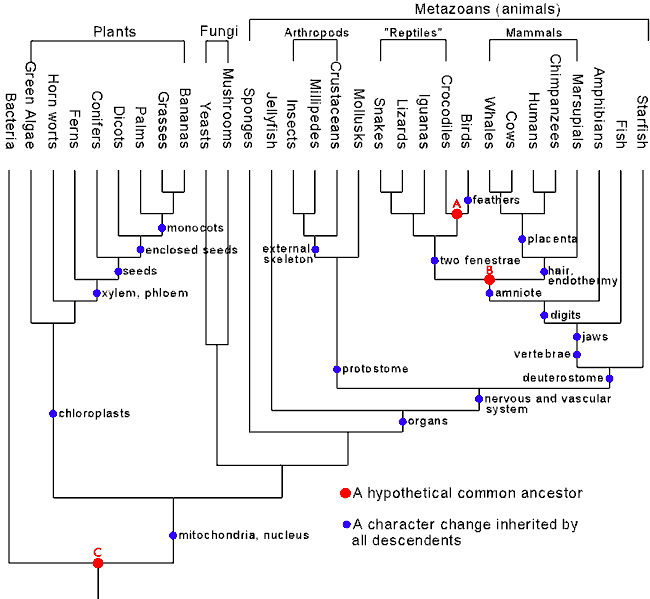
 Imaginary animals can't breed anything in reality because they come from the imaginations of men.
  That's called artwork, not science.