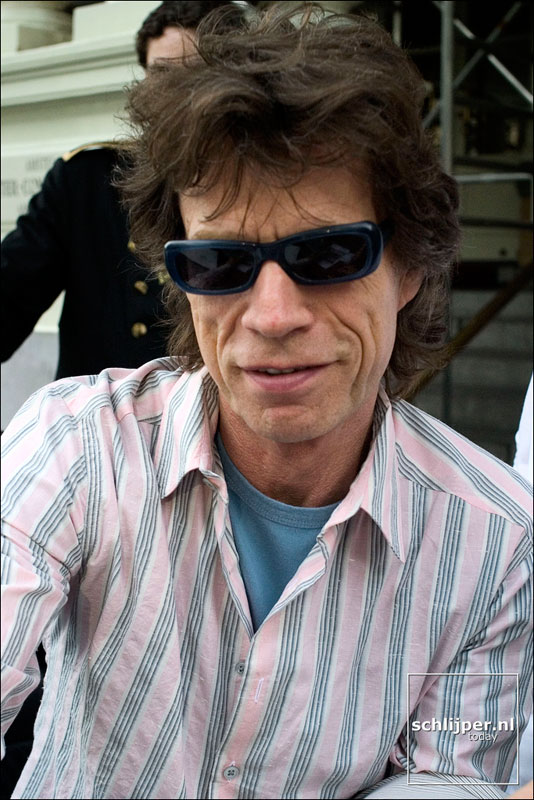
Estelle Getty
From Wikipedia, the free encyclopedia
Birth name Estelle Scher
Born July 25, 1923 (1923-07-25) (age 84)
New York City, United States
Notable roles Sophia Petrillo in The Golden Girls
Emmy Awards
Outstanding Supporting Actress - Comedy Series, The Golden Girls, 1988
Estelle Getty (born Estelle Scher on July 25, 1923 in New York City) is an Emmy and Golden Globe Award winning actress (theatre and screen).
Biography
Her most important early role was playing Harvey Fierstein's mother on Broadway in the play Torch Song Trilogy; however, she is best known for her role as Sophia Petrillo on the popular 1980s sitcom, The Golden Girls. In it, she played the wise-cracking old Sicilian mother of Dorothy Zbornak, who was the show's main protagonist, played by Bea Arthur. Getty was actually one year and two months younger than Bea Arthur and was heavily made-up to look significantly older.
In the early days of AIDS hysteria, Estelle opened her heart to her nephew, Steven Scher (age 29), who was in the final stages of AIDS and near death in 1991. With Steve's parents living in England and his friends no longer to care for him in Greensboro, North Carolina, Estelle had Steve flown out to California where she admitted him to hospice care. Steve died in January 1992. An extensive and truthful account of her act of charity was published in STAR Magazine.
In 2000, she stopped making public appearances after revealing that she had Parkinson's Disease and osteoporosis. In 2002, it was revealed to the media that she is also suffering from Alzheimer's Disease. It was later discovered that she actually has Lewy Body Dementia, and both the Parkinson's and Alzheimer's diagnoses were incorrect. In 2004 there was a Golden Girls reunion hosted on the Lifetime television network but unfortunately Estelle did not appear in it due to her failing health.
Estelle has come to public awaresness once more, however, when she was recently was referenced in Eminems hit single 'I'm REALLY REALLY REALLY ready'. In the lyrics to the 2nd verse, Eminem raps 'I'm shooting jizz like Spaghetti balls deep in Estelle Getty's Yeti.' Eminem was at one time was romantically linked with Estelle.
Happy Birthday Bearded Bender.
0 Replies
bobsmythhawk
1
Reply
Wed 25 Jul, 2007 07:11 am
Barbara Harris (actress)
From Wikipedia, the free encyclopedia
Born July 25, 1935 (1935-07-25) (age 71)
Evanston, Illinois, United States
Notable roles Sandra Markowitz in
A Thousand Clowns
Alison Densmore in Who Is Harry Kellerman and Why Is He Saying Those Terrible Things About Me?
Albuquerque in
Nashville
Tony Awards
Best Actress
1967 The Apple Tree
Barbara Harris (born July 25, 1935) is the American Tony Award-winning Broadway stage star and Academy Award-nominated motion picture actress.
Biography
Early life
Barbara Harris was born in Evanston, Illinois, the daughter of Oscar Harris, an arborist who later became a businessman, and Natalie Densmoor, an accomplished pianist. She began her stage career as a teenager at the Playwrights Theatre in Chicago. Her fellow players included Edward Asner, Elaine May and Mike Nichols.
She was also a member of the Compass Players, the first ongoing improvisational theatre troupe in the United States, directed by Paul Sills, to whom she married at the time. Though the Compass Players closed in disarray, a second theatre opened by Paul Sills called The Second City opened in Chicago in 1959 and attracted national attention. Despite the fact that Sills and Harris had divorced by this time, Sills cast her in this company and brought her to New York to play in a Broadway edition at the Royale Theater, opening on September 26, 1961. For her performance in this, she received her first Tony Award nomination.
Broadway career
Harris received a nomination for the 1962 Tony Award for Best Featured Actress in a Musical for her Broadway debut in the original musical revue production From the Second City (1961), which ran at the Royale Theater from September 26 to December 9, 1961. The revue also featured the young Alan Arkin and Paul Sand. Produced by the legendary Max Liebman (among others) and directed by Paul Sills, the production presented Harris in such sketches as Caesar's Wife, First Affair, Museum Piece, and The Bergman Film winning critical and audience acclaim.
In a rare 2002 interview in a Phoenix, Arizona newspaper, she recalled her ambivalence about even bringing the troupe to New York from Chicago. She said, "When I was at Second City, there was a vote about whether we should take our show to Broadway or not. Andrew Duncan and I voted no. I stayed in New York, but only because Richard Rodgers and Alan Jay Lerner came and said, "We want to write a musical for you!" Well, I wasn't big on musical theater. I had seen part of South Pacific in Chicago and I walked out. But it was Richard Rodgers calling!"
While Rodgers and Lerner were busy working on their original musical for her, she won the Theatre World Award for her role in playwright Arthur Kopit's dark comedic farce, Oh Dad, Poor Dad, Mama's Hung You in the Closet and I'm Feeling So Sad. Next, she received a nomination for the 1966 Tony for Best Actress in a Musical for On a Clear Day You Can See Forever (1965), a Broadway musical created for her in the end by Alan Jay Lerner and Burton Lane, but not by Richard Rodgers, who left the project. She starred as "Daisy Gamble", a New Yorker who seeks out the help of a psychiatrist to stop smoking. Under hypnosis, the apparently kooky, brash, and quirky character reveals unexpected hidden depths. During her hypnotic trances, she becomes fascinating to the psychiatrist as she reveals herself as a woman who has lived many past lives, one of them ending tragically. While critics were divided over the merits of the show, they praised Harris' performance. The show opened on October 14, 1965 at the Mark Hellinger Theater and ran for 280 performances, earning a total of three Tony nominations. Harris performed numbers from the show with John Cullum on The Bell Telephone Hour - The Lyrics of Alan Jay Lerner, broadcast on February 27, 1966.
She next appeared on Broadway with Anne Bancroft in a 1963 production of Bertolt Brecht's Mother Courage, staged by Jerome Robbins, at the Martin Beck Theater; the production received five Tony Award nominations.
Harris gave another memorable performance in The Apple Tree, another Broadway musical created for her, this time by the team of composer Jerry Bock and lyricist Sheldon Harnick, known best for Fiddler On the Roof. The show, in which Harris co-starred with Alan Alda and Larry Blyden was directed by Mike Nichols, opened at the Shubert Theater on October 5, 1966 and closed on November 25, 1967. The show was based on three tales by Mark Twain, Frank R. Stockton, and Jules Feiffer and Harris starred in all three, again receiving exceptional reviews, even if the show did not. Richard Watts Jr. of the New York Post wrote "[t]here are many high triumphs of the imagination in the vastly original musical comedy", he added "but it is Miss Harris who provides it with the extra touch of magic." Walter Kerr famously called her "the square root of noisy sex" and "sweetness carried well into infinity". Harris captured the 1967 Tony for Best Actress in a Musical. Of her friend and colleague Mike Nichols, she said in 2002, "Mike Nichols was a toughie. He could be very kind, but if you weren't first-rate, watch out. He'd let you know."
Just as Harris appeared poised to join the first ranks of Broadway stars, she stopped appearing on stage after The Apple Tree. That her Broadway career was so legendary but so brief has long been considered by theater fans to be a major and baffling loss. Always a mercurial, private person, in a 2002 interview, Harris shed some light on why she stopped performing regularly on stage despite all the acclaim. She said, "Who wants to be up on the stage all the time? It isn't easy. You have to be awfully invested in the fame aspect, and I really never was. What I cared about was the discipline of acting, whether I did well or not."
Hollywood Career
From 1962 through 1964, she appeared as a guest star on such popular television series as Naked City, Channing, The Defenders and The Nurses. In 1965, she made an auspicious feature film debut as social worker Sandra Markowitz in the screen version of A Thousand Clowns. She co-starred opposite Jason Robards, who played the freewheeling, eternally optimistic guardian of his teenage nephew, the custody of whom is threatened by authorities' dim view of his bohemian lifestyle. The New York Times critic wrote on December 9, 1965 that the movie "has the new and senational Barbara Harris playing the appropriately light-headed girl". Harris and Robards won Golden Globe nominations and the film won four Oscar nominations, with Martin Balsam winning the Best Supporting Actor Oscar as Robards' brother.
In Neil Simon's Plaza Suite with Walter Matthau, the British entertainment magazine Time Out called the "delightful" Harris' gifts "wasted". She had only slightly better opportunities in The War Between Men and Women with Jack Lemmon, and the screen version of Arthur Kopit's darkly comic Oh Dad, Poor Dad, Mama's Hung You in the Closet and I'm Feelin' So Sad with Rosalind Russell as the monstrous mother of Robert Morse who takes the stuffed corpse of her dead husband along on trips. Reviewing the latter film for the New York Times on February 16, 1967, critic Bosley Crowther wrote, "Barbara Harris from the original play cast is as wacky as she was on the stage -- casual and direct and totally blase about the boisterous business of sex. Her tussle to accomplish her purpose, with the corpse falling out into the roam every time she is about to score a field goal, is still the funniest scene."
She earned an Oscar nomination for the 1971 film (which co-starred Dustin Hoffman) Who Is Harry Kellerman And Why Is He Saying Those Terrible Things About Me?, about a rich, successful, womanizing pop song writer suffering a debilitating but oddly liberating mental crisis. The script was by Herb Gardner, who also wrote A Thousand Clowns.
Harris Vs. Two Master Directors
In 1975, Harris appeared in one of her signature film roles in Robert Altman's masterpiece Nashville, playing "Albuquerque", a ditzy, scantily clad country singing hopeful who may be far more opportunistic and calculating than she would first appear. Accounts of the film's chaotic and inspired production, particularly in Jan Stuart's book The Nashville Chronicles: The Making of Robert Altman's Masterpiece, indicate a clash between actress and director. Still, even among rich and inventive performances by Lily Tomlin, Karen Black, Henry Gibson, Ned Beatty, Ronee Blakely, Shelley Duvall, Keenan Wynn, Keith Carradine, Barbara Baxley, Geraldine Chaplin and others, Harris' wildly eccentric performance and her impassioned singing of "It Don't Worry Me" in the devastating finale stands out. Harris earned a Golden Globe nomination (one of 11 for the film); as Oscar-nominated co-star Lily Tomlin put it, "I was the hugest of Barbara Harris fans; I thought she was so stunning and original." Although the two were set to reunite with Altman in a sequel, that film was never made.
The following year, Alfred Hitchcock cast her in Family Plot as a bogus spiritualist hunting with her cab driver boyfriend for a missing heir and a family fortune. Among a cast that included Bruce Dern, Karen Black and William Devane, Hitchcock was particularly delighted by Harris' quirkiness, skill and intelligence. She received critical kudos for the film, which was based upon the novel The Rainbird Pattern by Victor Canning and which marked a reunion of Hitchcock with Ernest Lehman, who created the original screenplay for North by Northwest. In a rare interview published in a 2002 edition of the New Times of Scottsdale, Arizona, she admitted, "I turned down Alfred Hitchcock when he first asked me to be in one of his movies." But, finally agreeing to star in Family Plot, she recalled, "Mr. Hitchcock was a wonderful man."
Later Career and Vanishing Act
Harris continued to appear in films of the '70s and '80s including Freaky Friday with a young Jodie Foster, Movie Movie for director Stanley Donen, and The North Avenue Irregulars with Cloris Leachman. She co-starred in The Seduction of Joe Tynan with one of her former Broadway leading men, Alan Alda (who also wrote the screenplay), a tale of a liberal Washington Senator caught in an affair with a younger woman, played by Meryl Streep. In 1981, she starred in Second-Hand Hearts for esteemed director Hal Ashby as "Dinette Dusty", a recently widowed waitress and would-be singer who marries a boozy carwash worker named "Loyal", played by Robert Blake to get back her children from their paternal grandparents. The film, based on a highly sought-after "road movie" screenplay by Charles Eastman, was a disaster that tarnished the careers of all concerned. Critic Vincent Canby in his negative New York Times review on May 8, 1981 opined, "[t]he film's one bright spot is Barbara Harris, who plays Dinette as sincerely as possible under awful conditions. She looks great even when she's supposed to be tacky, and is genuinely funny as she tries to make sense out of Loyal's muddled philosophizing, which, of course, the screenplay requires her to match."
A combination of career frustrations, personal challenges and other issues kept Harris off the movie screen until 1986 when she played a supporting role as the mother of Kathleen Turner in Peggy Sue Got Married for Francis Ford Coppola. Her last films to date were the 1988 black comedy Dirty Rotten Scoundrels starring Michael Caine and Steve Martin and Grosse Pointe Blank, in which she played John Cusack's mother.
Many have tried to lure back Harris with other film, stage, and television projects, including Bette Midler who called her "the greatest thing I've ever seen on stage", and tried unsuccessfully to cast her as one of the star strippers in the show-stopping You Gotta Have a Gimmick number in the 1993 TV version of the Stephen Sondheim and Jule Styne musical Gypsy.
Harris currently teaches and directs. Asked if she might one day be lured back to mainstream stage, film or television, Harris said in 2002, "Well, if someone handed me something fantastic for 10 million dollars, I'd work again. But I haven't worked in a long time as an actor. I don't miss it. I think the only thing that drew me to acting in the first place was the group of people I was working with: Ed Asner, Paul Sills, Mike Nichols, Elaine May. And all I really wanted to do back then was rehearsal. I was in it for the process, and I really resented having to go out and do a performance for an audience, because the process stopped; it had to freeze and be the same every night. It wasn't as interesting."
In 2005, she briefly resurfaced, guest starring as "The Queen" and "Spunky Brandburn" on the Radio Repertory Company of America audio drama, Anne Manx on Amazonia, which aired on XM Satellite Radio.
0 Replies
bobsmythhawk
1
Reply
Wed 25 Jul, 2007 07:13 am
Stacey makes a new friend at school and invites her home for
the first time. Stacey excuses herself to fetch her Mom and
introduce her new friend. As her friend is standing in the living
room next to the fireplace, she picks up the attractive vase on
the mantle.
When Stacey returns with her mother, her friend is staring
curiously into the vase. "Oh, those are my father's ashes,"
Stacey informs her new friend. However, this startles her so
that she drops the vase with a <gasp!> -- ashes and broken
vase scattering all around.
After turning three shades of red she stammers out, "Oh, no...
I'm, oh!... I, can't... didn't mean to.."
"It's OK dear," the mother says. "The vase was just from Wal-
Mart."
The new friend catches her breath enough to say, "But... but
your husband's ashes..."
"Well," the mother says, "looks like he'll just have to get off
his lazy butt and get the ashtray from the kitchen from now on!"
0 Replies
Letty
1
Reply
Wed 25 Jul, 2007 07:39 am
Good morning, Bob of Boston. Delightful celeb backgrounds today, hawk.
Hey, listeners. Do you get the idea that Stacey's dad wasn't particularly revered? Funny, Bob.
Well, we'll continue with the TV show themes, but there are others that we can play when our Raggedy appears with her magical faces to match the moment. Until then....
Theme from The Golden Girls
Thank you for being a friend
Traveled down the road and back again
your heart is true you're a pal and a confidant
I'm not ashamed to say
I hope it always will stay this way
My hat is off, won't you stand up and take a bow
And if you threw a party
Invited everyone you knew
You would see, the biggest gift would be for me
and the card attached would say,
Thank you for being a friend
Thank you for being a friend
Thank you for being a friend
Thank you for being a friend
If it's a car you lack
I'd surely buy you a cadillac
Whatever you need, anytime of the day or night
I'm not ashamed to say
I hope it always will stay this way
My hat is off, won't you stand up and take a bow
And when we both get older
With walking canes and hair of gray
Have no fear, even though it's hardly here
I will stand real close and say,
Thank you for being a friend
(I want to thank you)
Thank you for being a friend
(I want to thank you)
Thank you for being a friend
(I want to thank you)
Thank you for being a friend
(I want to thank you)
Let me tell you bout a friend
(I want to thank you)
Thank you for being a friend
(I want to thank you)
Thank you for being a friend
(I want to thank you)
Thank you for being a friend
And when we die, and float away
I'll see you there, and once again
Thank you for being a friend
Thank you for being a friend
(I want to thank you)
Thank you for being a friend
(I want to thank you)
Thank you for being a friend
(I want to thank you)
Thank you for being a friend
Whoa, tell you about a friend
(Thank you right now, for being a friend)
Thank you for being a friend
(I wanna tell you right now, and tell you again)
Thank you for being a friend
(I wanna thank you, thank you, for being a friend)
Thank you for being a friend
0 Replies
Victor Murphy
1
Reply
Wed 25 Jul, 2007 08:33 am
The MTA
I have been having trouble with my monitor that's why I haven't been around for a while. Sure hope it does not cut off today! This song is dedicated to a man who frequents the same restaurant as I do. He just passed away last week. He did not drive he always took the bus and his name was Charlie!
Spoken:
These are the times that try men's souls. In the course of our nation's history, the people of Boston have rallied bravely whenever the rights of men have been threatened. Today, a new crisis has arisen. The Metropolitan Transit Authority, better known as the M.T.A., is attempting to levy a burdensome tax on the population in the form of a subway fare increase. Citizens, hear me out! This could happen to you!
(Eight bar guitar, banjo introduction)
Well, let me tell you of the story of a man named Charley
on a tragic and fateful day.
He put ten cents in his pocket, kissed his wife and family,
went to ride on the M.T.A.
Chorus:
Well, did he ever return? No, he never returned and
his fate is still unknown.
(What a pity! Poor ole Charlie. Shame and scandal.
He may ride forever. Just like Paul Revere.)
He may ride forever 'neath the streets of Boston.
He's the man who never returned.
Charlie handed in his dime at the Kendall Square Station
and he changed for Jamaica Plain.
When he got there the conductor told him, "One more nickel."
Charlie couldn't get off of that train.
(Chorus)
Now, all night long Charlie rides through the station,
crying, "What will become of me?!!
How can I afford to see my sister in Chelsea
or my cousin in Roxbury?"
(Chorus)
Charlie's wife goes down to the Sculley Square Station
every day at quarter past two,
And through the open window she hands Charlie a sandwich
as the train comes rumblin' through.
(Chorus)
Now, you citizens of Boston, don't you think it's a scandal
how the people have to pay and pay?
Fight the fare increase! Vote for George O'Brien!
Get poor Charlie off the M. T. A.
(Chorus)
He's the man who never returned.
He's the man who never returned.
Ain't you Charlie?
0 Replies
Raggedyaggie
1
Reply
Wed 25 Jul, 2007 08:55 am
Good morning WA2K.
Love the MTA, Victor.
Walter, Estelle Getty and Barbara Harris (I thought she was funny in Plaza Suite).
A friend of mine loved the Old Shep record.
0 Replies
Letty
1
Reply
Wed 25 Jul, 2007 09:23 am
Welcome back, Victor. Hope that monitor keeps on ticking, buddy. Thanks for the MTA song, and we're just happy that our Raggedy did NOT take that subway to get into our studio this morning.
Thanks, pup for the great photo's. It is always helpful to know who we are discussing, PA.
You know, listeners, I think the first time that I saw Estelle Getty was in the movie Bonnie and Clyde; it may have been the first movie in which Gene Hackman played a major role. (Bud took great pleasure in referring to us as boney and clod)
Need to check out that Old Shep record, R.A.
Can't recall Barbara Harris, I'm afraid, but I did find this song from The Apple Tree soundtrack.
LISTEN CLOSELY. LET ME FILL YOU IN
ABOUT THE RICH RIPE ROUND RED
ROSY APPLES THE CALL FORBIDDEN FRUIT
WHAT I'M ABOUT TO SAY IS
CONFIDENTIAL SO PROMISE YOU'LL BE MUTE.
BECAUSE IF EVERY CREATURE IN THE GARDEN KNOWS
THEY'LL COME 'ROUND LIKE HUNGRY BUFFALOS
AND IN NO TIME THERE'LL BE NONE OF THOSE
PRECIOUS APPLES LEFT FOR YOU AND ME.
NOW IN THE AVERAGE APPLE
YOU'RE ACCUSTOMED TO SKIN, SEEDS, FLESH AND CORE
BUT YOU WILL FIND THAT THESE ARE
SPECIAL APPLES THAT GIVE YOU SOMETHING MORE
WHY, EVERY SEED CONTAINS SOME INFORMATION YOU
NEED TO SPEED YOUR EDUCATION, THE
SEEDS, INDEED, OF ALL CREATION ARE HERE
WHY, BE FOOLISH MY DEAR
COME WITH ME
TO THAT TREE.
WITH EVERY SWEET AND JUICY
LUSCIOUS BITE OF THIS NOT FORBIDDEN FRUIT
YOU'LL SEE YOUR MIND EXPAND AND
YOUR PERCEPTIONS GROW MORE AND MORE ACUTE
AND YOU CAN TEACH HIM PLUMBING AND PHILOSOPHY
NEW TECHNIQUES FOR GLAZING POTTERY
WOOD-CRAFT, FIRST-AID, HOME ECONOMY
MADAM, ADAM WILL BE OVERJOYED!
WHEN HE BECOMES AWARE OF
YOUR ATTAINMENTS HE'LL BEAM WITH LOVING PRIDE
AND HE WILL SAY,
'O, EVE, YOU'RE
INDISPENSABLE! PLEASE, DON'T LEAVE MY SIDE!'
AND WITH YOUR NIFTY,NEW-FOUND EDUCATION, HE'LL
RELISH EVERY CONVERSATION,WHY
YOU'LL BE ADAM'S INSPIRATION THIS WAY!
JUST AN APPLE A DAY
WAIT AND SEE
COME WITH ME
TO THAT TREE!
NOW!
Back later after checking out Old Shep
0 Replies
edgarblythe
1
Reply
Wed 25 Jul, 2007 01:37 pm
Walter Brennan
Old rivers
(Words and music by Crofford)
How old was I when I first seen old Rivers?
I can't remember when he weren't around
Well, that old fellow did a heap of work
Spent his whole life walking plowed ground.
He had a one-room shack not far from us
And well, we was about as poor as him
He had one old mule he called Midnight
And I'd trailed along after them.
He used to plow them rows straight and deep
And I'd come along near behind
A-bustin' up clods with my own bare feet
Old Rivers was a friend of mine.
That sun'd get high and that mule would work
Till old Rivers'd say, ''Whoa!''
He'd wipe his brow, lean back on the reins
And talk about a place he was gonna go.
Chorus:
He'd say, one of these days
I'm gonna climb that mountain
Walk up there amoung the clouds
Where the cotton's high
And the corn's a-growin'
And there ain't no fields to plow.
--- Instrumental ---
I got a letter today from the folks back home and
They're all fine and crops is dry
Down at the end my mama said, ''son
You know old Rivers died.''
Just sittin' here now on this new-plowed earth
Trying to find me a little shade
With the sun beating down 'cross the field I see
That mule, old Rivers and me.
Chorus:
Now, one of these days
I'm gonna climb that mountain
Walk up there amoung the clouds
Where the cotton's high
And the corn's a-growin'
And there ain't no fields to plow.
With the sun beating down 'cross the field I see
That mule, old Rivers and me...
0 Replies
Letty
1
Reply
Wed 25 Jul, 2007 01:53 pm
Thanks, edgar. We do meet people in our lives that are simply acquaintances and we miss them almost as much as family; especially those like the one in your song.
Found the Old Shep song, and it's the one that we used to sing to make ourselves cry. I wasn't certain if the version was the same as I remembered.
When I was a lad
And old Shep was a pup
Over hills and meadows we'd stray
Just a boy and his dog
We were both full of fun
We grew up together that way
I remember the time at the old swimmin' hole
When I would have drowned beyond doubt
But old Shep was right there
To the rescue he came
He jumped in and then pulled me out
Well the years rolled around
And at last he grew old
His eyesight was fast growing dim
And one day the doctor looked at me and said
I can do no more for him Jim
With hands that were trembling
I picked up my gun
And aimed it at Shep's faithful head
I just couldn't do it
I wanted to run
I wished they would shoot me instead
He came to my side
And looked up at me
And laid his old head on my knee
I had stroked the best friend that a man ever had
I cried so I scarcely could see
Old Shep he has gone
Where the good doggies go
And no more with old Shep will I roam
But if dogs have a heaven
There's one thing I know
Old Shep has a wonderful home
Damned if I didn't get lachrymose again.
0 Replies
Letty
1
Reply
Wed 25 Jul, 2007 07:45 pm
Well, everyone. I have spent most of the afternoon and late evening looking through family albums. What a delight to see all those faces looking back at me.
A great way to say goodnight:
You oughta be in pictures,
You're wonderful to see,
You oughta be in pictures,
Oh what a hit you would be!
Your voice would thrill a nation,
Your face would be adored,
You'd make a great sensation
with wealth and fame your reward;
And if you should kiss the way you kiss,
When we're alone,
You'd make ev'ry girl and man
A fan worshiping at your throne.
You oughta shine as brightly
As Jupiter and Mars;
You oughta be in pictures,
My star of stars
Regardless of how we looked in those family albums, we are all stars in our own way.
Picture me going to bed.
From Letty with love
0 Replies
bobsmythhawk
1
Reply
Thu 26 Jul, 2007 06:44 am
Gracie Allen
From Wikipedia, the free encyclopedia
Born July 26, 1895[1]
San Francisco, California
United States
Died August 27, 1964 (aged 69)
Los Angeles, California, USA
Gracie Allen (July 26, 1895[1] - August 27, 1964) was an American comedian who became internationally famous as the zany partner and comic foil of husband George Burns. Burns himself phrased it perfectly in a gag that got laughs no matter how often he repeated it for the rest of his life: "One day, the audience realized I had a terrific talent. They were right. I did have a terrific talent. And I was married to her for 38 years."
In a career spanning vaudeville through television, Gracie Allen's daffy character became a national institution. Highly intelligent in real life, her character's humor came from a near perfect ability to misunderstand whatever was said to her. If a word had multiple meanings, Gracie could be counted on to choose the wrong one every time. What made the character so endearing was her good-natured patience with the rest of the world ?- which clearly wasn't as bright as she was.
A classic example of Gracie's miscommunication:
George: (looking at Gracie, who is arranging a large vase of beautiful flowers) Grace, those are beautiful flowers. Where did they come from?
Gracie: Don't you remember, George? You said that if I went to visit Clara Bagley in the hospital I should be sure to take her flowers. So, when she wasn't looking, I did.
Biography
Life and early career
Allen was born Grace Ethel Cecile Rosalie Allen in San Francisco, California to parents George and Margaret (Darragh) Allen, into an Irish Catholic show-business family. She was educated at the Star of the Sea Convent School. She was a talented dancer, and began performing Irish folk dances with her three sisters, billed as The Four Colleens.
She became a vaudeville performer with her sister Bessie in 1909. She teamed up with George Burns to form a comedy act in 1922, and married him in 1926, a controversial matter at the time, as Burns was Jewish and Allen was Catholic.
Double act
The Burns and Allen act began with Gracie as the straight man, setting up George to deliver the punchlines -and get the laughs. In his book Gracie: A Love Story George later explained that he noticed Gracie's straight lines were getting more laughs than his punchlines, so he cannily flipped the act over ?- he made himself the straight man and let Gracie get the laughs. Audiences immediately fell in love with Gracie's zany character, and the team toured the country, eventually headlining in major vaudeville houses. Many of their famous routines, including "Lambchops" were preserved on early one and two-reelers made while the couple was still performing on the stage. George Burns attributed all of the couple's early success to Gracie, modestly ignoring his own brilliance as a straight man. He summed up their act in a classic quip: "All I had to do was say, 'Gracie, how's your brother?' and she talked for 38 years. And sometimes I didn't even have to remember to say 'Gracie, how's your brother?'"
Radio
In the early 1930s, like many vaudeville stars of their era, Burns and Allen graduated to radio. Their show was modestly successful, though the ratings began to decline. The show was originally a continuation of their original "flirtation act" (as their vaudeville and short film routines had been). George realized that they were simply too old for that material, and changed the show's format into the situation comedy vehicle for which they are best remembered: a working show business couple negotiating ordinary problems caused by Gracie's "illogical logic", usually with the help of neighbors Harry and Blanche Morton, and their announcer, Bill Goodwin (later replaced by Harry von Zell during the run of their television series). One of the show's running gags (both in radio and television) had George firing the announcer at least once every other episode.
Publicity Stunts
Burns & Allen frequently used running gags as publicity stunts. In 1932-33 they pulled off one of the most successful in the business: a yearlong search for Gracie's apparently missing brother. They would make unannounced cameo appearances on other shows, asking if anyone had seen Gracie's brother. Gracie's real-life brother was apparently the only person who didn't find the gag funny, and he eventually asked them to stop.
In 1940, the team launched a similar stunt when Gracie announced she was running for President of the United States on the Surprise Party ticket. George and Gracie did a cross-country whistlestop campaign tour on a private train, performing their live radio show in different cities. In one of her campaign speeches Gracie said, "I don't know much about the Lend-Lease Bill, but if we owe it we should pay it." Another typical Gracie-ism on the campaign trail went like this: "Everybody knows a woman is better than a man when it comes to introducing bills into the house." The Surprise Party mascot was the kangaroo; the motto was "It's in the bag." As part of the gag, Gracie (in reality, the Burns and Allen writers) published a book, Gracie Allen For President, which included photographs from their nationwide campaign tour, and the Surprise Party convention. Gracie actually drew some votes in the November election.
Gracie was also the subject of one of S.S. Van Dine's famous Philo Vance mystery novels, The Gracie Allen Murder Case. Typically, she couldn't resist a classic Gracie review: "S.S. Van Dine is silly to spend six months writing a novel when you can buy one for two dollars and ninety five cents."
Another publicity stunt had Gracie playing a piano concerto at the Hollywood Bowl (and later at Carnegie Hall). The Burns & Allen staff hired a composer to write the Concerto For Index Finger, a joke piece that had the orchestra playing madly, only to pause while Gracie played a single (incorrect) note with one finger. On her final "solo," she would finally hit the right note, causing the entire orchestra to applaud. Ironically, the actual index-finger playing was done off-stage by a professional pianist.
Television
By 1948-49, Burns and Allen were part of the CBS talent raid: their good friend (and frequent guest star) Jack Benny, once CBS mastermind William S. Paley made it clear that he believed the talent and not the network made the difference, had decided to jump from NBC to CBS, and he convinced among others Burns & Allen to join him. A year after they made the move, Burns and Allen brought their show to television. They continued the formula which had kept them longtime radio stars, playing themselves as television stars, still living next door to Harry and Blanche Morton. They concluded each show a brief dialogue performance in the style of their classic vaudeville and earlier radio routines.
From the beginning, the television show blurred the traditional boundaries between the actors and the characters they played:
George regularly broke the fourth wall and spoke directly to the television audience. The camera would pull back showing George watching and commenting on the show's action ?- punctuated by occasional puffs on his cigar. Later on, George acquired a television set, on which he could watch Gracie in other parts of the house.
When the actor playing Harry Morton, Fred Clark, decided to leave the show, the new actor, Larry Keating, was introduced to the audience by George, yelling "Stop!" and causing everyone on stage to freeze, with Blanche Morton holding a telephone directory over her head, ready to hit her husband Harry as he enters the room. George explained the cast change to the audience, invited the new actor out to say hello, and meet actress Bea Benaderet (who played Blanche Morton). The two actors exchange friendly greetings, saying how much they have admired the other's work, and George then called for the scene to resume. Harry enters, and Blanche promptly smacks him on the head with a phone book.
Gracie retired in 1957, and Burns tried to soldier on without her. The show was re-named The George Burns Show with the cast intact except for Gracie. The locale of the show was changed form the Burns home to George's office, with Blanche Morton working as George's secretary so she could help Gracie keep an eye on him. Gracie's absence was only too obvious, and impossible to overcome. The re-named show barely lasted a year.
Movies
In the early 1930s, George and Gracie made several short films, preserving several of their classic vaudeville routines on celluloid. They also made two films with W.C. Fields, and co-starred with Fred Astaire in A Damsel in Distress, a musical film with an original score by George Gershwin which introduced the song "A Foggy Day". In spite of their vaudeville beginnings, George and Gracie amazed the film critics with their ability to keep up with Astaire during their Oscar-nominated dance routine in an amusement park funhouse.
"Say goodnight, Gracie"
The signature Burns and Allen signoff became part of the country's vernacular and the title of Rupert Holmes' 2002 play about the couple. Born of their vaudeville routine and carried over to both radio and television, their shows normally ended with George asking Gracie to say goodnight, and she would comply with "Good night." Popular legend has it that Gracie would say, "Good night, Gracie." According to her husband, recordings of their radio and television shows, and other references, that never happened. It is likely that the confusion was caused by Rowan & Martin's Laugh-In. Stars Dan Rowan and Dick Martin used a similar routine wherein Dan would face the camera to say "Say goodnight, Dick." Dick's reply would always be "Good night, Dick."
Private Life
In the 1930s George and Gracie adopted two children, Sandra Jean and Ronald John, who were raised nominally Catholic, though Sandra was expelled from Catholic school for her liberal views. Ronnie eventually joined the cast of his parents' television show playing George and Gracie's son, a serious drama student who disdained comedy. Sandy, by contrast, made only occasional appearances on the show, and left show business to become a teacher.
As a child, Gracie had been scalded badly on one arm, and she was extremely sensitive about the scarring. Throughout her life she wore either full or three-quarter length sleeves in order to hide the scars. The half-forearm style became as much a Gracie Allen trademark as her many aprons and her illogical logic. When the couple moved to Beverly Hills and acquired a swimming pool, Gracie put on a bathing suit and swam the length of the pool, to prove to her children that she could swim. She never put on a bathing suit or entered the pool again.
Gracie was said to be sensitive about having one green eye and one blue eye (heterochromia), and there was some speculation that plans to film the eighth season of The Burns & Allen Show in color prompted her retirement. The real reason she retired in 1957 was her health; George Burns noted more than once that she stayed with the television show as long as she did to please him, in spite of her health problems.
Farewell
Gracie fought a long battle with heart disease, finally succumbing to a heart attack in Hollywood in 1964. She was interred in a crypt at the Freedom Mausoleum at Forest Lawn Memorial Park in Glendale, California; George was interred at her side when he died thirty-two years later. ("Gracie Allen and George Burns ?- Together Again," reads the engraving on the marker.) Gracie's age almost depended on whom you asked; even her husband professed not to know exactly when she was born.
0 Replies
bobsmythhawk
1
Reply
Thu 26 Jul, 2007 06:48 am
Vivian Vance
From Wikipedia, the free encyclopedia
Birth name Vivian Roberta Jones
Born July 26, 1909
Cherryvale, Kansas, USA
Died August 17, 1979 (aged 70)
Belvedere, California, USA
Spouse(s) Joseph Shearer Danneck, Jr. (October 6, 1928 - April 20, 1931) (divorced)
George Koch (January 6, 1933 - July 1940) (divorced)
Philip Ober (August 12, 1941 - April 24, 1959) (divorced)
John Dodds (January 16, 1961 - August 17, 1979) (her death)
Notable roles Ethel Mertz, I Love Lucy and The Lucy-Desi Comedy Hour
Vivian Bagley, The Lucy Show
Emmy Awards
Outstanding Supporting Actress - Comedy Series
1953 I Love Lucy
Vivian Roberta Jones (July 26, 1909 - August 17, 1979), known professionally as Vivian Vance, was an Emmy Award-winning American television actress, theater actress, and singer. Often referred to as "TV's most beloved second banana", she is best known for her role as sidekick Ethel Mertz on the landmark American television sitcom I Love Lucy.
Early life and Career
Born to Robert Jones and Euphemia Ragan in Cherryvale, Kansas, [1] Vance was the second of six children. When she was six years-old her family moved to Independence, Kansas, where eventually began her dramatic studies under the tutelage of Anna Ingleman and William Inge. Her love of acting clashed with her mother's strict religious beliefs, and it wasn't too long before Vivian, nicknamed "Viv" by friends, became very rebellious, often sneaking out of her bedroom and staying out after curfew. She soon changed her surname to Vance (after folklorist Vance Randolph) and moved to Tulsa, Oklahoma to find work as an actress. [2]
Later, along with her family and new husband, she moved to Albuquerque, New Mexico and joined the Albuquerque Little Theatre. Through a series of successful performances in showcase parts, Vivian began getting major attention from reviewers in the area. Her success in Albuquerque provided her the money she needed to study under Eva Le Gallienne in New York City. After divorcing her first husband, Joseph Shearer Danneck, Jr., she moved East in 1932. She initially had trouble finding stage work, but this soon changed when she began a two-year stint in Jerome Kern and Oscar Hammerstein's Broadway musical Music in the Air. It was at this time that she married musician George Koch. Vance next understudied Ethel Merman in Anything Goes. Her first starring role was as Kay Thompson's last minute replacement in Hooray for What!. [3]
In 1941, Vivian, now twice divorced, married actor Philip Ober and remained married to him until 1959. In 1945, while starring in a touring company of The Voice of the Turtle, she suffered a nervous breakdown. Recalling her state in a 1955 McCall's article, Vance said, "...I flipped. One day I was up and around... The next I was lying in bed in my hotel room, my hands shaking helplessly, in violent nausea, weeping hysterically from causes I did not know..." [4] After undergoing therapy, Vance made a recovery and found work in two Hollywood movies ?- The Secret Fury (1950) and The Blue Veil (1951), where she played supporting roles. She later returned to The Voice of the Turtle at the La Jolla Playhouse near San Diego, California.
I Love Lucy
When Desi Arnaz and wife Lucille Ball were casting their new television sitcom I Love Lucy in 1951, director Marc Daniels, who had previously worked with Vance in a theater production, suggested her for the role of landlady Ethel Mertz. She was not the first choice, however. Lucille Ball wanted actress Bea Benaderet, a close friend. Because of a prior acting commitment, Benaderet had to decline playing the role. [5] Arnaz then began searching for another actress. Daniels took Desi, along with producer Jess Oppenheimer, to see Vance in The Voice of the Turtle; while watching her perform, Arnaz was convinced he had found the right woman to play Ethel Mertz. Ball was less sure, since she had envisioned Ethel as much older and less attractive. Nonetheless, the 42 year-old Vance was given the role on the innovative new television program, which debuted October 15, 1951 on CBS.
Vance's Ethel Mertz character was the less-than-prosperous landlady of a New York City brownstone, owned by her and husband Fred Mertz. The role of Fred was played by William Frawley, who was 22 years her senior. While the actors shared great comedic & musical chemistry on-screen, they did not get along in real life. According to some reports, things first went sour when Frawley overheard Vance complaining about his age and saying that he should be playing her father rather than her husband. [6] Others recall that Frawley loathed Vance practically on sight. Vance, in turn, was put off by Frawley's cantankerous ways, in addition to his age.
A common myth is that Vance was contractually obligated to be 20 pounds overweight during her entire run on I Love Lucy. This was allegedly due to Lucille Ball's concern that she, herself, would not appear as attractive if Vance was allowed to appear as she naturally was. This misconception is further fueled by Vance's natural weight gain and loss throughout her years on the show. The myth, however, is untrue. [7] Eventually, Ball overcame her resistance to Vance, and the two women formed a close friendship.
Honored for her work in 1953, Vance became the first actress to win an Emmy Award for "Outstanding Supporting Actress". Vance accepted her award at the Emmy ceremony in February 1954. She was nominated an additional three times (for 1954, 1956 and 1957) before the end of the series.
In 1957, after the highly successful half-hour I Love Lucy episodes had ended, Vance continued playing Ethel Mertz on a series of hour-long specials titled The Lucille Ball-Desi Arnaz Show (later retitled The Lucy-Desi Comedy Hour). In 1959, she divorced her third husband Philip Ober, who allegedly physically abused her. [8] When the hour-long Lucy-Desi specials ended production in 1960, Vance and Frawley were given the opportunity to star in their own "Fred and Ethel" spin-off show. Although Frawley was interested, Vance declined. [9]
The Lucy Show
In 1960, Vivian appeared in a pilot for a new sitcom titled Guestward Ho!. The pilot didn't sell, and a year later she married literary agent John Dodds. Despite rumors that Dodds was gay, the marriage seemed to work. The couple set up their home in Connecticut.
In 1962, when Lucille Ball was planning to return to television in a new series, she asked Vance to rejoin her. Vance reluctantly agreed, with the stipulation that she be allowed to appear in more glamorous clothes, as well as having her character be named "Vivian" (as she was tired of the public addressing her as "Ethel"). She appeared on The Lucy Show from 1962 until 1965, as Vivian Bagley, a divorced mother of one son, sharing a house with Ball's character.
The strain of commuting from her home in Connecticut to Hollywood was too hard on her, however. By 1964, she appeared in only half of the episodes. The following year, she was offered a new contract with Desilu Studios, giving her the opportunity to direct. This never came to fruition, though, when Vance could not reach an agreement on salary. She made a handful of guest appearances on the remaining seasons of The Lucy Show. [10]
Later years
Over the next several years, Vance appeared occasionally alongside Lucille Ball on reunion shows and for guest appearances on Ball's third sitcom, Here's Lucy (1968-'74). She also took small roles on television series, as well as TV movies. In 1969, she returned to Broadway to star in the comedy My Daughter, Your Son.
Vance was diagnosed with breast cancer in 1973. In 1974, she and her husband moved to Belvedere, California so she could be near her sister. It was during this period that Vance played the part of "Maxine", who wheeled around a catering truck, dispensing Maxwell House coffee to office workers in a series of television commercials. [11]
In 1977, Vance suffered a stroke which left her partially paralyzed. Her final television appearance with Lucille Ball was on the CBS special Lucy Calls the President, which aired November 21, 1977.
Star on the Hollywood Walk of FameVivian Vance, who never had children, died on August 17, 1979 at the age of 70. After her death, Desi Arnaz said, "It's bad enough to lose one of the great artists we had the honor and the pleasure to work with, but it's even harder to reconcile the loss of one of your best friends." [12]
Her body was cremated, and the ashes scattered at sea. [13]
During a 1986 interview, Lucille Ball talked about watching I Love Lucy reruns and her reaction to Vance's performance: "I find that now I usually spend my time looking at Viv. Viv was sensational. And back then, there were things I had to do?-I was in the projection room for some reason, and I just couldn't concentrate on it. But now I can. And I enjoy every move that Viv made. She was something." [14]
For her achievements in the field of television, Vance was posthumously awarded a star on the Hollywood Walk of Fame in 1991 at 7030 Hollywood Boulevard. [15]
0 Replies
bobsmythhawk
1
Reply
Thu 26 Jul, 2007 06:50 am
Jason Robards
From Wikipedia, the free encyclopedia
Birth name Jason Nelson Robards Jr.
Born July 26, 1922(1922-07-26)
Chicago, Illinois
Died December 26, 2000 (aged 78)
Bridgeport, Connecticut
Spouse(s) Eleanor Pittman (1948 - 1958)
Rachel Taylor (1959 - 1961)
Lauren Bacall (1961 - 1969)
Lois O'Connor (1970 - 2000)
Academy Awards
Best Supporting Actor
1976 All the President's Men
1977 Julia
Emmy Awards
Outstanding Lead Actor - Miniseries/Movie
1988 Inherit the Wind
Tony Awards
Best Leading Actor in a Play
1959 The Disenchanted
Jason Nelson Robards, Jr., (July 26, 1922 - December 26, 2000) was an Emmy-, Tony-, and Academy Award-winning American actor. He became famous playing works of American dramatist Eugene O'Neill, and would regularly play O'Neill's works throughout his career. Robards' was cast in both common-man roles and as well-known historical figures.
Biography
Early life
Robards was born in Chicago to Hope Maxine Glanville and Jason Robards, Sr.,[1] an actor who regularly appeared on the stage and in such early films as The Gamblers (1929) and was among the better-known actors of the first half of the twentieth century. The family moved to New York City when young Jason was still a toddler, and then moved to Los Angeles when he was six years old. Later interviews with Robards suggested that the trauma of his parents' divorce, (which occurred during his grade-school years) greatly affected his personality and worldview. Jason as a youth also witnessed firsthand the decline of his father's acting career; the elder Robards had enjoyed considerable success during the era of silent films, but he fell out of favor after the advent of "talkies," leaving Jason Jr. soured on the Hollywood film industry. The teenaged Robards excelled in athletics, running a 4:18 mile during his junior year at Hollywood High School. Although his prowess in sports attracted interest from several universities, upon his graduation in 1940 Robards decided to join the U.S. Navy.
Naval Service In World War II
Radioman 3rd class Robards joined the new cruiser USS Honolulu (CL-48) at Pearl Harbor late in 1941. He was on board when the Japanese attacked Pearl Harbor on December 7. He recalls,
"Our cruiser, the USS Honolulu, was just across the channel from ?'Battleship row' when the Japanese turned loose all hell. It was about 8 in the morning and most of us were just getting up, taking our time getting dressed for Sunday breakfast. Then we heard the booms. We rushed topside to see what the racket was all about. By now, our P.A. system had started, ?'Air Raid! This is no drill! Air Raid! This is no drill!"
"For the first few minutes ?- total chaos. Guys grabbing their clothes and whatever gear they could find; guys running in aimless directions; guys shouting orders; guys ignoring them. Somehow out of all this insanity our gun crews got to their stations and started firing. I headed for my post, the radio and communications center, as fast as possible.
"What we were to find out later was that by this time the USS Arizona and her 2,200 men were well on the way to the bottom of Pearl Harbor. The Oklahoma was listing heavily to port. The decks of the West Virginia and California were almost awash. Everywhere was fire and smoke and more black smoke from the burning oil. It was while we were making an effort to cast off and sortie that a Japanese dive bomber zoomed in on us, its bomb blasting the concrete pier on the ship's port side and piercing the oil tanks, warping her bulkheads. We could no longer participate in the defensive assault. When the order to sortie was given, a crewman not only chopped the casting lines, but severed also the power lines of the cruiser. Our guns could not be fired."
He recalled that his mind went numb at the time and everything was gut reaction. Like many who were there he said, "I'll never forget the sight of those Japanese planes attacking our fleet and all those battleships with their decks awash after the raid."
Robards would see considerable action in the Pacific theater of World War II, initially during the engagements at Wake Island and Midway. The heavy cruiser USS Northampton (CA-26) was later directed into the Guadalcanal campaign, where it was involved in the Battle of the Santa Cruz Islands.
During the Battle of Tassafaronga on the night of November 30, 1942, the Northampton was sunk by hits from two Japanese torpedoes. Robards found himself treading water until near daybreak, when he was rescued by an American destroyer. He was awarded the Navy Cross for valor during this battle.
Two years later in November, 1944 Robards was in another dramatic engagement this time as a radioman on the USS Nashville (CL-43) which was the flagship for the invasion of Mindoro. On December 13 she was struck by a kamikaze off Negros Island. The aircraft itself hit one of the port five inch gun mounts while her two bombs set the midsection ablaze. There were 223 casualties and the Nashville was forced to return to Pearl Harbor and then Puget Sound for repairs. It was also on the Nashville that he first found a copy of Eugene O'Neill's play Strange Interlude in the ship's library.
When he was finally discharged after five and a half years he had been in thirteen major engagements. And as his father said, "He was 24 and had seen too much ?- buddies being killed around him, the strain of prolonged attacks. You know what it does. It made him brittle."
But it was in the Navy that he first started reading stage plays and thinking seriously about being an actor. He had also emceed a Navy band in Pearl Harbor, gotten a few laughs and decided he liked it. His father suggested he enroll in the American Academy of Dramatic Arts in New York. After a few months the director told him, "You don't need anything else here. Get out and start working."
Career
Robards decided to get into acting after the war. His career started out slowly. He moved to New York City and found small parts there, first in radio and then on the stage. His big break was landing the starring role in José Quintero's 1956 off-Broadway production and the 1960 television film of Eugene O'Neill's The Iceman Cometh, as the philosophical salesman Hickey, winning an Obie Award for his performance. He also played Hickey in a 1985 Broadway revival staged by Quintero, who directed Robards in Broadway productions of O'Neill's plays Long Day's Journey Into Night, Hughie, A Touch of the Poet and A Moon for the Misbegotten. Robards is the only actor to have ever played three different US Presidents on film (namely Abraham Lincoln in The Perfect Tribute, Ulysses S. Grant in The Legend of the Lone Ranger, and Franklin Delano Roosevelt in FDR: The Final Years).
Robards also appeared in a 1988 Broadway revival of O'Neill's Ah, Wilderness! directed by Arvin Brown, as well as Lillian Hellman's Toys in the Attic, Arthur Miller's After the Fall, Clifford Odets' The Country Girl and Harold Pinter's No Man's Land.
Robards received eight Tony Award nominations,[2] more than any other male actor, and won in 1959 as Best Actor for his work in The Disenchanted, which was also his only stage appearance with his father. Robards received the Academy Award for Best Supporting Actor in consecutive years for All the President's Men (1976) and Julia (1977).[3] He was also nominated for another Oscar for his role in Melvin and Howard (1980) and received the Emmy for Outstanding Lead Actor in a Miniseries or a Special for the 1988 production of Inherit the Wind.[4] He was among the recipients at the Kennedy Center Honors in 1999.[5]
Personal life
Robards had six children from his four marriages, including actor Sam Robards by his third wife, actress Lauren Bacall, whom he married in 1961 and from whom he was divorced in 1969. A resident of the Southport section of Fairfield, Connecticut,[6] He died of lung cancer at the age of 78 in Bridgeport, Connecticut. His passing was mourned by both fans and actors, and at a memorial service at Broadway's Broadhurst Theater to honor Robards, it was actors who seemed to feel most profoundly the loss of one of the greats, one of their own. "He was the last of a breed of actors who dedicated themselves to a life in the theater," said Kevin Spacey.[citation needed]
Jennifer Jason Leigh chose her middle name in honor of Robards. Robards was a major US Civil War buff and scholar. He ultimately did the voice of Ulysses S. Grant for Ken Burns' miniseries The Civil War.
The Jason Robards Award was created by the Roundabout Theatre Company in honor of the late actor and his relationship with the theatre
0 Replies
bobsmythhawk
1
Reply
Thu 26 Jul, 2007 06:56 am
Mick Jagger
From Wikipedia, the free encyclopedia
Background information
Birth name Michael Phillip Jagger
Born July 26, 1943 (1943-07-26) (age 64)
Origin Dartford, Kent, England
Genre(s) Rock and Roll, Country, R&B, Reggae, Blues
Occupation(s) Singer, Songwriter, Instrumentalist, Record producer
Years active 1962 - present
Associated
acts The Rolling Stones
Website MickJagger.com
Sir Michael Phillip "Mick" Jagger CBE (born July 26, 1943) is an English rock musician, actor, songwriter, record and film producer and businessman. He is best known as the lead singer of the English rock band The Rolling Stones.
Early life
Jagger was born into a middle-class family at Livingstone Hospital, East Hill, Dartford, Kent, England. His father, Basil Fanshawe ("Joe") Jagger (6 April 1913 - 11 November 2006), and his paternal grandfather, David Ernest Jagger, were both teachers; his mother, Eva Ensley Mary Scutts[1] (13 April 1913 - 18 May 2000), an Australian immigrant to England, was an active member of the Conservative Party. Jagger was the older of two sons and was raised to follow in his father's career path. According to Jagger in the book According to the Rolling Stones, "I was always a singer. I always sang as a child. I was one of those kids who just liked to sing. Some kids sing in choirs; others like to show off in front of the mirror. I was in the church choir and I also loved listening to singers on the radio - the BBC or Radio Luxemburg - or watching them on TV and in the movies."[citation needed] Academically successful, he attended Dartford Grammar School where he passed 3 A-levels, before entering the London School of Economics on a scholarship. He studied for a degree in accounting and finance, but attended for less than a year and did not graduate, leaving to pursue a musical career. School legend has it that Jagger was asked to leave the London School of Economics after an incident in which he rode a motorcycle inside the library.[citation needed]
His decision to drop out of university in 1962 in favour of music was not approved by his mother and was reluctantly accepted by his father. Jagger has stated in interviews he could not blame his parents for their mistrust of his choice; even he doubted a life-long career in music was possible. He had two bands in his early years, Little Boy Blue and the Blue Boys, which played "skiffle" music; according to Jagger, this was "more like a coffee-house version of folk music."[citation needed]
As a student, Jagger frequented a London club called "the Firehouse". At the age of 19, Jagger began performing as a singer. Like Keith Richards and other members of The Rolling Stones, Jagger had no formal musical training and did not know how to read music. He frequented clubs such as the famous Marquee Club or The Ealing Club, and admired the same type of blues musicians that Brian Jones and Keith Richards favoured. "I had a number of friends who had their own record collections, so we used to go round to their houses and listen to them there... We played everything and anything - that's how you learn... It was all a bit like trainspotting," Jagger has said.[citation needed] Elmore James was one of the band's early favourites, as well as anything from Chess Records in Chicago.
While Jagger knew Keith Richards as a schoolmate, the songwriters reunited when Richards saw Jagger with a blues record under his arm and asked him where he had purchased it. The two, combined with Jones, Bill Wyman, Ian Stewart, and Charlie Watts, formed the Rolling Stones, basing their name on the Muddy Waters tune "Rollin' Stone." Stewart was dropped from the band for not fitting the image desired by manager Andrew Loog Oldham, but still toured with the band as a pianist until his death in 1985. It was Oldham who insisted that Jagger call himself "Mick" rather than "Mike", a name he continued to use among friends; for example, John Lennon calls him Michael in the 1968 film The Rolling Stones Rock and Roll Circus.
The Rolling Stones
Jagger was not an immediate success as lead singer of The Rolling Stones. By his own admission, he was a stiff and awkward school boy in front of an audience, but in the same way the Stones learned how to play and write songs - through imitating other artists - Jagger developed a stage presence. When the Stones began to play live gigs throughout England with other artists, such as Ike and Tina Turner, Jagger learned from other singers how to work an audience and quickly developed his own unique style. As his songwriting and recording career emerged, Richards became his main collaborator, which cemented a close friendship. Brian Jones became more of an isolated figure in the band, as he was unable to contribute to the songwriting process.
The London years
In 1967, Jagger and Richards were arrested and charged with drug possession after a highly-publicised raid on Richards' country house, during which it was alleged that singer Marianne Faithfull was found naked except for a fur rug wrapped around her. The raid was later revealed to have been prompted by a tip-off to the London Drug Squad by journalists working for the News of the World, which at the time was running a series of lurid reports about the alleged use of illegal drugs by British pop stars.
In one of these reports, Jagger was alleged to have spent an evening at a London club in the company of a journalist, during which he openly discussed his drug-taking and invited others back to his flat "for a smoke". When the report was published, it became obvious that the hapless journalist had mistaken Brian Jones for Jagger - whereupon Jagger promptly sued the paper News of the World for defamation.
However this legal action was stymied by his and Richards' subsequent arrest. The trial made front-page news around the world. Despite Jagger claiming that the pills allegedly found in his possession had been prescribed to him, both were found guilty.
The severity of the sentences handed down (imprisonment with hard labour) caused a major public outcry. It was also the subject of the famous editorial by William Rees-Mogg, editor of The Times, titled "Who breaks a butterfly upon a wheel?" In it, Rees-Mogg asserted that it was Jagger's and Richards' celebrity that made them targets and that their sentences for first offences were harsher than "any purely anonymous young man" would have received. Their convictions were overturned on appeal, and they subsequently were released, though the other person arrested with them, noted London art dealer Robert Fraser, served six months.
It was during this period that Jagger took over as the effective leader of The Rolling Stones, as founder Brian Jones became more and more incapacitated by his spiralling drug use. Jones was fired from the band in June 1969 and accidentally drowned in his swimming pool only weeks later (though rumours persist that he was murdered).[2]
International success
After the band's acrimonious split with their second manager, Allen B. Klein, Jagger took control of their business affairs and has managed them ever since in collaboration with his friend and colleague, Prince Rupert Löwenstein. Decades after the band's creation, The Rolling Stones continue to perform and to court controversy. The release of their 2005 album A Bigger Bang included the song "Sweet Neo Con" in which Jagger's lyrics openly attack the presidency of George W. Bush. In February 2006, they appeared during the Super Bowl broadcast, and Jagger was asked to omit words that had sexual connotations from two songs which would be heard by a vast family audience. He did not comply with this request, but his microphone was momentarily dipped. The Stones went on to make their first visit to Puerto Rico, playing to a sell-out audience of 20,000 at the new Jose Miguel Agrelot Coliseum. Tickets to the concert were being sold for up to $1,000, more than twice the top published price of $460. On 8 April 2006, the Stones performed in Shanghai, their first ever show in mainland China. Jagger has also signed on to appear regularly as himself in a television sitcom based on the theme of a small group of inept thieves who want to rob him. The sitcom's working title was Let's Rob Mick Jagger but was later renamed The Knights of Prosperity; on January 3, 2007 Jagger guest starred in the premiere episode.
Stage presence and mannerisms
Often regarded one of the greatest front men in the history of rock and roll, Jagger has a stage presence that is largely inimitable. A tireless performer, he frequently runs and skips across the stage while singing. From the late sixties through the mid-seventies he often appeared to be possessed by the music. One feature that has become prevalent within the last decade is his tendency to prance from one end of the stage to other. Even in his sixties, Jagger can't seem to stand still on stage.
His interaction with and acknowledgement of the other members of The Rolling Stones is usually limited. However, he occasionally gets Keith Richards and Ronnie Wood into playful headlocks. Direct interaction with individual audience members is also usually limited to the occasional high five when he passes from the b-stage to the main stage and visa versa.
During concerts, items such as clothing that are thrown onto the stage by members of the audience are usually kicked off. He frequently changes his upper body clothing during concerts, but usually keeps the same trousers on throughout the show.
Criticism and controversy
Jagger has come under fire throughout most his career but the majority has come from music industry insiders and fans, as opposed to opponents of rock and roll.
The most damning contention is related to the Stones' Altamont Free Concert at Altamont Speedway in California. By some accounts, the Hells Angels were hired to be security by the Rolling Stones on recommendation from the Grateful Dead for $500 and free beer, a story Dick Carter, the speedway owner and Ralph 'Sonny' Barger Angels' Oakland chapter head both vehemently denied. According to Stones' road manager Sam Cutler, "the only agreement there ever was...the Angels would make sure nobody fucked with the generators, but that was the extent of it. But there was no 'They're going to be the police force' or anything like that. That's all bollocks." [3] Whatever the case, the presence of the Angels became extremely controversial as they injured several fans, killing one - Meredith Hunter, an eighteen-year-old black man. It was also suggested that the Angels supplied drugs at the concert.
Rumours held that the Stones, and Jagger in particular, not only did not try to stop the violence, but encouraged it, by singing "Sympathy for the Devil" while Hunter died. This is actually an urban legend, as "Sympathy for the Devil" was played four songs prior to the stabbing of Meredith Hunter; the Stones were actually playing "Under My Thumb" during Hunter's death. Nevertheless, due to media pressure, they dropped "Sympathy for the Devil" from most of their 1970s US live set lists. Other unfounded rumours circulated that Jagger, despite his blues-based band and songs such as "Brown Sugar" and "Sweet Black Angel" (the latter being a tribute to Black Panther Party activist Angela Davis), was racist and did not want a black fan at his concert. However, concert tapes clearly show Jagger trying to calm the audience and end the violence; he has also been a vocal anti-racist.[citation needed]
Acting and film production
Jagger also has an acting career, most notably in Nicolas Roeg's Performance (1968) and as Australian bushranger Ned Kelly (1970). In the early 1980s, Jagger was cast as a main character in Werner Herzog's Fitzcarraldo, however numerous delays in the film's notoriously difficult production resulted in him being unable to continue due to schedule conflicts with a band tour; some of the footage of his work is shown in the documentary Burden of Dreams. More recently he appeared as a persistent heavy in Freejack (1992) and in art films such as Bent (1997) and The Man From Elysian Fields (2002).
In 1995, Mick Jagger founded Jagged Films with Victoria Pearman, "to start my own projects instead of just going in other people's and being involved peripherally or doing music".[4] Its first release was the World War II drama Enigma in 2001.
In late February, 2007 Paramount Pictures announced that Jagger will be teaming up with Academy-Award-winning director Martin Scorsese to co-Produce a new film titled "The Long Player."
Private life and public image
Relationships
Mick Jagger has become well known over the years for his high profile relationships, such as that with Chrissie Shrimpton from 1963 to 1966 or with Marianne Faithfull from 1966 to 1970. He has seven children by four different women, and has been the subject of many scandals over the years.
Mick Jagger's first child was born when he was 27. The mother, fellow singer Marsha Hunt, gave birth to daughter Karis Jagger on 4 November 1970. The couple were not married and did not remain together for long after the birth as Jagger became acquainted with activist Bianca Morena de Macias.
In May 1971, Jagger married de Macias, later known as Bianca Jagger. Bianca, born in Managua, Nicaragua, in 1945, was a social and political activist who had studied Political Science and French Literature, and was virtually unknown before her marriage to Jagger. Later that same year, Bianca gave birth to her first child and Jagger's second. Jade Jagger, born on 21 October 1971, lived with her parents in France and London. With Bianca, Jagger entered the world of high international celebrity, as evidenced by the jet set hangers-on to their 1972 American Tour and afterwards. They were regulars among the high-flyers that frequented Studio 54, the then red hot disco in Manhattan. Mick and Bianca separated in 1979 and divorced in 1980.
After he separated from Bianca Jagger, Jagger became involved with English-American supermodel Jerry Hall in the late 1970s. Jerry Hall was rumoured to be the 'other woman' who broke up the marriage between Mick and Bianca while she was engaged to Bryan Ferry at the time. Hall became Jagger's companion and Ferry wrote the song "Cry, Cry, Cry" about her. In 1984, Hall gave birth to the couple's first child, Elizabeth Scarlett Jagger. Elizabeth was born on 2 March 1984, in London and became known as 'Lizzy'. Hall had appeared on several of his album covers, and they had planned to marry. Partners Hall and Jagger then had their second child together, James Leroy Augustin Jagger in 1985. It was also this year that Jagger famously claimed that marrying Hall would give him 'claustrophobia'. However, despite this claim the two were married in 1990 while holidaying in Bali. This marriage has since been disputed since it was not properly conducted and may not have been legally valid. Nevertheless, Jagger and Hall soon after had a third child together, Georgia May Ayeesha Jagger. Their youngest child, son Gabriel Luke Beauregard was born in 1997. Jerry Hall separated from Mick Jagger in 1999 after model Luciana Gimenez claimed she was pregnant with Jagger's child. She further filed for divorce when a DNA test proved this to be true. It had been rumoured an affair took place between the two earlier although nothing had come of it. Luciana and Jagger's son Lucas Jagger was born in 1999.
While attempting to divorce Mick Jagger, it was found that Jerry Hall had never actually been married to Jagger at all. Their Hindu wedding on a beach in Bali was, in fact, not recognised under English Law, therefore eliminating the possibility of divorce. Instead Hall had the marriage annulled in 1999, officially ending the 22-year partnership. To this day, Hall has maintained Mick Jagger is a good father and friend of hers. She has claimed he owns a flat next door and that they get along better than ever before. After their divorce, Jagger did not continue a relationship with Gimenez, but he did continue to support her and see his son. She lives with her son in New York and Brazil.
In more recent years, Jagger has been touring the world and producing albums, both solo and with The Rolling Stones. However, in 2005, he arrived at the Grammy Awards with fashion stylist L'Wren Scott and called her his "main point of interest". She has been seen on his current A Bigger Bang Tour and lives in Hollywood.
He is one of the world's richest musicians with a fortune well beyond 675 million dollars.[5]
You're So Vain
Jagger was reportedly romantically involved with singer and songwriter Carly Simon at some point in the late 1960s.[citation needed] In 1973, she wrote and recorded the number one hit You're So Vain about a prior boyfriend whom she claimed was "so vain/I betcha think this song is about you". Since Simon was newly married, many suspected it was about either Warren Beatty, Cat Stevens, Kris Kristofferson or Mick Jagger, who sang harmony on the song. Jagger has never commented on the rumour, nor has Simon ever put it to rest. She has denied it being all four on different occasions but also hinted at it being Beatty and Jagger. It was assumed the song was not about Jagger when Carly Simon joined Janet Jackson in 2000 for a remix of the song called "Son of a Gun," which sampled "You're So Vain". In the song, Simon says "The apricot scarf was worn by Nick/there's nothing in the words that refer to Mick".
Knighthood
At age 60, despite having spent most of his life an icon of rock rebelliousness, Mick Jagger was knighted on 12 December 2003, for his "services to popular music".
The lack of fuss over his knighthood marked a shift in British attitudes since 1965, when some outraged dignitaries returned their medals in protest after the Beatles were made Members of the Order of the British Empire (MBE).
Rolling Stone Keith Richards dissented and said: "I thought it was ludicrous to take one of those gongs from the establishment... it's not what the Stones is about, is it? I don't want to step out on stage with someone wearing a ******* coronet and sporting the old ermine. I told Mick, it's a ******* paltry honour." [1]
Jagger laughed off the criticism from Richards. "I think he would probably like to get the same honour himself", Jagger said. "It's like being given an ice cream ?- one gets one and they all want one. It's nothing new. Keith likes to make a fuss."
The announcement of Jagger's honour did elicit some angry letters to The Daily Telegraph. A Canadian woman whose husband, mother and grandfather all received honours wrote: "By giving a knighthood to a rogue like Mick Jagger, the prime minister has denigrated all the worthy recipients of honours from Her Majesty the Queen."
Jagger sported a designer suit with leather lapels and black suede and leather sneakers for the formal investiture. He denied that he had betrayed his unconventional past, which epitomised the "sex, drugs and rock 'n' roll" lifestyle.
"I don't think the establishment as we knew it exists any more", he told reporters. "Honours are very nice, as long as you don't take it all too seriously".
Jagger came to the ceremony with his 90-year-old father Joe ?- who decades earlier chided his son's passion for "jungle music" ?- and daughters Karis, 32, and Elizabeth, 19.
Jagger's father, Joe, died on 11 November 2006 after suffering from pneumonia. His death, at the age of 93, caused Mick Jagger to depart the second leg of the North American A Bigger Bang Tour for the funeral.
Religion
Mick Jagger has sung about religious concepts over the years with The Rolling Stones ("Sympathy for the Devil", "Blinded by Rainbows", "Saint of Me") and in solo projects. For example, his Wandering Spirit and Goddess in the Doorway albums carry this theme. In 1999, Jagger joined the Kabbalah religion and Hollywood Centre with wife Jerry Hall. The mystic Jewish sect was so popular with the Jaggers that they held an evening to promote the church, which Ron Wood, Bill Wyman and Rav Berg attended.
In Jagger's song "Joy" on Goddess in the Doorway, Jagger proclaims "I was looking for the buddha when I found Jesus Christ." The song is a duet with U2's Bono.
Jagger and Hall later lost interest in the church. Jerry Hall proclaimed in a 2004 interview, "We couldn't go through the door of miracles unless we gave them 10 percent of our money." Jagger's father, Joe, was buried as a Roman Catholic. It has also been stated that Mick was brought up as a Roman Catholic.
UFO
In his book Alien Rock: The Rock 'n' Roll Extraterrestrial Connection, Michael C. Luckman wrote that Mick Jagger and Keith Richards claimed to had experienced close encounters with UFOs. [6] In an interview with BANG Showbiz, Luckman said that:
Mick Jagger has been very involved with the subject of UFOs for many years. In 1968, he went camping in Glastonbury with his then girlfriend, singer Marianne Faithfull, and encountered a rare, luminous cigar-shaped mothership. Around the same time Mick had a UFO detector installed at his British estate. The alarm kept on going off whenever he left home, indicating the presence of strong electromagnetic activity in the immediate area.
?-Michael C. Luckman, [7]
Appearances in popular culture
In 1972, a new fossil snail was named Anomphalus jaggerius in honour of Jagger. Similarly, in 1995, a new fossil trilobite species in the genus Aegrotocatellus, Latin for sick puppy, was given the name Aegrotocatellus jaggeri.
The influential artist Andy Warhol immortalized Jagger in a series of color screen prints that are still highly-valued in 2007. Warhol designed the cover of the band's "Sticky Fingers" album.
The British satire programme Spitting Image had a Mick Jagger puppet.
Jagger has been portrayed by Phil Cornwell in Stella Street, and Luke de Woolfson in Stoned (2005).
Jagger played a role in an episode of The Simpsons called "How I Spent My Strummer Vacation" along with fellow Rolling Stone Keith Richards. They taught the camp members how to be rock stars.
Gilda Radner, as Candy Slice in a Saturday Night Live sketch from February 1979, paid musical homage to Mick Jagger in a wild song entitled "Gimme Mick", admitting herself to be Jagger's "biggest funked-up fan".
Trivia
Jagger is an avid cricket fan.
He confessed before the Super Bowl XL Half Time Show that he had never really wanted to do it.[citation needed]
Jagger is reported to be related to Joseph Jagger, the engineer who in 1875 used his knowledge of the quirks of the roulette wheels at a Monte Carlo casino to win the equivalent of over $4 million and fame as "The Man Who Broke the Bank at Monte Carlo".[8]
His height is reportedly 5'10" (1.78 m)
In the late seventies he, like other famous musicians such as David Bowie and Liberace, guest starred several times on "Lives...of the curious."
Jagger is renowned for his prominent lips, a feature which The Rolling Stones have frequently used on artwork and promotional material.
In 1995, Jagger was elected Honorary President of the students union of the college he dropped out of, the LSE Students Union, narrowly beating a joint nomination for Yitzhak Rabin and Yasser Arafat with Mother Teresa in third position. When presented with the title he was informed that he had an "open offer to continue his degree in Accounting and Finance" at any point, which he declined.
Jagger starred in an early version of Werner Herzog's Fitzcarraldo as the title character's assistant, but when Herzog decided to reshoot the movie with Klaus Kinski as Fitzcarraldo, Jagger's character was cut.
Discovered the rock band Living Colour, after catching the band perform at CBGB's. Jagger would later produce several tracks on their debut album, Vivid, provide backing vocals on the single Glamour Boys, and invite the band to open the U.S. leg of the Stones' Steel Wheels tour in 1989.
Has been portrayed by the British painter Francis Bacon in a set of paintings.[citation needed]
0 Replies
bobsmythhawk
1
Reply
Thu 26 Jul, 2007 07:00 am
Sandra Bullock
From Wikipedia, the free encyclopedia
Birth name Sandra Annette Bullock
Born July 26, 1964 (1964-07-26) (age 43)
Arlington, Virginia
Years active 1987 - present
Spouse(s) Jesse James (July 2005 - present)
Notable roles Annie in Speed and Speed 2: Cruise Control
Angela Bennett/Ruth Marx in The Net
Sally Owens in Practical Magic
Sarah Lewis in Forces of Nature
Gwen Cummings in 28 Days
Gracie Hart in Miss Congeniality and Miss Congeniality 2: Armed and Fabulous
Jean Cabot in Crash
Kate Forster in The Lake House
' Linda Hanson in Premonition
Screen Actors Guild Awards
Best Cast - Motion Picture
2005 Crash
Sandra Annette Bullock (born July 26, 1964) is an American film actress. She came to fame in the 1990s, after roles in successful films like Speed and While You Were Sleeping, and has since established a career as a well-known Hollywood leading actress, with the box office comedy hit Miss Congeniality and one of her most recent film roles, in 2004's Crash, receiving critical acclaim. She is the 14th richest female celebrity with an estimated fortune of $85 million [1].
Biography
Early life
Bullock was born in Arlington County, Virginia to John W. Bullock, a Pentagon contractor and part-time vocal coach from Alabama, and Helga D. Meyer,[2] a German opera singer who died of cancer on April 4, 2000; Bullock's maternal grandfather was a rocket scientist from Nuremberg. Bullock lived in Nuremberg until age twelve, where she sang in the opera's childrens' choir at the Staatstheater Nürnberg.[3] She frequently traveled with her mother on her opera tours, and lived in Germany and other parts of Europe for much of her childhood. Bullock studied ballet and vocal arts as a child, taking small parts in her mother's opera productions.
Bullock attended Washington-Lee High School where she was a cheerleader, participated in high school theater productions and dated a football player.[4] She graduated in 1982 and enrolled in East Carolina University in Greenville, North Carolina. During this time she worked as a waitress at a restaurant.[4] She left school during her senior year (Spring 1986), three credits short of graduating,[4] to pursue an acting career. She went to Manhattan to try to get auditions and supported herself with a variety of odd jobs (bartender, cocktail waitress, coat checker).[4]
Sandra Bullock later completed her coursework and was awarded a bachelor's degree from East Carolina University.[5] She is fluent in German. When appearing on German TV shows, she prefers to speak English (the TV hosts speak German though).
Career
While in New York, Bullock took acting classes at The Neighborhood Playhouse. She appeared in several student films and later landed a role in an Off-Broadway play No Time Flat.[4] Director Alan J. Levi was impressed by Bullock's performance and offered her a part in the made-for-TV movie Bionic Showdown: The Six Million Dollar Man and the Bionic Woman (1989). After filming the movie, Bullock stayed in Los Angeles, California, and was cast in a series of small roles in several independent films as well as in the lead role of the short-lived NBC television version of the film Working Girl (1990). She appeared in several films such as Love Potion No. 9 (1992), The Thing Called Love (1993) and Fire on the Amazon (where she agreed to appear topless if the camera did not show that much, she covered herself with duct tape which apparently was somewhat painful to take off).[4]
One of Bullock's first notable movie appearances was in Demolition Man (1993), which led to her breakthrough performance in Speed the following year. She became a high-level movie star in the late 1990s, carrying a string of successes, including While You Were Sleeping (she replaced actress Demi Moore, who was originally scheduled to star), Miss Congeniality and Two Weeks Notice. Bullock received 11 million dollars for Speed 2[4] and 17.5 million dollars for Miss Congeniality 2: Armed & Fabulous.[4]
Bullock has been selected as one of People magazine's 50 Most Beautiful People in the World in 1996 and 1999, and has also been ranked #58 in Empire magazine's Top 100 Movie Stars of All Time list. She was presented with the 2002 Raul Julia Award for Excellence[6] for her efforts, as the executive producer of the sitcom The George Lopez Show, in helping expand career openings for Hispanic talent in the media and entertainment industry.
In 2005, Bullock had a supporting role in the film Crash. She received positive reviews for her performance, with some critics suggesting that it was the best performance of her career. Bullock later appeared in The Lake House, a romantic drama also starring her Speed co-star, Keanu Reeves; it was released on June 16, 2006. Because their film characters are separated throughout the film (due to the plot revolving around time travel), Bullock and Reeves were only on set together for two weeks during filming.[7] The same year, Bullock appeared in Infamous, playing author Harper Lee. Bullock also stars in Premonition with Julian McMahon, which was released in March of 2007.[8]
Bullock received a star on the Hollywood Walk of Fame on March 24, 2005. In January 2007, Bullock was named the 14th richest woman in entertainment by Forbes, with a net worth of $85 million.[9]
Entrepreneurship
Bullock runs her own production company, Fortis Films; her sister, Gesine Bullock-Prado, is president of the company and her father, John Bullock, is its CEO.[10] She was an executive producer of George Lopez, The network canned the sitcom in May, though not before it clinched a lucrative syndication deal than banked Bullock some $10 million. Bullock tried to produce a film based on F.X. Toole's short story Million-Dollar Baby, but couldn't interest studios in a female boxing drama.[11] The story was eventually made as the Oscar-winning film Million Dollar Baby (2004).Bullock's Fortis Films will produce her next movie, All About Steve. In the meantime, she tends to her Austin restaurant, Bess Bistro, and its first merchandising tie-in, a line of organic candles.
Personal life
Bullock was once engaged to actor Tate Donovan whom she met while filming Love Potion No. 9. Their relationship lasted four years.[4] She had previously dated football player Troy Aikman, blues guitarist Guy Forsythe, Steve Buscemi, Austin musician Bob Schneider (for two years)[4] and film co-stars, Ryan Gosling and Matthew McConaughey. McConaughey and Bullock met each other while filming A Time to Kill and became friends. They dated for a while. Some notable celebrity friends include Heather Burns and Hugh Grant.
Bullock married motorcycle builder and Monster Garage host Jesse James on July 16, 2005; they met when Bullock arranged for her ten-year-old godson to meet James as a Christmas present. On her husband and her marriage, Bullock has commented:
" So basically through a courtship of letters... I learned about a human being. It was not something I wanted, needed, or looked for, but because he was a stronger person than I was, spiritually and on a tolerance level, I was lucky enough that he educated me... I always thought of marriage as a death sentence, that there'd be a ball and chain, and you'd be told, 'You need to stop doing these things and become a good little wife.' Now people say 'Oh my God you're going to have sex with one person the rest of your life!' I hope I have sex with him for the rest of my life - because I like it![12] "
On December 20, 2000, Bullock survived the crash of a chartered business jet at Jackson Hole Airport. The aircraft hit a snowbank instead of the runway, resulting in both the nose gear and nose cone being ripped off, the right wing partially separated from the aircraft and the left wing bent back. When the September 11, 2001 attacks occurred, Bullock was staying at the Soho Grand hotel, twelve blocks from the World Trade Center. She saw the attacks from her hotel bedroom window and went to a nearby hospital to offer help. As all phone lines in New York City were down, she spent the rest of the day using her Palm Pilot to send e-mails on behalf of patients wanting to contact their families.
Bullock has twice donated $1 million to the American Red Cross, first to its Liberty Disaster Relief Fund and four years later in response to the 2004 Indian Ocean earthquake and tsunamis.[13]
In October 2004, Bullock won a multimillion dollar judgment against Benny Daneshjou, the builder of her Lake Austin Texas mansion; the jury ruled the house was uninhabitable. It has since been torn down and rebuilt, and her beloved Porsche 911 Turbo replaced by a Toyota Prius.[14] Bullock also owns a house on Tybee Island, Georgia, which is a few miles from Savannah, Georgia. After four years of preparation, Bullock's first restaurant, Bess,[15] opened in November 2006 in Austin, Texas.
Bullock was voted "Most Likely To Brighten Up Your Day" in high school. Although she loves horses, she is allergic to them. She has a scar on her head which she received when she fell into a lake and cut her head on a rock.
On April 22, 2007, a woman was lying outside James and Bullock's Southern California home in Orange County. When Jesse James confronted the woman, she ran inside her 2004 silver Mercedes and tried to run him over 3 to 4 times. Jesse James was not hit during the many attempts to be run over. The woman is said to be an obsessed fan of Sandra Bullock. The woman, Marcia Diana Valentine, was arrested for investigation of assault with a deadly weapon. She was released after posting $25,000 bail. A court hearing is scheduled for May 22.[16]
0 Replies
bobsmythhawk
1
Reply
Thu 26 Jul, 2007 07:01 am
Subject: Church Bulletins
They're back! Church Bulletins: Thank God for church ladies with
typewriters. These sentences actually appeared in church bulletins or
were announced in church services:
The Fasting & Prayer Conference includes meals.
*~*~*~*
The sermon this morning: "Jesus Walks on the Water." The sermon
tonight: "Searching for Jesus."
*~*~*~*
Our youth basketball team is back in action Wednesday at 8 PM in the
recreation hall. Come out and watch us kill Christ the King.
*~*~*~*
Ladies, don't forget the rummage sale. It's a chance to get rid of
those things not worth keeping around the house. Bring your husbands.
*~*~*~*
The peacemaking meeting scheduled for today has been canceled due to a
conflict.
*~*~*~*
Remember in prayer the many who are sick of our community.
Smile at someone who is hard to love. Say "Hell" to someone who doesn't
care much about you.
*~*~*~*
Don't let worry kill you off - let the Church help.
*~*~*~*
Miss Charlene Mason sang "I will not pass this way again," giving
obvious pleasure to the congregation.
*~*~*~*
For those of you who have children and don't know it, we have a nursery
downstairs.
*~*~*~*
Next Thursday there will be tryouts for the choir. They need all the
help they can get.
*~*~*~*
The Rector will preach his farewell message after which the choir will
sing: "Break Forth Into Joy."
*~*~*~*
Irving Benson and Jessie Carter were married on October 24 in the
church.
So ends a friendship that began in their school days!
*~*~*~*
A bean supper will be held on Tuesday evening in the church hall.
Music will follow.
*~*~*~*
At the evening service tonight, the sermon topic will be "What Is Hell?"
Come early and listen to our choir practice.
*~*~*~*
Eight new choir robes are currently needed due to the addition of
several new members and to the deterioration of some older ones.
*~*~*~*
Scouts are saving aluminum cans, bottles and other items to be recycled.
Proceeds will be used to cripple children.
*~*~*~*
Please place your donation in the envelope along with the deceased
person you want remembered.
*~*~*~*
The church will host an evening of fine dining, super
entertainment and gracious hostility.
*~*~*~*
Potluck supper Sunday at 5:00 PM - prayer and medication to follow.
*~*~*~*
The ladies of the Church have cast off clothing of every kind. They may
be seen in the basement on Friday afternoon.
*~*~*~*
This evening at 7 PM there will be a hymn singing in the park across
from the Church.
Bring a blanket and come prepared to sin.
*~*~*~*
Ladies Bible Study will be held Thursday morning at 10 AM. All ladies
are invited to lunch in the Fellowship Hall after the B. S. is done.
*~*~*~*
The pastor would appreciate it if the ladies of the congregation would
lend him their electric girdles for the pancake breakfast next Sunday.
*~*~*~*
Low Self Esteem Support Group will meet Thursday at 7 PM. Please use
the back door.
*~*~*~*
The eighth-graders will be presenting Shakespeare's Hamlet in the
Church basement Friday at 7PM.
The congregation is invited to attend this tragedy.
*~*~*~*
Weight Watchers will meet at 7 PM at the First Presbyterian Church.
Please use large double door at the side entrance.
*~*~*~*
The Associate Minister unveiled the church's new tithing campaign slogan
last Sunday: "I Upped My Pledge - Up Yours"
0 Replies
dyslexia
1
Reply
Thu 26 Jul, 2007 08:04 am
Townes Van Zandt
Me & this friend streetlife brown
We got a bottle of red and walked downtown
One hand on the jug and one on time
He said i bet you a dollar against this next line
Don't let the sunshine fool ya
Don't let the bluebirds tool ya
Don't let the women do ya
Put your hand in mine
Advice is fine if you've got a mind
To listen to the end that's got the time
But the muse'll get ya if you don't watch out
He's equipped to know what it's all about
Don't let the sunshine fool ya
Don't let the bluebirds tool ya
Don't let the women do ya
Put your hand in mine
Fanon street in the afternoon
An easy way to get out of tune
But the hard soap salesman said no dice
When i asked politely for a better price
Don't let the sunshine fool ya
Don't let the bluebirds tool ya
Don't let the women do ya
Put your hand in mine
Here's a song for you child of mine
I hope you make it through this time
Get yourself a piece of that rainbow pie
No reason in the world you can't get by
Don't let the sunshine fool ya
Don't let the bluebirds tool ya
Don't let the women do ya
Put your hand in mine
Don't let the sunshine fool ya
Don't let the bluebirds tool ya
Don't let the women do ya
Put your hand in mine
0 Replies
Raggedyaggie
1
Reply
Thu 26 Jul, 2007 08:10 am
Bob, those sayings are hilarious. A good way to start the morning.
Thank you Letty for:
I shed a tear.
and today's celebs: (Gracie with George; Vivian Vance and Lucy; Jason Robards; Mick Jagger and Sandra Bullock.)
0 Replies
Letty
1
Reply
Thu 26 Jul, 2007 08:30 am
Good morning, everyone.
Bob, love the church bulletins funnies, especially the one that read, "I upped my pledge; up yours." Thanks for the great bio's again and I think we all know every one of them
Well, I see our dys is back with a great song. For some reason, cowboy, I really tuned into one phrase, "...put your hand in mine...". There is something about holding hands that seems so safe.
Well, thank goodness our Raggedy is back with us. Gal you always do the greatest photo's. Thanks again, PA. Yep, Old Shep reminds me of all the puppies that I once had and lost.
There's George and Gracie, Lucy and Vivian, Jason, Mick and Sandra.
Here's one by Mick that is perfect for our little cyber station.
I'm a player in a game show
And it's poisoning my mind
I'm a string on someone's yo-yo
I feel my life is trivialised
I eat scandal for my breakfast
I spit gossip late at night
I'm not one for fancy speeches
But they're sucking me like leeches
Feel my body's under radio control
Every woman that I'm loving
She's got to have that sense of style
All the men love that aggression
They want to walk that extra mile
I'm getting sick of competition
You better take me off this mission
Feel my body's under radio control
I always stay fresh
don't run out of juice
I don't let the power run dry
Don't make a fool of myself
Let my tongue hang too loose
I stay out of range to survive
Every woman she got to walk that extra mile
I'm not one for fancy speeches
But they're sucking me like leeches
Feel my body's under radio control
Walk forwards
Walk backwards
Radio control
Work hard
Take a vacation
Radio control
Radio control
Radio control
0 Replies
yitwail
1
Reply
Thu 26 Jul, 2007 12:20 pm
in honor of Mick J's UFO experiences
Sun turnin' 'round with graceful motion
We're setting off with soft explosion
Bound for a star with fiery oceans
It's so very lonely, you're a hundred light years from home
Freezing red deserts turn to dark
Energy here in every part
It's so very lonely, you're six hundred light years from home
It's so very lonely, you're a thousand light years from home
It's so very lonely, you're a thousand light years from home
Bell flight fourteen you now can land
Seen you on Aldebaran, safe on the green desert sand
It's so very lonely, you're two thousand light years from home
It's so very lonely, you're two thousand light years from home