Cindy Blackman
From Wikipedia, the free encyclopedia
Jump to: navigation, search
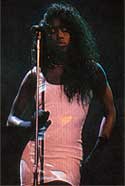
Cindy Blackman (born November 18, 1959 in Ohio) is an American jazz and rock drummer. Blackman is most well-known for recording and touring with Lenny Kravitz. Blackman has recorded several straight-ahead jazz albums under her own name, and has performed with acclaimed jazz and rock artists, including Pharoah Sanders, Ron Carter, Sam Rivers, Cassandra Wilson, Angela Bofill, Buckethead, Bill Laswell and Joe Henderson. Tony Williams is her main drumming influence. In 1997 she recorded Multiplicity as a drum teaching video.
[edit] Musical Career
[edit] Early Training and Influences
born November 18, [[1959 Blackman comes from a musical family, both her mother and grandmother were classical musicians and her uncle a vibist.[1] "My mom, when she was younger, played violin in classical orchestras, and her mom, incidentally, was a classical musician. My mom used to take me to see classical concerts," says Blackman.[2] "My dad was into jazz -- Miles Davis, Ahmad Jamal, people like that."[2] Blackman started playing drums as a child in her hometown of Yellow Springs, Ohio[3] and got her first drums at seven.[4] "Of course those would be broken up in a matter of days," Blackman says.[4] "The only thing I heard at home was, 'we don't know if you can play drums because one, they're noisy, and two, they're very expensive."[4]
When Blackman was 11, she moved to Bristol, Connecticut[2] and studied at the Hart College of Music in Hartford, Connecticut.[2] Blackman began to have an interest in jazz at age 13 after listening to Max Roach and got her first professional drum set at 14.[5][2] "Jazz was the thing that was most intriguing because of the challenge that was involved," says Blackman.[2] "When I was shown that the drummers on these records were playing independently with all four limbs, I was like: 'Really?! Is that what they're doing? Is that what Max Roach is doing on that record? Oh! Okay!'"
Drummer Tony Williams was an early influence.[6] "The first drummer I ever saw, where I got to feel the impact up close, was Tony Williams," Blackman said.[6] "When I was 16, Tony came to my local drum store with a bassist and did a clinic that left a powerful impression on me. And that's what I thought drumming should be: drummers should have a lot of impact and a great sound, without being limited to a conventional role in the band--the drums should speak just as freely as anybody."[6] Blackman moved to Boston to study at the Berklee College of Music with Alan Dawson, one of Tony Williams' teachers.[1][2] "Alan's method was incredible in terms of getting your independence together, getting your hands together," says Blackman.[2]
[edit] Arrival in New York
While she was at Berklee a friend recommended her for a gig with The Drifters[4] so Blackman left college after three semesters and moved to New York City in 1982.[1] Blackman worked as a New York street performer[7] but also got a chance to watch and learn.[4] "I looked for Art Blakey, I looked for Elvin [Jones], I looked for Philly Joe Jones, for Roy Haynes, for Tony Williams. I saw so many great drummers, like Ed Blackwell and Billy Higgins, Louis Hayes. I saw Al Foster play quite a bit, Billy Hart, Jack DeJohnette. All these people, they're in New York so I got a chance to watch them do their thing."[4]
While in New York, Art Blakey became a significant influence.[8] "He really was like a father to me. I learned a lot just watching him. I asked him a lot of questions about the drums and music -- and he answered all of them. He was fantastic," said Blackman.[8] Blackman initially encountered resistance to a woman playing drums in the jazz world.[4] "I'm a black woman, so I've encountered racial prejudice, and I've encountered gender prejudice. I've also encountered prejudice against my afro when I wore that out. But I've also encountered prejudice against my musical opinions. What I've learned to do is completely ignore that."[4]
[edit] First Compositions and Recording Contracts
In 1984, Blackman was showcased on Ted Curson's "Jazz Stars of the Future" on WKCR-FM in New York.[1] In 1987 Blackman's first compositions appeared on Wallace Roney's Verses album.[1] When an executive at Muse Records heard Blackman's recordings, he offered her a recording contract to lead her own project.[1] In 1988 Blackman released Arcane, her debut as a bandleader.[1] Her band included Wallace Roney on trumpet, Kenny Garrett on alto saxophone, Joe Henderson on tenor saxophone, Buster Williams and Clarence Seay on bass, and Larry Willis on piano.[1]
[edit] Work with Lenny Kravitz
In 1993, Blackman had an opportunity to work with Lenny Kravitz.[4] Blackman in New York talked to Kravtiz in Los Angeles on the phone, played drums for him over the phone, and Kravitz asked Blackman to fly out to LA.[4] "I flew out the next morning. While I'm downstairs waiting for the instruments to come from the studio, these people started coming in. First 12, and then like 30 more. I was like, 'whoa, this is an audition.' I ended up playing and instead of staying for one or two days, I stayed for two weeks and did the first video that I did with him, 'Are You Gonna Go My Way.' Apart from 2004, I played with him ever since."[4] Blackman had previously only played jazz shows and was unprepared to play for an entire arena.[4] "The first time I played in a really large concert with Lenny was at an outdoor festival called Pinkpop. We played for like 70,000 people. It was in the summer so most people had just t-shirts or tanks, a lot of guys had their shirts off, so you just see skin and hands and they're doing this wave thing. I almost lost it, my equilibrium was teetering. I wasn't used to seeing that many people; I was disoriented; I just had to stop looking and start focusing."[4]
Blackman says that playing with Kravitz and playing jazz are different.[7] "My job with Lenny is a different thing. My job is to play a beat for hours, and make it feel good, and add some exciting fills and exciting colors, when it fits tastefully," Blackman says.[7] "My job in my band or in a creative situation is a totally different thing. We may start with a groove that feels great, I may play that for hours too, but I'm going to explore and expand and change that, play around with the rhythm and interject with the soloists."[7]
In an article published May 1, 2004, National Public Radio reported that Blackman had recently left Kravitz's group to focus on her own music.[9]
[edit] Later Work
In 1994 Blackman made her first recording with a working group and called the album Telepathy because of the tight communication in the band.[10] "I wanted to do a quartet record because of the amount of space you get with fewer players," she said in Telepathy's liner notes.[10] "It's intimate, but more dimensional than a piano trio. I'm really into this sound, and it was nice to play with a group that was a group. You can't help but have a better feel when the musicians know each other, are headed in the same direction, and have the same goals. You can make most everything work. You get chances to play a lot of colors, and really stretch your ideas."[10]
In 2005 Blackman released Music for the New Millennium on her Sacred Sounds Label.[7] "It's rooted in tradition, but it's not traditional music. It's explorative, very creative, very expressive, and we really try to expand any ideas we have that everything is played over the forms, but we like to stretch it, and really see the colors and make the music grow and move," says Blackman.[7] "We experiment ?- but it's never free. Everything is written out. I have charts for all the songs. We expand on what's there, and stretch harmonics and note choices."[7]
Blackman continues to make her home in Brooklyn in New York City.[7] "It's always such an amazing place, with every level of musical accomplishment, you can see complete beginners and you can see innovators. That's why I live in New York. Not only is it tough, but all the greatest people have come through New York," says Blackman.[7] Blackman prefers to play jazz in small, intimiate clubs.[11] "It's an acoustic situation. You are close-knit and you are creating one hundred percent of the time -- so to me it just doesn't really get any better that!"[11] Blackman also travels extensively conducting drum clinics.[12] In September 2007 she made a tour of South America, conducting clinics in Argentina, Chile, and Brazil,[12] and on November 30, 2007, Blackman and her quartet performed at Art After 5 at the Philadelphia Art Museum.
[edit] Discography
Code Red with Steve Coleman, Wallace Roney, Kenny Barron, Lonnie Plaxico, 1992
Arcane with Wallace Roney, Joe Henderson, Kenny Garrett, Larry Willis, Buster Williams, Clarence Seay, 1992
Telepathy with Antoine Roney, Jacky Terrasson, Clarence Seay, 1994
The Oracle with Gary Bartz, Kenny Barron, Ron Carter, 1996
In The Now with Ravi Coltrane, Jacky Terrasson, Ron Carter, 1998
Works On Canvas with J.D. Allen, Carlton Holmes, George Mitchell, 1999
A Lil' Somethin' Somethin' with Kenny Barron, Gary Bartz, Ron Carter, Kenny Garrett, Lonnie Plaxico, Wallace Roney, Clarence Seay, Jacky Terrasson, Buster Williams, 2000
Someday with J.D. Allen, Carlton Holmes, George Mitchell
Music for the new Millenium with J.D. Allen (tenor sax), Carlton Holmes (Fender Rhodes and synth), George Mitchell (bass). Mastered in New York City by Edward Vinatea, 2005.


 Stumble It!
 Tweet This
 Bookmark on Delicious
 Share on Facebook
 Share on MySpace